Rachel Roddy’s ‘high-ranking’ penne with potatoes, cabbage, butter and cheese – recipe
In December 2023, the magazine La Cucina Italiana ranked Italians’ favourite pasta shapes, according to data gathered by Unione Italiana Food (“the leading association in Italy for the direct representation of food product categories”).I love this sort of thing.According to the UIF, by processing NielsenIQ data (comprehensive market research, consumer intelligence and retail measurement), they identified the five most popular shapes from over 500, and examined how preferences vary in different regions.In first place was spaghetti, while penne came in second, with these two shapes – which also takes in thinner spaghettini, chunkier spaghettoni and both ridged and smooth penne – accounting for 78% of all pasta sold in Italy in 2023.The regional variations of three, four and five are as follows: in the north-west and north-east, fusilli, short pasta and mixed pasta for broth or minestra; in central Italy, short pasta, fusilli and rigatoni; in the south, mixed pasta for broth or minestra, short pasta and tortiglioni.
It has to be said that the regional variations are a bit baggy, considering that short pasta takes in eight shapes: conchiglie, farfalle, mezze maniche, orecchiette, pasta mista, penne again (which is confusing), paccheri and trofie.All of which is justification for calling this week’s column the second highest-ranking pasta shape in Italy with potatoes, cabbage, butter and cheese (while also noting that you can instead use the shapes ranked number three, four and five).I am, however, not going to suggest you use pizzoccheri, which is best in a recipe called pizzoccheri della Valtellina, a dish typical of the alpine valley Valtellina, for which pizzoccheri (a short, fat, ribbon-like shape made with a blend of pale grey buckwheat flour and wheat flour) is boiled with greens (usually cabbage) and diced potatoes.It’s then layered with butter, a cow’s milk cheese called casera and parmesan, baked briefly and finished with garlic softened in butter.It is a wonderful dish.
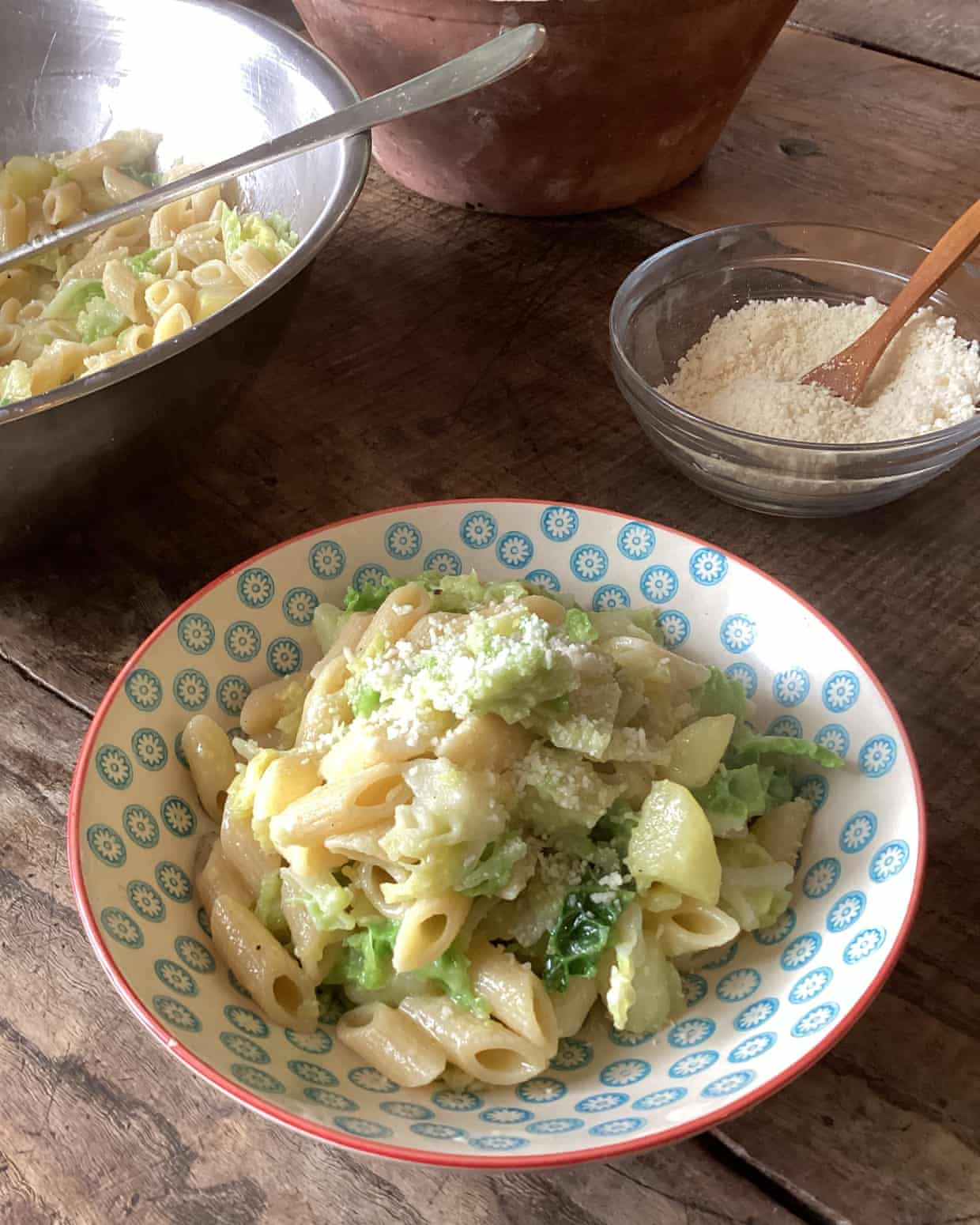
It is also an inspiring dish for its method; the potato softens at the edges as it cooks with the pasta, the cabbage (which goes in later) softens enough to wrap and cling, while the melted butter, cheese and starch from the pasta cooperate and act like a starchy-but-slippy adhesive that brings everything together.I have taken this idea and adapted it for a friendly recipe, which is an absolute favourite we eat almost weekly.It’s good value, too.This high-ranking dish is best served as soon as possible after mixing, passing around more grated cheese and some red chilli flakes for those who want them.Serves 4Salt and black pepper 400-500g penne, fusilli, radiatori, or other short pasta 2 medium-sized potatoes (any kind), peeled and cut into small cubes ½ small savoy cabbage, sliced75g butter1 garlic clove, peeled and gently squashed (but left whole) 4-6 tbsp grated parmesan, or grana padano, plus extra to serveRed chilli flakes, to serve (optional)Bring a large pan of water to a boil, then add salt and stir.
Add the pasta and potatoes to the boiling water, stir well, and set a timer for five minutes shy of the pasta’s cooking time,When the timer rings, add the cabbage, stir, and reset the timer for the remaining cooking time,While everything cooks, warm a large bowl by scooping out a ladleful of pasta water, swishing it around the bowl and discarding it,In a small pan, slowly melt the butter with the squashed garlic clove,Pour the melted butter into the warm bowl, add the grated cheese and lots of black pepper.
When the timer rings, use a sieve or slotted spoon to lift the pasta, potato and cabbage out of the pan, wait a few seconds so the excess water drips back into the pan, then drop them into the warmed bowl.Swish and jolt the bowl, and stir well, adding a little pasta cooking water if you feel it needs loosening, and swish again.Serve, passing around more grated cheese and some red chilli flakes for those who want them.

US tech firms successfully lobbied EU to keep datacentre emissions secret
Microsoft and other US tech companies successfully lobbied the EU to hide the environmental toll of their datacentres, an investigation has found, with demands to block a database of green metrics from public view written almost word for word into EU rules.The secrecy provision, which the European Commission added to its proposal almost verbatim after industry lobbying in 2024, hinders scrutiny of the pollution that individual datacentres emit. It leaves researchers with just national-level summaries of their energy footprints.The rise of AI chatbots has spurred a boom in the construction of chip-filled warehouses with a hunger for power that is being met, in part, by burning fossil gas. Legal scholars warn the blanket confidentiality clause may fall foul of EU transparency rules and the Aarhus convention on public access to environmental information

Liz Kendall urges UK public to embrace AI as government makes first £500m fund investment
The UK technology secretary has urged the country to “make AI work for Britain”, brushing off fears about its impact on jobs and cybersecurity as the government announced its first investment under a £500m sovereign AI fund. Liz Kendall said the UK had to “seize” the opportunity offered by AI despite concerns underlined this month when US startup Anthropic revealed it had developed an AI model that posed a potentially significant cyber threat. Asked how the government makes the case for embracing a technology that could disrupt jobs and now cybersecurity, Kendall said: “We have to seize this to make it work, for Britain, for our jobs, for solving the biggest challenges we face as a world.”Speaking on Thursday as the government unveiled its first investment in a UK company as part of a £500m sovereign AI fund, Kendall acknowledged “people are worried about the risks and what it means for their jobs”, but AI entrepreneurs also believed they can “make it work … they can create jobs”.In January Kendall admitted “some jobs will go” as AI automates certain tasks and roles, but it would also create new employment opportunities

‘How do I end a call?’: the elderly Japanese people determined to master smartphones
It’s not only young people whose gaze is fixed on tiny screens. But for these users in Tokyo, clicking and scrolling is anything but second nature.“I can’t deal with all of the apps that jump out at me,” says one. “How do I know if I’ve definitely ended a call?” asks another.They are common concerns among the four women and one man attending a beginner’s smartphone class at a public facility for older residents in Nerima in the Japanese capital’s north-west suburbs

Labour and Lib Dem MPs demand ‘shameful’ Palantir NHS contract be scrapped
MPs have queued up to demand the government scraps its £330m NHS contract with the spy-tech company Palantir, calling it “dreadful” and “shameful” in a debate on Thursday, after which the government said it was “no fan” of the US company’s politics.Labour and Liberal Democrat MPs led the calls for Palantir, which also works for Donald Trump’s ICE immigration crackdown and the Israeli military, to be removed as a supplier to the NHS federated data platform (FDP), with one Labour backbencher, Samantha Niblett, questioning whether it could be “trusted as a custodian of the intimate health records of tens of millions of British citizens”.The Lib Dem MP Luke Taylor, who called the deal “shameful”, said: “Palantir and Peter Thiel must have their hands ripped off of our NHS before it is too late.”Thiel, a Trump-supporting tech billionaire, founded the company and has previously said that democracy and freedom are incompatible.In response to the MPs who spoke in a Westminster Hall debate, the government confirmed it would consider whether to continue with the deal when a break clause is due in spring 2027, although £210m of the £330m has already been spent

Man used AI to make false statements to shut down London nightclub, police say
A businessman has pleaded guilty to making false statements in order to shut down a nightclub, which police believe were generated using AI.A Metropolitan police source said the use of AI to generate letters by complainants who do not exist is a growing issue.Aldo d’Aponte, 47, the CEO of Arbitrage Group Properties, pleaded guilty to writing two letters, supposedly by his neighbours, objecting to the reopening of Heaven nightclub, which temporarily closed after a rape allegation against one of its security guards.D’Aponte was given a 12-month conditional discharge and ordered to pay £85 costs and a £26 victim surcharge.Heaven, an LGBTQ nightclub in central London had its licence suspended in November 2024 after a 19-year-old woman accused a bouncer of rape

NAACP lawsuit accuses Elon Musk’s xAI of polluting Black neighborhoods near Memphis
A new lawsuit accuses Elon Musk’s artificial intelligence company of illegally spewing toxic pollutants into residential neighborhoods on the border of Tennessee and Mississippi.The suit, filed on Tuesday in Mississippi federal court, alleges xAI is violating the Clean Air Act due to emissions from its makeshift power plant in Southaven, Mississippi, which powers its datacenter there. The NAACP, represented by the environmental groups Southern Environmental Law Center and Earthjustice, says xAI has been polluting areas with homes, schools and churches, including in historically Black communities, by using dozens of methane gas generators without permits.The organization is seeking to force the company to stop operating its unpermitted turbines in Southaven.“A data center should not be a potential death sentence for a community’s health,” Abre’ Conner, the director of environmental and climate justice for the NAACP, said in a statement

Move over matcha: how ube cocktails and coffees are hitting the UK’s sweet spot
Rachel Roddy’s ‘high-ranking’ penne with potatoes, cabbage, butter and cheese – recipe

How to turn old bread into a brilliant Italian cake – recipe | Waste not

Roast chicken, cheesy scones and a genius cocktail: Ravinder Bhogal’s recipes for cooking with lime pickle

Vegemite is recognised globally – but how many people know Milo was invented in Australia?

What can I do with leftover rice? | Kitchen aide