New Mexico proposes $3.7bn fine for Meta and sweeping changes to its social platforms
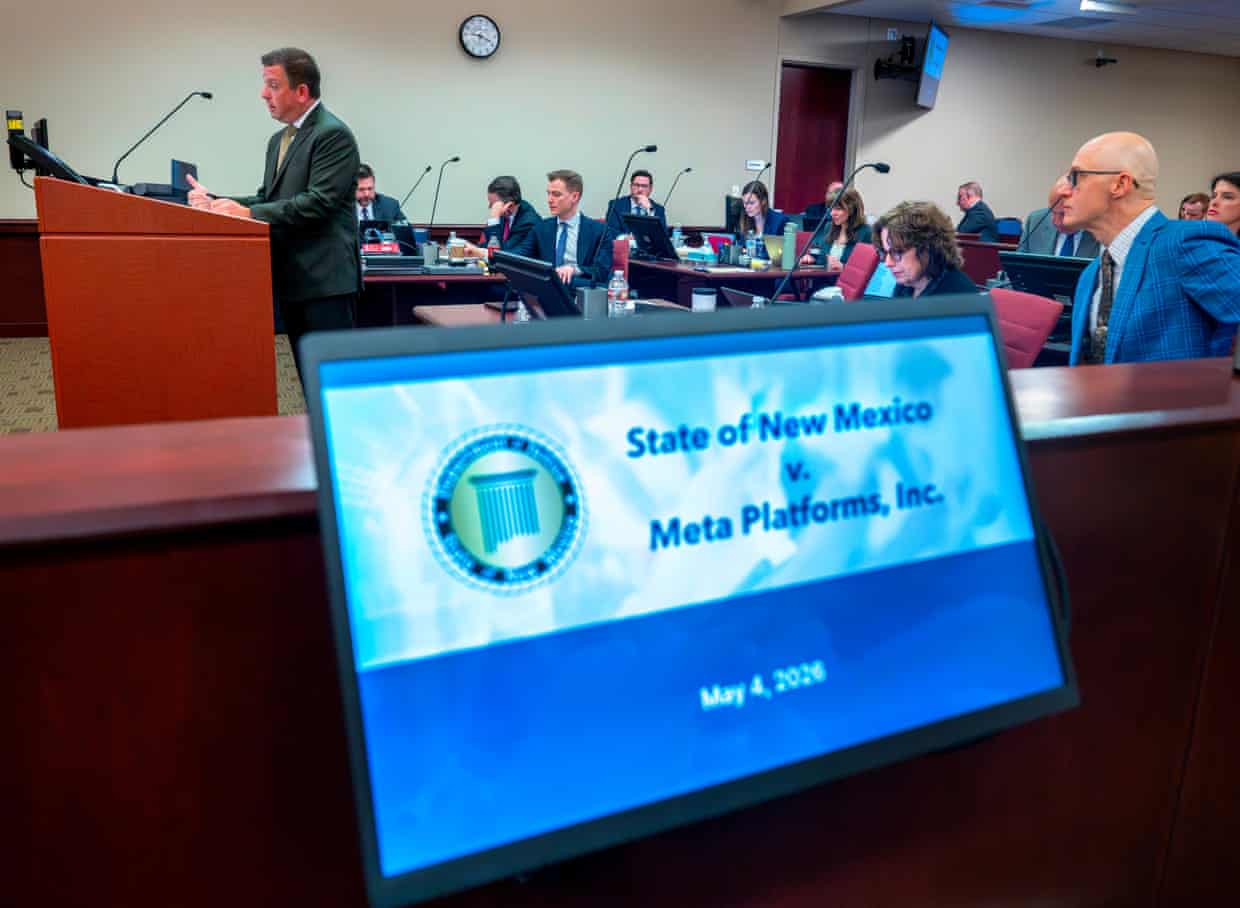
Meta has returned to court in the US this week for the second phase of a lawsuit brought by Raúl Torrez, New Mexico’s attorney general, following a March verdict that found the company liable for child safety failures and imposed a $375m fine.On Monday, the state petitioned for a legal sanction against the company, a monetary penalty 10 times the original amount, and a sweeping, drastic overhaul of Meta’s child safety protocols.In the second part of the landmark case, known as the remedies phase, the state is asking for Meta to be declared a public nuisance and for the judge to order the company to pay $3.7bn in an abatement plan.The money would fund programs for law enforcement, mental health services and educators.
The state is also requesting that the judge force a series of design changes to Meta’s platforms aimed at improving child safety, including universal age verification, de-encryption of children’s messages, a guardian account linked to every child’s account, and a child safety monitor tasked with holding Meta to account for five years,The New Mexico department of justice argues that these changes would make Meta’s social networks safer for underage users in the state,Meta, however, says the proposed reforms are unfeasible and could ultimately force it to shut down its platforms in the state altogether,The second phase of the trial is expected to last three weeks,Before opening statements on 4 May, Judge Bryan Biedscheid, said he needed to remain cognizant of free speech protections when evaluating the state’s arguments for Meta to impose the design measures, which he said could amount to “overreach”.
The key measures state regulators propose for Facebook, Instagram and WhatsApp aim to proactively prevent online child sexual exploitation by restricting how adults can interact with minors on the platform, attorneys for New Mexico said.Under the measures, Meta would need to enact age verification tools for all users and then permanently delete any personal identifying information collected to verify age.The company would be compelled to block users determined to be under 13 from using their platforms and delete their accounts.The proposed measures would mandate a court-appointed child safety monitor to oversee Meta’s compliance for at least five years.Last week, Torrez said his office was reviewing potential independent technical monitors from around the country, but a particular one has not yet been identified.
Other proposed actions include blocking adults from finding or messaging users under 18 unless directly connected, limiting contact from users in regions linked to sextortion, and prohibiting both adults and AI chatbots from engaging minors in romantic or sexualized conversations.The rules also call for strict enforcement, including permanent bans for offending users and preventing those users from creating new accounts with the same device, IP address or phone number.The state is calling for Meta to improve its reporting of online child sexual exploitation to the National Center of Missing & Exploited Children (NCMEC), by including actionable information in a timely manner.It also wants Meta to make it easier for users to report child sexual exploitation and ensure these reports are reviewed by a human within 48 hours.The state is also requesting that New Mexico law enforcement be permitted by the company to operate undercover accounts to test child safety on Meta products.
It wants end-to-end encryption of direct messages on Meta’s platforms eliminated for all users aged under 18.By protecting users’ privacy, encryption prevents the company and law enforcement from reviewing messages, which, the state argues, means they cannot be scanned for child sexual abuse material.If enacted, another measure would see Meta implement a “warning label” on its products, alerting to the likelihood that teens will encounter violating content, report any product breaches that affect children’s safety, and make Meta’s litigation documents public.The state is also seeking a requirement that all users of Facebook, Instagram and WhatsApp aged under 18 have a linked guardian account.Child safety experts have previously criticized social media protections that place the burden on parents or guardians to monitor and protect minors.
The state wants guardians to be alerted when users under 18 are contacted by suspicious adults.The New Mexico lawsuit was first filed in December 2023, following a Guardian investigation published in April of that year that found Facebook and Instagram had become marketplaces for child sex trafficking, and was cited multiple times in the complaint.Meta has said it plans to appeal the ruling.The first trial spanned seven weeks earlier this year, and Meta has said it plans to appeal the ruling.In the first phase of the trial, the jury heard how Meta’s design features, such as infinite scroll and push notifications, can be addictive.
The state has requested design changes to alleviate this, as well as implementing mandatory time limits for users under 18.It also wants to prohibit the use of minors’ data for personalized recommendations.

Did breakthrough in US fentanyl crisis start in China?
As Donald Trump travels to Beijing this week, fentanyl – and China’s role in its supply chain – remains an enduring point of acrimony in bilateral relations.At a UN meeting in March, the US again accused China of failing to stop its chemical industry selling the precursors required to make the potent synthetic opioid, while China suggested the US was shifting the blame for its domestic drug problem.Yet there are growing signs that the US fentanyl crisis has turned a corner – and some experts believe that interventions made in China have played a key role.“There was a supply shock: the purity of fentanyl fell,” said Keith Humphreys, a professor at Stanford University. “The question is why was there a supply shock

Older people risk mental decline if they do long hours of caring, UK study shows
The stresses and strains of caring for someone for 50 hours or more a week leads to “accelerated cognitive decline” in middle-aged and older people, research shows.However, providing care for only five to nine hours a week has the opposite effect, boosting brain health so much that the benefits last until older age.Carers UK called the findings “extremely worrying” and said they highlight how long hours spent providing care raises the risk of social isolation and burnout.Dr Baowen Xue, an academic at University College London and the lead author of the paper, said: “Our study shows that the caring responsibilities many people take on in later life can be a double-edged sword.“On the one hand, lighter caring responsibilities can be good for you by providing mental stimulation from interacting with loved ones or others you’re helping and a sense of purpose and usefulness

Steve Lismore obituary
My partner, Steve Lismore, who has died aged 71 in a climbing accident in Italy, was a civil servant and local politician with twin passions for giving children a good start in life and establishing equality of access to employment. Steve’s energy and commitment to action has had a lasting impact across north Derbyshire.Born in Toronto, Canada, to Violet (nee Greaves), a secretary, and Basil Lismore, a toolmaker, Steve loved reading and excelled at Bayview Heights school, Ontario, skipping a grade and winning awards at science fairs.His approach to life was formed in his teens. He combined adventure, practicality and ingenuity as he coaxed cheap motorbikes to ever improved performance

Renters’ Rights Act could worsen court delays without proper funding | Letters
The new Renters’ Rights Act is a step forward in ensuring that both tenants and landlords can access justice, but without proper investment it risks creating new court delays and injustices for both parties (The Guardian view on the Renters’ Rights Act: finally, protections fit for the modern housing market, 5 May).The end of “no fault” evictions in England is expected to lead to an increase in the number of contested repossession cases. If courts do not have the funding to handle the increase, delays will grow and leave many people in limbo, as we have recently seen with the closure of the Hillingdon Law Centre.This investment must include further funding for housing legal aid. While last year the UK government pledged to increase the fees paid to housing legal aid firms, those changes are yet to be fully implemented

‘Everyone was in tears’: the tenants given eviction notices just before ban in England
It was 2pm on 30 April when Carl Kansinde Middleton received a “no fault” eviction from his landlord in Brighton – just 10 hours before section 21 notices were officially banned under the Renters’ Right Act.“As we were getting closer, I really thought I was safe,” he said. “It just never occurred to me that it would just come right on the last day – I truly felt blindsided.“I lost my job in November and it’s been a struggle for me financially as I have no support system. I was just about treading water but this has swept me under

Ash scattering is a risky business | Brief letters
I had a similar experience to Zoe Williams (The day had come to scatter my mum’s ashes. What could possibly go wrong?, 5 May) when I scattered my dad’s ashes near the first tee at his golf club. After reaching into the urn and grabbing a large handful of his ashes, I threw them into the air only to have them all blown back at me by a sudden gust of wind. Friends always said I looked very much like him and I felt a tremendous sense of pride as parts of him went into every orifice.Bob DawsonGreenmount, Greater Manchester Glad to read about the campaign to save the mother of Bramley apples tree (Report, 5 May)

Nvidia’s Jensen Huang joins other US bosses on Trump trip to China

How to use spent tea leaves to smoke Chinese-style duck – recipe

Weight gain as adult increases cancer risk by up to five times, research shows

Sarah Taylor named England men’s fielding coach while Gay, Rew and Baker are called up

Wes Streeting prepares to launch leadership challenge against Keir Starmer

Coconut dal, cheesy pickle toasties, carrot halva cakes: Ravinder Bhogal’s tastes of home – recipes