‘Soon publishers won’t stand a chance’: literary world in struggle to detect AI-written books

Recently, the literary agent Kate Nash started noticing that the submission letters she was receiving from authors were becoming more thorough – albeit also more formulaic.“I took it as a rise in diligence,” she said.“I thought it was a good thing.”But then she had what she described as her eureka moment: the letter with the AI prompt right at the top.“It read: ‘Rewrite my query letter for Kate Nash including a comp to a writer she represents,’” she said.
Once Nash had seen the prompt, she “couldn’t unsee AI-assisted or AI-written queries again”,The news last week that Mia Ballard’s “femgore” horror novel Shy Girl could be up to 78% AI-generated, however, has forced literary agents and publishers alike to consider whether sharp eyes alone can detect AI-generated work,“The question of how Shy Girl slipped through Hachette’s net is something the publisher has to answer themselves, but in reality, it was only a matter of time before this happened,” said Anna Ganley, the chief executive of the Society of Authors,Wildfire, a UK imprint of Hachette, had published Shy Girl in November 2025,It was due for US publication in April, but the controversy led to its UK discontinuation and US cancellation earlier this month.
Ballard has denied using AI to write Shy Girl, telling the New York Times, which first reported the story, that an acquaintance she hired to edit a self-published version of the novel had used it.An editor at one of the “big five” publishing houses said a “cold shiver went down my spine” when the Shy Girl story broke.“It really is a case of ‘there but for the grace of God go I,’” they said.“It’s an issue publishers are keenly aware of.We make it very clear to authors what we expect, we get them to sign contracts and we run their work through multiple AI detection tools, but we know all this is fallible.
“Hence the cold shiver: if an author is determined to use AI, then cover their tracks, there’s very little we can do.”Prof Patrick Juola, a US computer scientist known for his work on authorship attribution, agreed.“I don’t want to call AI detection tools a scam, but it’s a technology that simply doesn’t work.”He likened the failure to antibiotic resistance: “AI is a learning system continually upgraded by its manufacturers.If there was a detection technology that worked, then people would simply build better AI tools to fool it.
”Mor Naaman, a professor of information science at Cornell Tech and head of its social technologies research group, agreed.“AI learns very quickly how to avoid AI detection.We’re not quite there yet, but soon publishers won’t stand a chance,” he said.Already, the sophistication of the technology threw up an interesting point, said Nikhil Garg, an assistant professor at Cornell Tech’s Jacobs Institute.“Sophisticated authors who want to evade the detection tools know how to edit their text, test it against these tools and revise again,” he said.
“At some point, you have to ask: has it become their own work anyway, despite the AI?”Naaman agreed that while Shy Girl appeared to be an “egregious” example, there were increasingly grey areas.“We all work in an AI-hybrid world now.When does something become an AI-generated book, rather than just using AI like I use a spellchecker, to fix my grammar or maybe spark ideas?” he asked.If all this is true, the obvious question is: why does it matter if AI writes our books? After all, at one end of the spectrum, generic, formulaic books have always represented a sizeable proportion of any bookshop shelf.Why would it matter whether they were generated by humans or AI?And if AI did become sophisticated enough to write genuinely engaging books, does that matter, as long the literature is good?For Naamen, the reason it matters is cultural: AI may flood the page, but it cannot replace the messy, difficult work of being human – the very work that literature exists to reflect back at its readers.
“AI nudges users into a bland monoculture.It could never generate the truly diverse creativity of the human mind,” he said.The debate wasn’t about originality alone, he added, it was also about who gets to write, who gets to be read, and who ultimately shapes our culture.“AI subtly inserts specific viewpoints into its work that are driven by algorithms of all-too-powerful corporations,” Naamen said.“And if AI sucks up all the minor writing jobs and opportunities, then emerging authors are deskilled before they get the chance to create their really significant works.
”Earlier this month, Ganley launched the Human Authored scheme to identify works written by humans,It is, however, a system based on trust – that singularly human and inherently vulnerable value,But, as Nash says, in this era of deception, trust is more valuable than ever,“Readers trust writers,Writers need to continue to trust themselves over machines,” she said.
“The bond between reader and writer is likewise based on trust; the engagement can operate on many levels, but most of all, it must be meaningful.”
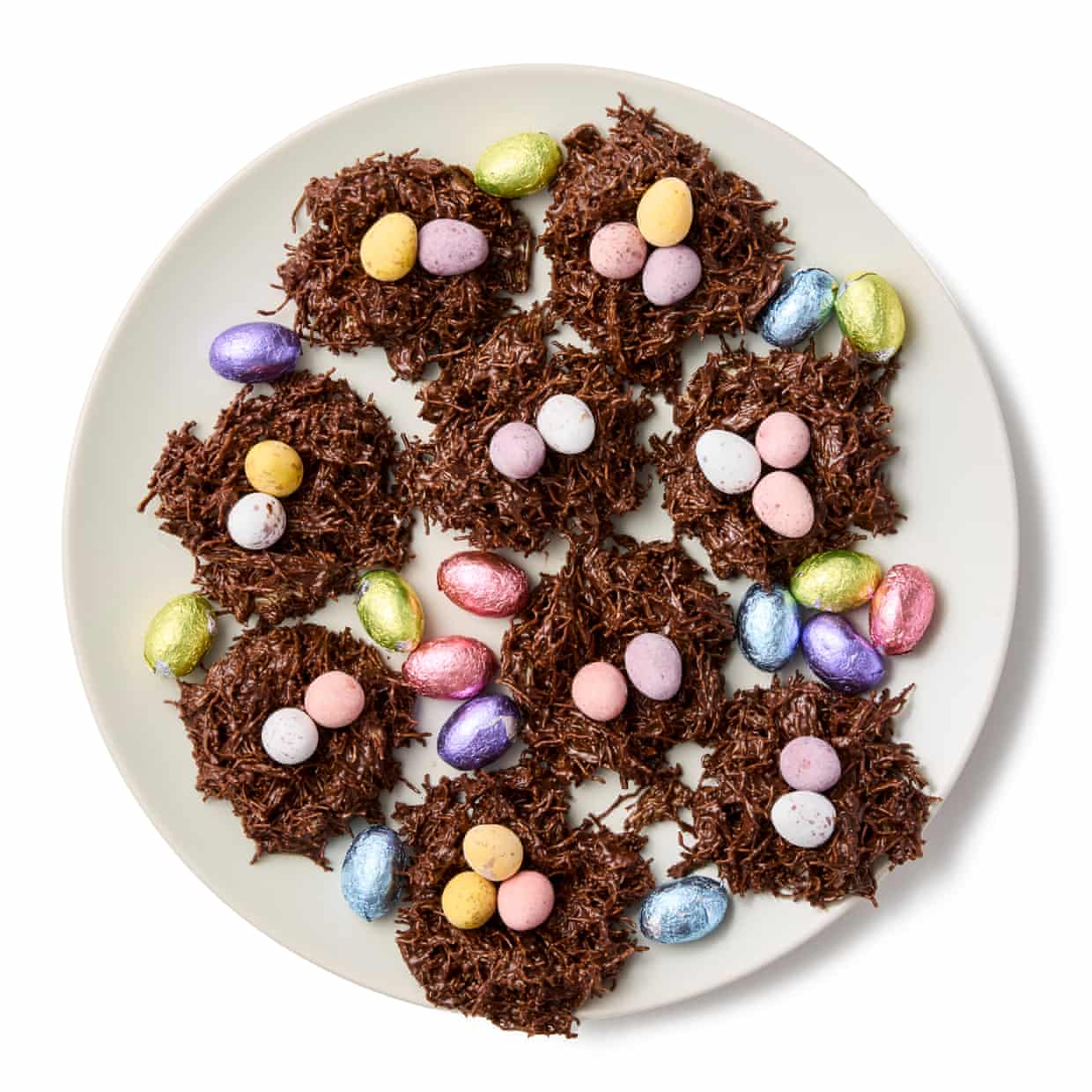
How to make Easter chocolate nests – recipe. | Felicity Cloake's Masterclass
Much as I love Easter eggs – and I really do, despite being that irritating person still nibbling away at them at Christmas time – these charming, crunchy little nests full of colourful treasure are up there with hot cross buns as my favourite seasonal produce. Top tip: they’re even easier to make if you enlist a small sous chef or two to help stir the pan!Prep 20 min Cook 5 minChill 2 hr Makes About 1280g Shredded Wheat (about 3½ full-sized ones), or other cereal (see step 1)75g dark chocolate (see step 3)100g milk chocolate 35g butter, or vegan alternative50g golden syrup 1 pinch salt ¼ tsp mixed spice (optional)Finely grated zest of ¼ orange (optional)36 miniature chocolate eggs (about 115g)Shredded Wheat (or another brand of similar cereal) is not the only choice here: you could substitute corn or bran flakes, puffed rice, Weetabix and so on, but it does look the most authentically twig-like. Try to get the big ones, if possible, because it’s all too easy to crush the bite-size variety to dust.Break the Shredded Wheat into pieces (leave flaked cereals, puffed rice and so on whole, and crumble Weetabix) in a large bowl – use your hands, the end of a flat rolling pin or glass, or the bottom of a smaller bowl to do this, and aim for a variety of lengths, rather than crushing the cereal to smithereens.Almost any chocolate will work here (this is, in fact, a great use of last year’s Easter eggs or Christmas chocolate, if you still have some left), though be careful with white chocolate, which doesn’t always melt well

The Wellington, Margate, Kent: ‘Worth risking a werewolf attack to get to’ – restaurant review | Grace Dent on restaurants
The ever-changing menu is a paean to things that make me happyThe Wellington has been drawing crowds to Margate of late, due to a recent takeover by chef Billy Stock and front-of-house queen Ellie Topham. Stock is formerly of nearby Sète, which I loved very much, and also cooked at London’s The Marksman and St John, which is a pedigree that says: “I like feeding people proper food, not fancy, itsy-bitsy suggestions of food.” So with that, I set off to the south-east Riviera on a day when the weather ranged from hailstones to simply freezing gales.Much is said about Margate being freshly desirable, hip and charming, but on a freezing day at the tail end of winter, this seaside town certainly tests the prescription of one’s rose-tinted spectacles. None of the down-from-London brigade cries, “Let’s move to Margate!” as icy hail plink-plonks off their nose while they cower in the door of the Turner Contemporary

Five Guys CEO says he gave a $1.5m bonus to his workers so he wouldn’t get shot in the back
Five Guys’ chief executive officer, Jerry Murrell, said he gave a $1.5m bonus to employees of his US-based burger restaurant chain because “I didn’t want anybody shooting me” after the company recently “screwed … up” a buy-one-get-one-free promotion.Murrell did not elaborate on the comment, which he gave to Fortune in an interview published on Wednesday – but it came a little more than a year after the UnitedHealthcare CEO Brian Thompson was shot dead on a midtown Manhattan street in what was widely considered a murderous rebuke of the US health insurance industry’s profit-driven practices.Fortune’s conversation with Murrell revisited a two-for-one promotion that Five Guys organized in February to celebrate its 40th anniversary that proved to be much more popular than the chain expected. Five Guys’ app crashed as customers sought to take advantage of the promotion, and many overwhelmed chain locations discontinued the offer early, inviting backlash on social media

Ready to order? 10 rules for UK’s restaurant diners
Hospitality is in a right state at the moment, what with the seemingly never-ending shitshow of rising rents and rates, extortionate VAT, higher staffing, produce and utility costs, and all those other well-documented socioeconomic pressures (don’t mention the Bre*it word, please). So the last thing those of us who work in this beleaguered industry need right now is to be kicked in the proverbials by the very people we rely on perhaps more than anyone. And, yes, by that I mean you, our lovely customers. So here is some advice on how to avoid infuriating your serving staff.Turn up … Pre-Covid, most restaurants didn’t have the balls to take card details or charge for late cancellations and no-shows, but that’s all changed now (thank God)

Is foraging really feasible to feed myself?
When I called Robin Greenfield, an environmental activist and author, his assistant answered. “We’re stopped really quick,” Marielle said, adding “he is harvesting a ton of wild onions right now. He’ll be on in just a minute.”I waited, curious to see his haul and bemused by his willingness to delay an interview for wild vegetables. I had called Greenfield, who wrote Food Freedom about the year he grew and foraged 100% of his food, to talk about how possible, or hard, it is to do just that

Benjamina Ebuehi’s recipe for lemon lamington cake | The sweet spot
I think lamingtons should be much more popular than they are on this side of the world. One of my go-to coffee shops is Aussie-run and they always have a proud display of chunky, jam-filled, chocolate- and coconut-coated lamingtons. Making them isn’t complicated, just a little messy with all the filling and dipping of multiple cubes of cake in different bowls. In an attempt to streamline the process, and because giant versions of anything are always fun, I’ve made one extra-large lamington. It’s a wonderfully soft sponge, covered in lemon curd ganache and filled with plenty of cream, making for a very pretty Easter centrepiece
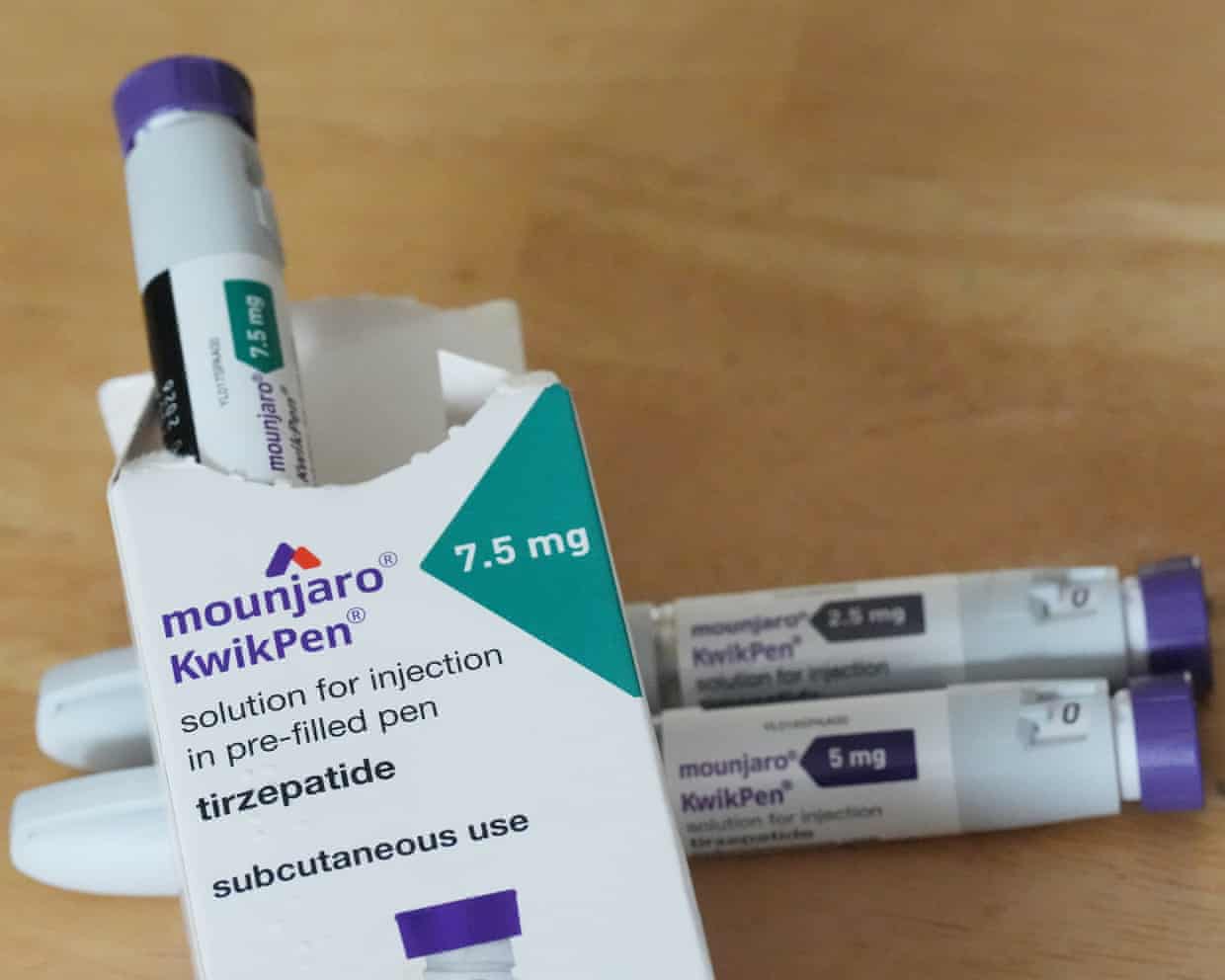
Mounjaro maker wants NHS drug price rises in return for more investment in UK

Pessimism takes root in UK as shoppers struggle to afford essentials

Millions of boomer small business owners will soon retire. Will their companies just disappear? | Gene Marks

One in five UK hospitality businesses fear collapse as costs surge

Oil on track for record monthly surge as Iran war disrupts markets

War in Iran erodes the chancellor’s headroom and exposes our fragility | Heather Stewart