‘Pure shock’: how ministers reacted to revelation of Mandelson vetting failure

When the Guardian revealed that Peter Mandelson had failed his vetting checks before being appointed as British ambassador to Washington, members of Keir Starmer’s cabinet, who were scattered around the world on government business, were caught by the same element of surprise.In Washington for the spring meeting of the International Monetary Fund, the chancellor, Rachel Reeves, had just come out of a meeting with the Ukrainian finance minister when she was told the breaking news.“I didn’t know anything about the vetting process,” she told reporters.“I’m the chancellor, I’m not the foreign secretary and I’m not 10 Downing Street, so I can’t give you any more information on that.”David Lammy, the deputy prime minister, was on a military flight back from the Middle East when he was summoned to the cockpit by the captain who told him that No 10 needed to speak to him over the radio.
Aides told him about the story and asked whether he had been aware of the vetting process given he had been foreign secretary at the time.He said he had not.Yvette Cooper, the current foreign secretary, was sitting in her wood-panelled office in the Foreign Office in London, just about to start a meeting.When an aide received a message from the Guardian about the story and relayed it to Cooper, her immediate reaction was “pure, unbelievable shock” according to one person who was there.Darren Jones, the prime minister’s chief secretary, was knocking on voters’ doors in Southampton when a Downing Street aide called and told him to get on a train back to London.
One cabinet minister happened to be travelling with a Guardian reporter when the news broke.After the journalist showed them the story on their phone, they simply replied: “Gosh.”The common sense of shock felt by the most senior members of the UK government gives a sense of how few people knew that Mandelson had been appointed against the advice of senior security officials.Downing Street insisted this week that no minister, including the prime minister, knew about it at the time.Whether that is true, and the exact sequence of events, both in the winter of 2024-25 and in recent days, will be pored over in the coming weeks.
The outcome of those inquiries will decide whether or not the British prime minister – who is already unpopular and faces heavy losses in the local elections next month – can remain in his job.The story begins just over a year ago.It was January 2025, a month after Keir Starmer had announced Mandelson as his controversial pick for the most important post in the diplomatic service: the British ambassador in Washington, the UK’s Trump whisperer.It had been more than a decade and a half since Mandelson was last in government, and during his post-ministerial career he had founded a lobbying firm, Global Counsel, which has clients with connections to China, raising questions around a potential conflict of interest.There was also the question of his relationship with the convicted child sex offender Jeffrey Epstein, which was public knowledge at the time of his appointment.
But it is rare for applicants to be denied developed vetting by UK Security Vetting (UKSV), the division of the Cabinet Office that oversees the background checks.Almost all officials in the Foreign Office, including junior civil servants, require developed vetting (DV) and almost all of them get approval from UKSV.Mandelson was no junior official.His controversy-laden career included stints in the Cabinet Office as business secretary and secretary of state for trade and industry.He had also held an extremely sensitive brief, secretary of state for Northern Ireland, and the role of European commissioner.
Despite his chequered reputation, and the many questions about his suitability for the job in Washington, the Foreign Office, and Starmer, may nonetheless have thought the UKSV process would be straightforward.It turned out to be anything but.According to publicly available government documents, the DV process includes a questionnaire and interviews requiring disclosure of highly private information, including questions about personal finances, business connections and sexual history.The security services also provide input.The UKSV had three options: approve Mandelson’s security clearance, approve his security clearance with risk mitigations or deny him clearance.
By 28 January last year, it had made its decision,As the Guardian revealed on Thursday, security officials denied the clearance,For whatever reason, senior officials at the Foreign Office decided to give Mandelson security clearance anyway, acting against the advice of those carrying out the vetting,Downing Street said this week that the decision was taken inside the department, with the prime minister’s own team left unaware,Starmer told reporters on Friday: “That I wasn’t told that he’d failed security vetting when I was telling parliament that due process had been followed is unforgivable.
Not only was I not told, no minister was told and I’m absolutely furious about it.”If Starmer is right, senior officials in the Foreign Office decided to take the incredible decision to override their own security advice without telling any senior politician or any of the prime minister’s advisers.If he is not telling the truth, Starmer will stand accused of deliberately misleading MPs and the public.He has told parliament repeatedly in recent months that “full due process” was followed when appointing Mandelson.Speaking to journalists during an event in February, he was even more specific.
“[There was] security vetting carried out independently by the security services, which is an intensive exercise that gave [Mandelson] clearance for the role,” he said.“Clearly both the due diligence and the security vetting need to be looked at again.”While some of Starmer’s parliamentary colleagues do not believe his version of events, many believe he is telling the truth, and are still unimpressed.They say the prime minister’s time in office has been defined by a lack of political nous and a noticeable incuriosity in the face of difficult or sensitive decisions.“It does seems incredible that he didn’t know,” said one.
“But the problem is that it’s quite possible as well.”As for the prime minister, aides say he was first notified of Mandelson’s failed security check earlier this week when officials in the Cabinet Office saw documents relating to the vetting process.The Cabinet Office is the closest thing the prime minister has to his own department and has been preparing various documents about Mandelson’s appointment after MPs demanded to see them.No 10 told Starmer there was a problem straight away.The prime minister, who had just finished preparing for the following day’s prime minister’s questions, the set-piece event of the parliamentary week, called an urgent meeting at about 8pm on Tuesday.
Those in the room included Antonia Romeo, the most senior civil servant in the government, Catherine Little, the official in charge of the Cabinet Office, and the prime minister’s chief of staff, Vidhya Alakeson,Officials told the prime minister there was an issue with Mandelson’s vetting, but they did not have the full facts,Those close to Starmer say he was furious and immediately tasked them with finding out exactly what had gone wrong so he could then tell parliament,But he did not do so immediately,At PMQs the next day, which was dominated by questions about defence spending, there was no mention of the Mandelson vetting process.
Jones said on Friday that the prime minister had not raised the issue because he still had not ascertained all the facts.“If he went before he’d had those facts and inadvertently made a mistake, parliament would rightly criticise the prime minister for doing that,” he told the BBC.The prime minister’s allies say he is particularly angry that officials had not told him at various points when it would have been obvious to do so, such as when the US Department of Justice published the latest Epstein files.Soon after the Downing Street meeting, Starmer picked up the phone to Olly Robbins, the most senior civil servant in the Foreign Office, to tell him he was fired.Robbins has been invited to testify in front of MPs on the foreign affairs select committee next week, a session that will be watched closely by those keen to find out whether the prime minister is telling the truth.
If Robbins testifies, it will be one of two parliamentary sessions next week that could decide the prime minister’s political fate, the other being his own statement to the Commons on Monday afternoon.The leaders of all major opposition parties are already calling for the prime minister to be investigated or to resign.Kemi Badenoch, the Conservative leader, said on Friday: “You ask if I believe that the prime minister is lying? Yes, I do.The only other alternative is that he is so grossly incompetent he has no idea what is going on.He told me at PMQs, the full due process has been followed.
”More problematic for the prime minister is the fact that MPs in his own Labour party are already in a febrile mood, angry over repeated scandals and the likelihood that the party will suffer heavy defeats at the local elections in three weeks’ time.Until Thursday, many around the prime minister believed he would survive the May elections, helped by the fact that there is no obvious successor behind whom the Labour party can unite.The danger for Starmer now is that events overtake him.If MPs feel they can no longer defend the prime minister publicly, he will find it difficult to remain in post.As Boris Johnson said after he was unseated as prime minister, having lost the confidence of his parliamentary party: “When the herd moves, it moves.
”

How to turn old bread into a brilliant Italian cake – recipe | Waste not
Old sourdough is my secret ingredient. To stop it going mouldy, I take it out of any plastic packaging and keep it in the bread bin with plenty of airflow around it – that way, it will dry out slowly, rather than turning mouldy. Any odds and ends, meanwhile, I store in a cloth bag to use in various dishes, from pangrattato (or poor man’s parmesan) to strata, a savoury bread-and-butter pudding.My new favourite recipe discovery for using up stale bread is today’s torta paesana, or village cake, from Lombardy. The best way I can come up with to describe it is that it’s a bit like a firm baked custard

Roast chicken, cheesy scones and a genius cocktail: Ravinder Bhogal’s recipes for cooking with lime pickle
I’m obsessed with lime pickle. It’s savoury, sour, funky, spicy and full of bold personality that enlivens anything it’s smeared on. It’s made by salting and fermenting limes with chillies and spices for a fierce, flavour-packed condiment that’s traditionally eaten as a side to poppadoms or with simple dal and rice. Over the years, I have also folded it into grilled cheese toasties, marinades for fat prawns to barbecue in the summer or made compound butters with it to smother over sweet potatoes before roasting. It’s an instant flavour bomb and my pantry is never without a jar

Vegemite is recognised globally – but how many people know Milo was invented in Australia?
The chocolate malt powder is sold in more than 40 countries, and Australian cafe owners say there’s ‘jingoistic pride’ in serving it on their menusGet our weekend culture and lifestyle emailWhen I order the jumbo-sized Milo Godzilla at Ho Jiak in Sydney’s Haymarket, it arrives as advertised – it’s comically large. The Malaysian restaurant prepares the drink by swirling Milo powder with hot water, adding sweet drizzles of condensed milk then chilling the mix with ice. Scoops of ice-cream are added and extra choc-malt powder is showered on top. Served in a one-litre jug, it’s so big I can’t finish it solo: staff hand me three takeaway cups to transport the leftovers.Like many beloved Milo drinks, the Godzilla is native to south-east Asia

What can I do with leftover rice? | Kitchen aide
How do I store cooked rice safely, and what can I make with it the next day?Michael, by email“It’s a bit of a running joke with rice, because I think of all the people in China who aren’t spreading their leftover rice immediately on to a tray to cool and are still alive,” says Amy Poon, of Poon’s at Somerset House in London. “But I have to be responsible and say: cool the rice as quickly as possible, within the hour, and put it in an airtight container and pop it in the fridge [or freezer] straight away.” The reason being, as food science guru Harold McGee notes in his bible On Food & Cooking, “Raw rice almost always carries dormant spores of the bacterium Bacillus cereus, which produces powerful gastrointestinal toxins. The spores can tolerate high temperatures, and some survive cooking.” In short: good storage practices will prevent bacterial growth, not to mention open a whole world of dinner opportunities
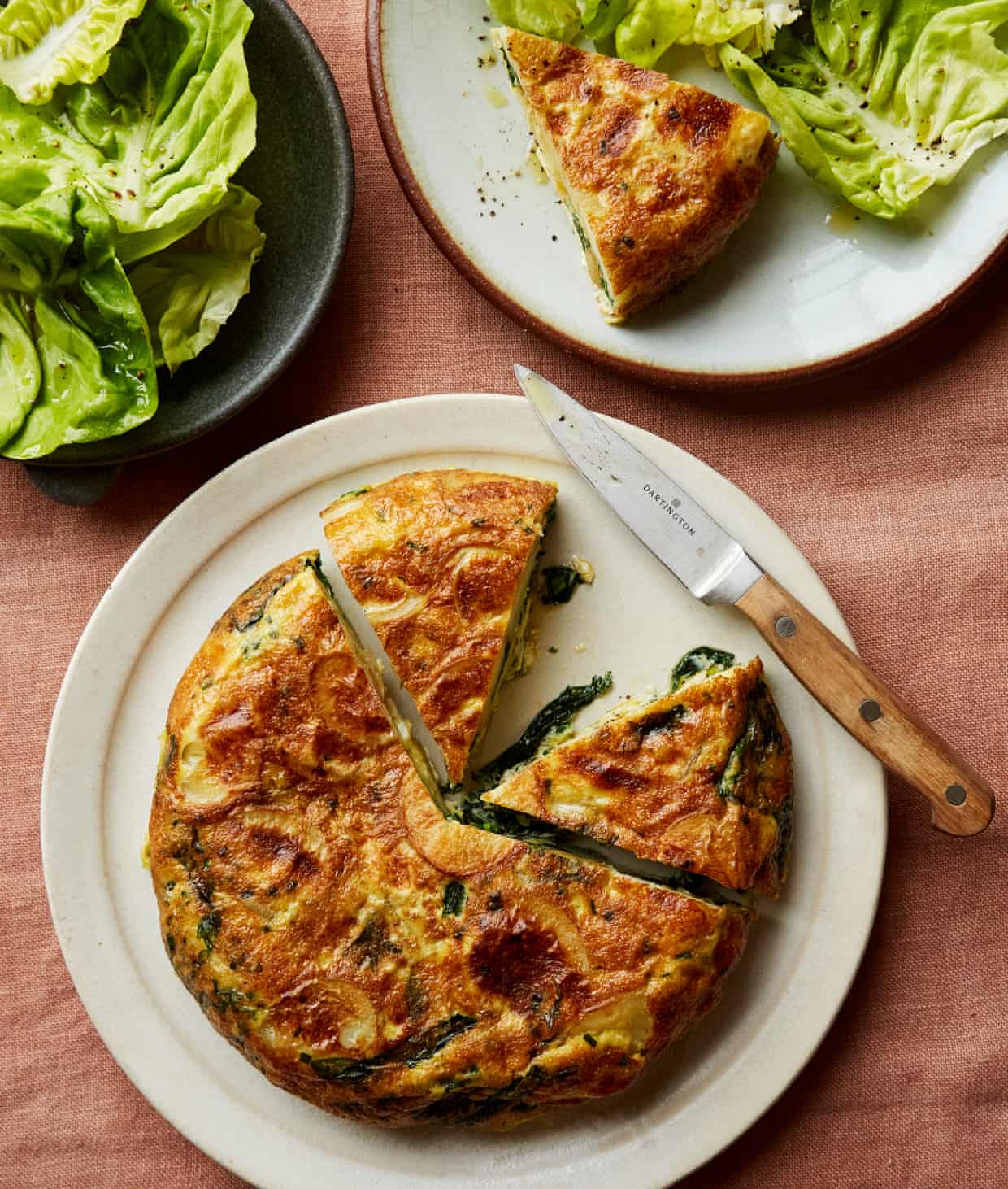
José Pizarro’s recipe for nettle (or wild garlic) and goat’s cheese tortilla
When I was growing up in the small village of Talaván in Extremadura, Spain, we never ate nettles. They were wild plants that grew along the edges of the fields, and the sort you tried to avoid: like many children, I learned about them the hard way, brushing against them while playing and getting stung. It was only when I came to the UK that I first saw nettles used in cooking, which surprised me: suddenly, this wild plant had a place in the kitchen. Now, whenever I visit my mum, Isabel, I see them everywhere. It makes me smile to think that at this year’s Spring Garden at the Chelsea flower show, I will be cooking among a world of magnificent plants and gardens

Gone from shop shelves, but not forgotten | Letters
How lucky for Adrian Chiles that he didn’t live in the German Democratic Republic (Rose’s Lime Marmalade? Gone. Dark chocolate Bounty? No more. But what about their heartbroken fans?, 8 April). After reunification, there were street markets selling the last of products from the old days, and there was an exhibition in a national museum – memorably called “They’ve even taken our tomato ketchup” – lamenting the loss of many food products and other features of former times, such as children’s TV programmes.Derek JanesDuns, Scottish Borders Can Adrian Chiles tell me where to find Halls’ chocolate sour lemons? Maybe they stopped being made because they turned your tongue black, but they tasted great

Central bank bosses enlist for war game to gauge threat of Lehman-style bust

Iron will: Australia’s richest person counts the cost as court orders she share mining millions with rival family

Rachel Reeves to raise windfall tax on low-carbon electricity generators

Oil price drops below $90 a barrel after Iran says strait of Hormuz is open

Oil tumbles 10% and stock markets rally as Iran declares strait of Hormuz ‘completely open’ – as it happened

Employees at first ever Starbucks store seek to unionize amid fight for contract