Trump’s trade war risks undermining his hopes of hefty US interest rate cuts | Graeme Wearden

Donald Trump and Denis Healey don’t have much in common,One of the greatest prime ministers Britain never had shares little of his famous hinterland with what some historians see as one of the worst occupants of the White House,But Trump would be well advised to remember Healey’s first law of holes – when you’re in one, stop diggingInstead, having seen the supreme court reject his sweeping global tariffs on Friday, Trump dug his shovel out, announcing a new global tariff of first 10%, then upping it to 15%,That may have lifted the president’s mood, after a stinging rebuke from the top judges in the US, but it risks backfiring on his hopes for hefty interest rate cuts this year,The trade war, with its exhortation to businesses to make their products in the US if they know what’s good for them, is one of Trump’s signature policies.
The logic is to create prosperity and long-term opportunity through bringing more investment and innovation into the US, lifting incomes.It also provided lucrative opportunities to tax Americans, with the tariffs rejected by the supreme court estimated to have raked in roughly $110bn (£81bn) from those importing goods from overseas.The City consultancy Capital Economics has calculated that by raising the global tariff to 15%, Trump has ensured that at least for the next 150 days the effective tariff rate will rise back to 14.5%, slightly above where it had settled before the supreme court stuck down the reciprocal tariffs based on the International Emergency Economic Powers Act.That means American importers will still be paying higher prices for goods from overseas, with a knock-on impact on inflation.
Companies who have stumped up for IEEPA tariffs are agitating for their money back.That could be a potential fiscal stimulus, if they get the cash.This adds up to a headache for the US Federal Reserve, and its next leader, the freshly anointed Kevin Warsh, and may make it harder to justify a rate cut.Trump made it clear what he wants from Warsh last Friday, declaring “interest rates should come down very substantially” on his watch.However, Warsh will be on a sticky wicket, as the Fed appears split – the minutes of its last meeting showed that some Fed officials wonder whether rate increases could soon be needed to keep inflation pegged, while others do expect cuts ahead.
A rate rise from the Fed would enrage the ever-flammable Trump.Last month he told the World Economic Forum it was wrong that markets went down when the US reported “a great quarter, a great month, great earnings” because investors expect higher interest rates as a result.Now it may feel counterintuitive but this “good news is bad news” mechanism is vital for healthy financial markets.If faster growth leads to higher demand, and inflationary pressures, a responsible central bank should be diluting the punchbowl (through tighter monetary policy) to prevent the party getting out of hand rather than encouraging the revelry.On this point, central bankers’ long-term record is mixed.
When he was the Fed chair, Alan Greenspan resisted rate increases during the technology boom of the 1990s – creating an era of cheap money that culminated in the dot-com crash.While the Trump White House would like Warsh to model his tenure on Greenspan, the US – and world – economy is rather different from three decades ago, even though the Treasury secretary, Scott Bessent, is pushing a 90s-style deregulation drive.Dario Perkins of TS Lombard, for example, is not convinced that the Bessent-Warsh combo can recreate the bullish macroeconomic conditions of the 1990s.“Even if AI productivity gains can match the hype – which seems unlikely – the global inflation backdrop is very different from the 1990s.Tariffs and immigration curbs have damaged US supply potential, while ‘crowding in’ [private sector investment] is mostly just rhetoric,” he warns.
Last week the Fed’s favoured inflation measure rose, dampening hopes that deflationary effects were building,That is why the markets expect virtually no chance of a Fed rate cut in March, although two cuts are expected by Christmas,It is hard to know exactly what the next Fed chair makes of the current economic situation because, unusually, Warsh and Trump did not hold a joint press conference after the president announced his choice in early February,In the past, Warsh has indicated that the Fed should dial back its “incantations” rather than keeping its audience on “the edge of its seats” by trying to vocally provide signals to the markets through forward guidance,A worthy idea but one that risks leaving investors guessing about how the Fed will approach an economy where growth slowed at the end of last year, and relatively few jobs are being created.
That policy uncertainty risks undermining the US dollar, and the wider markets, in 2026.And with a president digging in to fight his trade war, Warsh may struggle to persuade the rest of the Fed’s interest rate-setting committee to vote for cuts.Still, he could always remember another Healey maxim: “We cannot hope to achieve full employment and sustain it until we have mastered inflation.”
Trump’s trade war risks undermining his hopes of hefty US interest rate cuts | Graeme Wearden
Donald Trump and Denis Healey don’t have much in common. One of the greatest prime ministers Britain never had shares little of his famous hinterland with what some historians see as one of the worst occupants of the White House.But Trump would be well advised to remember Healey’s first law of holes – when you’re in one, stop diggingInstead, having seen the supreme court reject his sweeping global tariffs on Friday, Trump dug his shovel out, announcing a new global tariff of first 10%, then upping it to 15%. That may have lifted the president’s mood, after a stinging rebuke from the top judges in the US, but it risks backfiring on his hopes for hefty interest rate cuts this year.The trade war, with its exhortation to businesses to make their products in the US if they know what’s good for them, is one of Trump’s signature policies
China overtakes US as Germany’s top trading partner
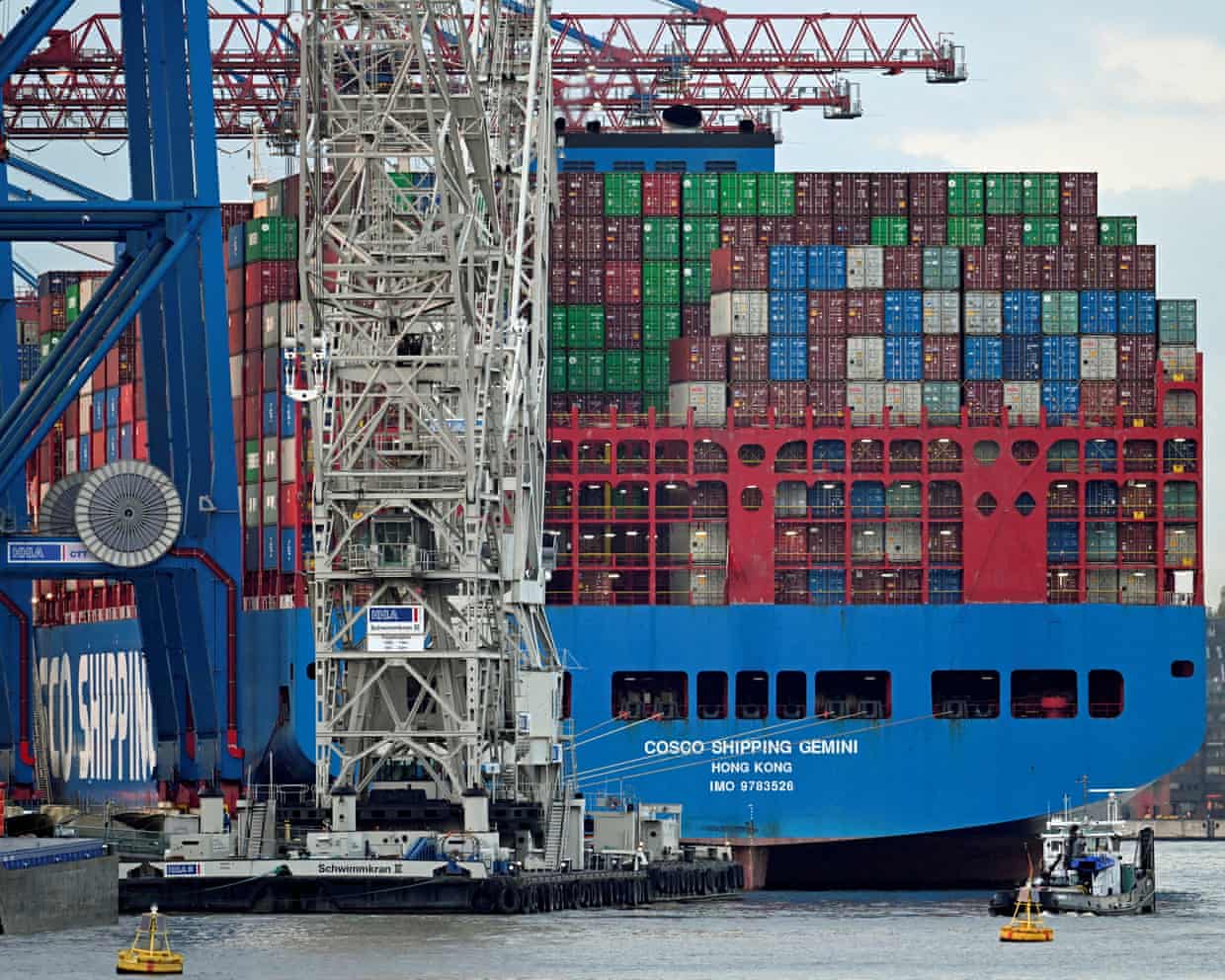
China has overtaken the US as Germany’s top trading partner, figures have shown, as the chancellor, Friedrich Merz, prepares for his first visit to Beijing since taking office.Merz will head to China on Tuesday and will be welcomed with military honours on Wednesday in Beijing by the prime minister, Li Qiang, before later meeting the president, Xi Jinping, for talks over dinner, his spokesperson Sebastian Hille said.Germany’s Federal Statistical Office released figures on Friday showing that China was back on top as the country’s most important market with €251bn (£219bn) in trade in 2025, up 2.2% on 2024, when the US was the country’s leading export destination.Germany imported goods worth about €170

‘It’s survival of the fittest’: the UK kebab chain seeking an edge with robot slicers
They are already packing our groceries and delivering shopping. Now robots are coming to the kebab shop, alongside self-service screens and loyalty apps, as takeaways look for ways to tackle rising costs.German Doner Kebab (GDK), a perhaps surprisingly British-owned chain that has been springing up across the country, has turned to technology to keep its fast food business buzzing in the face of rising costs and tough times on the high street.With households cooking at home more often to save money, and restaurants facing increases in energy bills, business rates, national insurance and hourly pay, profits are under pressure despite rising prices at the till.“It is survival of the fittest,” says Simon Wallis, the CEO of the brand, which operates via dozens of franchise partners running 155 outlets in the UK and nearly 40 more overseas including in the US, Dubai, Ireland and Sweden
Nascent tech, real fear: how AI anxiety is upending career ambitions
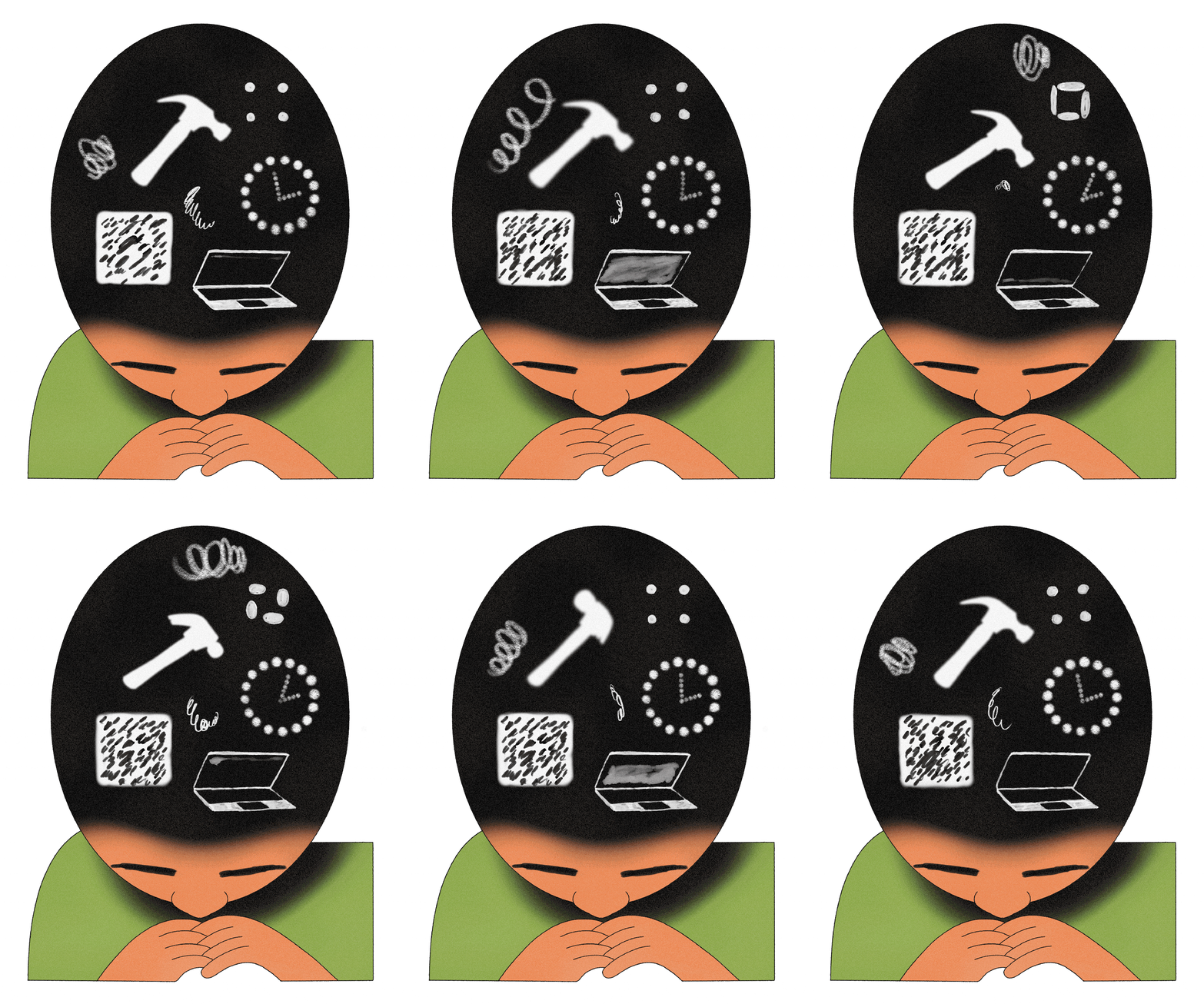
Matthew Ramirez started at Western Governors University as a computer science major in 2025, drawn by the promise of a high-paying, flexible career as a programmer. But as headlines mounted about tech layoffs and AI’s potential to replace entry-level coders, he began to question whether that path would actually lead to a job.When the 20-year-old interviewed for a datacenter technician role that June and never heard back, his doubts deepened. In December, Ramirez decided on what he thought was a safer bet: turning away from computer science entirely. He dropped his planned major to instead apply to nursing school
‘The Brits are coming again’: Team GB hail their greatest ever Winter Olympics
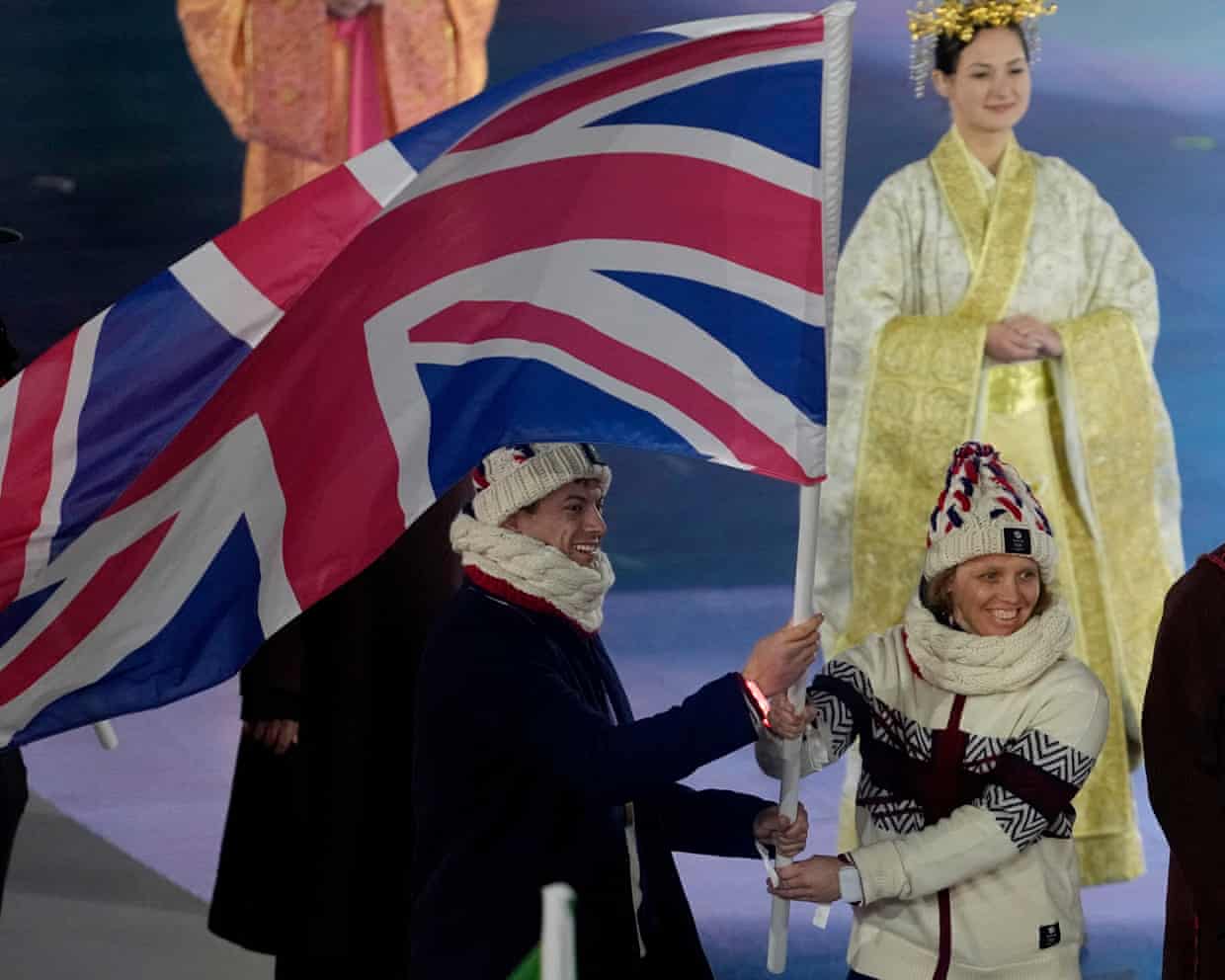
Team GB have hailed a “historic” Winter Olympics after Britain’s greatest performance in the 102 years of the Games left them 15th in the medal table – and warned their rivals the “Brits are coming again”.Zoe Atkin’s women’s halfpipe bronze medal on Sunday ensured that Britain left Milano Cortina with five medals – equalling the tally from Sochi in 2014 and Pyeongchang in 2018. However, Team GB also won a record three gold medals with Matt Weston winning two of them in the individual skeleton and the mixed event with Tabitha Stoecker. Charlotte Bankes and Huw Nightingale also took gold in the mixed snowboard cross, while the men’s curling team won silver.“It is far and away our most successful Games ever, both in terms of total medals achieved but also the number of Olympic champions,” the UK Sport performance director, Kate Baker, said

Winter Olympics 2026 come to a close at Verona Arena after Norway top medal table – as it happened
Norway has once again topped the Winter Olympics medal table, surpassing countries with far larger populations.The Scandinavian country won more gold medals (18) and more total medals (41) than the US, who came second in both categories (12 golds and 33 total medals). Norway’s 18 golds were the most by a country in Winter Olympics history, while their cross-country skiing hero Johannes Høsflot Klæbo accounted for six golds on his own, more than the all but seven other countries at this year’s Games.The achievements of Norway, which has a population of about 5.7m, are all the more remarkable given that they outperformed winter-sports nations with far larger populations such as the US (342m), China (1

‘It’s a ticking timebomb’: food producers sound alarm on rise in energy charges

High energy prices threaten UK’s status as manufacturing power, business groups say

Don’t be fooled by recent good news, the UK economy is still in a precarious state

‘Doubling down on meat’: is the UK’s love affair with vegetarian food over?
Stock markets rally and US dollar dips after supreme court rules against Trump’s sweeping tariffs; Hat-trick of good UK economic news – as it happened

Brighter UK economy gives Reeves a springboard for March statement