Nascent tech, real fear: how AI anxiety is upending career ambitions
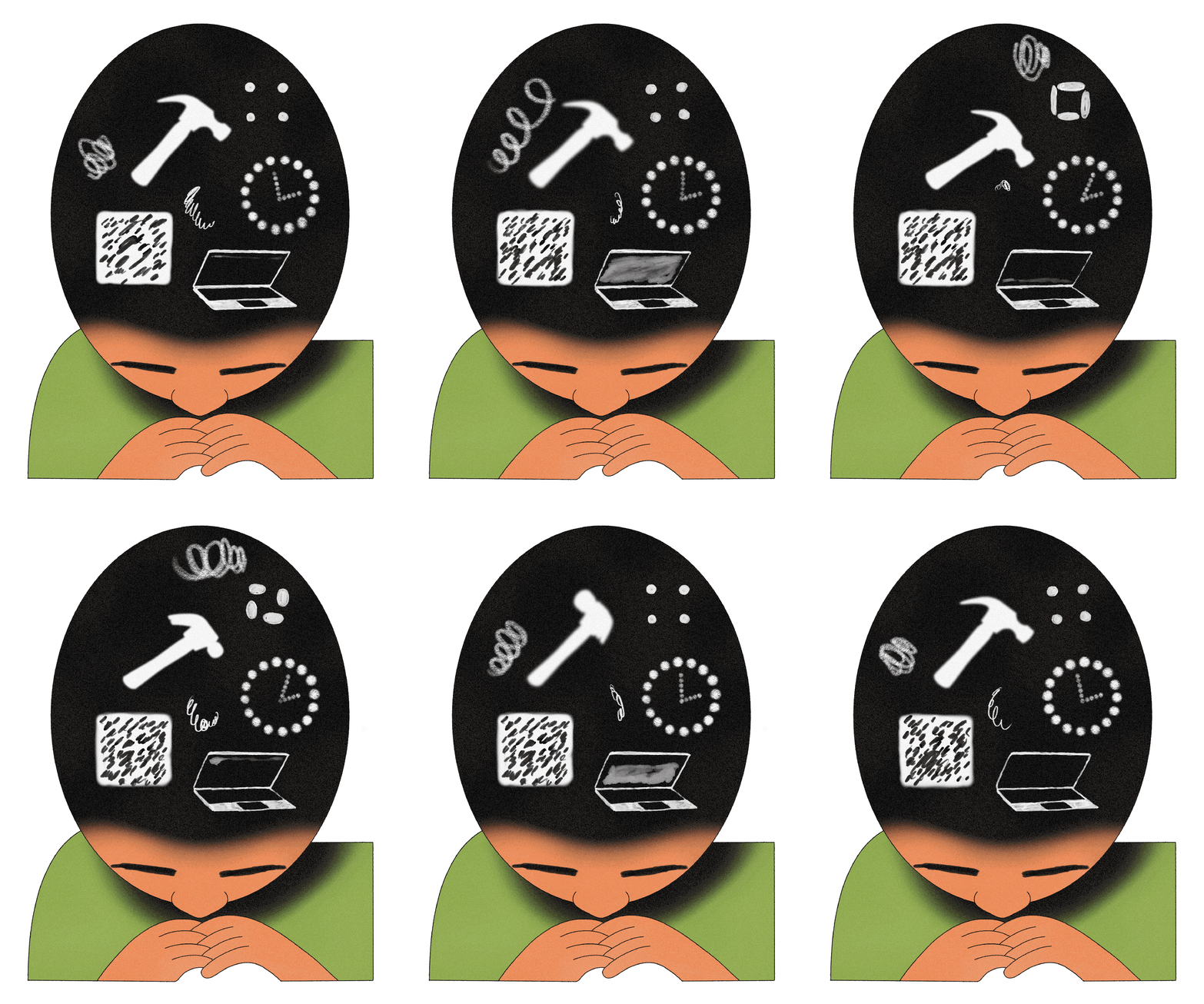
Matthew Ramirez started at Western Governors University as a computer science major in 2025, drawn by the promise of a high-paying, flexible career as a programmer.But as headlines mounted about tech layoffs and AI’s potential to replace entry-level coders, he began to question whether that path would actually lead to a job.When the 20-year-old interviewed for a datacenter technician role that June and never heard back, his doubts deepened.In December, Ramirez decided on what he thought was a safer bet: turning away from computer science entirely.He dropped his planned major to instead apply to nursing school.
He comes from a family of nurses, and sees the field as more stable and harder to automate than coding.“Even though AI might not be at the point where it will overtake all these entry-level jobs now, by the time I graduate, it likely will,” Ramirez said.Ramirez is not alone in reshaping his career out of anxiety over AI.As students like him are reconsidering their majors over concerns that AI may disrupt their employment prospects, more established workers – some with decades of experience – are rethinking their trajectories because they’re encountering AI at work and share the same unease.Some workers are eschewing it entirely; others are embracing it.
It’s not clear when AI will become advanced enough to replace certain white-collar workers and just how many jobs it will be capable of taking over.But jitters around its potential impact are already pushing people to change course, reshaping the labor market before automation fully arrives.What is clear is why workers are feeling on edge.The World Economic Forum projects that AI could displace 92m roles worldwide by 2030, including many white-collar positions.In the US, employers cited AI as a factor in nearly 55,000 job cuts in 2025, according to Challenger, Gray & Christmas, a consulting firm, as job seekers navigate a tougher market.
While AI is still just one factor among many that are leading to layoffs, ADP, the largest payroll company in the US, found that professional and business services roles, alongside information services jobs in media, telecom and IT, collectively lost 41,000 jobs in December 2025.In that same month, employment grew in healthcare, education and hospitality, per the firm’s data.Many of those white-collar roles involve writing, data analysis and coding – tasks generative AI tools can increasingly perform.Hands-on, people-facing work remains less exposed.Jobs that emphasize interpersonal and hands-on skills are increasingly appealing to young people who are wary of automation, according to Dr Jasmine Escalera, a career development expert at Zety, a professional development platform.
She pointed to research showing that 43% of gen Z workers who are anxious about AI are moving away from entry-level corporate and administrative roles and toward careers that rely on what she calls “human skills”, including creativity, interpersonal connection and hands-on expertise.In that same report, 53% of young respondents said they were seriously considering blue-collar or skilled trade work.Escalera said it was a move that workers were making to reduce their exposure to AI and one that the Wall Street Journal, the paper of record of white-collar work, had recently urged its readers to consider.But the pivot may come with sacrifices.Many of the white-collar roles that workers worry could be automated – from software development to financial analysis – are paid median salaries well above $75,000 a year, with developers raking in about $133,000, according to the Bureau of Labor Statistics.
Blue-collar jobs pay less.Many skilled trades, like electricians and plumbers, receive closer to $60,000 a year.These types of jobs also often require in-person work, physical labor and less predictable schedules – all trade-offs workers may accept in their attempts to future-proof their careers.For some job seekers, any mention of AI is a red flag in job listings, so they’re skipping them entirely.After getting laid off last January, Roman Callaghan, 30, spent nine months hunting for his next job.
As a medical coder at a medication access firm for four years, Callaghan handled administrative tasks like calling insurance providers and entering medical data,After his employer started rolling out AI across the company to streamline workflows, he wondered whether the move would one day affect his job,When he was laid off two years later, he suspected his fears had come true, though his employer didn’t specifically cite AI as a reason,When he looked for new work, he avoided any roles that mentioned phrases like “integrating AI”, “AI-first” or “developing AI” in job descriptions,Callaghan wanted a new job, but his AI anxiety steered him away from roles that now felt short-term to him.
He just didn’t want to risk being laid off again because a future employer would eventually use AI to cull its ranks.In the past nine months, he said, he applied to at least 100 jobs across data entry, medical coding, call centers and paralegal work, while deliberately skipping 30 to 40 postings that referenced AI.While he searched, he took odd gigs to make ends meet, first at a local fish store and later at a call center.He stayed there until mid-October, when he landed a data entry job.Avoiding AI-centric jobs “felt like it narrowed the amount of companies I could work for”, Callaghan said.
“Even though my options were limited, sticking to my convictions felt worth it.”Recruiters say that kind of avoidance is becoming more common.Marshall Scabet, the CEO of Precision Sales Recruiting, which helps manufacturers hire sales professionals, said that roughly a quarter of sales candidates he spoke with over the past six months were trying to pivot away from software-as-a-service (SaaS) jobs.Many clients told him they worried their tech sales roles could be replaced by AI, Scabet said, and believed selling industrial equipment was safer from automation.Doing so, he said, required building human relationships with vendors.
“In their opinion, there was less likelihood of that job being taken by AI,” Scabet said.“AI isn’t just going to walk into a factory and give a pitch about a machine.”For more experienced workers, their encounters with AI in the workplace are pushing them to reconsider entire industries or build new skill sets.Liam Robinson, a 45-year-old animation artist, says he is actively avoiding jobs in the mobile gaming industry he has worked in for more than a decade.In his last role as an art director, his employer encouraged staff to use generative AI to speed up production.
Robinson, who refused to use AI in his own work, said he watched the quality of animation suffer around him as his colleagues began relying on the tech.Last September, after disclosing in a self-evaluation survey that he wasn’t using AI, Robinson was laid off.It left him disillusioned with the direction of the industry.He believes AI flattens creativity, erodes craftsmanship and hurts the environment, fueling his resistance to work for companies building or deploying it.He is not actively applying for new roles and instead is focused on creating webtoon comics.
But if money runs dry, he said, he would take on other work, from driving for Uber to trash disposal.“As long as I’m useful and making a little money, that’s enough,” Robinson said.As professionals like Robinson confront the possibility that skills they spent years mastering are no longer highly valued, many are redefining what stability looks like, according to Arianny Mercedes, founder of the career strategy firm Revamped.Rather than chasing prestige or high salaries, Mercedes said her job-seeking clients increasingly prioritize roles tied to regulated or essential parts of an organization, such as healthcare administration, education or compliance.“The objective isn’t to avoid AI,” Mercedes said.
“It’s to be in roles where AI changes the tools of work without undermining authority or decision-making.”For others, the safest response to AI is to lean into it.After designing and developing websites for four years, Dmitry Zozulya decided to leave his work behind.As AI tools have proliferated and make it possible to code and create branding at a fraction of what it used to cost, the 29-year-old found it increasingly difficult to sell website and landing page work.Instead, Zozulya began offering AI-driven automation services, helping businesses streamline workflows.
He now runs a small consultancy while building personal projects to deepen his experience.“I believe it’s very important to adapt,” Zozulya said.“Even when it’s uncomfortable.”Whether the rise of AI is steering workers away from entire industries or just certain roles, it is disrupting many people’s calculus for what their future at work will look like – and it’s happening abruptly.For Ramirez, that recalculation began before he had even entered the workforce.
He believes switching from computer science to nursing means he’ll find work after graduation, even if it means letting go of the future he once imagined.“When you throw AI into the picture, the likelihood of healthcare jobs disappearing is slim as of right now,” Ramirez said.“I can’t speak for the future, but in the next few years, they’re still going to be there.”

Labour minister falsely linked journalists to ‘pro-Kremlin’ network in emails to GCHQ
A Labour minister who claimed to be “surprised” and “furious” at a PR agency’s work to investigate journalists on his behalf had been personally involved in naming them to British intelligence officials and falsely linking them to pro-Russian propaganda, the Guardian can reveal.Josh Simons, who was running the thinktank Labour Together at the time, was also involved in telling security officials that another journalist was “living with” the daughter of a former adviser to Jeremy Corbyn. Officials were told by Simons’ team that the former adviser was “suspected of links to Russian intelligence”.The extraordinary disclosures are contained in emails that Simons and his chief of staff at Labour Together sent to the National Cyber Security Centre (NCSC), a division of the spy agency GCHQ, in 2024. A spokesperson for Simons, a Cabinet Office minister, said: “These claims are untrue

UK reports record-breaking budget surplus of £30.4bn in surprise boost for Rachel Reeves
The UK government has posted the biggest ever budget surplus, official figures show, after a large increase in self-assessment and capital gains tax receipts.In a boost for the chancellor, Rachel Reeves, in the run-up to her spring statement next month, public sector finances recorded a surplus of £30.4bn in January, according to the Office for National Statistics. This was double the surplus recorded in January 2025.The figure is the largest monthly total since records began in 1993 and much higher than the forecast of £24bn made by the Office for Budget Responsibility (OBR), the government’s official forecaster, and a poll of City economists

Appointment of Antonia Romeo as head of civil service shows ‘poor judgment’, say former colleagues
Keir Starmer’s decision to appoint Antonia Romeo as the country’s most senior civil servant has prompted dismay among former colleagues who complained about what they considered bullying behaviour when she was a diplomat in New York.Several people who worked with Romeo at the New York consulate nearly 10 years ago have told the Guardian they are upset by the prime minister’s decision to make her cabinet secretary despite knowing about their complaints.The allegations from several colleagues were made as part of one formal complaint against Romeo in 2017. That complaint was investigated by a senior diplomat who found that she had a case to answer, but was then dismissed by her line managers at the Cabinet Office, who gave her the all clear.The complaint has resurfaced in recent days after Simon McDonald, the former lead civil servant at the Foreign Office, urged the prime minister to do more due diligence before making his decision

Starmer appoints Antonia Romeo as Britain’s first female cabinet secretary – UK politics live
The Times is reporting that Donald Trump issued his latest diatribe about the UK’s Chagos Islands deal (see 9.34am) because Keir Starmer is not letting the US use Diego Garcia to bomb Iran.In their story, Oliver Wright, George Grylls and Geraldine Scott say:double quotation markThe White House is drawing up detailed military plans for a strike against Iran involving the use of both Diego Garcia and RAF Fairford in Gloucestershire, which is home to America’s fleet of heavy bombers in Europe.Under the terms of long-standing agreements with Washington, these bases can only be used for military operations that have been agreed in advance with the government.The Times understands that the UK is yet to give permission for the US to use the bases in the event that Trump orders a strike on Iran, owing to concerns that it would be a breach of international law which makes no distinction between a state carrying out the attack and those in support if the latter have “knowledge of the circumstances of the internationally wrongful act”

Spending even more on defence won’t buy us peace | Letters
We are told to spend even more, and more quickly, on the armed forces, whose current budget for this year is expected to amount to more than £60bn (‘Britain ‘needs to go faster’ on defence spending, Starmer says, 16 February). The Ministry of Defence must surely first show it can put its house in order.The government is considering whether to scrap Ajax, the army’s planned new armoured vehicle, even though more than £6bn of taxpayers’ money has already been spent on the project. Ajax is eight years late, its defects so serious that vibration and noise have made soldiers training on it sick, with some suffering hearing loss.It is the latest and most egregious example of the huge waste caused by the MoD’s incompetence and profligacy over recent years

Global Counsel calls in administrators, blaming Peter Mandelson ‘maelstrom’
Global Counsel, the advisory firm co-founded by Peter Mandelson, is to collapse into administration, blaming the “maelstrom” caused by revelations about the former peer’s relationship with the convicted sex offender Jeffrey Epstein.Companies including Barclays, Tesco and the Premier League have all deserted Global Counsel, despite the company’s efforts to sever ties with Mandelson and the company’s co-founder Benjamin Wegg-Prosser.The crisis engulfed Global Counsel after it emerged that Mandelson had sought Epstein’s advice on setting up the business in 2010, shortly after leaving office when Labour lost the general election.On Thursday, the Financial Times reported that staff at Global Counsel had been told that the “Peter Mandelson legacy” had effectively capsized the business.In a statement posted on the professional social networking site LinkedIn, Global Counsel confirmed that it had asked a court to appoint Interpath as administrator “to take control of and realise the assets of the company”

Colbert on RFK Jr’s Maha workout video: ‘Senior softcore that feels like dropping acid’

Colbert on Trump’s Epstein ties: ‘Apparently he does not know the meaning of exonerated’

‘He invented a style’: war chronicler Robert Capa refashioned himself and revolutionised photography

Australian screen industry crushed as Universal shutters Matchbox Pictures, with 30 jobs lost

Javier Bardem and Tilda Swinton among those to condemn Berlinale’s ‘silence’ on Gaza

Colbert on Kristi Noem: ‘Everyone can’t wait to tell a reporter how awful you are’