Why Trump is worried datacenters might cost his party an election

Donald Trump is worried about datacenters.Specifically, he is concerned about their effects on an already expensive electricity market in the United States.Will Americans’ resentment of sharply rising energy costs scuttle his party’s November election ambitions?The US president’s anxiety is evident in two actions in recent weeks.On 13 January, Trump and Microsoft’s president jointly announced that the tech giant would pay more for its datacenters, paying full property taxes and accepting neither tax reductions nor electricity rate discounts in towns where it operates datacenters.“We are the ‘HOTTEST’ Country in the World, and Number One in AI.
Data Centers are key to that boom, and keeping Americans FREE and SECURE but, the big Technology Companies who build them must ‘pay their own way,’” Trump wrote on Truth Social,“Thank you, and congratulations to Microsoft,”On 16 January, Trump and governors of states in the north-east US directed the country’s largest power grid operator to hold an emergency reliability power auction by September, per Bloomberg,The move could force tech giants to pay for the construction of new power plants by requiring them to bid on the future reliability of the electricity they plan to draw from the grid.
“I never want Americans to pay higher Electricity bills because of Data Centers,” Trump said.OpenAI followed Microsoft’s lead with an announcement on 20 January.The company committed to “paying our own way on energy, so that our operations don’t increase your electricity prices”.The company is part of the Stargate collaboration between the AI industry and the Trump administration to invest $500bn in AI infrastructure.Trump is tugging at the edges of the problem of rapidly rising electricity demand.
He promised Americans he’d slash their electricity bills by half.But as the Guardian reported just after Trump and Microsoft made their joint proclamation, there’s little prospect of him delivering on that vow.At the same time that AI is increasing the demand for electricity, the administration is blocking renewable energy projects Trump calls a “scam” and a “con job” but were set to provide electricity for millions of US homes, instead pushing the expansion of drilling for gas and oil.Administration edicts to reverse the closure of ageing coal plants and to restart the overseas export of liquified natural gas could counterintuitively raise costs further for domestic consumers.Power prices play into larger concerns about the cost of living in the US, an issue that has Trump’s party on its back foot as congressional elections loom in November.
As ever with technology news, Elon Musk is part of the story.On 15 January, the US Environmental Protection Agency (EPA) ruled that Musk’s company xAI had illegally been operating methane-powered generators at its Memphis facility.The ruling establishes a precedent for tech companies in search of more electricity than they can obtain from the grid: you can’t simply bring in a backup generator, like a homeowner would do when facing a regular power outage.You’ll have to purchase nuclear power plants like Meta, Microsoft, Google and Amazon have.Musk and xAI have not commented.
European governments are likewise confronting the limitations their resources pose on the potential growth of datacenters, which are limitlessly hungry.In Germany, which boasts the highest number of datacenters in Europe, high energy prices constrain growth.Chancellor Friedrich Merz, like Trump, is very much in favor of constructing more datacenters but has taken an opposite tack to the US president’s deal with Microsoft.In November, Merz’s ruling party agreed to subsidize heavy industrial use of electricity until 2028 and reduce grid fees for consumers and businesses alike.One important distinction from the US: datacenters in Germany are required to source half of their electricity from renewable sources.
Germans are skeptical of the tech industry’s ability to abide by the requirement, which leads to general wariness of expanding datacenter construction, according to a survey published in October,In the UK, home to the second-highest number of datacenters in Europe, construction of new facilities is expanding, and energy costs are rising,Electricity rates in the UK are already multiple times those in the US and among the highest in the world, and increases pose severe problems for a populace that has dealt with a cost-of-living crisis for multiple years now,Despite the brewing problem, the Department for Science, Innovation and Technology proposed in November to offer electricity discounts to datacenters in so-called “AI growth zones” to encourage investment and development,A nearby example looms large: in neighboring Ireland, datacenters’ electricity use overtook that of all urban homes in 2024.
The strain on the grid has led to significantly higher costs for everyday Irish people, so much so that the Irish government imposed a ban on new datacenters connecting to Dublin’s power grid in 2021.The measure effectively prohibited new construction in the city and its surrounding area.It ended in December.The next stops in the datacenter boom are locales with resource limitations of different sorts.Trump and the tech giants have committed to constructing one of the largest datacenters in the world in the United Arab Emirates and several more facilities elsewhere in the Gulf states.
Energy is cheap in the region, but the billions of liters of water that datacenters need to cool off is scarce.Microsoft, Amazon and Meta have likewise announced $17bn in investment in data centers in India, where electricity availability is far less reliable than in the US or Europe.Part of the promised cash may be needed to fund the modernization of the grid, or, as has been the case in the city of Mumbai, local governments may keep ageing infrastructure in use longer than intended, worsening pollution.

Rum is booming but only Jamaican classics have the true funk
After Hurricane Melissa hit Jamaica last October, rum lovers anxiously awaited news from the island’s six distilleries. Hampden Estate, in the parish of Trelawney to the north, was right in the hurricane’s path, and the furious winds deprived its historic buildings of their roofs and the palm trees of their fronds. Then came more alarming rumours: the dunder pits had overflowed.The Guardian’s journalism is independent. We will earn a commission if you buy something through an affiliate link

Rachel Roddy’s recipe for pasta e fagioli with coconut, spring onion, chilli and lemon | A kitchen in Rome
Throughout the 1990s and into the early 2000s, under the banner of story, art and folklore, the Roman publishing house Newton Compton published a series of 27 books about regional Italian cooking. Some, such as Jeanne Carola Francesconi’s epic 1965 La Cucina Napoletana, were reprints of established books, while others were specially commissioned for the series. There is considerable variation; some of the 20 regions occupy 650 densely filled pages, sometimes spread over two volumes, while other regions have 236 pages with larger fonts, with everything in between. All of which is great, although I can’t help feeling affectionate towards the regions with 14-point font.In the face of the vast variation of regional culinary habits, knowledge and rituals, I also feel affectionate towards the common traditions; those that are specific to a place, but at the same time that cross local and national borders, as well as for the stories of the ingredients

‘We want to make jacket potatoes sexy again!’: how the humble spud became a fast food sensation
After Spudulike closed in 2024, the reign of the jacket potato seemed over in the UK. But now the favourite is back, piled with new toppings, sold by new companies and promoted all over social media by potato influencersThey were once a lunch option that inspired little excitement – but the jacket potato’s time has finally come. After decades in epicurean exile, the humble spud has made a roaring comeback in the UK and piqued the interest of foodies across the world. A-listers, tourists and trend-hopping teenagers are queueing for hours to get their hands on them. For Jacob Nelson, who sells loaded spuds that have gone super-viral on social media, this was all part of the plan
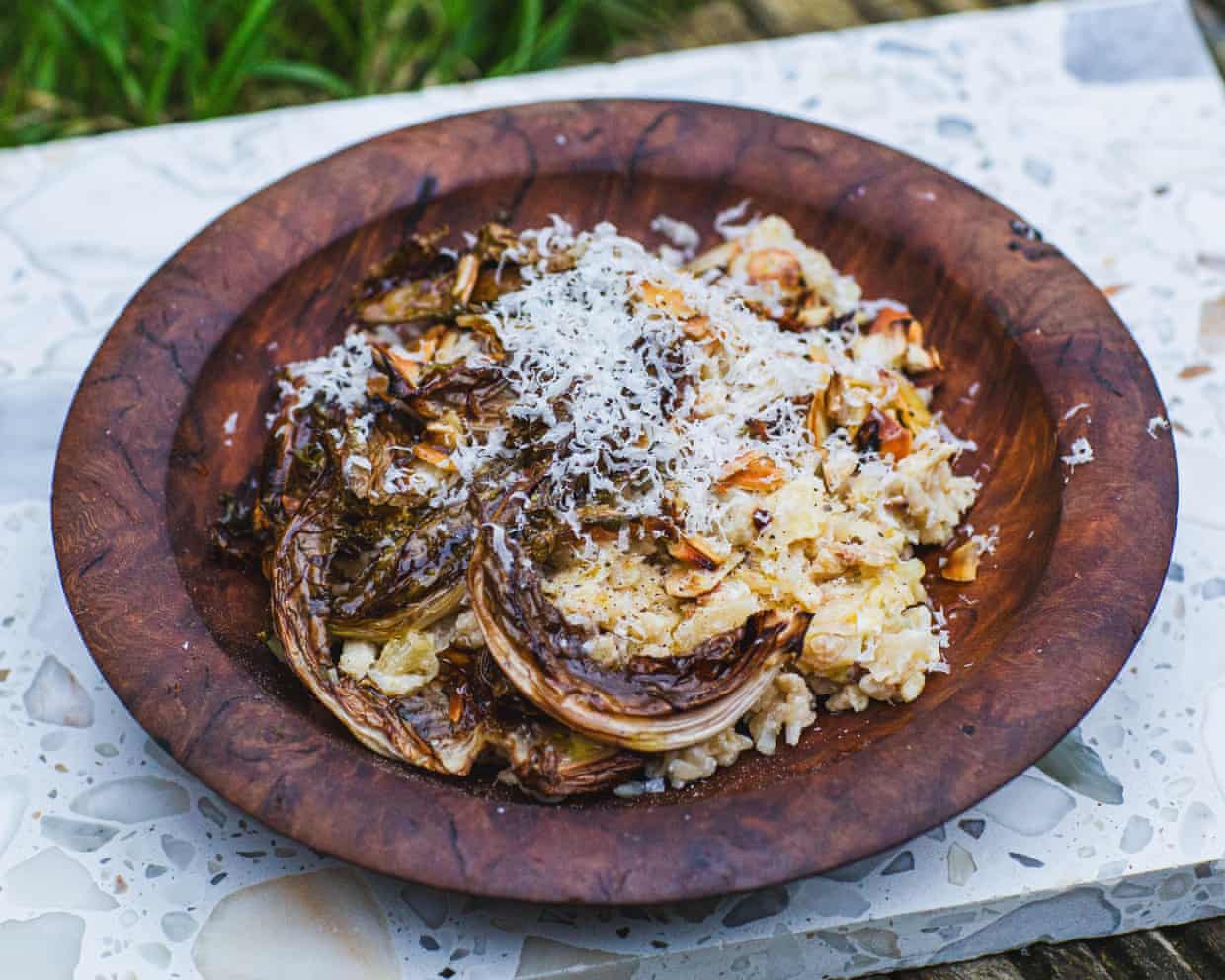
How to turn a cauliflower into ‘risotto’ – recipe | Waste not
I’m fasting for three days a week for the whole of this month. It’s not for everyone, I know, and it’s important to talk to your doctor first, but the benefits are well researched and include improved digestion and immune function, and lowered blood pressure. When we fast, the body goes into ketosis, which breaks down fat for energy, and to stay in ketosis afterwards it helps to reduce carbs and increase protein, which is where today’s low-carb, zero-waste recipe comes in.The humble cauliflower has had a rebrand over the past decade, as chefs and home cooks get more inventive with our seasonal produce. The leaves are incredibly nutritious and one of my favourite ingredients, not least because I always try to include a leafy green in our main meals for the health benefits

Homemade Bounty bars, savoury granola and flapjacks: Melissa Hemsley’s recipes for healthy sweet treats
I love a Bounty, although I call them paradise bars. I also love matcha (and not only for its health-supporting benefits). Though my partner doesn’t enjoy drinking matcha tea, when I mix it into the sweetness of the coconut filling, even he’s on board. Then, a very munchable and grabbable savoury granola, and flapjacks that you can throw together in minutes for a week’s worth of on-the-go snacks.If I’m in a rush and don’t want to be individually dipping 24 chocolate bars, sometimes I put the coconut matcha mix in a large, wide tin to set, then simply drizzle the melted chocolate layer on top and chill

He never warms the jars, so why doesn’t my son’s marmalade go mouldy?
When my son makes marmalade, he never warms the jars or uses circles of baking paper and cellophane – he just puts the lids on. It never goes mouldy, so am I wasting my time doing it the “proper” way?Dagna, Berkhamsted, HertsYou can’t get much sweeter than marmalade, and this is most likely the reason for both Dagna and her son’s success, despite their differing strategies. “The chance of mould developing is low because there’s so much sugar to balance the bitterness of the orange peel,” says Camilla Wynne, preserver and author of All That Crumbs Allow. “Mould needs water to do its thing, and sugar binds to water.” She recalls a former student who, like Dagna’s son, simply ladled her marmalade into jars and closed the lids

Experts warn of threat to democracy from ‘AI bot swarms’ infesting social media

Grok AI generated about 3m sexualised images in 11 days, study finds

Scarlett Johansson and Cate Blanchett back campaign accusing AI firms of theft
Why Trump is worried datacenters might cost his party an election

My analogue month: would ditching my smartphone make me healthier, happier – or more stressed?

Big tech continues to bend the knee to Trump a year after his inauguration