Experts warn of threat to democracy from ‘AI bot swarms’ infesting social media

Political leaders could soon launch swarms of human-imitating AI agents to reshape public opinion in a way that threatens to undermine democracy, a high profile group of experts in AI and online misinformation has warned.The Nobel peace prize-winning free-speech activist Maria Ressa, and leading AI and social science researchers from Berkeley, Harvard, Oxford, Cambridge and Yale are among a global consortium flagging the new “disruptive threat” posed by hard-to-detect, malicious “AI swarms” infesting social media and messaging channels.A would-be autocrat could use such swarms to persuade populations to accept cancelled elections or overturn results, they said, amid predictions the technology could be deployed at scale by the time of the US presidential election in 2028.The warnings, published today in Science, come alongside calls for coordinated global action to counter the risk, including “swarm scanners” and watermarked content to counter AI-run misinformation campaigns.Early versions of AI-powered influence operations have been used in the 2024 elections in Taiwan, India and Indonesia.
“A disruptive threat is emerging: swarms of collaborative, malicious AI agents,” the authors said.“These systems are capable of coordinating autonomously, infiltrating communities and fabricating consensus efficiently.By adaptively mimicking human social dynamics, they threaten democracy.”One leading expert in propaganda technology, Inga Trauthig, said the adoption of such advanced technology is likely to be slowed by politicians’ reluctance to cede campaign control to AIs.Another cause for skepticism is concern that using such illicit techniques would not be worth the risk, given voters are still more influenced by offline material.
The experts behind the warning include New York University’s Gary Marcus, a prominent sceptic about the claimed potential of current AI models who calls himself a “generative AI realist”, and Audrey Tang, Taiwan’s first digital minister, who has warned: “Those in the pay of authoritarian forces are undermining electoral processes, weaponizing AI and employing our societal strengths against us,”Others include David Garcia, professor for social and behavioural data science at the University of Konstanz, Sander van der Linden, a misinformation expert and director of Cambridge University’s social decision-making lab, and Christopher Summerfield, AI researcher and professor of cognitive neuroscience at Oxford University,Together they say political leaders could deploy almost limitless numbers of AIs to masquerade as humans online and precisely infiltrate communities, learn their foibles over time and use increasingly convincing and carefully tailored falsehoods, to change population-wide opinions,The threat is being supercharged by advances in AIs’ ability to pick up on the tone and content of discourse,They are increasingly able to mimic human dynamics, for example, by using appropriate slang and posting irregularly to avoid detection.
Progress in the development of “agentic” AI also means the ability to autonomously plan and coordinate action.As well as operating across social media, they may use messaging channels and even write blogs or use email, depending on which channel the AI thinks best helps achieve an aim, said one of the authors, Daniel Thilo Schroeder, a research scientist at the Sintef research institute in Oslo.“It’s just frightening how easy these things are to vibe code and just have small bot armies that can actually navigate online social media platforms and email and use these tools,” said Schroeder, who has been simulating swarms in laboratory conditions.Another of the authors, Jonas Kunst, professor of communication at the BI Norwegian Business School, said: “If these bots start to evolve into a collective and exchange information to solve a problem – in this case a malicious goal, namely analysing a community and finding a weak spot – then coordination will increase their accuracy and efficiency.“That is a really serious threat that we predict is going to materialise.
”In Taiwan, where voters are regularly targeted by Chinese propaganda, often unknowingly, AI bots have been increasing engagement with citizens on Threads and Facebook in the last two to three months, said Puma Shen, a Taiwanese Democratic Progressive Party MP and campaigner against Chinese disinformation.During discussions on political topics the AIs tend to provide “tonnes of information that you cannot verify”, creating “information overload”, Shen said.He said AIs might cite fake articles about how America will abandon Taiwan.Another recent trend is for the AI bots to stress to younger Taiwanese people that the China-Taiwan dispute is very complicated “so do not take sides if you have no knowledge”.“It’s not telling you that China’s great, but it’s [encouraging them] to be neutral,” Shen told the Guardian.
“This is very dangerous, because then you think people like me are radical.”Amid signs the progress of AI technology is not as rapid as Silicon Valley companies like OpenAI and Anthropic have claimed, the Guardian asked independent AI experts to assess the swarm warnings.“In the election-heavy year of 2024 the capabilities were there for AI-driven microtargeting but we didn’t see as much of that as scholars predicted,” said Trauthig, an adviser to the International Panel on the Information Environment.“Most political propagandists I interview are still using older technologies and are not at this cutting edge.”“It isn’t fanciful,” said Michael Wooldridge, professor of the foundations of AI at Oxford University.
“I think it is entirely plausible that bad actors will try to mobilise virtual armies of LLM-powered agents to disrupt elections and manipulate public opinion, for example targeting large numbers of individuals on social media and other electronic media.It’s technologically perfectly feasible … the technology has got progressively better and much more accessible.”The best public interest journalism relies on first-hand accounts from people in the know.If you have something to share on this subject, you can contact us confidentially using the following methods.Secure Messaging in the Guardian appThe Guardian app has a tool to send tips about stories.
Messages are end to end encrypted and concealed within the routine activity that every Guardian mobile app performs.This prevents an observer from knowing that you are communicating with us at all, let alone what is being said.If you don't already have the Guardian app, download it (iOS/Android) and go to the menu.Select ‘Secure Messaging’.SecureDrop, instant messengers, email, telephone and postIf you can safely use the Tor network without being observed or monitored, you can send messages and documents to the Guardian via our SecureDrop platform.
Finally, our guide at theguardian,com/tips lists several ways to contact us securely, and discusses the pros and cons of each,

Stephen Colbert on Trump’s first year back: ‘Today’s maniacal criminality distracts us from yesterday’s maniac crimes’
Late-night hosts acknowledged one full, maniacal year of Donald Trump’s second term as president of the United States.Tuesday 20 January, marked one full year of Trump’s second presidency, and “during that time, he has monopolized our attention every second of every minute of every hour of every day,” said Stephen Colbert on The Late Show. “Which is sad. Because today we’re not focusing on the real meaning of January 20: it’s Penguin Awareness Day.”On a more serious note, “a lot has happened in a short time”, the host noted

‘We played to 8,000 Mexicans who knew every word’: how the Whitest Boy Alive conquered the world
He lit up Europe with bands ranging from Peachfuzz to Kings of Convenience. But it was the Whitest Boy Alive that sent Erlend Øye stratospheric. As they return, the soft-singing, country-hopping sensation looks backIf you were to imagine the recent evolution of music in Europe as a series of scenes from a Where’s Wally?-style puzzle book, one bespectacled, lanky figure would pop up on almost every page. There he is in mid-90s London, handing out flyers for his first band Peachfuzz. Here he is in NME at the dawn of the new millennium, fronting folk duo Kings of Convenience and spearheading the new acoustic movement

Sally Tallant appointed as new director of London’s Hayward Gallery
Sally Tallant, the former boss of the Liverpool Biennial, has been announced as the new director of the Hayward Gallery and visual arts at London’s Southbank Centre.Tallant, who is currently in charge of the Queens Museum in New York, will return to the UK to take over from Ralph Rugoff, who will step down after two decades in charge of the institution, which celebrates its 75th anniversary this year.The Leeds-born Tallant has been in the US since 2019 after an eight-year stint in charge of the Liverpool Biennial and more than a decade working at the Serpentine Gallery, where she was head of programmes until 2011.She said she was delighted to be returning to London and excited to build on the “outstanding legacy” of Rugoff, who also took charge of the Venice Biennale in 2019. She said she was looking forward to “shaping the next chapter of this vital cultural destination and civic institution”

Seth Meyers on Trump: ‘It shouldn’t be this hard to make sense of what the president says and does’
With most late-night hosts on holiday, Seth Meyers mocked Donald Trump’s secondhand Nobel peace prize and his incoherent logic for taking over Greenland.Seth Meyers returned to the Late Night desk on Monday evening – Martin Luther King Jr Day in the US, for which other late-night shows remained on break – with a quick rundown of yet another weekend of unfathomably stupid updates from the White House.In the past few days, Trump “threatened to invade Greenland, which is a part of Denmark, because he didn’t win the Nobel peace prize, which he thinks is decided by Norway, which it’s not”, Meyers said. “For more on this, it’s time for ‘Seth Rubs His Temples and Tries to Dissociate for 15 Minutes.’“The news has once again gotten dumber and more exhausting,” he continued

Mama Does Derby review – Virginia Gay’s Town Hall takeover is ambitious, entertaining and irresistibly warm
Sydney’s Town Hall has transformed into a tennis court and a beach for recent iterations of the Sydney festival; this year, it’s a roller derby rink, with a moving set and music stage, and a live band belting covers.Inside the ornate Victorian interior of Centennial Hall, an oval flat track has been installed; on either side are stadium-style seating banks. This is the set for Mama Does Derby, the new family dramedy from Adelaide’s Windmill Production Company, premiering in Sydney ahead of Adelaide festival.There’s something thrilling about seeing art in unusual spaces, and about seeing familiar places rendered strange and wonderful through art. This has become the bread and butter for city festivals over the past decade, offering the thrill of the catch-it-while-you-can live communal experience as a counterpoint to our increasingly isolated lives

The Guide #226: SPOILER ALERT! It’s never been easier to avoid having your favourite show ruined
Don’t be alarmed by the image above. I can assure you that this newsletter features no spoilers for the current season of The Traitors. We won’t be discussing the shocking departure of REDACTED, or the nefarious actions of EXPUNGED, or the fact that CENSORED is the wife/half-brother/hairdresser of NAME REMOVED. Relax, you are in a hermetically sealed Traitors safe space here.Indeed, what has gradually dawned on me while watching this latest series is how relatively straightforward avoiding spoilers has been
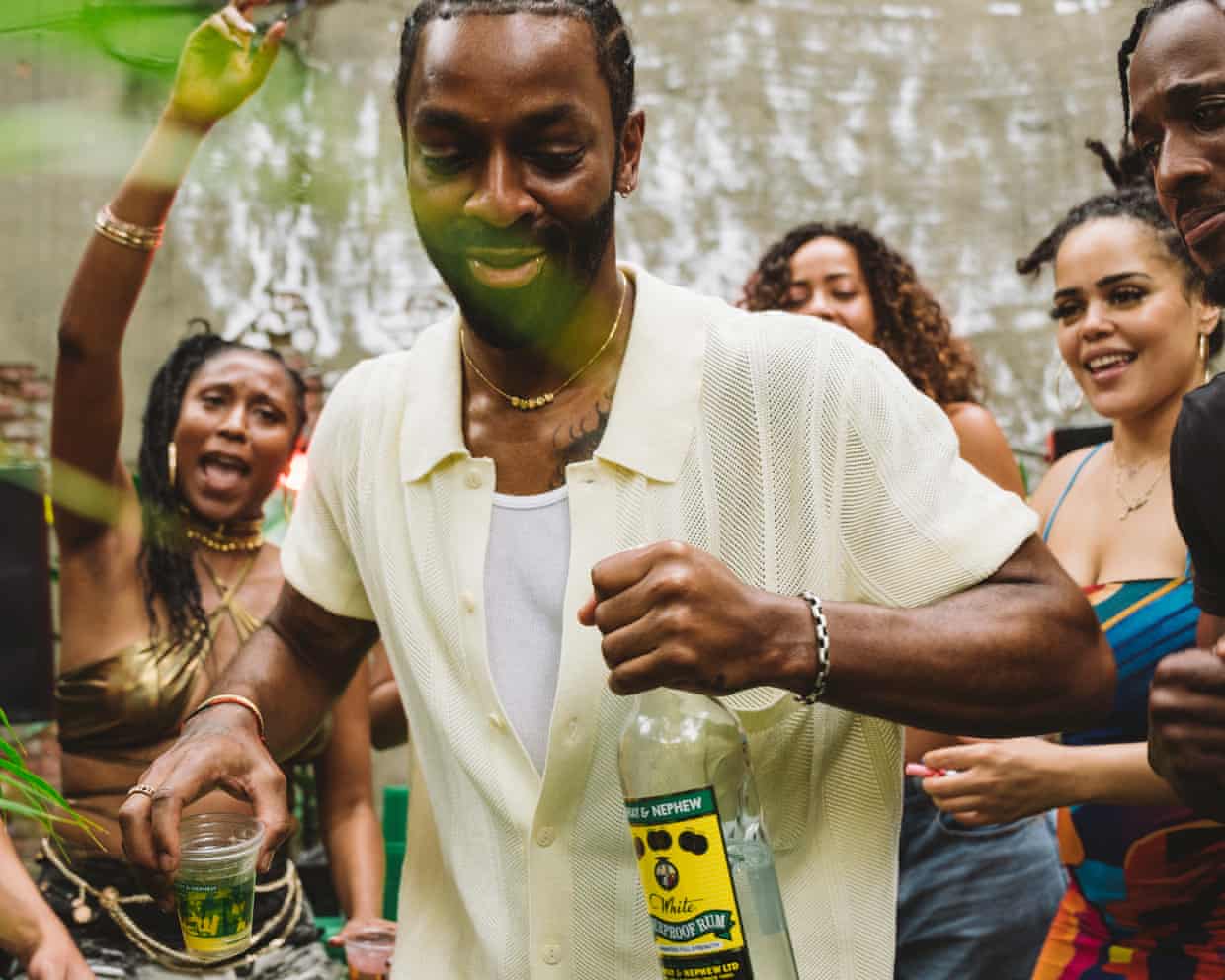
Rum is booming but only Jamaican classics have the true funk
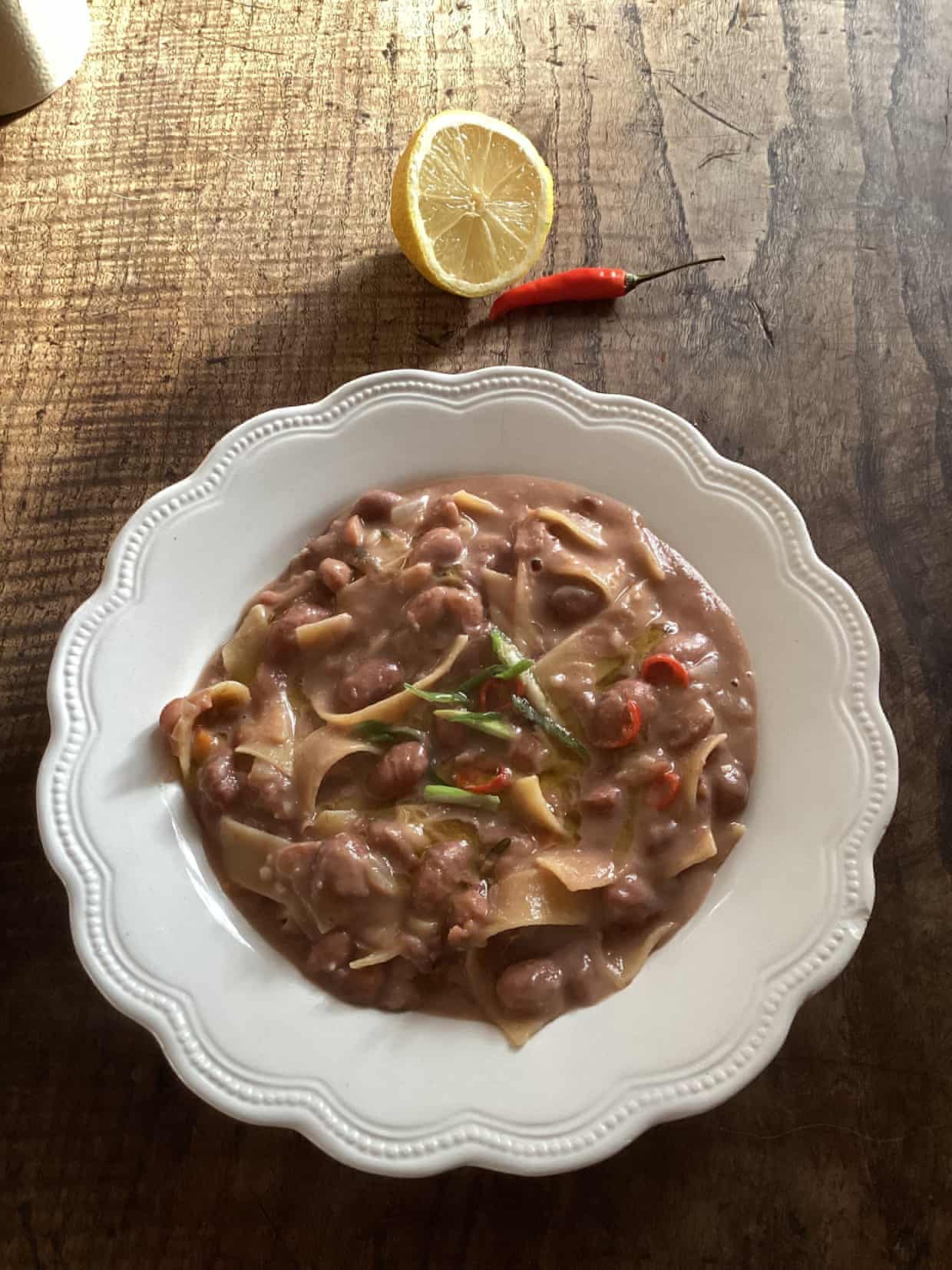
Rachel Roddy’s recipe for pasta e fagioli with coconut, spring onion, chilli and lemon | A kitchen in Rome

‘We want to make jacket potatoes sexy again!’: how the humble spud became a fast food sensation

How to turn a cauliflower into ‘risotto’ – recipe | Waste not
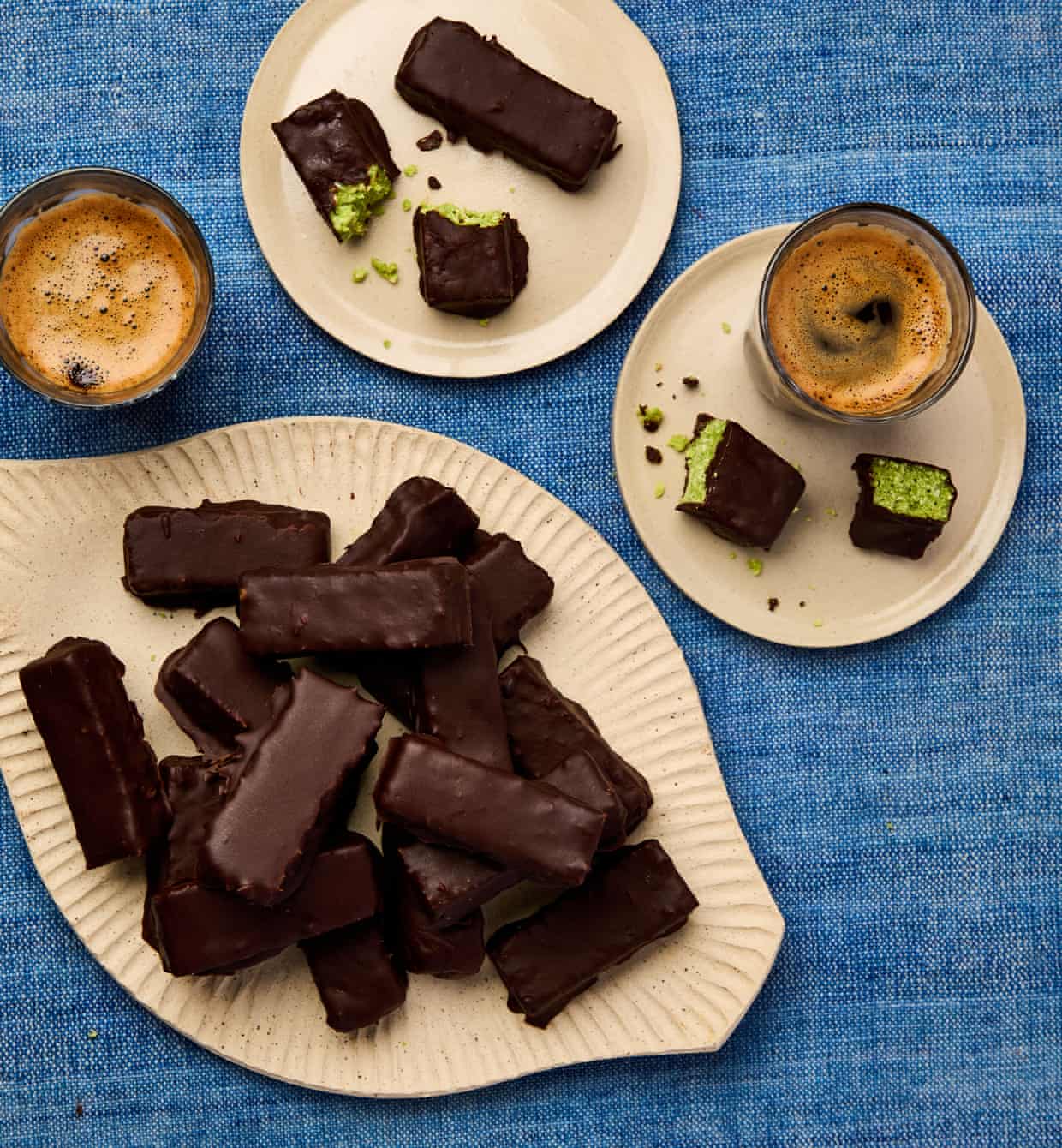
Homemade Bounty bars, savoury granola and flapjacks: Melissa Hemsley’s recipes for healthy sweet treats

He never warms the jars, so why doesn’t my son’s marmalade go mouldy?