Top US body-camera maker reports record revenue amid Trump immigration crackdown
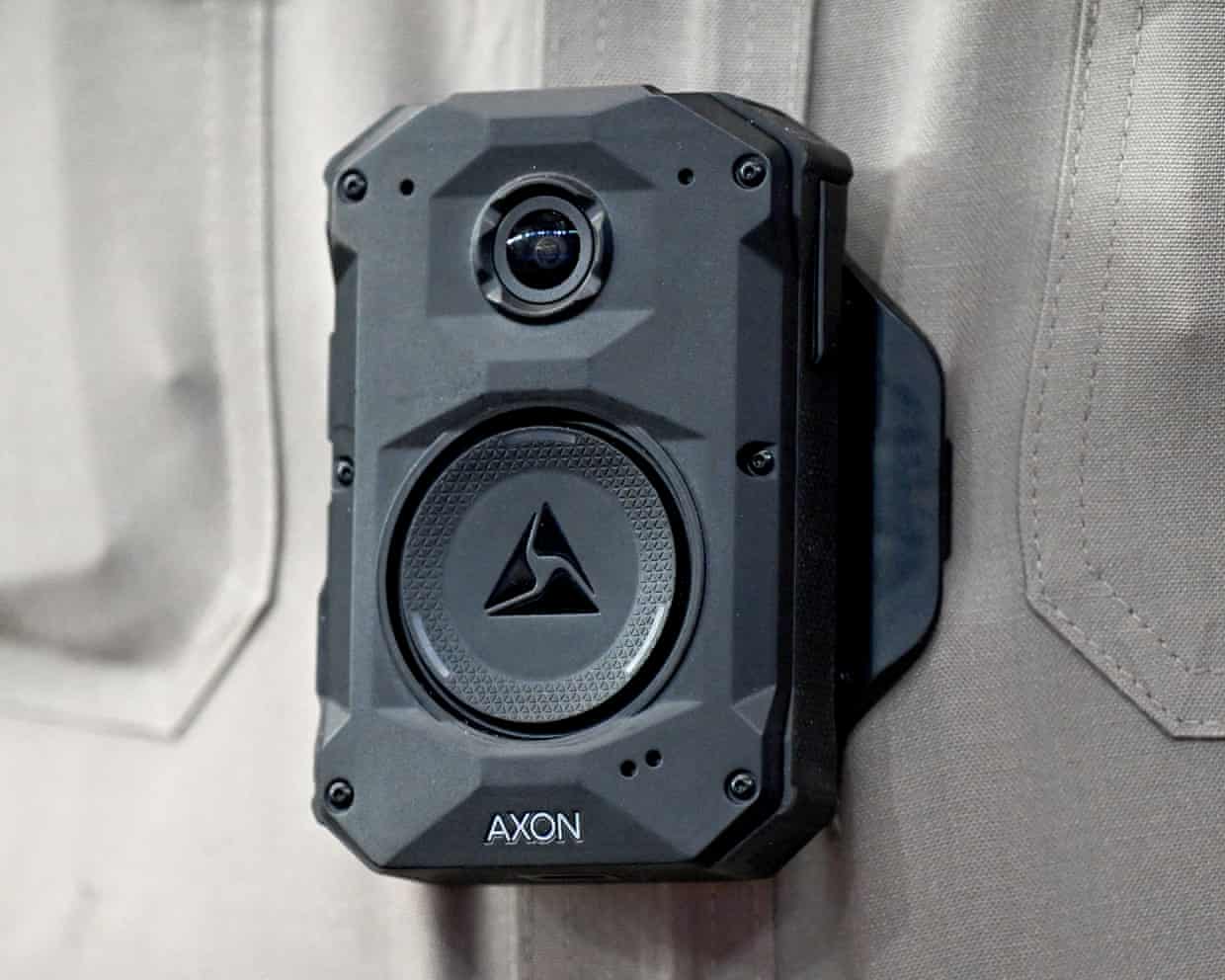
The largest body-camera maker in the US celebrated its latest financial results on Tuesday – reporting record revenue and forecasting major growth – as it prepares to cash in on the Department of Homeland Security’s planned rapid acquisition and deployment of these devices nationwide.In Tuesday’s earnings presentation, body-camera maker Axon, which also makes the well-known Taser device, announced that it blew past Wall Street expectations with $797m in revenue, up 39% year-over-year.The company attributed its growth to the offerings of its “AI era plan”, which includes a voice-activated companion for its body cameras.Executives also outlined a “major opportunity” for working with federal law enforcement in the year to come, in particular: body cameras and software licenses for the DHS.Asked by investors about his biggest worries, CEO Rick Smith said: “A misstep around privacy and data handling.
”Without elaborating on specific examples, he said: “We are seeing that those are concerns right now out in the public,I think that would be one where we could make a mistake that would have outsized negative consequences,”Data privacy experts fear that body-camera footage in the hands of the DHS will only be used to further surveil immigrants and protesters rather than ensure accountability for Immigrations and Customs Enforcement (ICE) officers and other federal agents,The expanded use of body cameras “will make every agent who wears a body camera a surveillance tool”, says Spencer Reynolds, a national security attorney at the NAACP Legal Defense Fund,What’s more, law enforcement agencies are often selective about what video they release, “and with DHS, in particular, we’ve been seeing that they aggressively release propaganda videos”, he says.
Axon dominates the body-camera market – so much so that it was sued, in 2023, by three cities alleging the company unlawfully gained monopoly powers; the case was largely dismissed last year.The homeland security department already has a $5.1m contract with Axon for body cameras and cloud storage licenses that began last March.Congress has proposed setting aside $20m for body cameras after aggressive lobbying by Axon.The company spent more than $1.
4m in the second half of last year advocating for greater use of its body cameras, counter-drone wares and digital evidence management technology,Ruben Gallego and Mark Kelly, US Democratic senators for Arizona, introduced a bill last month that would mandate body cameras for all DHS officers,Gallego has received more than $20,000 in campaign donations from Axon’s CEO and executives since 2017, according to FEC data,He declined to comment,Axon is based in Arizona.
Leading Democrats have broadly framed body cameras – with guardrails around data access, use and retention – as a way to provide oversight, despite surveillance concerns.Current DHS spending proposals citing $20m for body cameras do not include these protections, though.Republicans offered money for body cameras as part of their negotiations with Democrats for the DHS spending bill, and some have said they are not opposed to their use.Axon was known for producing Tasers before it made body cameras, and it has expanded its offerings drastically in recent years.The company currently positions itself as a holistic, real-time, AI-powered crime center.
On Tuesday’s call, Smith described Axon as the“world’s largest global sensor network”, focused less on analyzing incidents after they occur and more on analyzing data in real-time to assist decisions.In practice, that looks like a seamless, AI-powered Axon ecosystem that does it all: rapidly transcribing and translating dispatch calls; sourcing video from its automated license plate readers, drones and public cameras; hosting footage with a suite of cloud-based products, and drafting automated police reports that draw on visual evidence collected on the scene.“The body cameras are the tip of the iceberg … the real money is in the data storage and being able to offer analytics,” says Andrew Guthrie Ferguson, a law professor at George Washington University.Much of Axon’s revenue comes from AI-powered software, and the infrastructure required to host the huge amounts of videos its devices collect.The company’s software and services revenue grew 40% in its fourth quarter to $343m.
Given Axon’s vast capabilities in the context of local law enforcement, Ferguson is concerned about who controls body-camera footage taken by DHS officers – and whether it can be used to surveil people and respond to situations in real time.As Axon reaches new financial heights, it’s also exploring “responsible facial recognition on body-worn cameras”, according to a December blogpost by Smith.The company had abandoned plans to incorporate this technology into its devices in 2019 because of concerns over bias, accuracy and oversight.But Smith said it was starting a limited program with the Edmonton police in Alberta, stressing, “This is not a launch,” while also noting that “the reality is that facial recognition is already here”.Facial recognition technology by federal and local law enforcement has increasingly come under fire for jeopardising civil liberties.
The most recent backlash is over federal immigration officers’ use of apps, such as Mobile Fortify, to scan faces amid concerns that the DHS is building a database of people it considers to be terrorists; the federal agency has denied doing so despite video footage of an officer suggesting the existence of one.Ferguson, at George Washington University, says Axon appeared to be ahead of the curve with its facial recognition research in 2019, before it paused deployment.“In stopping, they allowed other companies who didn’t have those sorts of ethical qualms to get ahead of them and form a competitive advantage,” he says.“No doubt, when they see ICE agents using Mobile Fortify in the wild, they probably recognize that in some ways other companies did fill the void … and now they’ve lost market share.”Emily Tucker, executive director at the Center on Privacy & Technology at Georgetown Law, isn’t convinced that guardrails can do much to restrain the DHS’s use of body cameras.
The only real way to prevent abuse would be to ensure footage is controlled by an independent entity “that is in no way beholden to the executive branch” and ensuring that the video “isn’t uploaded to a ‘database of domestic terrorists”, she says.“DHS cannot be trusted to have the data.”Axon entered the automated license plate reader market last year, and executives noted on Tuesday’s earnings call that they have “barely scratched the surface”, though the business did not make a significant contribution to the company’s bottom line.License plate readers – particularly those owned by an Axon competitor, Flock Safety – have been subject to controversy in recent months, for helping local and federal law enforcement pursue immigrants and people seeking abortions.Flock says it does not give the DHS direct access to its systems, but news reports have documented a loophole: cases in which local law enforcement has used Flock’s tool in aiding federal immigration authorities.
In Denver on Tuesday, the mayor proposed replacing Flock’s license plate readers with Axon’s following community pushback, saying the larger company made more convincing security and privacy promises.Axon’s executives see the privacy backlash against Flock as yet another opportunity.“We’re hearing directly from customers – some of whom came to us from other vendors – that our track record on privacy and ethics was a deciding factor in their decision,” said Joshua Isner, Axon’s COO, on Tuesday’s earnings call.Activists who protested for months for the city to drop Flock are still skeptical.“It’s not much of an improvement.
It’s actually worse,” says Juan Sebastian Pinto, an organizer for AI regulation in Denver, who has protested against Flock.

Table for one: is eating lunch at work on your own a bad thing?
Name: The lonely lunch.Age: Recent, but growing.Appearance: Très misérable.Why are you talking French to me? Have you gone all pretentious? I am talking French to you because this is a French problem.It is? Oui

How to use on-the-turn milk to make an Italian classic – recipe
According to the Sustainable Food Trust, “the milk from 40,000 cows (300,000 tonnes) is tipped down the kitchen sink each year – a real slap in the face for the farmer”. Even though some supermarkets have now swapped use-by for best-before dates on their milk, those dates can still be confusing, so always do the sniff test before binning it: even if it’s a little sour, you can still cook with it.The Food Standards Agency advises that food with a best-before date can usually be tested using sensory cues such as the sniff test. And what better way to use up spent or sour milk than maiale al latte, or milk-braised pork, for which pork is slowly braised in milk and flavoured with a few aromatics until tender. The milk splits and forms large curds that thicken and caramelise the sauce, so creating a creamy rich dressing for the meat

Nadiya Hussain on food, faith and finding her voice: ‘I get paid less than the white version of me’
In a food world where the trend is for protein and weight-loss injections and sugar is the supervillain, Nadiya’s Quick Comforts seems somewhat contrary. There are golden syrup dumplings. There is a chapter devoted to deep frying, with cheese balls and ingenious deep-fried cannelloni.“If I could write an entire book on deep frying, I absolutely would,” says Hussain with a laugh. “This is how I cook, this is how I eat, this is how I show love to my family

Should you sanitise your strawberries? Experts on the right way to wash fruit and vegetables
You know the cost-of-living crisis is biting when videos of influencers unpacking their grocery “hauls” are viral on TikTok. Chewing through millions of views, fruit and vegetables are aesthetically plopped into a sink filled with water, piece by piece. “Sanitising” products are then added, ranging from the fizz of baking soda and vinegar to specialised vegetable soaps (“Amazon link in my bio!”). There are even expensive electronic purifiers, which shake, shimmy and bubble away in the basin, supposedly removing any nasties.But is ASMR deep-cleaning your fresh produce really necessary? And is it all too late for those of us who can barely remember to rinse our pears?For Queensland’s Rebecca Scurr, who shares what it’s like to “sell fruit for a living” to her 26,000 TikTok followers, fruit-washing videos make her “cringe so much”

Do you really need to chill cookie dough? | Kitchen Aide
Does chilling cookie dough really make for a better result?Emily, by email “It all depends on what kind of cookie it is,” says Guardian baker Helen Goh. “Let’s say it’s a cookie that you need to stamp out – the dough needs to be firm enough to roll it, but not so firm that you can’t.” That said, the question of whether to fridge or not to fridge is probably most prevalent in the chocolate chip cookie sphere. “There’s a perceived wisdom that chilling helps the dough develop the flavour and caramelisation,” Goh says, “but, to be honest, it also makes the dough a little easier to roll and ensures it bakes evenly, which is worth far more than that slight improvement in flavour.”Recommended chilling times vary from 30 minutes to overnight, although Goh finds the latter results in a “cakey” cookie: “I’m a real Goldilocks, so I like crisp at the edges with a chewy centre

José Pizarro’s recipe for roast carrot, saffron and chickpea stew with spinach
This is everyday cooking, the kind that comes naturally in winter. Carrots are always around and often forgotten, but they give a lot when you treat them properly. The saffron brings warmth and colour, and always makes me think of home. February can feel quiet and grey, and this stew suits that mood. It is comforting without being heavy, made for evenings when you want something ready on the stove and bread on the table, eaten calmly and enjoyed without any fuss

CPS issues new guidance on ‘honour’-based and dowry abuse
UK anti-slavery watchdog calls for overhaul of adult sexual services sites
NHS maternity units often cover up harmful errors in childbirth, report finds

Ed Davey accuses care home trustee of embezzlement amid watchdog inquiry

People living in UK’s poorest areas have less diverse gut bacteria, study finds

The rise of rejection sensitive dysphoria: ‘My chest feels like it’s collapsing’