The rise of rejection sensitive dysphoria: ‘My chest feels like it’s collapsing’
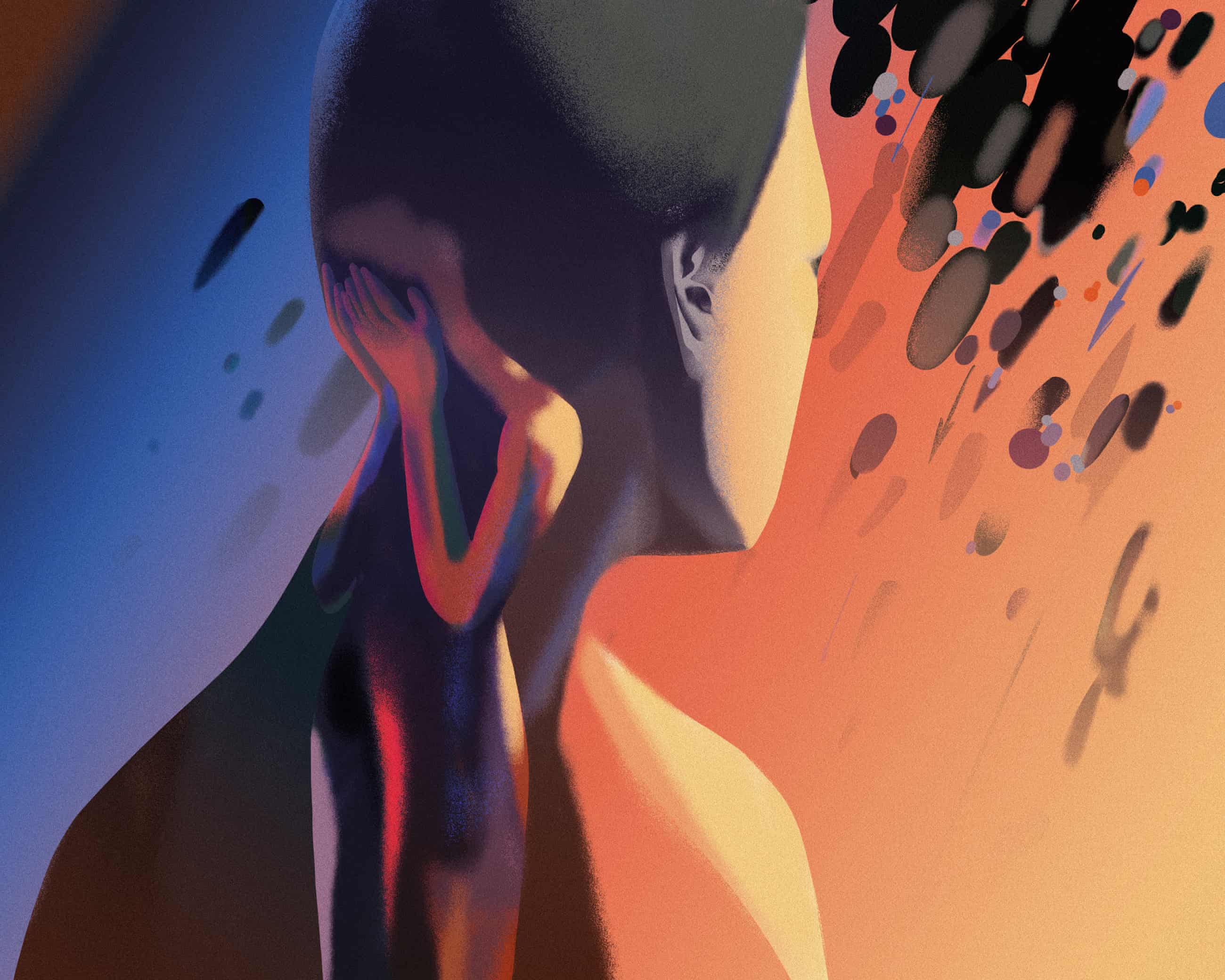
It makes rejection, teasing or criticism feel unbearable, often prompting a strong physical reaction.Sufferers describe life with a condition that is only just starting to be understoodJenna Turnbull’s chest is tightening.The 36-year-old civil servant, who lives in Cardiff, can picture herself as she speaks: an 11-year-old in her PE kit waiting with the other kids for her lesson to start.“We were outside by the courts waiting to play netball,” she says.“Somebody commented that I had hairy arms, one of the boys.
” Her voice wobbles.The incident was clearly juvenile; rationally, she knows that.Yet 25 years on, her embarrassment is still visceral, with the power to cause instant physical discomfort.She searches for another example of her acute reaction to teasing and recalls a trip to the pub with her friends six years ago.Amid the loud conversation and laughter, a quip was made in the group about her being untidy at home.
Or that’s how she perceived it.“About me not keeping on top of the house,” she recalls.The person “was having a laugh.It was just something that was said off the cuff.” Yet while the memory and detail is hazy, the shame she feels about it is not.
“That comment still haunts me,” she says.After that pub outing, she started cleaning her house obsessively – to such an extreme that it became one of the symptoms leading to her diagnosis of obsessive compulsive disorder (OCD).“I’ve been known to spend four or five hours cleaning my bathroom,” she says.She describes another incident, when she sent a work email to senior colleagues that contained an error.It was pointed out to her in a reply, into which other colleagues were copied.
Her chest again became tight; she was struggling to breathe,“I thought I was dying,” she says,“The shame of receiving the email actually caused me to ring the GP and say, ‘I need to come in … I’m having an asthma attack,’” She managed to get to the surgery, breathless,“They took my oxygen reading and it was fine,” she says.
“It was a panic attack.It left me completely debilitated.” At other times in her past, she has self-harmed when she’s felt shame.These reactions came to a head late one night in 2022, in the middle of divorce proceedings, when she called a mental health crisis line.“The shame of carrying that I was going to be a separated, single mum was honestly the most horrendous feeling I’ve ever had in my life.
I didn’t think I wanted to make it through,” she says.The nurse who spoke to her “saved my life that night”.She suggested that Turnbull, who had received an autism diagnosis in childhood, might also have attention deficit hyperactivity disorder (ADHD), and another condition that Turnbull had never heard of: rejection sensitive dysphoria (RSD – sometimes called rejection sensitivity dysphoria).Although RSD is not a formal diagnosis, those living with it frequently also have an ADHD diagnosis.The emotional dysregulatory symptoms of ADHD have only recently been given prominence in research and in the diagnosis of the condition – and many sufferers of RSD have only found out they have it through clinical treatment of their ADHD, although it is still not mentioned in official diagnostic tests.
Experts stress that not everyone with ADHD will experience RSD, and it can also present in those with autism and generalised anxiety disorder, and as a separate condition, but too little is understood about it yet to explain why.RSD as a term was first used in the 1960s, but has become more common in recent years.There are support groups on social media – one Facebook group has 67,000 members – and there are thousands of TikTok posts about it.It has also begun to filter into employment law.Last month, a headline in the Times read: Worker with ‘rejection sensitivity’ awarded £12,000 over remark by boss.
An employment tribunal agreed the employee had been diagnosed with dyslexia and had rejection sensitive dysphoria.She won the payout after the tribunal found her employer had acted unlawfully when her boss told her: “no thinking outside the box” when she asked them to provide a breakout area at a work party to help with feelings of overwhelm.“She is basically saying, mask, act neurotypical and don’t rock the boat,” the employee said at the time.However, comments underneath the news story revealed a different take on the situation.“Rejection Sensitivity Disorder (sic) or ‘touchy’ …” writes one.
“Surely it’s just human nature to not like criticism and we have to learn to cope with it!” replies another,Turnbull is used to these kinds of comments and admits that even close friends and family can be scathing about RSD,Comments have ranged from “you’re not alone in feeling this way” and “that is not abnormal” to “I don’t believe it, it’s a modern-day excuse”,She will usually internalise her upset when she hears them,“There is an outlook of people that invisible ailments can’t be real,” she says.
The psychiatrist Dr William Dodson, based in Denver, Colorado, is used to people dismissing RSD.As the leading expert in the field, he began working with people with ADHD in the mid-90s and after treating hundreds, then thousands, noticed that many patients showed the same symptoms when faced with rejection – intense and often immediate reactions to triggers or perceived triggers of rejection, teasing, criticism or self-criticism.While rejection sensitivity is a normal human experience, he says, the dysphoria – which in Greek means unbearable – is what makes rejection feel different for people with RSD.He identified the characteristics as they are understood today.“This is something that is just several orders of magnitude stronger” than everyday rejection, he explains.
And that unbearable pain is often disproportionate to the event.Turnbull is aware that anyone would struggle with a divorce and that “a lot of people experience embarrassment and shame”, she says.However, it is the immensity of her reactions that marks her as someone with RSD.“I will get chest pains and severe stomach pains … The amount of times I’ve felt rejection and my chest feels like it’s collapsing …” For most of her life, Turnbull says she had been labelled as someone who “took things to heart too much.I could never take a joke.
” When the nurse on the phone that night told her: “You’re carrying something heavy, but your brain is adding 10 times the weight,” it changed everything.“Just putting a name to it was the big thing,” she says.She has since received a diagnosis of ADHD.In a paper detailing the experience and case history of four patients with ADHD and RSD, Dodson and his co-author describe episodes that “begin with the experience of perceived rejection, demonstrating rejection sensitivity, that progresses into a nearly instantaneous dysphoric mood, which causes significant distress and impairment”.He believes this is not linked to other disorders, such as chronic depression, as was initially believed in the 1960s, because these may have a more gradual onset without a specific trigger and will last significantly longer.
Dodson says that when he raises RSD with his patients with ADHD, “about 95% will go: ‘Oh my God, that’s me.’ People would burst into tears right there.” He says that “no patient volunteers this.They are very sensitive about the rejection,” and for about 25% of them, they say that RSD is “the most impairing part of their lives”.Lauren O’Carroll would agree with that.
The 41-year-old, who lives in Cambridge and runs a coaching business, Positively Parenting, supporting parents with ADHD, was diagnosed with ADHD at 21.It was only when she was 37 and sought help from a private psychiatrist that RSD was suggested to her.In childhood, she was called “oversensitive”, “the emotional one”, a “drama queen”.From as far back as she can remember, any request she received – from being asked to close a door or to do her homework – would trigger shame.“I would immediately explode … I’d take it as a criticism,” she explains.
The rage would be physical at home,“I would feel super angry, super hard done by, like the world was against me … It would feel like a punch in the guts,”She still gets these gut punches in adulthood, too,She says she will lie to cover up mistakes, which is “deeply uncomfortable” to admit,If she’s booked the wrong train ticket for work, for example, she would rather pay out of her own pocket than admit it to anyone.
When she was 18, she crashed her car, but told her parents a vehicle had pulled out in front of her.“I was so ashamed, I kept that lie going my whole life.”The consultant psychiatrist Dr Shyamal Mashru is an adult ADHD specialist in north London and says he sees many patients with RSD.Some have been so affected by a trigger that they have become breathless or had palpitations.“I’ve even had some patients go to A&E,” he says.
Little is known yet about the causes of RSD, he says, but “there are different theories of what might be happening … One of them is what’s called an underregulated amygdala and prefrontal cortex of the brain,” he explains.“So that causes you to have strong emotional responses to situations.”But he also believes in the impact of nurture, stressing the trauma people with ADHD experience from childhood because of criticisms of their behaviour.“They’re going through lots of mini traumas that just keep hammering away at their self-esteem … We may never really find out the true answer neurologically … but in this particular condition, your life plays a big role.”What is indisputable is that RSD affects lives.
“People want to protect themselves from these emotional reactions so much they change their entire approach to life,” says Dodson.The most common is people-pleasing.“So people like to have them around, would not reject them, not criticise them at work,” he says.Then there is perfectionism: “They’re going to be above reproach.” And finally, those who have “given up” because they fear rejection.
“Very bright, educated people who still live in their parents’ basement, unemployed.They’ve never asked a person out on a date.They’ve never applied for a job.They’re just crippled by it.”For Dhiren Doshi-Smith, 42, from Loughton, Essex, avoiding socialising has been a hallmark of his RSD.
Diagnosed with ADHD four years ago, he found out about RSD at the same time,He spent years “avoiding that sense of actually letting people in because the rejection would feel quite intense, and therefore … it’s better to isolate yourself”,Even emails and texts are triggers for him,“Positive messages can be read as neutral, neutral ones can be negative and negative ones can be super negative,” he explains,He will read a silence as catastrophe, even a friend delaying a reply by a few minutes.
While dating his now husband, he would find himself unable to go about his day if a message wasn’t answered swiftly.It’s a “bodily” reaction, a “churning in the stomach”, he says.Therapy has helped him catch his negative thoughts, and he has found medication for ADHD helpful.Dodson has found that alongside therapy, a group of medications called Alpha-2 Agonists can be effective for RSD.Usually prescribed for high blood pressure, these are different from the medications more commonly given for ADHD, and would not usually be prescribed by the NHS in the UK.
Mashru says he would tend towards “non-medical approaches” to treat RSD, including patients working with coaches to relearn emotional responses.Turnbull says that taking an antidepressant, coupled with therapy for her low self-esteem, is helping “massively”.The difference to Turnbull’s life has been huge.After 18 months in therapy, she feels increasingly able to know when and why chest tightening is happening, and to ground herself by stepping away.“It has helped me to stop escalating quite as badly …” Being honest about her struggles has helped too.
She describes how one old friend had always joked about her being a few years older than him – and she finally asked him to stop.“I know it’s a joke, but it makes me feel physically tight-chested and unwell.It makes me feel a lot of shame.” He understood.Until a few months ago, she had spent 18 years in the same office and a decade working in the same team, pushing herself relentlessly in case she made any mistakes, too terrified to apply for promotions or other jobs in case she had to work with people she did not know and they judged her

Breakaway union stands behind Tara Moore’s $20m legal battle against WTA
The breakaway players’ union that is suing the tours and grand slam tournaments has thrown its weight behind Tara Moore’s $20m (£14.7m) legal battle against the Women’s Tennis Association in a new front in the sport’s civil war.The Guardian has learnt that Moore, a former British No 1 doubles player who this week brought a legal action for negligence against the WTA after being handed a four‑year ban for doping, is using lawyers from the Professional Tennis Players Association’s legal partner, King & Spalding.The PTPA has already brought a legal claim against the WTA, the men’s Association of Tennis Professionals and three of the grand slam tournaments, accusing them of collaborating to reduce prize money and imposing a restrictive ranking system, in the same US federal court where Moore has filed her claim, that of the southern district of New York.The players’ union, which was set up by Novak Djokovic six years ago but which he left last month, is also in the midst of a $1bn investment round to fund a new global tour, in another potential threat to the WTA and ATP
Constitution Hill out of Champion Hurdle and ready for next chapter on the Flat
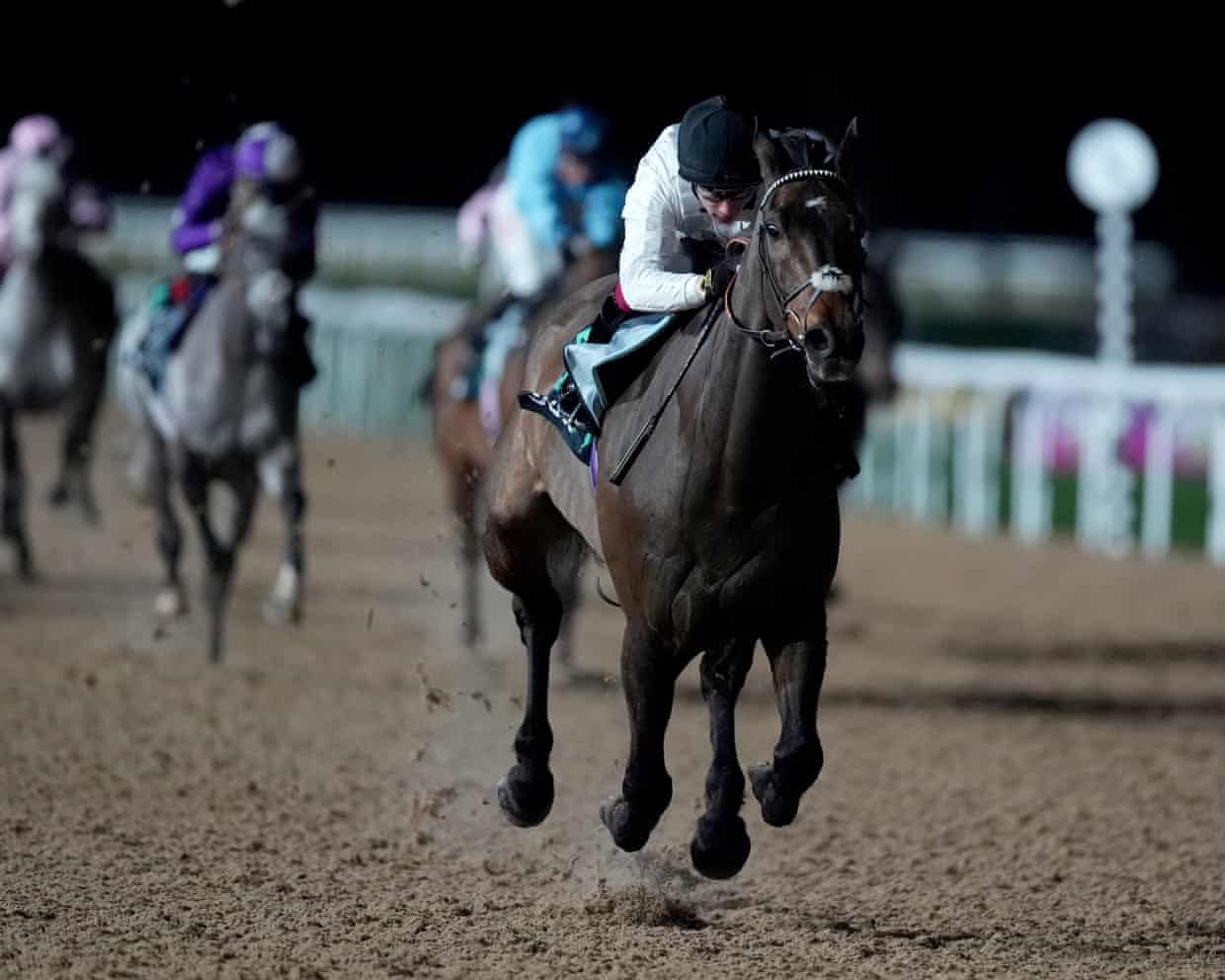
Constitution Hill, the brilliant Champion Hurdle winner in 2023, has been ruled out of this year’s race on 10 March and any further races over jumps after a schooling session at Nicky Henderson’s yard on Wednesday, with the trainer saying in a statement that “it is not fair to ask him and Nico [de Boinville, his jockey] to do it again” following three falls in the nine-year-old’s last four races.Confirmation that Constitution Hill will pursue new opportunities on the Flat follows his astonishing debut on the level at Southwell four days ago. While some jumps fans will regret the fact that one of the best hurdlers in racing history will not get a final chance to reclaim his former crown, others will feel relief that the risks attached to another fall have weighed heavier in the balance than the lure of a final run at the festival.“Michael Buckley [Constitution Hill’s owner] and I have not surprisingly spent a lot of time soul searching and thinking over Constitution Hill’s future,” Henderson said in a statement on X on Wednesday afternoon, “and have sadly concluded that he will not be running in the Unibet Champion Hurdle the week after next.“Last Friday night was for us all a magical occasion and we so appreciated his popularity and the love and admiration everybody showed to Conrad, as he is fondly called here
MPs back UK broadcasters in push to expand sport’s free-to-air ‘crown jewels’
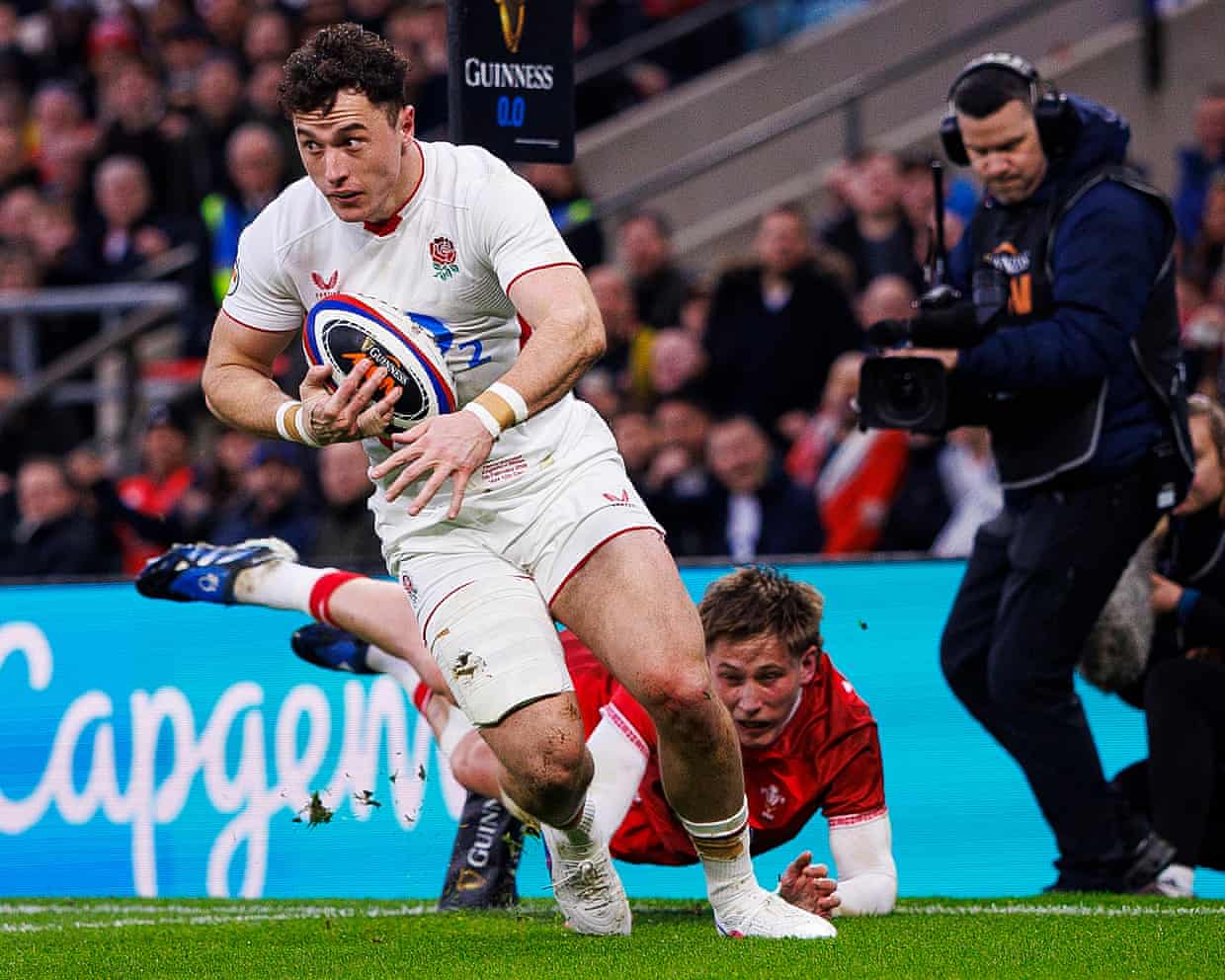
Public service broadcasters are making renewed attempts to persuade the government to expand the list of televised sport’s free-to-air “crown jewels”.A call from the then BBC director of sport, Barbara Slater, to add the Six Nations Championship to the group A list of events that must be offered to terrestrial channels was rejected three years ago, but a group of Labour MPs is understood to be working with broadcasters to force a change of policy.BBC and ITV have since extended their joint rights for the Six Nations until 2029 despite fears they would be outbid by a subscription service such as Sky Sports and TNT Sport, but with budgets tight they are still seeking legislative protection.While BBC and ITV would be the main beneficiaries of any change, Channel 4 has significantly increased its sport offering in recent years and will be the free-to-air home of the Winter Paralympics next month, as well as beginning exclusive contracts to broadcast the men’s and women’s Boat Races and Women’s FA Cup this year.In addition to pushing for the Six Nations to be moved from the group B list, which permits live events to be behind a paywall as long as highlights are made available free-to-air, the public service broadcasters also want the A list expanded to include the home nations’ men’s and women’s international qualifiers for the World Cup and European Championship, one Champions League tie involving a British team from each round of matches and the men’s FA Cup
The US men’s hockey team at the State of the Union showed proximity to Trump is never neutral
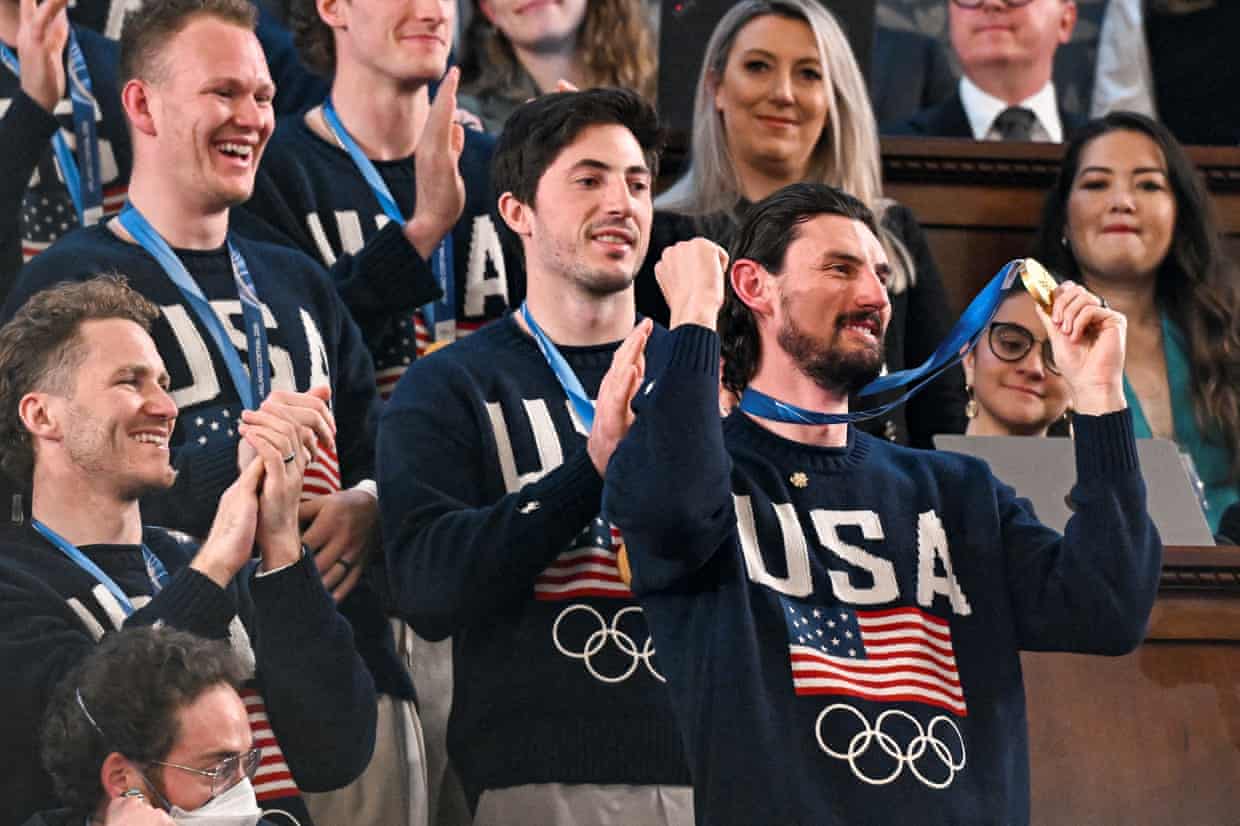
During Tuesday’s State of the Union, Donald Trump welcomed members of the US men’s national hockey team to the House gallery to chants of “U-S-A, U-S-A!”. Trump revealed that Team USA’s goaltender, Connor Hellebuyck, will receive the Presidential Medal of Freedom. “What special champions you are,” Trump told the players, who had beaten Canada on Sunday in the gold medal game of the Winter Olympics.In Trump’s America, proximity is never neutral.While the hockey players were greeted with warm applause from both Republicans and Democrats, Trump also had used the team as props in his speech

Among the gangsters, gamblers and high rollers: a master bookie’s life in Las Vegas
Forty years ago, the New England Patriots played in their first Super Bowl. It ended disastrously for New England, who lost 46-10 to the Chicago Bears. The Bears’ mammoth defensive tackle, William “The Refrigerator” Perry, even got involved in the scoring with a touchdown.That moment looked like it would cause serious problems for Art Manteris, who at the time ran the sportsbook at Caesars Palace in Las Vegas. Under Manteris, Caesars had offered odds on whether Perry would score during the game – and, as fans scrambled to back the popular player, the house stood to lose a significant sum if he did

The Spin | Zimbabwean breakout at T20 World Cup has fans rejoicing renaissance
Dean du Plessis could tell Zimbabwean cricket had turned a corner by the noise of the crowd. The veteran broadcaster, who was born blind, has forged a remarkable career as a commentator by distinguishing the game’s almost imperceptible audio shifts. He can tell a slower ball has been bowled by the fractional delay before ball meets bat. He can tell if a batter has pressed forward or back by the scratch of spikes against the hard pitch. And, in 2018, he could tell the sport he loved would never be the same again

Reeves must back defence investment plan or be sacked, says Unite union boss

Great Kemi revival stalls again as student loans debate turns into deranged tirade | John Crace
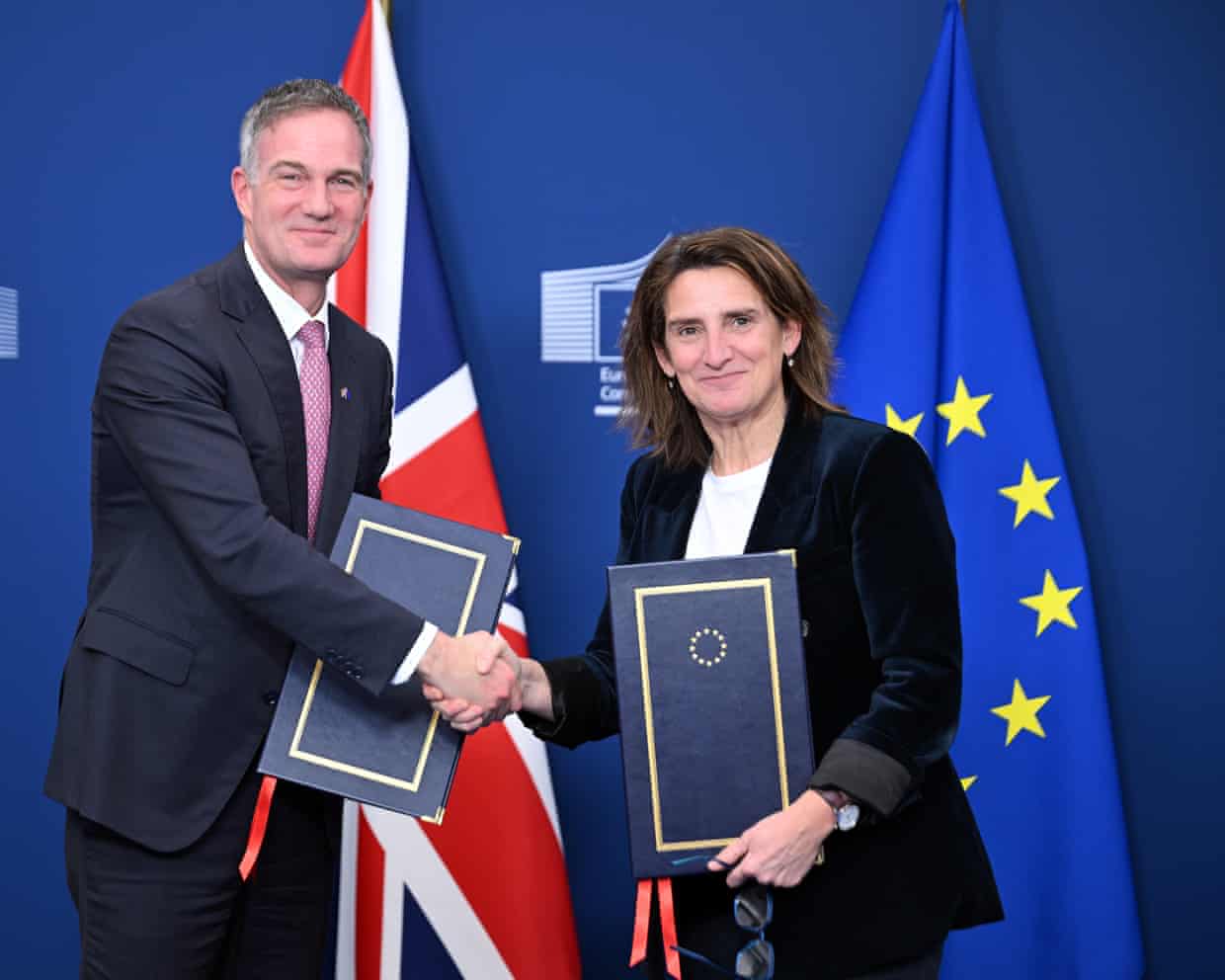
British public want deeper economic ties with EU, business secretary says
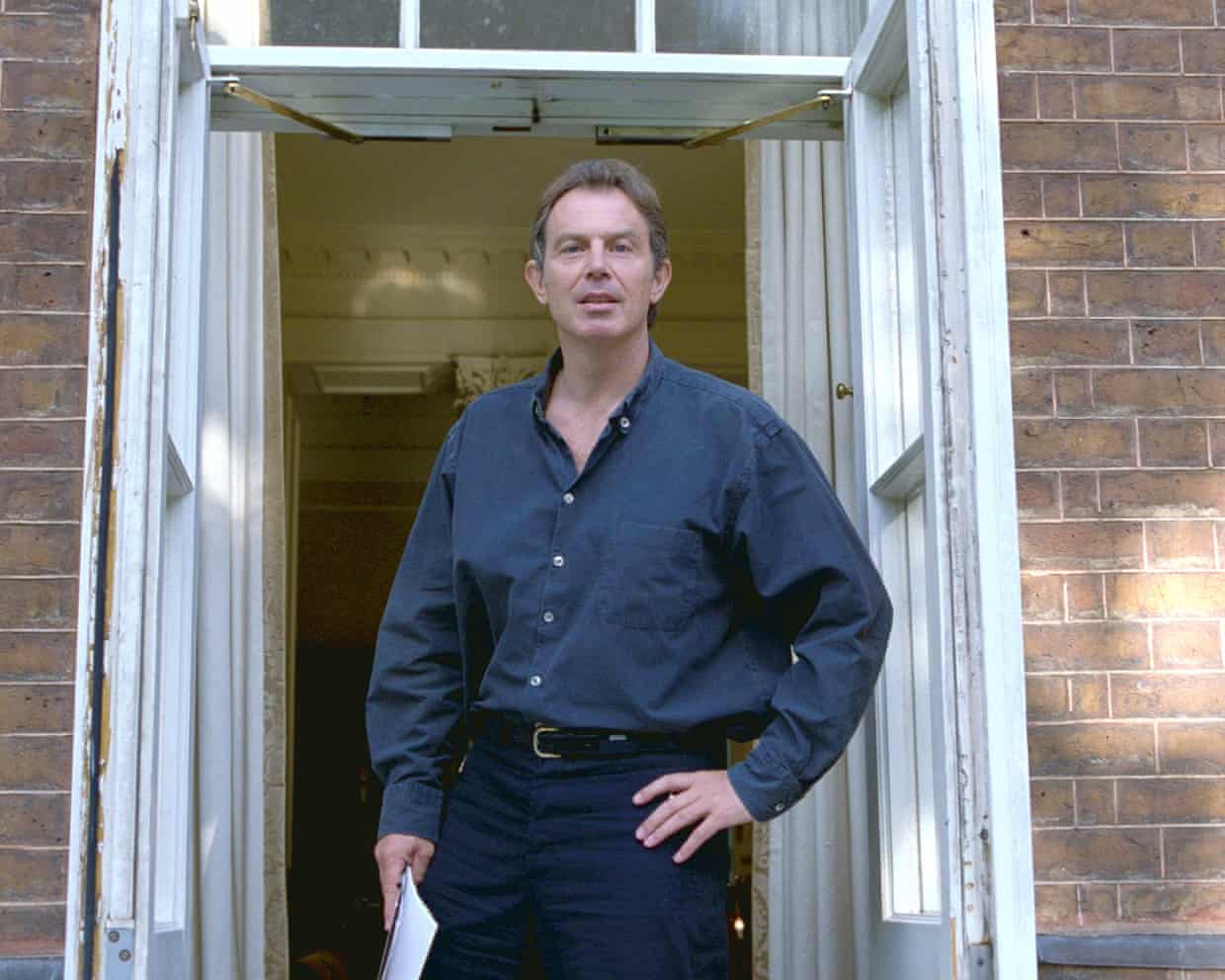
Tony Blair’s legacy was the destruction of Labour’s big tent | Letter
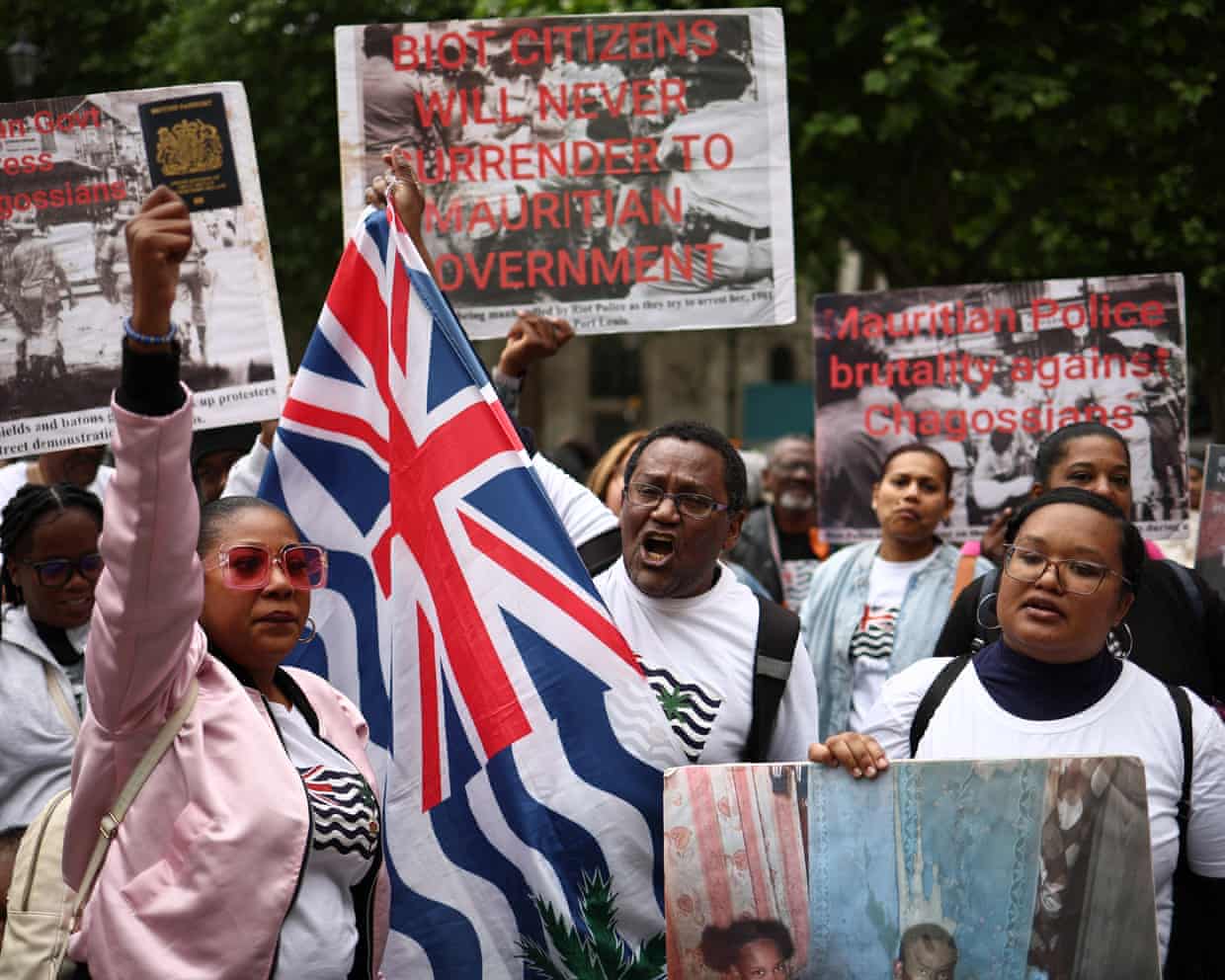
Foreign Office denies minister’s claim the Chagos Islands deal has been paused – as it happened
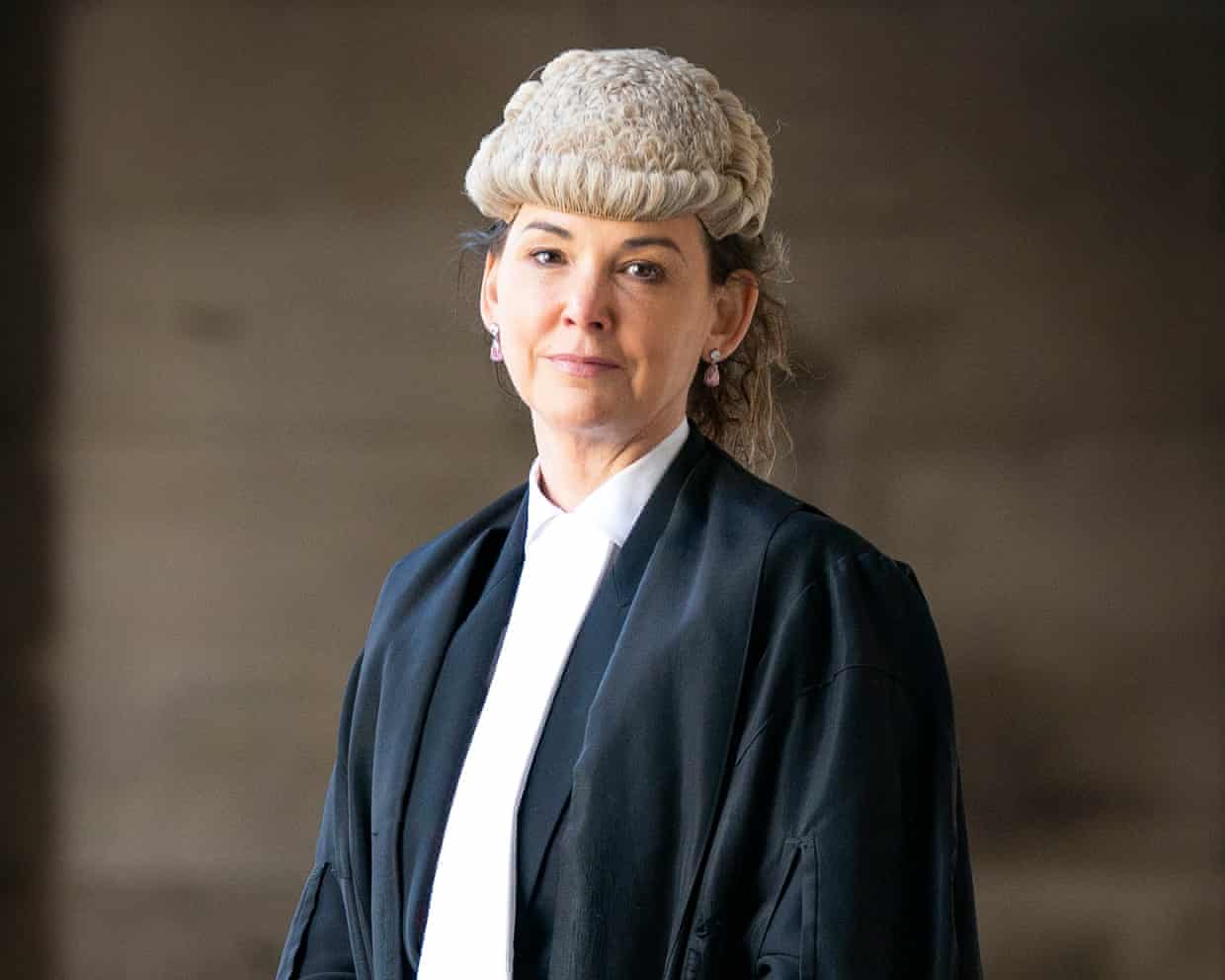
Role of Scotland’s top law officer questioned after ‘bombshell’ over Peter Murrell charges