Trump ‘plans to roll back’ some metal tariffs; NatWest hands bankers £495m bonus pot – business live

European markets are subdued this morning – the FTSE 100 is now down very slightly by 0.01%, and the pan-continental Europe Stoxx 600 index is down by 0.34%.That loss is being led by the basic materials sector, which is down 1.43%.
The French IT company Capgemini is a bright spot, with its shares rising by 4.9% after it beat its own target for full-year revenue, up 3.4% at constant exchange rates to €22.5bn (£19.25bn) in 2025.
Net income slipped 4% to €1.6bn.But all eyes will be on the US when the market opens in a few hours, as investors grapple with concerns about how AI could disrupt various industries.Mohit Kumar, an economist at the investment broker Jefferies, thinks some of the fears might be overblown.He said:We do not agree with the frenzy, but we also know not to stand in the way of position unwinds and flows.
Hence, we would not be stepping in to fade the recent weakness,We believe that the current market is more nuanced and requires more detailed bottoms up approach to identify winners and losers,AI disruption is not a negative,…Companies which could show cost advantages from AI would be the winners while companies where the revenue stream is getting impacted would be losers,For now, we would recommend investors investing time and effort in identifying winners and losers, and keep powder dry rather than try not to fade the recent weakness.
The Russian central bank has cut its key interest rate by a half a percentage point to 15.5% on Friday, in a surprise move as the country tries to shore up its slowing economy.The move was predicted by just eight of the 24 analysts polled by Reuters ahead of the decision.The bank said in a statement:The Bank of Russia will assess the need for a further key rate cut at its upcoming meetings depending on the sustainability of the inflation slowdown and the dynamics of inflation expectations.The baseline scenario assumes the average key rate to be in the range from 13.
5% to 14.5% per annum in 2026.This means that monetary conditions will remain tight.”Russia’s economy has come under strain from high borrowing costs, after the central bank increased the interest rate last year to fight inflation.Growth has slowed amid falling oil prices – a key source of government revenue – as well as Western sanctions.
The Russian government has forecast growth of 1.3% this year, after 1.0% in 2025.The central bank estimates growth of around 0.5-1.
5% this year.The bank said:The upward deviation of the Russian economy from a balanced growth path is decreasing…Growth in domestic demand will moderate in the coming months.Business sentiment demonstrates the same expectations.”Gold is recovering today too, up 1.1% at $4,973.
1 per ounce, gaining back some ground after dropping by about 3% yesterday.The yellow metal came under pressure after data released on Wednesday showed the US job market began 2026 on firmer footing than expected, reinforcing the view that policymakers may keep interest rates elevated for longer.Higher interest rates can make gold less attractive to some investors, as the metal does not pay a yield.Gold will be one to watch later this afternoon when the US releases inflation data for January.Donald Trump has signed a trade deal with Taiwan that will reduce almost all of its tariffs and unlock billions of dollars worth of investment in the US chip industry.
It formalises an agreement between Washington and Taipei announced in January, lowering tariffs on Taiwanese goods from 20% to 15%.US trade representative Jamieson Greer said in a statement:President Trump’s leadership in the Asia-Pacific region continues to generate prosperous trade ties for the United States with important partners across Asia, while further advancing the economic and national security interests of the American people.”The Taiwanese government said the new tariff rate set allows its companies to compete on a level field with Japan, South Korea and the European Union.It also said the agreement “eliminated” the disadvantage from a lack of a free trade.Taiwan also pledged to invest about $250 billion in US industries, such as computer chips, AI applications and energy, as the US bolsters its semiconductor supply chains and ramps up investment in American manufacturing.
The FTSE 100 is still holding up this morning, up 0,13% as it recovers from some of the AI fear trade that has dominated the stock market this week,Neil Wilson, investor strategist at Saxo Markets, says that a broad AI fear trade is taking place, touching most parts of the market – apart from those that are more sheltered from the disruption: materials, energy and staples,The 3-month chart below shows a “broadening bull market”, Wilson says, with trackers for materials (XLB), energy (XLE), consumer staples (XLP) and industrials (XLI) all rising,While Anthropic’s legal AI tool triggered a sell-off in software and analytics businesses this month, fear is starting to spread to other sectors too – shares in trucking and logistics companies have plunged after the launch of a new AI tool in the sector.
The announcement about the performance capability of Algorhythm’s SemiCab platform, which it claimed was helping customers scale freight volumes by 300% to 400% without having to increase headcount, sparked an almost 30% surge in the company’s share price on Thursday.But its impact sent the Russell 3000 Trucking Index – which tracks shares in the US trucking sector – down 6.6% on Thursday, with CH Robinson Worldwide plunging 15% by the close of trading, having been down as much as 24%.You can find my colleague Mark Sweney’s full story here:Paul Thwaite is now the highest earning CEO at NatWest Group since his disgraced predecessor Fred Goodwin was handed £7.7m in the lead-up to the financial crisis (and, let’s not forget, its £45bn bailout) in 2006.
I asked during the earnings media call this morning whether Thwaite was comfortable with his new £6.6m pay package for 2025, and whether it was an appropriate moment to be returning to pre-financial crisis pay levels.This was Thwaite’s response:The first thing I’d say is that I recognise that senior roles in financial services, in banking and actually in wider professional services, are very well paid.I appreciate that.I know that, I believe I’m very fortunate, and it would be churlish for me to suggest otherwise.
The exec pay policy is set by the board, It’s voted on by shareholders.There’s obviously a very close link between reward and performance.And it goes up and down depending upon performance.So that’s all I’ll say on that, really.I’ve been here a long time and very proud of what we’ve achieved over the last couple of years as the bank.
We have a fantastic team and we’re trying to make sure we support the UK economy, and that’s where all my time and energy goes,”The price of aluminium has slipped this morning as investors digest reports that Donald Trump could roll back some tariffs on aluminium and metal goods,The contract on the Shanghai Futures Exchange dropped 1,76% to close daytime trading at 23,195 yuan ($3,355,27) a tonne.
The benchmark three-month aluminium on the London Metal Exchange also dipped, down by as much as 1.18% to $3,063.50 a tonne.The UK’s blue-chip FTSE 100 is up 0.34% early doors this morning, led by software and analytics giant Relx.
Its shares are up by about 3.6%, recovering slightly from a brutal sell-off this month triggered by fears around the launch of plug-in legal products from the AI business Anthropic to its Claude Cowork office assistant.Relx shares are looking a bit better this morning, at about £21.37 apiece, but the new Claude tool has still shaken investor confidence: analysts at both Bernstein and Deutsche Bank have cut their target prices for the stock.DB has reduced from £37 to £30.
50, while Bernstein has cut from £43.45 to £34.50, according to Reuters.NatWest has beat expectations this morning with a 24% rise in pre-tax profit to £7.7bn last year.
The results come days after the bank announced a £2.7bn deal to buy Evelyn Partners, one of the biggest wealth managers in the country and NatWest’s biggest deal since its government bailout in 2008.Matt Britzman, a senior equity analyst at the investment broker Hargreaves Lansdown, says the results will be reassuring for investors after a rocky week for its share price.Result beat expectations across the board, with profits coming in 10% ahead.The standout was lending income, while tighter cost control and lower bad-loan charges gave profits an extra lift.
The balance sheet also looks healthier, with capital ticking up (though there was a benefit from the smaller-than-hoped buyback announced earlier in the week).Looking ahead, management’s 2026 outlook looks cautious rather than ambitious, but that’s typical for NatWest and leaves room for upgrades as we move through the year.”He does however note that there is still a question mark around the price tag for Evelyn Partners.Buybacks are still on the cards, but at a reduced level for the time being.The push for lucrative non-interest income shouldn’t come as a surprise, and while the price may feel lofty, the strategic rationale looks solid.
”Good morning and welcome to our rolling coverage of business, the financial markets and the world economy.Donald Trump is reportedly planning to scale back some of his trade tariffs on steel and aluminium goods.The US president announced tariffs of up to 50% on steel and aluminium imports last year, including goods made from those metals such as washing machines and ovens.The Financial Times has reported this morning that the Trump administration is reviewing the list of products affected by the tariffs, and plans to exempt some of those items.The US would instead launch more targeted national security probes into specific goods, the FT reports, citing three unnamed people familiar with the matter.
These people told the FT that US trade officials believe the tariffs are hurting consumers by raising prices for goods within the US,It comes as Americans increasingly say they are struggling with the cost of living, with more than 70% reporting in October that their monthly costs had risen by between $100 and $749,The FT cites a Pew Research Center poll from January that suggests roughly 7 in 10 US adults rate economic conditions in the country as fair or poor,Elsewhere this morning, NatWest has just posted its full-year earnings, which show its boss Paul Thwaite has secured an annual pay package of £6,6m, a 33% increase compared with the year prior.
It comes a year after the bank privatised and lifted its banker bonus cap.Thwaite is not the only banker enjoying a purple patch at NatWest – its committee agreed to a 2025 bonus pool of £495m for its staff, 10.8% higher than the 2024 bonus pool of £446.6m.The agenda7am GMT: Earnings from NatWest, Capgemini10am GMT: Eurozone trade data1pm GMT: Moderna earnings1:30pm GMT: US inflation for JanuaryMunich security conference
Trump ‘plans to roll back’ some metal tariffs; NatWest hands bankers £495m bonus pot – business live
European markets are subdued this morning – the FTSE 100 is now down very slightly by 0.01%, and the pan-continental Europe Stoxx 600 index is down by 0.34%. That loss is being led by the basic materials sector, which is down 1.43%
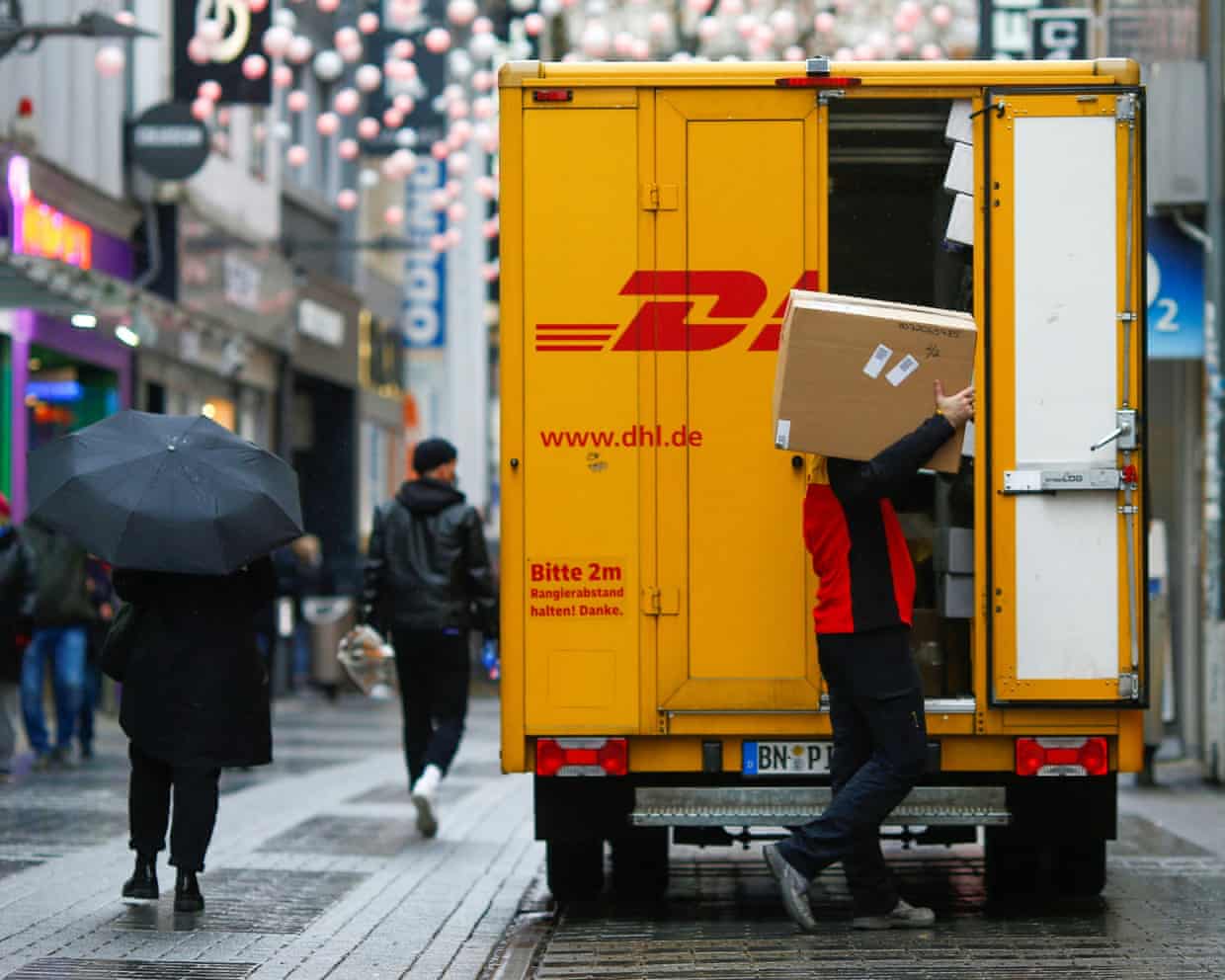
Shares in trucking and logistics firms plunge after AI freight tool launch
Shares in trucking and logistics companies have plunged as the sector became the latest to be targeted by investors fearful that new artificial intelligence tools could slash demand.A new tool launched by Algorhythm Holdings, a former maker of in-car karaoke systems turned AI company with a market capitalisation of just $6m (£4.4m), sparked a sell-off on Thursday that made the logistics industry the latest victim of AI jitters that have already rocked listed companies operating in the software and real estate sectors.The announcement about the performance capability of Algorhythm’s SemiCab platform, which it claimed was helping customers scale freight volumes by 300% to 400% without having to increase headcount, sparked an almost 30% surge in the company’s share price on Thursday.However, the impact of the announcement sent the Russell 3000 Trucking Index – which tracks shares in the US trucking sector – down 6

Anthropic raises $30bn in latest round, valuing Claude bot maker at $380bn
Anthropic, the US AI startup behind the Claude chatbot, has raised $30bn (£22bn) in a funding round that more than doubled its valuation to $380bn.The company’s previous funding round in September achieved a value of $183bn, with further improvements in the technology since then spurring even greater investor interest.The fundraising was announced amid a series of stock market moves against industries that face disruption from the latest models, including software, trucking and logistics, wealth management and commercial property services.The funding round, led by the Singapore sovereign wealth fund GIC and the hedge fund Coatue Management, is among the largest private fundraising deals on record.“Anthropic is the clear category leader in enterprise AI,” said Choo Yong Cheen, the chief investment officer of private equity at GIC

How to deal with the “Claude crash”: Relx should keep buying back shares, then buy more | Nils Pratley
As the FTSE 100 index bobs along close to all-time highs, it is easy to miss the quiet share price crash in one corner of the market. It’s got a name – the “Claude crash”, referencing the plug-in legal products added by the AI firm Anthropic to its Claude Cowork office assistant.This launch, or so you would think from the panicked stock market reaction in the past few weeks, marks the moment when the AI revolution rips chunks out of some of the UK’s biggest public companies – those in the dull but successful “data” game, including Relx, the London Stock Exchange Group, Experian, Sage and Informa.Relx, the former Reed Elsevier, whose brands include the Lancet and LexisNexis, is the most intriguing in that list. The company’s description of itself contains at least five words to provoke a yawn – “a global provider of information-based analytics and decision tools for professional and business customers” – but the pre-Claude share price was a thing of wonder

Winter Olympics 2026: Klæbo seals golden treble; Italy’s Passler to compete despite positive test – live
Klaebo is now the joint most decorated Winter Olympian in history! And there are three more chances of gold to come, in the men’s relay, men’s team sprint and 50k marathon.France’s Mathis wins silver, and Einar Hedegart bronze. Britain’s Andrew Musgrave finishes a fantastic sixth, bare arms and all.Men’s ice hockey: A couple of games are underway on the rink. Finland are 2-0 up against their Scandi rivals Sweden, while it’s 0-0 between Italy and Slovakia

Olympic chiefs have got it badly wrong over Heraskevych ban and owe him an apology | Lizzy Yarnold
I’m deeply saddened by the IOC banning skeleton athlete Vladyslav Heraskevych from the Winter Olympics. His helmet depicting images of athletes and children who died in Russia’s invasion of Ukraine, some who he knew personally, was a human display of remembrance. The IOC’s response was not an appropriate one.One only needed to look at the image of Heraskevych’s father when he was told the news of his son’s disqualification – doubled over with his head in his hands – to know the emotional toll. I cannot imagine what they are experiencing but, as both a former athlete and a just a fan watching on, I also feel emotional about it and cried when both Vlad and his dad messaged me on social media to say thank you for my messages of support

Paul Thwaite seals largest payout for NatWest CEO since disgraced Fred Goodwin in 2006
Tony Blair’s oil lobbying is a misleading rehash of fossil fuel industry spin

Share values of property services firms tumble over fears of AI disruption

Elon Musk posted about race almost every day in January
MLR leaders hail players union deal as US league heads for six-team season

From the foul line to the fault line: Deni Avdija, Israel and the collapse of online nuance