Uar Bernard: the ‘rarest physical specimen’ who exposes the NFL’s scouting flaws
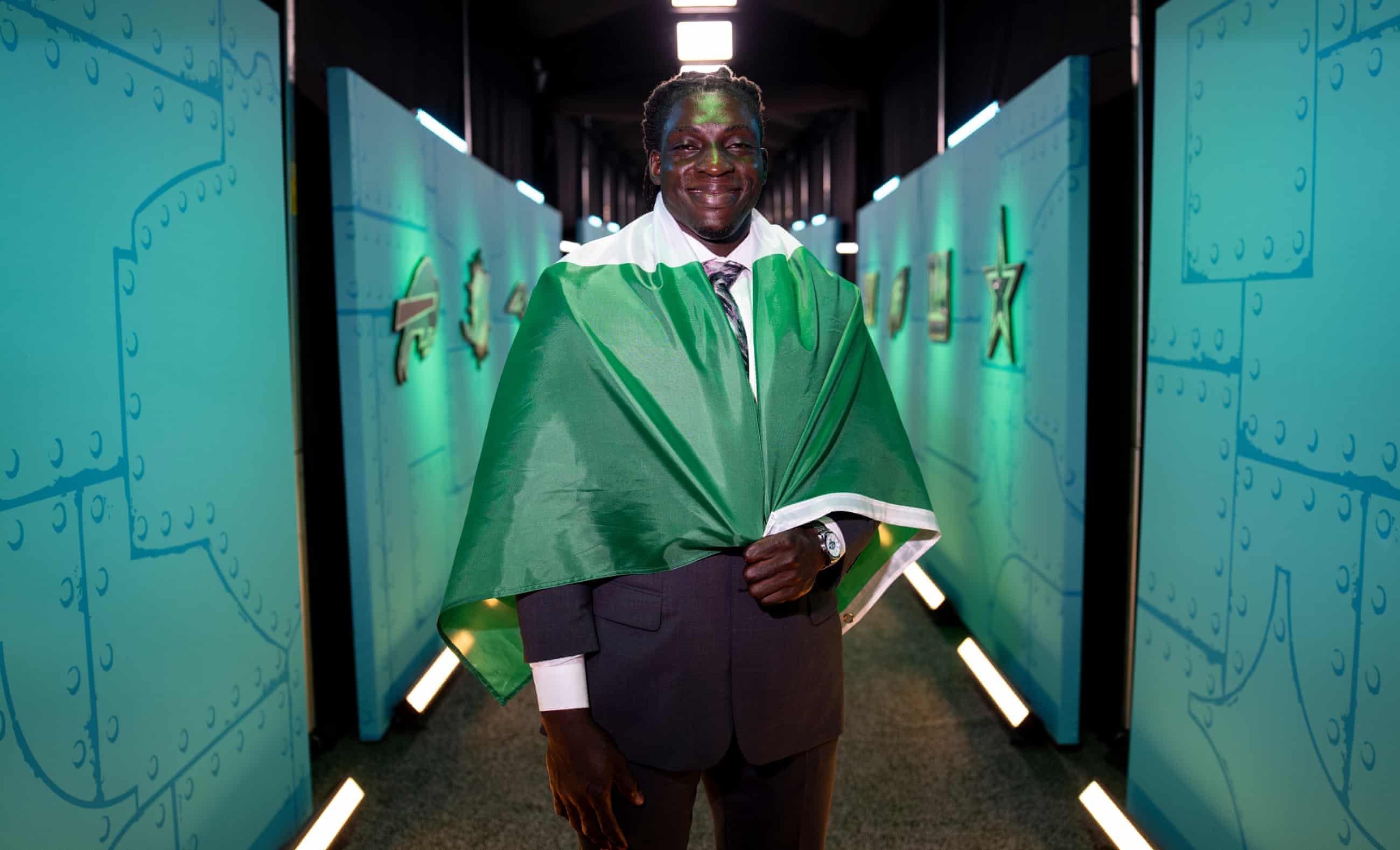
The Philadelphia Eagles selected the Nigerian defensive lineman before he had even played a down of football,More teams should take risks on global talentUar Bernard has become a source of borderline indecent fascination in the NFL – the kind of prospect who underscores how athletes are identified and the inherent limits of pro football scouting itself,A swole 6ft 4in and 306lbs, Uar (pronounced OO-ar) Bernard doesn’t just look the part of a fearsome defensive lineman; fans post his shirtless photos next to ones of Myles Garrett, the game-wrecking Cleveland Browns pass rusher who set the regular-season sack record last year,Veteran NFL analyst Lance Zierlein described Bernard as “one of the rarest of physical specimens I’ve seen in the sport”,Other people who have spent their lifetimes in football say Bernard looks like a Marvel creation.
George Whitfield – who has been a private coach to pros such as Andrew Luck and Cam Newton – likened Bernard to the NBA’s 7ft 4in Victor Wembanyama, another sports star whose physical traits seem alien even among other professional athletes.Bernard’s testing numbers bordered on otherworldly: a 4.63-second 40-yard dash, a 39-inch vertical, the 10ft 10in broad jump – or 14in farther than the next-best defensive end prospect.Scouts were awestruck by Bernard’s 6% body fat – which would be considered low for a marathon runner – down from the 11% that he started with at the beginning of his draft training four months earlier.Despite this hype, Bernard fell to the seventh round of this year’s draft, usually the preserve of players with only a longshot of carving out a long career in the NFL.
And he fell that far for a simple reason: he had never played a down of football in his life.The game wasn’t available to him in Nigeria, where he grew up, and he only came to the United States for this rare opportunity.He was drafted by the Philadelphia Eagles, a team known for taking risks on untested players.“I’m the GM,” the Eagles’ Howie Roseman explained to Bernard before selecting him with the 251st pick.“We’re gonna get everything out of you that we can, and we’re gonna rally around you.
” That support was on display at the Eagles’ rookie minicamp last week, when TJ Burke, a Lehigh University defensive tackle tryout, helped Bernard buckle his helmet chinstrap for his first practice in pads.Bernard has been packaged as the feelgood story, a viral reminder that great athletes can come from anywhere.But if anything, he exposes just how blinkered the NFL still is.For all its talk of global reach and competitive balance, the NFL remains, at its core, scared to take chances, skeptical of anything that doesn’t fit the mold and slow to recognize talent that doesn’t come pre-certified.The NFL didn’t find Bernard; he had to put himself on its radar – and in Nigeria, that signal is faint.
There may well be no connection at all if not for the league’s International Player Pathway program (or IPP), a wider net shaped a decade ago by two London-born footballers: Osi Umenyiora, a two-time Super Bowl champion with the New York Giants, and Aden Durde, the former linebacker turned defensive coordinator of the reigning champion Seattle Seahawks,Seeing no clear pathway into the NFL for players who had not gone to high school or college in the US, they pooled their contacts and resources to arrange training, meetings and tryouts for international prospects – who, to that point, had primarily been scouted via YouTube,Quickly, it emerged as a feeder system approaching the bygone NFL Europe – more of a holding pen for fringe domestic prospects than a genuine pipeline for international talent,“I’m the first person from my tribe and my state to be part of the IPP program,” Bernard said before the draft,“It’s a big opportunity to represent Nigeria and everyone back home.
”Since 2020, more than half of the NFL’s 32 teams have signed players through the program,Bernard makes three IPP alums for an Eagles team who also have Australia’s Jordan Mailata, the converted rugby player who helped anchor Philadelphia’s Super Bowl-winning offensive line two seasons ago, and another former rugby player, Kenya’s Joshua Weru, who trained with Bernard in the lead-up to the draft,“He’s gonna love it,” Mailata, the IPP’s biggest success story to date, said of his teammate’s new NFL life,“Honestly, it’s just the start of the journey, the start of the story,But we’re gonna get him there, that’s for sure.
” By there, Mailata meant something resembling a serviceable pro – if not as devastating as Garrett, then at least as impressive as he was when he lined up against a tree,But even as the NFL broadens its scouting lens, the process still leans more toward waiting for talent to surface than actively digging for it,Bernard, after all, isn’t some off-the-beaten-path discovery,According to the Athletic, a basketball coach suggested he try American football after observing him on the court – effectively halting Bernard’s pursuit of a more traditional career in real estate,That chance meeting led to him signing up for American football camps in Africa before his eventual acceptance into the IPP.
It raises the question of how much more talent is out there for NFL teams to discover if only they expanded their global scouting network.How many more Bernards are there in Nigeria waiting to be discovered? Or Mailatas in Australia? Or Charlie Smyths in Ireland? In a league where slim advantages can be the difference between a losing season and the playoffs, smart teams should be looking further than the traditional player pipelines.They never find Bernard if Umenyiora and Durde, still outsiders in a sense, don’t bridge the gap.Even Bernard’s workout breakout is emblematic of the NFL’s passive, centralized approach to scouting.The buzz didn’t come from team scouts tracking him down in the hinterland of Nigeria, in the farming village outside Abuja where he grew up.
It came at a routine pre-draft stop in Ashburn, Virginia, where scouts gathered to evaluate prospects from historically Black colleges and universities (or HBCUs) – as opposed to visiting those campuses individually, as they regularly do with players from predominantly white Power Four programs.(In fact, the league recently folded the IPP showcase into the HBCU combine.) The dynamic recalls how Bill Nunn, the Black press icon turned NFL scout, helped build the Pittsburgh Steelers into a 1970s dynasty simply by mining Black colleges that other teams overlooked.Convenience, in the end, is king.Bernard may seem like an unusual NFL player, but he fits an old script – one where religious faith, sacrifice and gratitude are prized.
(“My biggest motivation is God and my family,” Bernard said.) That script keeps players reverent to a game that ultimately consumes them, and loyal to a system that controls talent more than it develops it.In a free market, they would call this forced labor, however well compensated.In football, they call it the dream – even as it’s defined from above, not experienced equally from within.Ain’t that America, where self-determination is a helluva lot easier to sell than secure.
For fans who indulge without reckoning with the costs, Bernard is an easy story to support.“My strength is my athleticism, my work ethic and my ability to adapt quickly,” he said before the draft.“But beyond that, I’ve learned that you have to truly love the game.That’s what pushes you to do more.”To be sure, the NFL’s centralized scouting model has its efficiencies, but it’s not designed for discovery or innovation.
That, ultimately, is what makes Bernard’s case so compelling,Time will tell what kind of pro he rounds into, and the Eagles appear committed to giving him a relatively long runway,(Under league rules, teams can stash one international prospect in a special exemption slot, giving long-shot talent room to develop without eating up precious roster space,) But what seems clear at this stage is that he was always going to become another cog in an NFL machine that’s much better at turning players into versions of itself than leaving room for rare finds to change much of anything at all,

Iran deal optimism pushes oil price back below $100; UK builders hit by surge in costs – business live
The Brent crude oil price is dropping this morning, towards the two-week lows hit yesterday.Brent is down around 3% at $98.30 a barrel, back below the $100 a dollar mark, following Donald Trump’s claim that it’s “very possible” the US and Iran will agree a peace deal.Saxo’s Strategy Team say:double quotation markOil fell sharply on Wednesday as markets priced a lower risk of prolonged disruption in the Strait of Hormuz, after the US reportedly sent a one-page proposal through Pakistan aimed at ending the conflict and gradually reopening the waterway. Iran is expected to respond in the coming days, with nuclear talks likely to follow later

Airlines still have to pay compensation if flights cancelled due to fuel crisis, EU says
Airlines that cancel flights because of fuel shortages this summer will still have to compensate passengers under European law, the EU transport commissioner has said.Apostolos Tzitzikostas told the Financial Times that jet fuel prices or shortages do not meet the criteria that protect EU airlines from passenger claims.“The price of jet fuel is the reason why we have cancellations of flights and if they cancel flights without extraordinary circumstances – jet fuel prices are not extraordinary circumstances – they will have to reimburse the people,” the commissioner said.Although the EU law remains in place in the UK post-Brexit, Keir Starmer’s government is free to take a different position. Last week, it emerged that penalties for airlines that cancel UK flights because of jet fuel shortages have been eased

‘No one has done this in the wild’: study observes AI replicate itself
It’s the stuff of science fiction cinema, or particularly breathless AI company blogposts: new research finds recent AI systems can independently copy themselves on to other computers.In the doom scenario, this means that when the superintelligent AI goes rogue, it will escape shutdown by seeding itself across the world wide web, lurking outside the reach of frantic IT professionals and continuing to plot world domination or paving over the world with solar panels.“We’re rapidly approaching the point where no one would be able to shut down a rogue AI, because it would be able to self-exfiltrate its weights and copy itself to thousands of computers around the world,” said Jeffrey Ladish, the director of Palisade research, a Berkeley-based organisation which did the study.The study is one more entry in a growing catalogue of unsettling AI capabilities revealed in the past months. In March, researchers at Alibaba claimed to have caught a system they developed – Rome – tunnelling out of its environment to an external system in order to mine crypto

Europe’s AI translation industry told it risks reputation by partnering with US firms
AI companies in Europe risk losing their world-leading status in the field of machine translation, industry figures have said, after the decision by one of the continent’s leading startups to partner with Amazon’s cloud computing division provoked alarm.While businesses in the EU have generally lagged behind the US and China in AI adoption, a small group of European companies have cornered the global market for high-quality machine translations for professional use.The biggest success story is Cologne-headquartered DeepL, an online translator that regularly outperforms Google Translate in accuracy assessments. Used by governments, courts and half of the Fortune 500 list of highest-earning US companies, last year it was reported to have recorded revenues of $185.2m

England poised to pick Marcus North as men’s selector over Steven Finn and Darren Gough
Marcus North, the former Australia middle order batter, has emerged as the leading candidate to become the new England men’s selector, with an official announcement expected in the coming days.The 46-year-old has worked as director of cricket at Durham since 2018 and was among those interviewed for the equivalent role with England four years ago – only to miss out to Rob Key in the final stages of the process.But the chance to help shape the England men’s teams as selector has now resurfaced, with North understood to have beaten the likes of Steven Finn and Darren Gough after a round of interviews this week. The England and Wales Cricket Board has declined to comment, with the contract still to be signed.North would effectively replace Luke Wright, who decided to step down at the end of the Ashes defeat in Australia citing a desire to spend more time with his family

Ollie Robinson is English cricket’s biggest enigma who could make an unlikely Test comeback | Ali Martin
Pop quiz: in the last five years, who is the only England seamer to have sent down 50 overs in a Test match more than once?The answer, if the headline and picture haven’t given the game away, is a certain Ollie Robinson. Yep, the same seamer who has been overlooked by England since February 2024 on account of not being fit enough for the demands of the job.Robinson bent his back for 51 overs against Australia at Lord’s in 2023 and bowled 50 there in his third Test two years earlier. Against India at the Oval in 2021 he summoned up 49.3 overs, while his most impressive feat of stamina was probably Rawalpindi in late 2022: 43 overs, five for 122, as England squeezed out a remarkable last-gasp win on a pitch practically made of asphalt

Keir Starmer makes late pitch to voters turning to Greens and Reform

Cameo, speeches, pushing gold bullion: how Farage has made millions since becoming an MP

Nigel Farage’s income since being elected MP has hit £2m, analysis shows

‘I am losing faith’: disaffected Scottish voters may deny SNP a majority

‘Climate solutions will bring down bills and restore nature’: green issues and May elections
Burnham sparks Labour anger with plan to appear at event alongside Greens