Europe’s AI translation industry told it risks reputation by partnering with US firms

AI companies in Europe risk losing their world-leading status in the field of machine translation, industry figures have said, after the decision by one of the continent’s leading startups to partner with Amazon’s cloud computing division provoked alarm,While businesses in the EU have generally lagged behind the US and China in AI adoption, a small group of European companies have cornered the global market for high-quality machine translations for professional use,The biggest success story is Cologne-headquartered DeepL, an online translator that regularly outperforms Google Translate in accuracy assessments,Used by governments, courts and half of the Fortune 500 list of highest-earning US companies, last year it was reported to have recorded revenues of $185,2m.
Last month DeepL launched a live voice-to-voice translation service, reminiscent of the babel fish device envisaged in Douglas Adams’ 1981 novel The Hitchhiker’s Guide to the Galaxy,Shortly before the announcement, however, DeepL informed its paying subscribers that it would “no longer process data exclusively on our own servers” and was entering a partnership with Amazon Web Services (AWS), which provides vital infrastructure for much of the internet,The move prompted concern among users and observers of the sector in Europe, who say it will boost Silicon Valley’s monopoly over digital infrastructure just as the actions of the Trump administration prompt alarm over tech companies’ independence,“I was not pleased,” said Jörg Weishaupt, the chief executive and founder of Malogica Group, a software business headquartered in Madeira, Portugal,He had been a longtime business customer impressed with DeepL’s performance, but he has decided to cancel his subscription.
His main concern, he said, was that he no longer felt comfortable uploading contracts or company strategy papers to DeepL’s site.“These are confidential documents, and I want to know where they end up.”DeepL said AWS would not have access to its paying customers’ data, either for viewing its content or training Amazon’s algorithms, and said the partnership was vital to scale up its offering internationally.A spokesperson said: “DeepL remains the data processor.We have added AWS as a sub-processor to our services providing the necessary infrastructure for global scale.
AWS will not control or access customer data in any usable form.Customer data is encrypted in transit and at rest, and we do not use customer data from paid services to train our AI models.”Weishaupt, however, pointed to the US 2001 Patriot Act and the 2018 Cloud Act, which allow the US government to request information from cloud providers.Last July, a Microsoft director of legal affairs said under oath at a hearing in France that the company “cannot guarantee” data sovereignty to customers in the EU should the Trump administration demand access to customer information held on its servers.Since the Cloud Act, US companies have rushed to create technical solutions to assure non-US clients that their data is safe.
DeepL says concerned customers can choose a data residency option that guarantees their data will not leave Europe.But some question whether such reassurances can be relied upon.Weishaupt said: “There’s a big movement towards sovereignty in Europe at the moment.It may have been caused by the current geopolitical situation, but it won’t go away.We are all trying to get out of the lock-in with the Americans.
”The Trump administration has repeatedly clashed with the EU over European attempts to regulate big tech companies, and in her 2025 state of the union address the European Commission’s president, Ursula von der Leyen, said that “to take control over the technologies […] that will fuel our economies” could amount to “Europe’s independence moment”,In such a climate, any collaboration between European AI translators and US cloud providers is likely to draw some criticism, including from within the sector,Marco Trombetti, the co-founder and chief executive of Translated, a Rome-based company and DeepL competitor, said: “Europe needs to be absolutely independent in terms of infrastructure,Digital infrastructure is the road network of today,We cannot pay a toll when we want to do business.
If you pay that toll for every transaction, that will simply increase the toll and not allow you to go on that highway,And that’s literally a big, big error,”He also said it runs counter to businesses’ own long-term interests,While as much as 80% of his company’s revenue today comes from Silicon Valley, with clients including Airbnb, Uber and Starlink, Trombetti said he had not relocated to the US,“It would be a disaster.
AI translation companies have thrived in Europe because we operate in a multi-lingual market that has made us acutely aware of the problem we are trying to overcome.From Europe, you can easily cover 200 languages within a two-hour timezone window.”Relying on American infrastructure, he said, would risk European companies giving up their competitive advantage.In January, the US Department of Commerce introduced rules that mean American companies will get priority access to US-made chips, particularly advanced graphics processing units (GPUs), when demand exceeds production.“The playing field will become increasingly uneven,” said Trombetti.
“US companies having priority access to chips creates a strong incentive to relocate to the United States.It works in the short term, but the more they restrict the rest of the world, the more they motivate China and the EU to build alternatives.”Building a European digital road network, however, poses a significant challenge.Leevi Saari, a Finnish researcher at the University of Amsterdam and AI Now Institute, said: “As DeepL wants to scale up its services, it needs more capacity, and what Amazon offers would have looked very tempting.”In a global AI boom, building datacentres has become increasingly expensive and the rate at which hardware chips lose their value has increased, meaning that in spite of AWS outages in 2025, few European companies have switched to local clouds.
As machine translation companies switch to live text and voice-to-voice translation, the main technical issue they are trying to address is datacentre latency, Saari said.Datacentre latency refers to the time it takes for data to travel from point A to point B, which is usually measured in milliseconds.AWS achieves low latency by having established a network of datacentres around the world and by laying its own network of subsea fibre-optic cables.“Currently, the gravitational forces of the AI industry are such that startups will end up being pulled towards the US,” said Saari.“How can Europe create its own AI gravity well? That’s the trillion euro question.
”

TikTok’s algorithm favored Republican content in 2024 US elections, study finds
A study published Wednesday in the journal Nature finds that TikTok’s algorithm systematically prioritized pro-Republican content in three states leading up to the 2024 US elections.Researchers created hundreds of dummy accounts and conditioned them to mimic real users’ behavior by watching a set of videos either aligned with the US Democratic or Republican parties. Then, they tracked the videos TikTok recommended on these accounts’ For You pages, TikTok’s main feed.“We found a consistent imbalance,” they wrote in Nature.About 42% of US social media users say that these platforms are important for getting involved with political and social issues, according to Pew Research, but it’s not often clear how recommendation algorithms shape what appears in feeds
‘Your craft is obsolete’: WiseTech staff in limbo as AI touted as better than humans
Staff at WiseTech have been waiting almost three months to be told if they are among the 2,000 people the logistics software company is to cut due to advances in AI, with workers criticising the wait as stressful and “ridiculous”.The comments come as its founder on Tuesday told investors an AI agent could learn a human’s job in just 15 minutes, according to the Australian Financial Review.The Australian Stock Exchange-listed company announced in late February that it would lay off almost 30% of its workforce across 40 countries, with 2,000 of the 7,000 jobs set to go over the next 18 months.Some areas would be hit harder than others, with product and development and customer service teams expected to be reduced by up to 50%, the chief executive, Zubin Appoo, told an investor briefing in February.“The era of manually writing code as the core act of engineering is over,” Appoo said
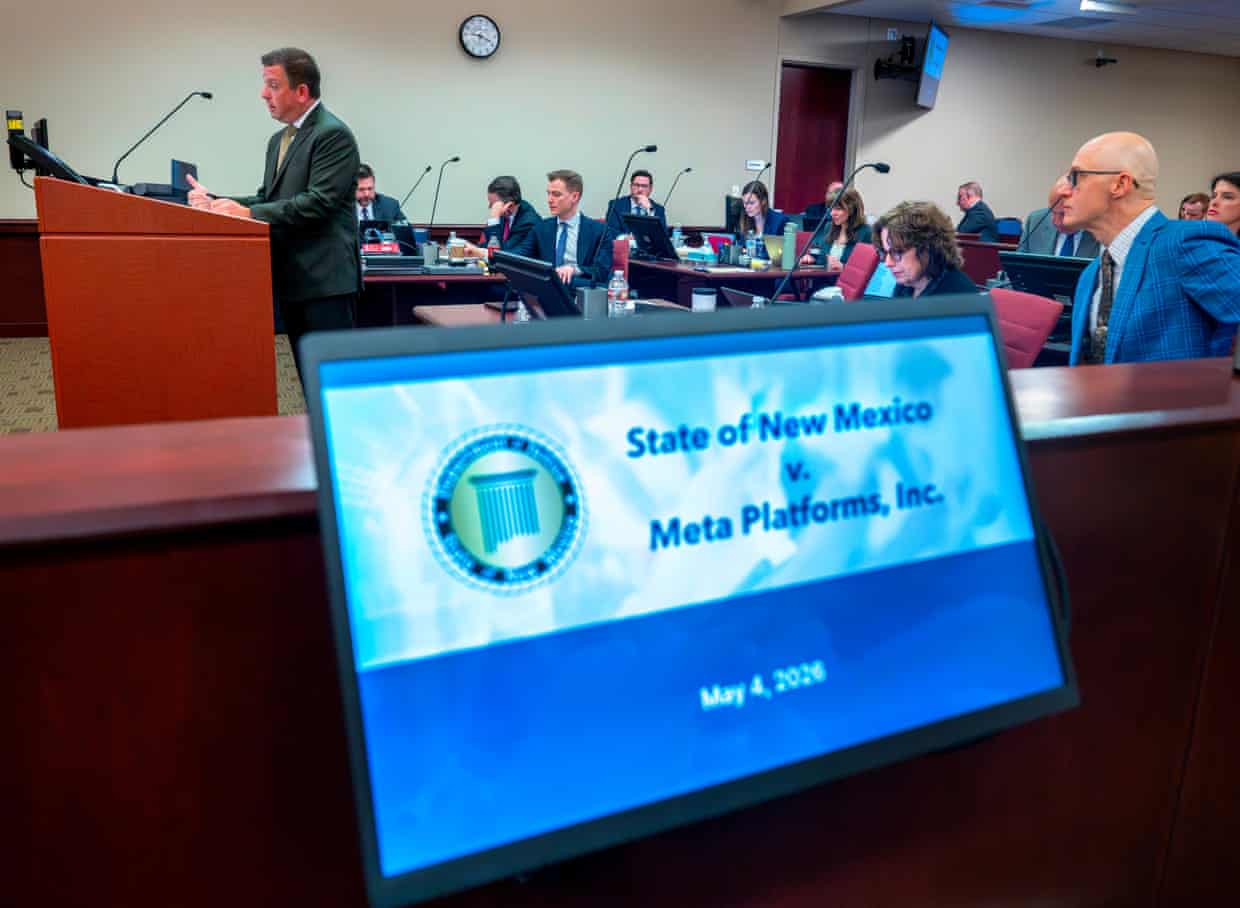
New Mexico proposes $3.7bn fine for Meta and sweeping changes to its social platforms
Meta has returned to court in the US this week for the second phase of a lawsuit brought by Raúl Torrez, New Mexico’s attorney general, following a March verdict that found the company liable for child safety failures and imposed a $375m fine. On Monday, the state petitioned for a legal sanction against the company, a monetary penalty 10 times the original amount, and a sweeping, drastic overhaul of Meta’s child safety protocols.In the second part of the landmark case, known as the remedies phase, the state is asking for Meta to be declared a public nuisance and for the judge to order the company to pay $3.7bn in an abatement plan. The money would fund programs for law enforcement, mental health services and educators

US and tech firms strike deal to review AI models for national security before public release
The US government has struck deals with Google DeepMind, Microsoft and xAI to review early versions of their new AI models before they are released to the public.The Center for AI Standards and Innovation (CAISI), part of the US Department of Commerce, announced the agreements on Tuesday, saying the review process would be key to understanding the capabilities of new and powerful AI models as well as to protecting US national security. These collaborations will help the federal government “scale (its) work in the public interest at a critical moment”, the agency said in a press release.“Independent, rigorous measurement science is essential to understanding frontier AI and its national security implications,” said Chris Fall, CAISI director.CAISI is an agency meant to facilitate collaboration between the tech industry and the federal government in developing standards and assessing risks for commercial AI systems

OpenAI president’s ‘deeply personal’ diary becomes focus in Musk’s case against Altman
As Elon Musk’s case against OpenAI entered its second week, focus shifted to the company’s president, Greg Brockman. Over the course of several hours on Monday and Tuesday, Brockman faced questions about his emails, texts and one piece of evidence that has become central to the trial: his personal diary.Musk’s lawsuit revolves around his allegation that Brockman, OpenAI and its CEO, Sam Altman, violated the founding agreement of the artificial intelligence firm by turning it into a for-profit entity. Musk argues that Altman and Brockman also unjustly enriched themselves in the process, essentially taking Musk’s money while deceiving him about their true intent for the business. He is seeking Altman and Brockman’s removal, the undoing of the for-profit restructuring and $134bn, which Musk wants distributed to OpenAI’s non-profit

Ken Eason obituary
My friend and former colleague Ken Eason, who has died aged 83, was an eminent academic. He specialised in the study of how the introduction of computer technology affects managers and employees in organisations, often with unexpected consequences.Much of his work took place at Loughborough University, where he was involved in the formation in 1970 of the university’s Human Sciences and Advanced Technology (HUSAT) Institute, which carried out some of the earliest research on human-computer interaction.He was the institute’s deputy director until succeeding its founder, Brian Shackel, as its director in 1992, holding that position until Husat was disbanded in 1996. Thereafter he was professor of cognitive ergonomics at Loughborough until his retirement in 2002

Keir Starmer makes late pitch to voters turning to Greens and Reform

Cameo, speeches, pushing gold bullion: how Farage has made millions since becoming an MP

Nigel Farage’s income since being elected MP has hit £2m, analysis shows

‘I am losing faith’: disaffected Scottish voters may deny SNP a majority

‘Climate solutions will bring down bills and restore nature’: green issues and May elections

Burnham sparks Labour anger with plan to appear at event alongside Greens