Robo athletes miss the point of sport – there is no drama without emotion | Emma John
It hurts to miss an unmarked shot in basketball,And it certainly seemed to pain the Alvark Tokyo shooter, halfway through April’s Japanese league game against Shimane Susanoo Magic,As the ball bounded off the rim, the player wheeled away, head lowered, eyes downcast,The disappointment looked glaringly real,Which is interesting, because it was not.
The player could not have cared less.They literally could not care at all, and not just because this was a half-time exhibition.It was because they were a robot, created by Alvark Tokyo’s team sponsor, Toyota.CUE7 is not the first AI-powered b-baller, but it is the coolest-looking so far.At 7ft 2in, it wears the team kit well, gliding easily around the court with wheels for feet and hoops for hands.
Red, jointed limbs sport a metallic sheen that might, on a human, be sweat,Alongside a cyclops-style eye, the cameras that help guide its movements have been fashioned into deeply familiar features, like the LeBron James-style beard and headband,Its look and its movements are recognisable enough that it is impossible to watch it line up at the foul line without a twinge of anticipation,Is Big Red going to make the shot? Even when watching a highly edited clip, I found myself anthropomorphising the robot so quickly that I felt a guilty horror when I saw him – it, dammit, it – being hoisted away at the end of the demo by a crane,No athlete should suffer so undignified an exit from the arena.
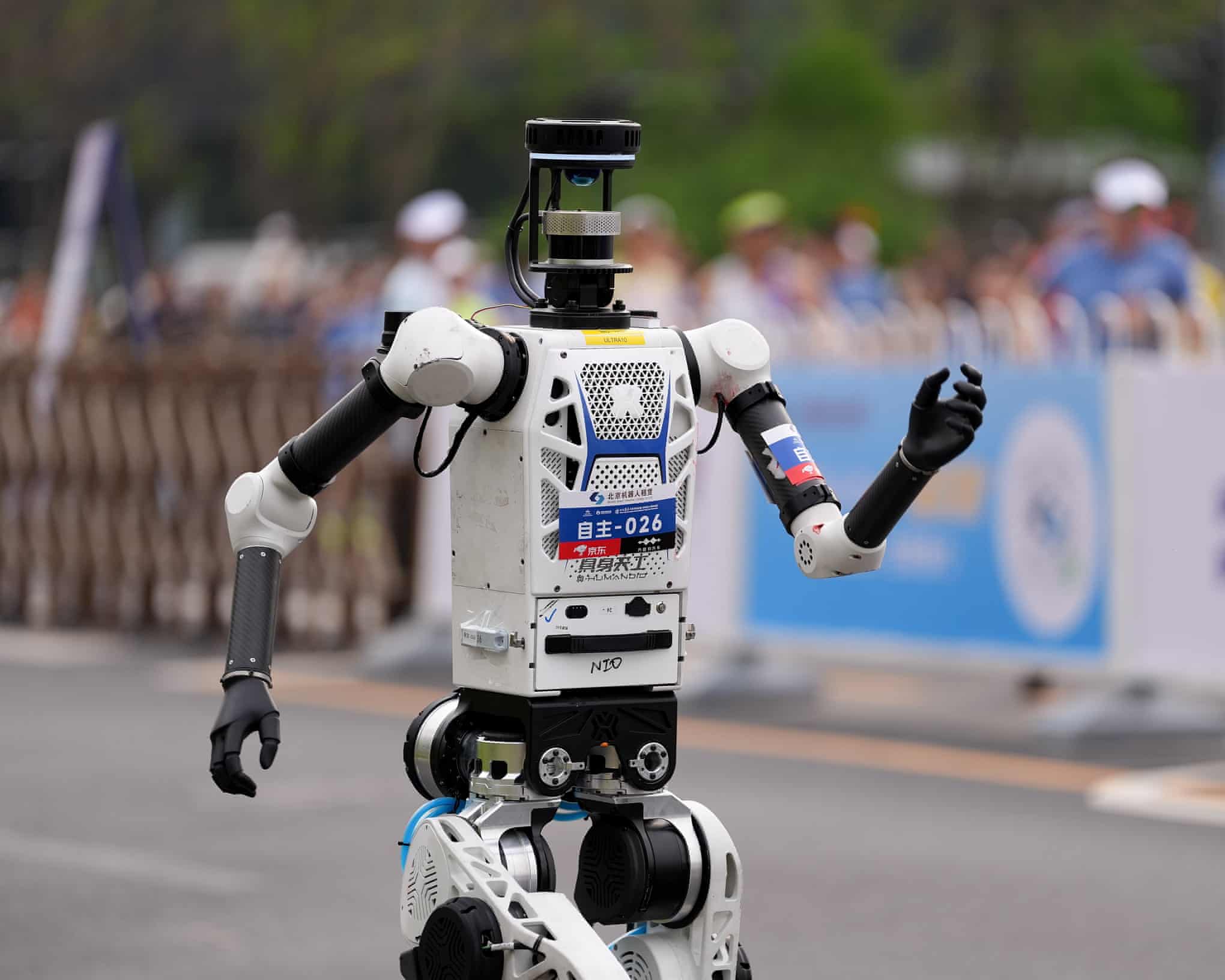
For anyone who has never contemplated the rising dawn of robot athletes, the past two weeks may come as a shock.Just a few days before CUE7 made its debut, the Beijing half-marathon saw humans and robots running the course together, albeit in separate lanes.This is the second consecutive year the experiment has been tried: in 2025, several of the non-human competitors struggled to get away from the start line, and most failed to finish.The winning robot, Tiangong, which needed its battery replaced three times around the course, finished in 2hr 40min, twice as long as the quickest man.Last month’s results, then, are a miracle of technological advancement (or, depending on your outlook, yet another death knell for humanity).
All three robots on the podium beat the current world record, set in Lisbon in March by Jacob Kiplimo.Kiplimo ran 57:20; Lightning, a robot created by smartphone manufacturer Honor, was nearly seven minutes faster in Beijing.Once, we could comfort ourselves that however good machines were at, say, chess, they could never mimic the super-fast physical reactions that occur so naturally and instinctively in a human athlete.Now, thanks to advances in AI, they can.Only a week ago, Sony AI shared footage of their table tennis-playing robot, Ace, winning three out of five matches against elite players.
Ace is not the kind of athlete anyone is putting on a magazine cover soon.There is nothing humanoid about its appearance at all – it is a robotic arm on a moving platform that looks like it manufactures cars in its spare time.While short clips of Ace in action against the professionals are diverting enough, it is hard to imagine a future where people tune in en masse for the spectacle.But that is not the ultimate goal of sporting robots, say the experts: their value will be in training flesh-and-blood sportspeople.To date, sporting history bears out the argument.
Bowling machines may be more consistently accurate, and capable of faster speeds, than the best paceman on your cricket team, but no one has changed the laws to include one in a team yet.Ever since Deep Blue beat the world champion Garry Kasparov exactly three decades ago, computers that can easily beat humans have established their place in chess as training companions.And Ace has already proved its worth in that regard: a former Olympian, watching the footage, saw it play a shot he had previously thought impossible.The development of sports-playing robots generally is not about sport at all – rather, it is a focus for research and development in the wider scientific field.RoboCup, the annual football tournament which celebrates its 30th anniversary this year, aims to develop robots capable of beating the World Cup winners by 2050.
The average football fan may consider that ambitious: in last year’s final, the half-height humanoids stamped around the pitch at walking pace, shuffling up to the ball and occasionally falling flat on their face,But whether RoboCup achieves its goal or not, the tech it has inspired is already benefiting society from search and rescue operations to Amazon warehouses,There are plenty more sports that robots are already being taught to play, from badminton to pool, archery to martial arts, skiing to parkour (there is also a Tesla machine that does yoga, although what it gets out of it is unclear),But even some of those most invested are realistic about the more general appeal,Peter Stone, chief scientist at Sony AI and a former president of RoboCup, has said that after the initial “buzz” of robots achieving or surpassing human skills, “it tends to get less interesting” to the public.
Fundamentally, the philosophical question of what meaning there might be in any theoretical future contests between machines and humans remains unanswered.For humans, sport is a physical and mental trial, an effort of body and will.What pleasure can be had watching the exchange of shots or blows between contestants that experience no nerves, fatigue, or elation?Which brings me back to CUE7’s on-court miscue.One of its older siblings – a 2019 incarnation named CUE3 – set a world record when it shot 2,020 consecutive free throws over six and a half hours.Perfect scores might be impressive, but they are also fundamentally dull.
Perhaps with that miss last month, sporting AI learned its most valuable lesson yet.Do you have an opinion on the issues raised in this article? If you would like to submit a response of up to 300 words by email to be considered for publication in our letters section, please click here.

MPs accuse South East Water leaders of incompetence over repeated outages
MPs have accused the leadership of South East Water of incompetence over repeated water outages for tens of thousands of customers in a damning report, and expressed no confidence in their ability to reform the company.After publication of the report, SEW announced the resignation of its independent non-executive chair, Chris Train, saying new leadership was needed to “oversee a critical period of positive, transformative change”.MPs from across the political spectrum said David Hinton, SEW’s chief executive, and the board of directors operated a culture of unaccountability at the company, which provides drinking water for 2.3 million customers in Berkshire, Hampshire, Kent, Surrey and Sussex.SEW describes its leadership in official communications as having a “family feel”, but the environment, food and rural affairs committee of MPs said they were better described as “an unaccountable clique”

Claire’s expected to return to UK high streets with about 50 stores from June
The jewellery and accessories chain Claire’s is expected to return to UK high streets with about 50 stores to be reopened from June onwards by the operator of its shops in France, Austria, Portugal and Spain.Julien Jarjoura, the French entrepreneur behind jewellery company Une Ligne, which sells online and via museum stores including the Louvre and the Palace of Versailles, said he had the blessing of the US owner of the Claire’s brand, Ames Watson, to open stores in the UK and was signing new leases with UK landlords.The plans emerged just days after the chain closed its final UK stores with the loss of more than 1,000 jobs and ending three decades on British high streets.“I feel so sad when I see such a nice business going down,” Jarjoura told the Guardian. “The brand was basically dead and we’re bringing it back to life

Iran war may cause food shortages in Africa, world’s largest fertiliser firm says
The Iran war could have “dramatic consequences”, causing food shortages and price rises in some of Africa’s poorest and most vulnerable communities, the head of the world’s largest fertiliser company has said.Svein Tore Holsether, the chief executive of Yara International, said world leaders needed to guard against soaring prices and shortages of fertiliser causing a de facto global auction that would leave the poorest countries, particularly in Africa, scrambling for supplies they could ill afford.“The most important thing we can do now is raise the alarm on what we are seeing right now – that there is a risk of a global auction on fertiliser that means it becomes unaffordable for those most vulnerable,” he said.“Africa is actually quite well positioned to be a major food producer, not only for self-sufficiency, but even for exports to the rest of the world, but the reality is that they are massive food importers.“But we need to be aware in this part of the world of the potential consequences that if we get to a global auction on food, there will not be a famine in Europe – but we need to be aware of who we are taking the food away from

If you’re not Thames, the water looks lovely for investors | Nils Pratley
Thames Water, with occasional cameos by ugly little siblings Southern Water and South East Water, grabs most of the attention in the sector for obvious reasons. So it’s easy to overlook what’s happening further north. Short answer: the new era of higher bills and higher spending on water infrastructure will feel splendid if you’re United Utilities, licence-holder in north-west England, or Severn Trent, operating in the Midlands.The former’s share price surged 11% on Thursday, the sort of thing that shouldn’t happen at a utility where success is meant to be defined in terms of dull predictability. And it’s definitely unusual to see a one-day valuation jump of that size when the company is issuing £800m-worth of new shares

Bank of England warns ‘higher inflation unavoidable’ after holding interest rates
The Bank of England has left interest rates unchanged at 3.75% but said the UK may need to brace for increases later this year, as “higher inflation is unavoidable” as a result of the war in the Middle East.The Bank’s rate-setting monetary policy committee (MPC) voted to leave borrowing costs on hold, but said that if energy costs stayed persistently high it might have to take a more “forceful” response to keep inflation under control.The nine-member MPC was split 8-1 in its decision to keep borrowing costs on hold for the third consecutive meeting.Andrew Bailey, the governor of the Bank of England, said: “Where we go from here will depend on the size and duration of the shock to energy prices” as the conflict in the Middle East evolves

The chips are down: pizza, fried chicken and doughnut shares plunge on ASX as living costs bite budgets
Once a symbol of cheap eating, fast food is transforming into a luxury many can no longer afford due to resurgent living costs.This shift is reflected on the ASX, where major pizza, fried chicken and doughnut outlets are seeing significant price drops, raising the question: are consumers so downbeat that they are even giving up on fast food?Shares in Domino’s Pizza, KFC operator Collins Foods and multi-brand food franchise owner Retail Food Group have all suffered double-digit falls over the past two months, coinciding with surging oil prices tied to the US-Israel war on Iran.The Guzman y Gomez share price is also down, even as the broader ASX has proven robust.Lochlan Halloway, an equity market strategist at Morningstar, says the stocks are under pressure because concerns over consumer spending are coinciding with fast-rising operational costs.“Fast food is a discretionary purchase, something that’s probably fairly easy to cut if your budget’s pinched, and so they might be a casualty of consumers just trading out of the category entirely,” Halloway said

How to turn old pitta into spiced chips – recipe | Waste not

Why sweet, chewy dates go perfectly with chocolate – and the best ones to try

The perfect birthday cake: tips for the best blow-out

Rukmini Iyer’s quick and easy recipe for green chilli eggs with coriander and coconut | Quick and easy

A pasta bake and a sumac salad: Sami Tamimi’s prep-ahead sharing recipes

The truth about cooking oils: 14 essential facts for healthier, cheaper meals