Green biotech firms to open factories at Grangemouth; Oracle shares tumble 15% after results disappoint – as it happened
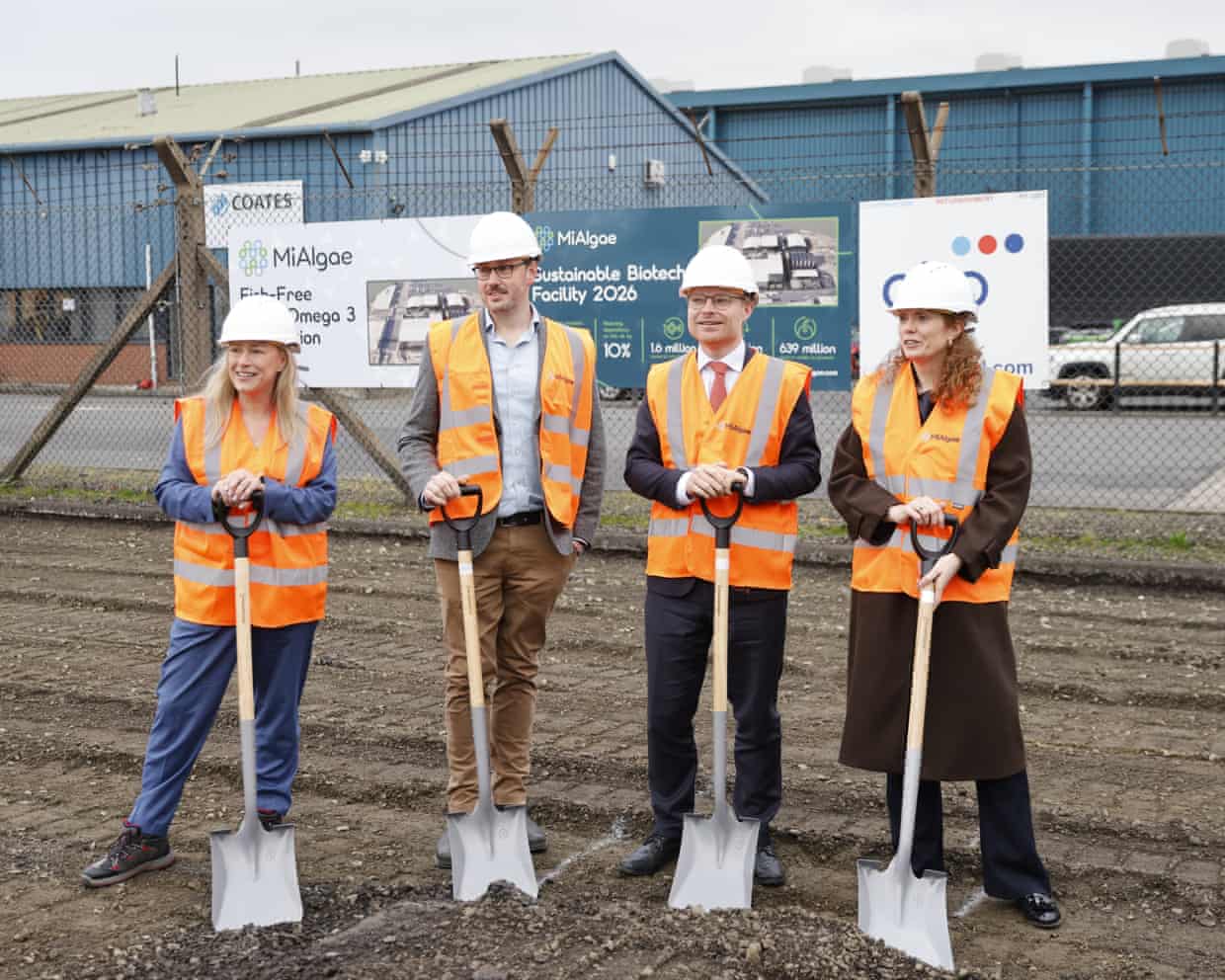
Two green biotechnology firms have announced they will build new factories at Scotland’s Grangemouth site which will employ up to 460 people, in the first phase of projects to replace hundreds of jobs lost when the PetroIneos refinery closed down.The projects by MiAlgae, a start-up based in Edinburgh which uses whisky waste to make fish-free Omega 3 oils, and Celtic Renewables, which uses whisky and agricultural byproducts to make chemicals, have won £10m in funding from the Scottish and UK governments to build new plants at Grangemouth.MiAlgae’s founder and chief executive Douglas Martin said their Omega 3 plant would start production in the second quarter of 2026, employing 75 people.It uses whisky wash, a byproduct, of whisky production to produce plant-based Omega 3 for pet food and fish farm feed.Martin said their modular plant, which has been given £3m by the UK and Scottish governments, can be rapidly expanded to eventually create up to 310 jobs.
Celtic Renewables, which uses agricultural byproducts to make acetone, butanol and ethanol used in cosmetics, chemicals and has been given £6.23m to build a plant expected to employ 149 by 2030.The projects are being funded by the Grangemouth just transition fund and are linked to the Project Willow programme run by Scottish Enterprise to replace the 400 jobs lost when Grangemouth’s refinery closed down earlier this year, fueling a political storm over mounting job losses from North Sea industries.Its closure is believed to affect up to 4,200 other jobs in the wider supply chain, intensifying pressure on both governments and Scottish Enterprise to quickly bring in high value jobs.Jan Robertson, Scottish Enterprise’s director of Grangemouth transition, said both firms were expected to be part of a closely integrated supply and production chain which connected waste and byproducts from farms, food producers and whisky distilleries with bio-energy and bio-technology companies.
The investment agency has been in talks with 140 firms interested in investing at Grangemouth: the long-term goal is to see a sustainable aviation fuel refinery and plastics recycling plants built there.Time to wrap up…Oracle’s shares have tumbled by up to 15% today after its latest quarterly financial results disappointed Wall Street.The business software company, co-founded by Donald Trump ally Larry Ellison, saw roughly $80bn vanish from its value, falling from $630bn to $550bn in market capitalization and fuelling fears of a bubble in artificial intelligence-related stocks.Shares of chipmaker Nvidia, seen as a bellwether for the AI boom, fell after Oracle’s.The drop extended a 11.
5% fall during after-hours trading that followed results showing a lower-than-expected 14% rise in revenues to $16bn (£12bn) in the latest quarter.Investors were also spooked by Oracle raising forecasts for its already-enormous investment in AI.It expects capital expenditure to jump by 40% to $50bn, with the bulk of the increase aimed at building datacentres.In a busy day for AI news, Walt Disney has announced a $1bn equity investment in OpenAI, enabling the AI start-up’s Sora video generation tool to use its characters….…while Google DeepMind is to build its first “automated science laboratory” in the UK, in a boost to the country’s artificial intelligence ambitions.
Meanwhile in Scotland, two green biotechnology firms have announced they will build new factories at the Grangemouth site which will employ up to 460 people.Interest rates were cut in Turkey…..and held at zero in Switzerland.Britain’s stock market has ended the day higher, as the City shrugs off AI bubble worries.
The FTSE 100 share index has closed 47 points higher at 9703, up 0.49%, its highest closing level in a week.Metlen Energy (+5.3%), Ashtead Group (+4.7%) and JD Sports (+3.
5%) led the risers, with Informa (-3.2%) and Smith & Nephew (-2.7%) the top fallers.“US tech stocks pulled back after Oracle shocked the market with weaker than expected results and plans to keep doling out the cash on AI-related investments,” says Dan Coatsworth, head of markets at AJ Bell, adding: “Names in the broader AI universe were in the red, including Arm Holdings, Broadcom, Advanced Micro Devices and Nvidia, as tech investors wondered if there has been too much exuberance in the space.“It’s stoked bubble fears again, leading to a wobbly market just days before Christmas.
Investors want to know when all this AI money is going to generate a positive financial return, and it’s unclear if that’s happening sooner or later.“Hot on the heels of a US interest rate cut were jobless claims figures that came in higher than expected.The Fed is watching the labour market closely for signs of weakness and any notable deterioration would strengthen the argument for more interest rate cuts down the line.“Meanwhile on this side of the Atlantic, the FTSE 100 burst to life in afternoon trading, with materials, consumer cyclicals and healthcare leading the way.”In other artificial intelligence news, Walt Disney has announced a $1bn equity investment in OpenAI, enabling the AI start-up’s Sora video generation tool to use its characters.
Users of Sora will be able to generate short, user-prompted social videos that draw on more than 200 Disney, Marvel, Pixar and Star Wars characters as part of a three-year licensing agreement between OpenAI and the entertainment giant.The agreement – a landmark deal amid intense anxiety in Hollywood over the impact of artificial intelligence on the future of entertainment – will not cover talent likenesses or voices.Bob Iger, Disney’s CEO, hailed a deal which paired his firm’s “iconic stories and characters” with OpenAI’s AI technology.It will place “imagination and creativity directly into the hands of Disney fans in ways we’ve never seen before”, he claimed.Despite AI concerns, the Dow Jones industrial average has hit a new alltime high.
The DJIA, which contains 30 large US companies, is up 457 points or 0.95% at 48,515 points.Most stocks on the Dow are up, as traders welcome yesterday’s cut to US interest rates.Oracle is not in the Dow, but it is in the Nasdaq composite index – which has fallen by almost 1%Joe Mazzola, head trading & derivatives strategist at Charles Schwab, says:“Oracle’s results disappointed, hitting tech stocks after the market neared record highs Wednesday on the Fed rate cut.Broadcom reports later, providing another look at AI demand.
”Fawad Razaqzada, market analyst at City Index, says:“Oracle has dropped a cold splash of reality on the AI-trade frenzy, reminding markets that not all AI-related spending is a guaranteed home run.”Some other artificial intelligence-related stocks are also falling in New York.Chipmaker Nvidia is leading the fallers on the Dow Jones industrial average, down 2.7%.Semiconductor designers Synopsys and Arm Holdings have both lost 3.
2%, and chipmaker AMD is down 3.1%, and data firm Palantir has dropped by 2.8%.As feared, shares in Oracle have tumbled at the start of trading as Wall Street gives its verdict to the tech giant’s results last night.Oracle’s shares have dropped by 15.
7% at the start of trading, down to $188.29.That, by my maths, knocks almost $100bn off the company’s market capitalisation.As flagged earlier (see opening post), Oracle missed revenue forecasts last night – and also hiked its capital expenditure plans by $15bn.That has led to mounting concerns about the company’s massive AI spending and the lack of a clear timeline on returns from the investments.
Back in the AI world, the cost of insuring Oracle’s debt against default has risen to its highest in at least five years.That reflects investor concerns about Oracle’s borrowing spree to fund its AI investments, after it missed Wall Street forecasts last night.Reuters flags that Oracle’s five-year credit default swaps, a derivative that pays bondholders in the event an issuer defaults, rose by nearly 12 basis points on the day to 139 bps, according to S&P Global Market Intelligence.This was the highest since at least September 2020, according to LSEG data.It means it would cost $139 to insure $10,000 of Oracle debt, so still implying a low risk.
Oracle shares are currently down 13.7% in pre-market trading.Gillian Martin, the Scottish government’s net zero secretary, said she expected other green, low carbon industries such as plastics recycling and sustainable aviation fuel to set up in Grangemouth following the decision by the Scottish and UK governments to fund two bio-technology factories there (see earlier post).She said the new MiAlgae plant at Grangemouth, which expects to employ 75 people making omega 3 oils for animal and fish farm feed from whisky waste from spring next year, was additional to the types of industries proposed by the Project Willow programme to attract major new employers to Grangemouth, published after PetroIneos announced it was closing its oil refinery there.Speaking at the site of MiAlgae’s new plant, she said:“The projects we are announcing today are outwith what we anticipated would be the main outcomes of Project Willow and that’s actually really exciting.
“Today we’re able to make announcements about tangible operations that are going to be here that are going to be providing highly skilled jobs.But I think the most exciting part of it is its future industries.“It’s industries that are going to be displacing an awful lot of carbon intensive processes, like MiAlgae are doing today - meaning that we’re not importing fish oil from around the world, and we’ve actually got a more sustainable product, but highly skilled work as well.“The only way to turn the terrible negativity - because people are losing their jobs in traditional industries like PetroIneos, who have made decisions that are outwith government control - is to step in and do what you say you’re going to do, and that’s actually facilitate replacement jobs happening in that area.And that’s what we’re doing here today.
We’re only at the start of this.”Michael Shanks, the UK government’s energy minister, said the announcement of nearly £10m in funding to build two new green biotechnology plants at Grangemouth, following the closure of PetroIneos’s oil refinery, was “a really important moment.” Speaking as heavy machinery began cutting away tarmac for MiAlgae’s new plant, he said: “the truth is, we should have been doing a lot of this a long time ago.” He said it took time to “get those viable projects coming forward [and] they give us not a sort of flash in the pan moment, they are sustainable, a business rooted in a community like this and interested in expanding”.Shanks told the Guardian:“Yes, it’s jobs early next year, which is really important for us to say - that there are jobs coming to Grangemouth very soon.
But secondly, it’s a statement of faith that Grangemouth is a positive place, that actually, this isn’t just a place of decline as we’ve seen too much of, but is a huge opportunity as well.”Pressed on whether enough was being done to demonstrate the transition to net zero created high value jobs and wealth, he said:“We need to see a lot more examples of these kind of businesses coming forward to demonstrate the jobs.There are actually many and the thousands of jobs being created in Scotland right now in offshore wind, in hydrogen in ports.But we’re not telling the story often enough.“MiAlgae is actually is a brilliant story to tell of good, well-paid sustainable jobs, of cutting edge innovation.
But also it’s the climate argument in a nutshell.It’s good jobs here at Grangemouth, but they’re helping to save the planet.”Two green biotechnology firms have announced they will build new factories at Scotland’s Grangemouth site which will employ up to 460 people, in the first phase of projects to replace hundreds of jobs lost when the PetroIneos refinery closed down.The projects by MiAlgae, a start-up based in Edinburgh which uses whisky waste to make fish-free Omega 3 oils, and Celtic Renewables, which uses whisky and agricultural byproducts to make chemicals, have won £10m in funding from the Scottish and UK governments to build new plants at Grangemouth.MiAlgae’s founder and chief executive Douglas Martin said their Omega 3 plant would start production in the second quarter of 2026, employing 75 people.
It uses whisky wash, a byproduct, of whisky production to produce plant-based Omega 3 for pet food and fish farm feed.Martin said their modular plant, which has been given £3m by the UK and Scottish governments, can be rapidly expanded to eventually create up to 310 jobs.Celtic Renewables, which uses agricultural byproducts to make acetone, butanol and ethanol used in cosmetics, chemicals and has been given £6.23m to build a plant expected to employ 149 by 2030.The projects are being funded by the Grangemouth just transition fund and are linked to the Project Willow programme run by Scottish Enterprise to replace the 400 jobs lost when Grangemouth’s refinery closed down earlier this year, fueling a political storm over mounting job losses from North Sea industries.
Its closure is believed to affect up to 4,200 other jobs in the wider supply chain, intensifying pressure on both governments and Scottish Enterprise to quickly bring in high value jobs.Jan Robertson, Scottish Enterprise’s director of Grangemouth transition, said both firms were expected to be part of a closely integrated supply and production chain which connected waste and byproducts from farms, food producers and whisky distilleries with bio-energy and bio-technology companies.The investment agency has been in talks with 140 firms interested in investing at Grangemouth: the long-term goal is to see a sustainable aviation fuel refinery and plastics recycling plants built there.City veteran Philip Jansen has a new challenge – steering Heathrow though its plans for a new runway and terminal expansion.Jansen has today been named as the chairman of Heathrow, replacing Lord Paul Deighton when he steps down on 31 December.
Heathrow says:Jansen’s significant experience working with private investors as well as successfully leading a business within a highly regulated environment means that he is ideally placed to help prepare the airport for its next phase of modernisation and oversee the airport’s future strategy.That strategy includes Heathrow’s proposal for a £33bn scheme for a 2.2-mile (3.5km) north-western runway crossing the M25 motorway, which the government backed last month.It is also proposing a £15bn project to expand Terminal 2 and ultimately closing Terminal 3.
Jansen has plenty of experience for the role; he’s currently Chair of WPP (the advertising group which is being relegated from the FTSE 100), and was previously the CEO of BT Group, Worldpay Group and Sodexo.Jansen says: “Heathrow is the UK’s gateway to growth, therefore I am delighted to be taking on the role as Chairman at this pivotal time for both the business and the country.I’m keenly aware of the instrumental role Heathrow plays in the success of the UK economy and I’m motivated to play my part in its future, helping to navigate the UK’s hub as it looks to modernise and expand.”A surge of $5bn-plus megadeals has helped to make 2025 the second-largest year for merger and acquisition activity on record, a new report from Bain & Company shows.Technology M&A, powered by AI-related deals, was behind the year’s surge in merger activity, Bain reports, with $4.
8tn of M&A activity this year.Those $5bn-plus deals “contributed 75% of strategic deal value growth”, Bain says – big bets on large-scale, transformational mergers that are potentially both high-risk and high reward for acquiring companies.Suzanne Kumar, executive vice president of Bain & Company’s M&A and Divestitures practice, explains:“Companies across industries are seeing an urgent need to reboot strategy.Amid improved deal market conditions, with both buyers and sellers more confident about valuations, strategic buyers are again putting M&A front and center to drive business growth.The number one reason for increased dealmaking was M&A’s central role in strategy, according to our survey of more than 300 M&A executives,” said“We see important implications from the dealmaking rebound
Trump clears way for Nvidia to sell powerful AI chips to China
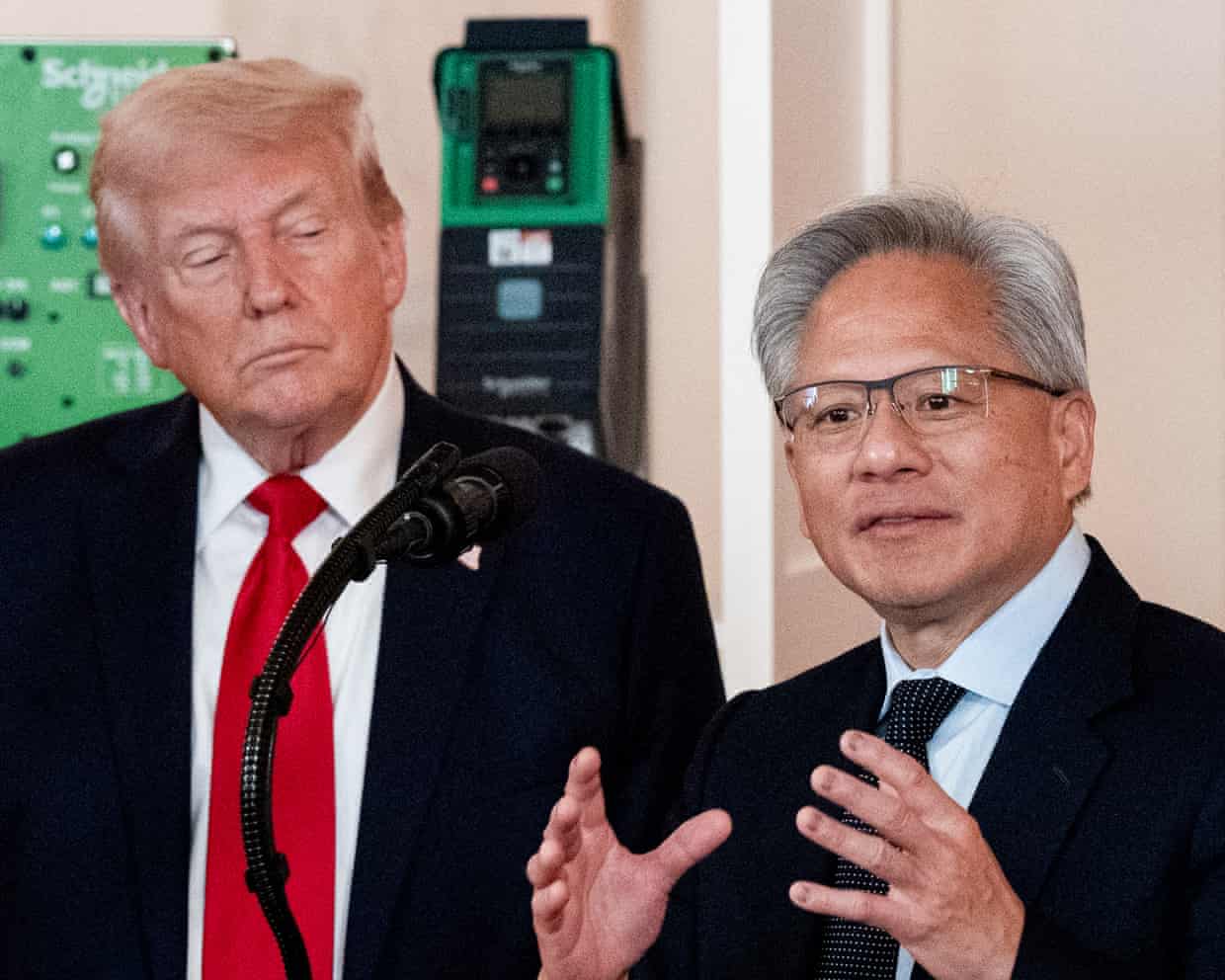
Donald Trump has cleared the way for Nvidia to begin selling its powerful AI computer chips to China, marking a win for the chip maker and its CEO, Jensen Huang, who has spent months lobbying the White House to open up sales in the country.Before Monday’s announcement, the US had prohibited sales of Nvidia’s most advanced chips to China over national security concerns.Trump posted to Truth Social on Monday: “I have informed President Xi, of China, that the United States will allow NVIDIA to ship its H200 products to approved customers in China, and other Countries, under conditions that allow for continued strong National Security. President Xi responded positively!”Trump said the Department of Commerce was finalising the details and that he was planning to make the same offer to other chip companies, including Advanced Micro Devices (AMD) and Intel. Nvidia’s H200 chips are the company’s second most powerful, and far more advanced than the H20, which was originally designed as a lower-powered model for the Chinese market that would not breach restrictions, but which the US banned anyway in April

AI researchers are to blame for serving up slop | Letter
I’m not surprised to read that the field of artificial intelligence research is complaining about being overwhelmed by the very slop that it has pioneered (Artificial intelligence research has a slop problem, academics say: ‘It’s a mess’, 6 December). But this is a bit like bears getting indignant about all the shit in the woods.It serves AI researchers right for the irresponsible innovations that they’ve unleashed on the world, without ever bothering to ask the rest of us whether we wanted it.But what about the rest of us? The problem is not restricted to AI research – their slop generators have flooded other disciplines that bear no blame for this revolution. As a peer reviewer for top ethics journals, I’ve had to point out that submissions are AI-generated slop

EU opens investigation into Google’s use of online content for AI models
The EU has opened an investigation to assess whether Google is breaching European competition rules in its use of online content from publishers and YouTube creators for artificial intelligence.The European Commission said on Tuesday it would examine whether the US tech company, which runs the Gemini AI model and is owned by Alphabet, was putting rival AI owners at a “disadvantage”.The commission said: “The investigation will notably examine whether Google is distorting competition by imposing unfair terms and conditions on publishers and content creators, or by granting itself privileged access to such content, thereby placing developers of rival AI models at a disadvantage.”It said it was concerned that Google may have used content from web publishers to generate AI-powered services on its search results pages without appropriate compensation to publishers and without offering them the possibility to refuse such use of their content.The commission said it was also concerned as to whether Google had used content uploaded to YouTube to train its own generative AI models without offering creators compensation or the possibility to refuse

Australia launches a social media ban – and is AI a bubble about to pop?
Hello, and welcome to TechScape. I’m your host, Blake Montgomery, writing to you from a New York City that feels much colder than last December. 🥶In a world first, Australia implemented a ban on social media use for people under 16. It’s the first country to take such a far-reaching measure. Starting on 10 December, children and teens under 16 will not be allowed to use social media in Australia

‘I feel it’s a friend’: quarter of teenagers turn to AI chatbots for mental health support
It was after one friend was shot and another stabbed, both fatally, that Shan asked ChatGPT for help. She had tried conventional mental health services but “chat”, as she came to know her AI “friend”, felt safer, less intimidating and, crucially, more available when it came to handling the trauma from the deaths of her young friends.As she started consulting the AI model, the Tottenham teenager joined about 40% of 13- to 17-year-olds in England and Wales affected by youth violence who are turning to AI chatbots for mental health support, according to research among more than 11,000 young people.It found that both victims and perpetrators of violence were markedly more likely to be using AI for such support than other teenagers. The findings, from the Youth Endowment Fund, have sparked warnings from youth leaders that children at risk “need a human not a bot”

Social media use damages children’s ability to focus, say researchers
Increased use of social media by children damages their concentration levels and may be contributing to an increase in cases of attention deficit hyperactivity disorder, according to a study.The peer-reviewed report monitored the development of more than 8,300 US-based children from the age of 10 to 14 and linked social media use to “increased inattention symptoms”.Reseachers at the Karolinska Institute in Sweden and the Oregon Health & Science University in the US found that children spent an average of 2.3 hours a day watching television or online videos, 1.4 hours on social media and 1
NHS ‘facing worst-case scenario’ as hospital flu cases jump 55% in a week

‘This country’s divided’: how a Sunderland charity is changing that – one house, park and shop at a time

Online child sexual abuse surges by 26% in year as police say tech firms must act
Britain slipping down global league table for youth employment, says report
Homelessness minister promises to end use of B&Bs as emergency housing

Ruth Johns obituary