Will Great Britain’s offshore wind subsidy auction mean lower energy bills?
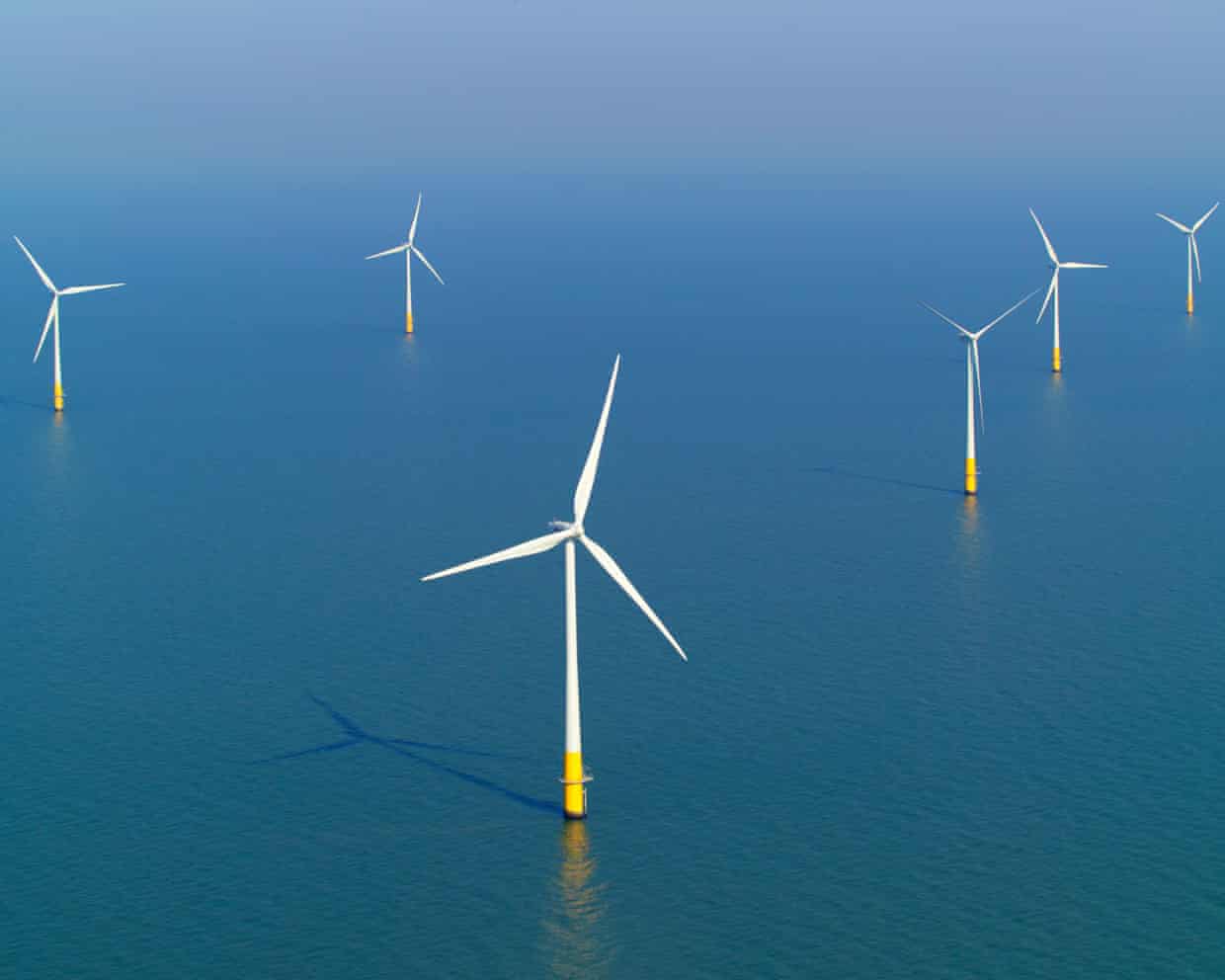
Great Britain has secured enough new offshore wind to power 12m homes after the most competitive – and financially generous – subsidy auction on record.The competition to secure renewable energy support contracts was considered a crucial test of the government’s pro-growth agenda and its ambition to achieve a clean power system by 2030.In response, Ed Miliband, the energy secretary, said the “historic auction” had proved the government’s doubters wrong.The biggest single procurement of offshore wind in the UK and mainland Europe would now bring forward investment of £22bn into the sector and create 7,000 new jobs, he said.Here we look at how the renewable energy auction promises to help the British government meet its clean energy targets.
The UK pioneered the “contracts for difference” scheme, which supports new renewable electricity projects via a “reverse auction” in which the lowest bids win.This helps to incentivise the multibillion-pound upfront costs of investing in low-carbon energy, such as solar, wind and nuclear power projects.It also helps to ensure that only those schemes that offer the best value for money receive support at the lowest cost to consumers.The latest auction is the seventh of its kind to be held in the UK in the last 11 years, and the format has been replicated elsewhere in Europe and globally.Over the summer, clean energy developers submitted closed bids indicating the lowest price they could accept for each megawatt of electricity produced by their project.
About 25 offshore wind projects were eligible to bid in the latest auction – the equivalent of more than 24 gigawatts (GW) of electricity capacity, or enough to power 20m homes when the windfarms are running at their full potential.In the end, funding was awarded to 8.4GW of offshore wind capacity.The Low Carbon Contracts Company administers the scheme for the government and awards contracts to the best bids.If the market price for electricity is below the “strike price” set in the support contract, a levy on household energy bills is used to top up the payments received by developers.
If the wholesale market price soars above the strike price, developers are contractually bound to pay back the difference to consumers.Initially these contracts guaranteed revenues for 15 years but in the latest auction the government offered 20-year contracts in the hope that developers would submit lower bids in exchange for a longer period of support.It was considered the last realistic chance for Labour to meet the clean energy targets it set out ahead of its election victory.The party promised to lower energy bills by creating a virtually carbon-free electricity system by 2030.To do this it plans to double Britain’s onshore wind power, triple its solar power and quadruple its offshore wind power capacity.
The plan to become a “clean energy superpower” relies heavily on the government’s particularly ambitious offshore wind targets at a time when the industry has faced rising costs.Currently the UK has about 27.6GW of offshore wind capacity either in operation, under construction or which holds a government contract – enough to power the equivalent of over 27m homes when running at full capacity.The government would need to add at least 16GW of offshore wind over the next two years to reach its offshore wind target of between 43GW to 50GW.The government believes so.
Official figures show that electricity generated by the latest generation of offshore windfarms will be 40% less expensive than the power produced by a new gas-fired power plant.In official figures published on Wednesday, the government said the cost of building and operating a new gas-fired power station was £147 per megawatt hour, while the auction price for offshore wind was £90.91 per megawatt hour on average.Before the auction, industry experts found that if the government could bring forward investment in renewable energy at a price of below £94 to £95 per megawatt-hour in 2024 prices then it would meet its targets at no extra cost to consumers.In the end, the contracts were awarded at £89.
49-£91.20/MWh.The current market price for electricity bought in advance is about £74/MWh, suggesting bill-payers would have to offer top-ups to developers to match the strike price if they began operating today.However, analysis by Aurora Energy Research and the consultancy Baringa found that an increase in renewable energy today would lower the future wholesale price – cushioning the impact of rising levies on bills.Aurora said this fall in wholesale market prices would more than offset the impact of higher levies to support renewable energy, “keeping household energy bills effectively neutral through to 2035”.
Separate analysis from a green thinktank suggests the UK’s energy costs last year could have been about 46% higher without wind.The average spot price of electricity traded on markets last year was about £83/MWh but might have climbed as high as £121/MWh if windfarms had not been available to limit the use of expensive gas plants, according to the Energy and Climate Intelligence Unit.The auction results will keep the government’s progress towards its 2030 offshore wind target on track – but it will still need to procure another 8GW of offshore wind in next year’s auction to hit its goal of growing the country’s offshore wind capacity to 43-50GW by the end of the decade.Although it is technically feasible for projects that are successful next year to build their projects in time to begin generating power for the UK by 2030, industry insiders have expressed concern that the “practical realities of construction and supply chains” could mean that future projects struggle to meet the government’s timeline.The pressure will be on the industry to keep producing record-breaking investments in the years ahead – and at a cost that provides value for money to consumers, too.

West African sunshine dishes: Toyo Odetunde’s chicken yassa pot pie and stuffed plantain boats – recipes
If there’s anything that can assuage my winter blues, it’s a soul-soothing chicken pie. I’ve long enjoyed innovating fusions between west African and other cuisines, and today’s marriage of a deeply flavourful Senegalese chicken yassa-inspired filling in buttery, flaky puff pastry is one of my all-time favourites. But, first, my take on hearty Nigerian stewed beans – ewa riro – using tinned beans for added convenience. Typically paired with ripe plantain, I use the rich beans to fill canoas (plantain boats) in a playful, Latin American-inspired twist.Dried prawns and west African red palm oil, which are integral to our cooking (and the latter is not to be confused with those industrial palm oils that are driving mass deforestation), give this dish its signature umami and uniquely earthy and subtly sweet flavour
How to make penne all’arrabbiata – recipe | Felicity Cloake's Masterclass
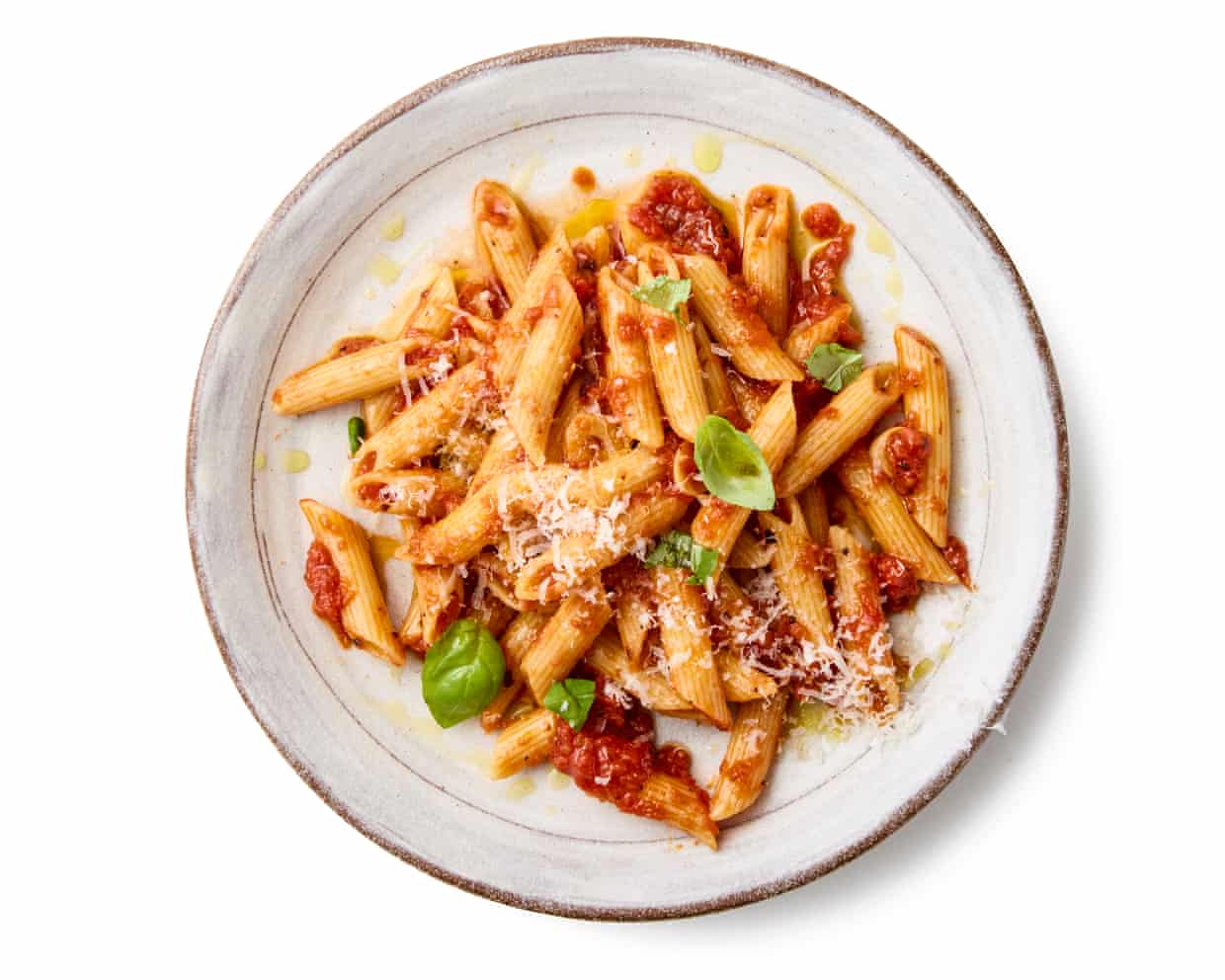
Pasta all’arrabbiata is the perfect dish for January. Not only is it quick, vegan and made from ingredients you might conceivably have in the cupboard already, but the name, which means angry, could be said to suit my mood now that the last of the Christmas festivities are over. Happily, a big plate of rich, tomatoey pasta can always be relied upon to lift the spirits.Prep 5 min Cook 25 min Serves 22 tbsp extra-virgin olive oil, plus a little more to finish1 tsp chilli flakes 2 garlic cloves 400g good tinned tomatoes, or passata 200g penne (see step 1)Salt and black pepper ¼ tsp red-wine vinegar 1 handful basil leaves, or flat-leaf parsleyThis dish is traditionally made with penne, but any shape that traps chunky pieces of sauce will give maximum enjoyment. Caz Hildebrand and Jacob Kenedy’s book The Geometry of Pasta suggests no fewer than 14 alternatives, including farfalle, pappardelle and tagliatelle, while I’d recommend rigatoni, fusilli, conchiglie or, indeed, anything that looks vaguely like them

Martino’s, London SW1: ‘Beautiful bedlam’ – restaurant review | Grace Dent on restaurants
Does central London really need another fancy Italian restaurant? Well, yes, apparently it does …Does the area around Sloane Square in central London really need another fancy, Italian-leaning restaurant that serves up tortellini in brodo and veal Milanese? Well, yes, apparently it does. One Saturday lunchtime late last year at Martino’s was hectic even in the delightful reception area, where we were waiting to check in a coat with the elegantly uniformed front-of-house ladies. All the tables in this hot new all-day brasserie were booked and busy, and plenty of walk-ins were champing at the bit for cancellations.Actually, “delightful reception” is not a phrase I’ve often uttered, or even thought, but this is a Martin Kuczmarski restaurant, so the small things tend to add up to a larger picture – this cocoon-like holding pen keeps would-be queuers away from the diners. Why was I so charmed by this weird, crisply officiated bends chamber that operates as a liminal space between the real grubby world outside and the glitzy, sexy, mock-Italian trattoria inside? Well, it turns out that’s because it solved a problem that I didn’t even realise I had

Helen Goh’s recipe for baked apples with lemon and tahini | The sweet spot
After the excesses of December, these baked apples are a light, refreshing vegan pudding. The filling makes good use of any dried fruit lingering still from Christmas, and is brightened with lemon and bound with nutty tahini. As the apples bake, they turn yielding and fragrant, while the sesame oat topping crisps to a golden crown. Serve warm with a splash of cream, yoghurt or ice-cream (dairy or otherwise), and you have comfort that feels wholesome and indulgent.If need be, you can make these vegan and/or dairy-free with a few simple tweaks

Health by stealth: the rise of drinkable no- and low-alcohol beer
As the last of the liqueur bottles are consigned to the recycling and the festive hangovers subside, even those of us who scorn the very concept of Dry January (no booze at all? In the gloomiest month of the year? Are they mad?) tend to take our feet off the alcohol pedal and give our livers something of a rest.The Guardian’s journalism is independent. We will earn a commission if you buy something through an affiliate link. Learn more.Water, of course, is the easiest, cheapest and probably most effective way to detox; it’s also the most boring

Mark Hix’s recipe for roast pumpkin and pickled walnut salad
I try to grow a few varieties of squash every season, but in the past couple of years the results have more or less failed me. I originally put that down to the lack of time and attention I’d given those poor plants, but I’m now starting to wonder if the soil in my raised garden beds overlooking Lyme Bay in Dorset is actually right for them.I’m not giving up just yet, though, and this year I’ll be trying different varieties in a different bed that I’ve prepared and composted over the winter with seaweed mulch. As luck would have it, however, my friend Rob Corbett came to the rescue a couple of weeks ago by giving me several specimens when he delivered some wine from his Castlewood vineyard a few miles away in east Devon. If you know your gourds even a little, you will also know that squashes keep for months, which is handy, because they ideally need to cure and ripen before use

Coca-Cola reportedly abandons plans to sell Costa Coffee chain

Trump says JP Morgan boss ‘wrong’ over Fed defence; Miliband hails record windfarm auction – business live

Young people, parents and teachers: share your views about Grok AI

Use of AI to harm women has only just begun, experts warn

Why is Stephen A Smith blaming Renee Good for her own death?

The Spin | Nimble or nervous 90s? Cricket maths show best approach to scoring a century