‘Doubling down on meat’: is the UK’s love affair with vegetarian food over?

McDonald’s, Wagamama and others scale back plant-based choices in the UK in favour of ‘high-margin’ meat-led dishesIn 2021, vegetarianism and veganism were booming and menus reflected it.Restaurants and fast-food chains rapidly expanded their meat-free offerings, racing to meet growing demand from diners.McDonald’s launched its first plant-based burger, joining a wave of operators embracing non-meat options.Fast forward to 2026 and the landscape looks markedly different.Last month, the fast food chain announced it was axing most of its vegetarian range – sparing only its McPlant burger – owing to weak sales.
Wagamama has removed some vegan dishes from its menu, while Domino’s has also scaled back its plant-based options.The final Veggie Pret, a standalone concept store from the high street sandwich chain that started in 2016, closed in February 2024.Some industry observers say the shift reflects growing consumer scepticism around ultra-processed foods, with certain vegetarian meat alternatives criticised for being overly processed.In their place, data shows whole sources of protein are regaining ground, particularly chicken.Others argue the change is less dramatic: rather than retreat, the sector is stabilising after a rapid boom.
Data from Lumina’s Menu Tracker shows that in the first three months of 2025, pubs and bars served two fewer dishes compared with the same period the previous year.Vegetarian options were described as “explicitly shrinking”, as average main course listings remained high at 54 items but menus leaned more towards meat-led dishes.Liv Warren, an insight manager at Lumina, said pubs were “stripping back lower-volume categories, with vegetarian dishes shrinking, while doubling down on high-margin core meat dishes”.A similar pattern has emerged in restaurants.Traditional meat mains grew in prominence, with pizzas and burgers recording an uptick.
“Vegetable dishes were present but declining marginally,” Warren said.High-protein chicken dishes were a key driver, increasing by 4.2 percentage points of mains share over the period analysed.Looking across the first half of 2025, Warren said that while menus were expanding in some channels, growth was firmly meat-led.“Pubs are explicitly reducing vegetarian dishes,” she noted, with expansion driven by “chicken and protein”.
She added: “Vegetable dishes are present but not leading growth … indulgence and protein are outperforming plant-based innovation.”Operators were reallocating menu space towards higher-margin meat dishes, particularly chicken, she said.The shift reflects ongoing cost pressures, a normalisation of demand after the plant-based boom and a change in health messaging from “meat-free” to “high-protein”.Bia Bezamat, the cultural insights director at the market research firm Kantar, said: “A lot of people won’t realise how algorithm-driven food trends can be, too.TikTok is full of micro-trends like high protein, which often lean heavily towards meat, and gut health which is behind the rise of fermented foods like kefir and pickles.
“The rise of GLP-1 medicines also means there’s a trend towards smaller and more nutrient-dense meals.So, restaurants are ultimately responding to all of these different trends.”Kara Buffrey, the founding partner of restaurant agency Chomp, believes the changes amount to adjustment rather than reversal.“The scaling back of veggie options at McDonald’s and Domino’s, along with the closure of concepts like Veggie Pret and other fully vegan restaurants, feels more like a market correction than a cultural reversal,” she said.“Veganism arguably went through a hype phase and brands were bold in responding to that momentum.
But fast food operates on very tight margins and is entirely demand-led.If people aren’t ordering veggie takeaways in high enough numbers, those products won’t survive.”She added that the pressures of rising menu prices may also be influencing consumer choices.“I don’t think vegetarianism itself is necessarily declining, rather, with eating out becoming more expensive, consumers may feel they get more value from meat options.This looks like brands responding pragmatically to purchasing behaviour rather than making a broader ideological shift.
”Inflation, higher wages, increases to national insurance and business rates are all squeezing margins – and with nearly 38% of diners now eating out less than they did a year ago, citing rising costs and the need to save money, businesses are making difficult decisions about which dishes to cut.Laura Hellwig, managing director at the vegan charity Viva!, agreed that wider economic factors could not be ignored.“Hospitality is dealing with higher wages, inflation and rising costs … Across the sector, operators are cutting lower-performing items from menus.”According to Hellwig, consumer interest in plant-based lifestyles is still strong – and actually growing.She cited the Good Food Institute, which released research in May last year stating that 31% of people in the UK were actively reducing their meat intake while 9% said they followed meatless diets.
Veganuary 2026 was record-breaking, with about 30 million participants worldwide, up from 25.8 million the previous year.For these reasons, she rejected the idea of a plant-based collapse.She also emphasised that Wagamama still offered an extensive vegan range and argued the sector was entering a period of consolidation.“It’s normal.
That level of rapid growth wasn’t sustainable long term.Many brands jumped on the plant-based bandwagon and launched large numbers of products; it’s inevitable that some of those would fall away.”Importantly, Hellwig said, strong performers were still in place.“The McPlant remains very popular.The products that work are sticking.
” Affordable high street options, such as the McPlant and the Greggs vegan sausage roll, continue to sell strongly.Helllwig added that “minimally processed, whole-food and naturally high-protein options such as tofu, tempeh, seitan and falafel are growing, as are functional foods with additional health benefits”.
Starmer 2.0: could a more authentic PM revive Labour’s appeal?
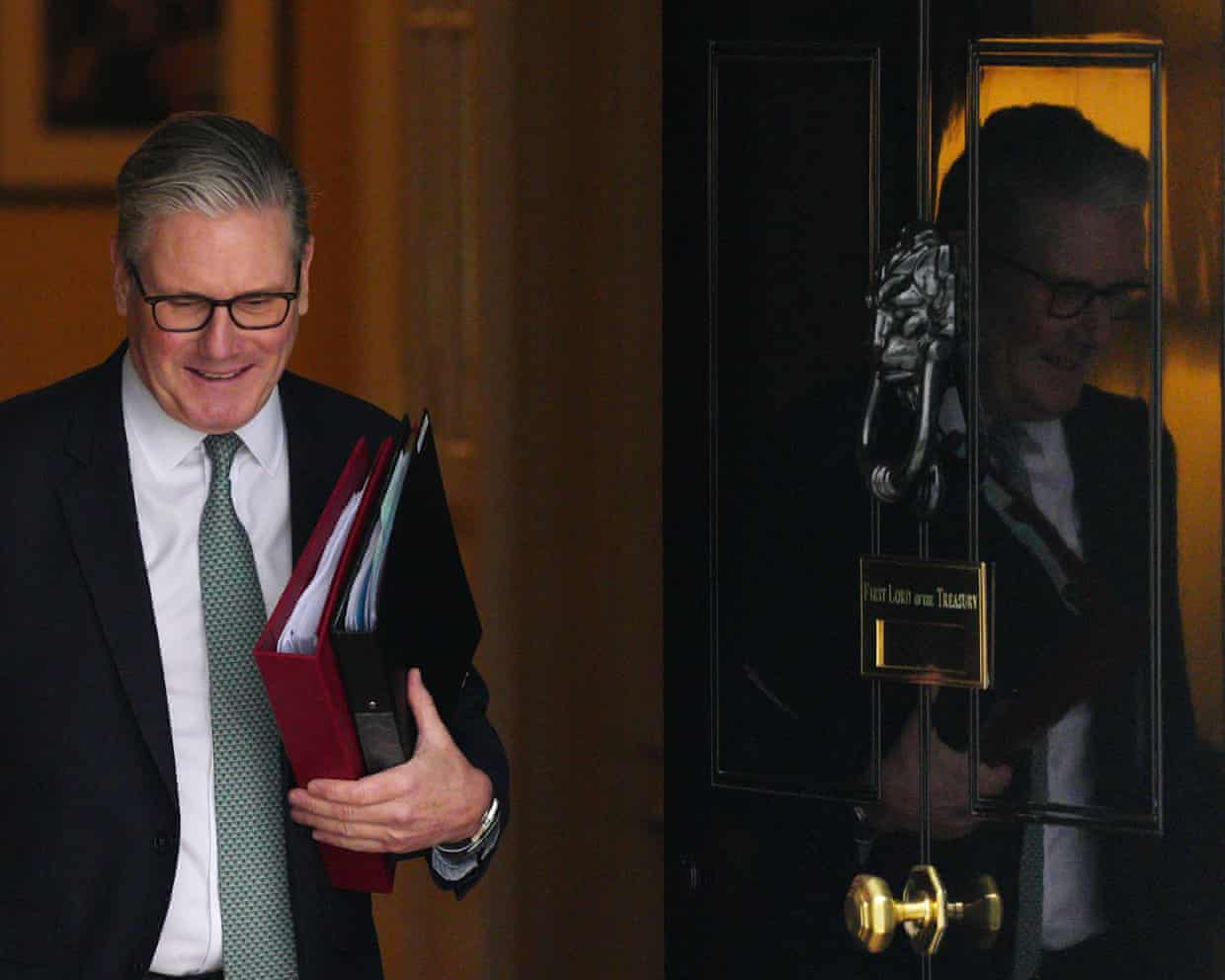
Two days after Keir Starmer had been disowned by the Scottish Labour leader last week, and as a row raged over another controversial peerage, the prime minister decided to pick a fight with a billionaire.It was a dark week for the prime minister, with the departure of his longtime chief of staff Morgan McSweeney, who had become a deeply divisive figure and who took the hit for the appointment of Peter Mandelson as US ambassador, despite his links to the convicted child sex offender Jeffrey Epstein.But last Thursday morning had – for a change – been dominated by a different story. Top of the bulletins were comments from Jim Ratcliffe, the Monaco-based Manchester United owner, who said the UK had been “colonised by immigrants”, citing wildly inaccurate figures.The previous afternoon, when the comments were first broadcast, Starmer tweeted to proactively condemn them as “offensive and wrong”

UK ‘working with US’ to analyse impact of supreme court’s ruling against tariffs
Britain and the EU said they were assessing the implications of the US supreme court ruling against Donald Trump’s global tariffs, while business groups reacted to the court’s announcement with caution.A spokesperson for Downing Street said: “The UK government is working with the US to understand how the overturning of Donald Trump’s tariffs by the supreme court will affect the UK but expects our privileged trading position with the US to continue.”The UK was the first to strike a tariff deal with the US, with 10% tariffs on all imports from Britain, compared with a blanket 15% rate for the EU.The EU said it was analysing the ruling while continuing its drive to work towards reducing the tariffs the US imposed on European exports.The EU agreed the 15% tariff rate with the US at Trump’s Scottish golf course last July but 50% tariffs are still imposed on steel

Letter: Nigel de Gruchy obituary
The trade union leader Nigel de Gruchy may have exhibited “self-opinionated vanity”, but as a parent campaigner in the 1990s, I found him to be a principled man who was supportive of the Campaign for State Education (Case), which I represented with others.I once went to see him in the Covent Garden office to ask for money for Case to campaign against the 11-plus. He himself supported selection, I think, but he said it was union policy to oppose it, and we got the money.Another time, on a train journey he apologised for making a press call but said his members needed to know he was working in return for their membership fees. I also enjoyed his acerbic wit and being invited to enjoy the Sancerre at the NASUWT Christmas drinks
Consultancy co-founded by Peter Mandelson falls into administration
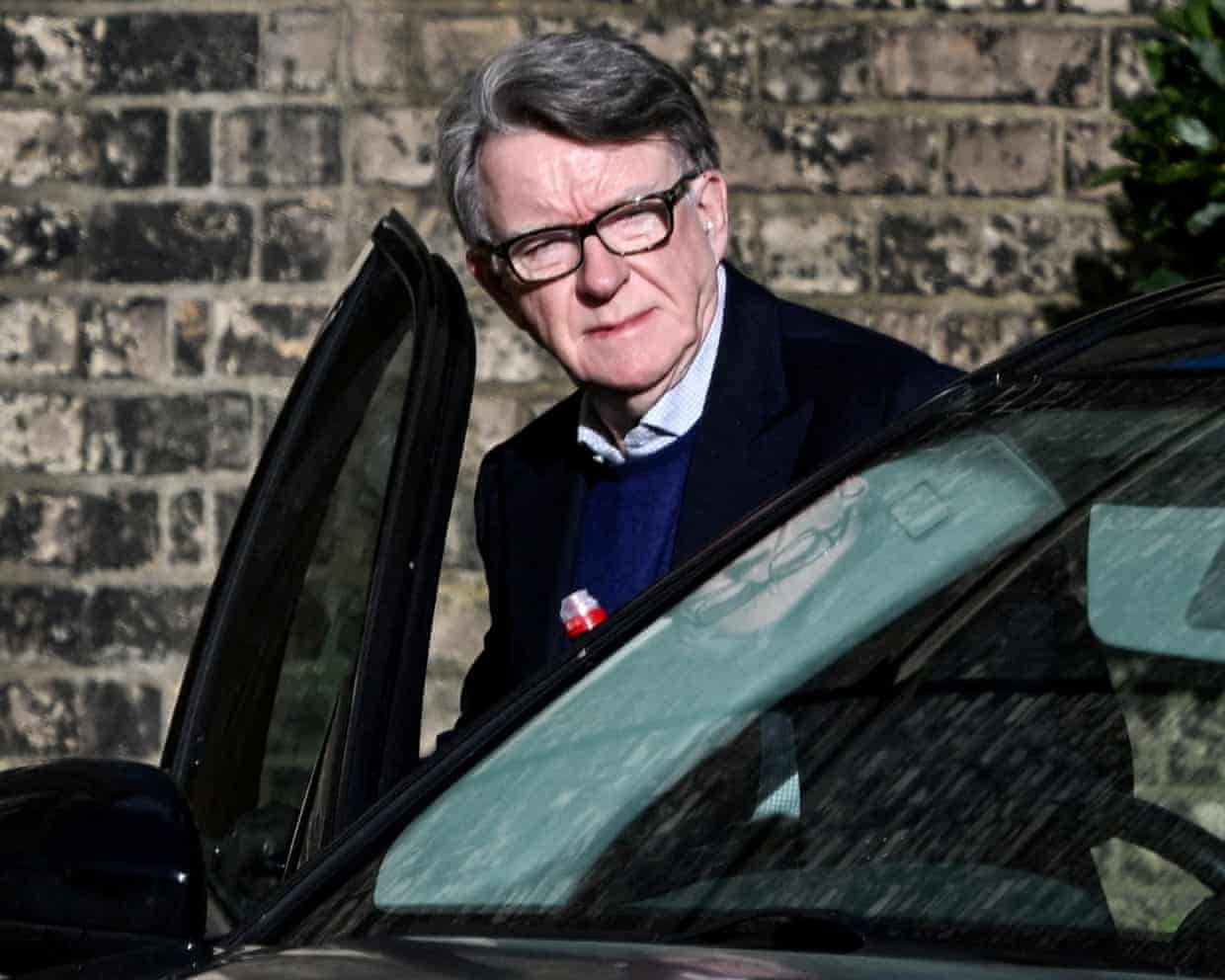
The consultancy co-founded by Peter Mandelson has collapsed into administration, after a number of clients cut ties with the company over the former ambassador’s relationship with the convicted child sex offender Jeffrey Epstein.Global Counsel, which Mandelson co-founded in 2010, said on Friday that it had stopped trading and its staff in the UK were being made redundant.The London-based company employs about 100 people, the vast majority of whom are based in the UK. It also has employees in Berlin, Brussels, Doha and Singapore.Administrators at Interpath said Global Counsel had “no option” but to enter administration after a number of its clients cut ties with the business, despite its attempts to distance itself from Mandelson and its other co-founder, Benjamin Wegg-Prosser

Reform UK’s Matt Goodwin faced GB News complaint over colleague’s claim of ‘inappropriate comments’
Matt Goodwin, Reform UK’s candidate in the Gorton and Denton byelection, was accused by a young woman working at GB News of making inappropriate comments which she viewed as sexually harassing, the Guardian can reveal.The junior staffer complained to HR last year alleging Goodwin had made inappropriate comments, one regarding her appearance, sources say. Goodwin, 44, volunteered an apology after the complaint had been raised.The woman is understood to have complained to the network’s HR department in 2025. She later left the network for unrelated reasons

Labour minister falsely linked journalists to ‘pro-Kremlin’ network in emails to GCHQ
A Labour minister who claimed to be “surprised” and “furious” at a PR agency’s work to investigate journalists on his behalf had been personally involved in naming them to British intelligence officials and falsely linking them to pro-Russian propaganda, the Guardian can reveal.Josh Simons, who was running the thinktank Labour Together at the time, was also involved in telling security officials that another journalist was “living with” the daughter of a former adviser to Jeremy Corbyn. Officials were told by Simons’ team that the former adviser was “suspected of links to Russian intelligence”.The extraordinary disclosures are contained in emails that Simons and his chief of staff at Labour Together sent to the National Cyber Security Centre (NCSC), a division of the spy agency GCHQ, in 2024. A spokesperson for Simons, a Cabinet Office minister, said: “These claims are untrue

Don’t be fooled by recent good news, the UK economy is still in a precarious state
‘Doubling down on meat’: is the UK’s love affair with vegetarian food over?
‘It’s survival of the fittest’: the UK kebab chain seeking an edge with robot slicers

Nascent tech, real fear: how AI anxiety is upending career ambitions

Winter Olympics 2026: Canada beat GB to curling gold, bobsleigh, ice hockey and more – as it happened

Heartbreak for Team GB as Canada take men’s curling gold on last stone