Sam Altman’s make-or-break year: can the OpenAI CEO cash in his bet on the future?
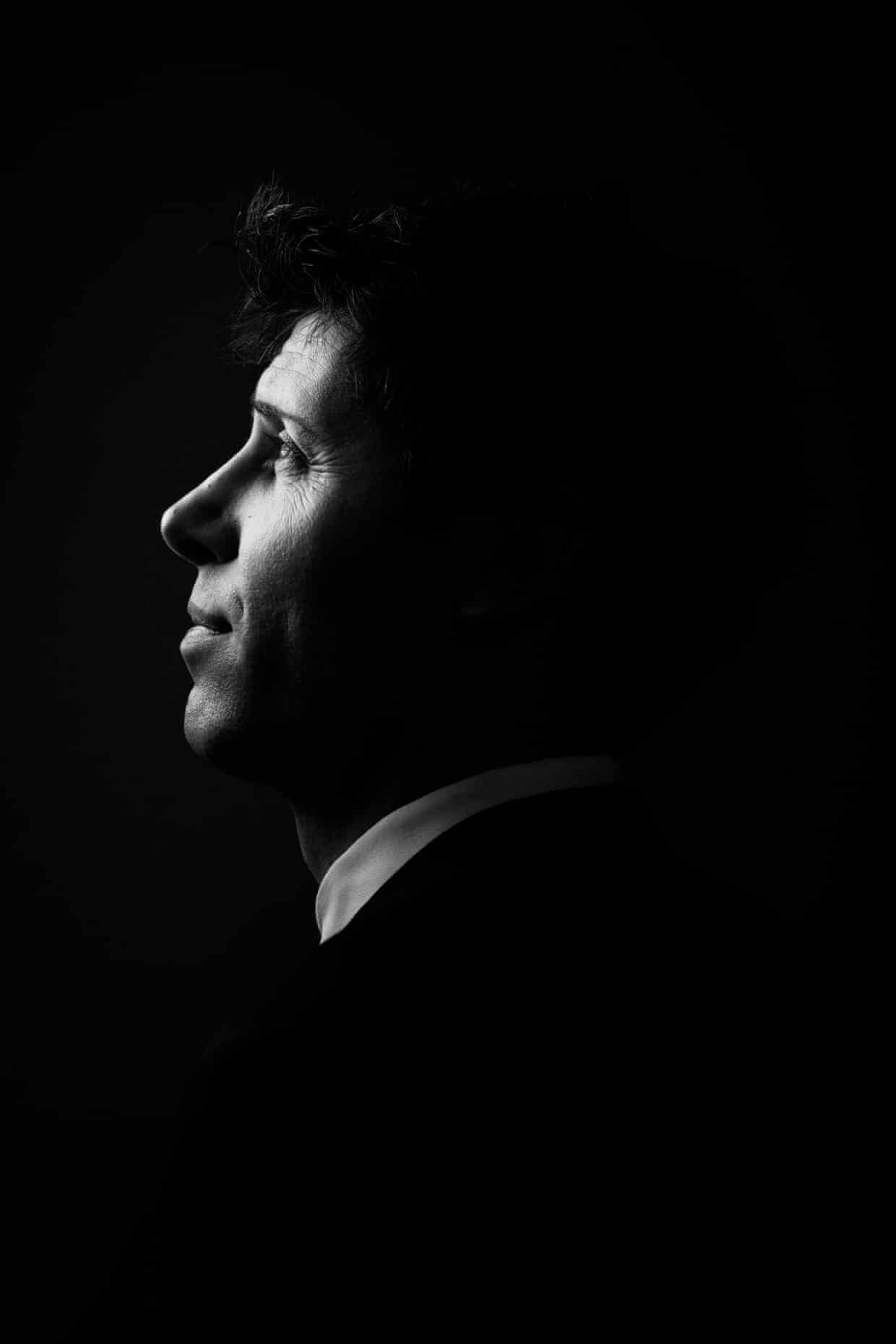
Sam Altman has claimed over the years that the advancement of AI could solve climate change, cure cancer, create a benevolent superintelligence beyond human comprehension, provide a tutor for every student, take over nearly half of the tasks in the economy and create what he calls “universal extreme wealth”.In order to bring about his utopian future, Altman is demanding enormous resources from the present.As CEO of OpenAI, the world’s most valuable privately owned company, he has in recent months announced plans for $1tn of investment into datacenters and struck multibillion-dollar deals with several chipmakers.If completed, the datacenters are expected to use more power than entire European nations.OpenAI is pushing an aggressive expansion – encroaching on industries like e-commerce, healthcare and entertainment – while increasingly integrating its products into government, universities, and the US military and making a play to turn ChatGPT into the new default homepage for millions.
Altman’s long bid to make himself the power broker of a new, AI-powered society has started to look closer to reality as a large portion of the US economy now rides on the success of his vision,There are reports the company is preparing to go public towards the end of 2026 with up to a $1tn valuation in one of the biggest initial public offerings in history,OpenAI and Altman’s burgeoning empire is not going unchallenged,Google’s rival Gemini AI chatbot is advancing fast enough that Altman last month issued a company-wide “code red” to refocus on ChatGPT,Many analysts have become concerned that OpenAI may be becoming too big to fail as it expands its infrastructure and computing spending, while circular funding deals with partners have not assuaged those fears.
Then there is the fact that OpenAI is burning through tens of billions of dollars, with even its own optimistic forecasts showing the startup is years from becoming profitable.In an effort to maintain investor confidence in this profit-free spending spree and avoid regulatory crackdowns, Altman has intensified a charm offensive over the past year, deepened his political connections and promised even more from OpenAI – with the company claiming that AI will soon be a utility “on par with electricity, clean water, or food”.The CEO has also expanded his personal portfolio, backing new energy and neuroscience technologies just as other tech moguls have.This year will test: can he maintain the relentless balancing act?As OpenAI sought to shift its main business to a for-profit corporation in 2025 and faced down attempts from states across the US to pass AI regulation, it greatly expanded its efforts to influence lawmakers.The company spent $2.
99m on lobbying efforts in 2025, according to Lobbying Disclosure Act filings, with its spending ramping up in the latter half of the year.That number is up from $1.76m in lobbying the previous year and just $260,000 in 2023.The push for friendly policies continues after Trump handed the industry a victory with an executive order that preempts and precludes any state-level regulation of AI.Other AI companies have followed suit, with Anthropic spending a little over $3.
1m during that same period.OpenAI also hired consultants and lobbyists from across the political spectrum, including those who have worked for California governor Gavin Newsom and former New York City mayor Bill de Blasio.They have also brought on the former deputy chief of staff for Republican senator Lindsey Graham and a former staffer from the Senate foreign relations committee.The company’s most effective campaigner does not hail from K Street, however.It has been Altman himself, who has joined other tech moguls in ingratiating themselves with Donald Trump and allying themselves with the current administration.
He has dined with Trump at Mar-a-Lago and appeared at the White House for an event touting the administration’s ties with the tech industry.In September, Altman was one of several tech CEOs who joined Trump and King Charles for a state dinner in the UK.As investors increasingly warn the AI industry is a bubble, with excessive investment in tech infrastructure for unclear payoff, Altman has conceded that some parts of the industry “are kind of bubbly right now”.Yet he has continued to emphasize that OpenAI remains on steady ground and that its $1.4tn commitment to build out datacenters and computational power is necessary.
His message is part of a longstanding emphasis on scaling computational power and pursuing growth that has been a fixture of OpenAI since its early breakthroughs in the mid-2010s.It is also in keeping with a sentiment that Altman has expressed for years – that technological progress is inevitable despite the harms that it may create.“We should understand that as a consequence of technology and an economy of ideas, the gap between the rich and the poor will likely increase from its already high-seeming levels,” Altman wrote in 2013, in a blog post that thanked his friend Peter Thiel for ideological input.“There is good and bad to this, but we should be careful not to legislate against it, which will hurt growth.”More than a decade later, Altman’s views on how technological change may affect society seem consistent.
“There will be very hard parts like whole classes of jobs going away,” Altman wrote in a July blog post.“But on the other hand the world will be getting so much richer so quickly that we’ll be able to seriously entertain new policy ideas we never could before.”In a lengthy post on X in November, Altman defended OpenAI against accusations it was becoming “too big to fail” or seeking government backstops for its investments.Altman went on the defensive after the company’s CFO Sarah Friar spooked analysts with a suggestion that OpenAI could seek government aid, which she then hastily reversed amid widespread pushback.Altman predicted that OpenAI would generate hundreds of billions in revenue by 2030, potentially branching into consumer devices and robotics amid “massive demand” for AI.
He also downplayed the fallout if the company were to fail, which analysts fear would have a devastating effect on the economy.“That’s how capitalism works, and the ecosystem and economy would be fine,” Altman posted.“We plan to be a wildly successful company, but if we get it wrong, that’s on us.”Altman’s appearances and apparent friendliness are a stark turnaround from his earlier view of Trump, which he expressed in a mid-2016 blog post that likened Trump’s rise to Hitler’s.“To anyone familiar with the history of Germany in the 1930s, it’s chilling to watch Trump in action,” Altman wrote in 2016 prior to Trump’s election win.
“He is not merely irresponsible.He is irresponsible in the way dictators are.”But as Trump’s second term began, Altman posted a message lauding the president and recanting his previous opposition.“Watching @potus more carefully recently has really changed my perspective on him (i wish i had done more of my own thinking and definitely fell in the npc trap),” Altman posted on X days after Trump’s inauguration.“I’m not going to agree with him on everything, but i think he will be incredible for the country in many ways!”Altman and OpenAI have found a warm welcome in the Trump administration.
The White House’s attempts to show off economic growth and win in a technology race with China have led it to embrace OpenAI, while the Department of Defense awarded a $200m contract to the company in June for it to develop AI solutions for “warfighting and enterprise domains”.“The AI future is not going to be won by hand-wringing about safety,” JD Vance said in a speech at a summit on artificial intelligence in February.The White House has not leant a friendly ear to lawmakers calling for the regulation of AI.Altman’s shift on Trump has come not only as tech has lurched to the political right but also as OpenAI faces growing pushback, including lawsuits from families alleging that its ChatGPT service encouraged users to kill themselves, numerous copyright infringement lawsuits and concern over data centers’ rising energy costs.While Altman has long made broad calls for some form of regulation on AI, he has eased off calls for oversight over the past year and said that requiring government sign-off to release AI models would be “disastrous”.
In friendlier environments, the CEO has framed mitigating AI’s harms as something that is a burden for regulators and users.Shortly after the launch of OpenAI’s video app Sora, which drew sizable backlash over generating deepfakes of historical figures such as Martin Luther King Jr and its potential for creating misinformation at scale, Altman seemed unconcerned with AI video’s implications.“Very soon the world is going to have to contend with incredible video models that can deepfake anyone or kind of show anything you want.And that will mostly be great,” Altman said on the venture capital firm Andreessen Horowitz’s podcast in October.“There will be some adjustment that society has to go through.
”He did not speak much about regulation, which he said “probably has a lot of downside”,“I expect some really bad stuff to happen because of the technology, which also has happened with previous technologies,” Altman said,“All the way back to fire,” Ben Horowitz, the firm’s co-founder, replied,While Altman has been traveling the world as a frontman for OpenAI and generative AI writ large, he has also been building out his own portfolio of investments, which offers a sense of where he thinks the world is heading,Altman is a big proponent of nuclear technology and has called past bans on nuclear energy over safety concerns “incredibly dumb”.
He has financially backed the nuclear energy startup Helion, which in July announced it had begun construction on a nuclear fusion power plant intended to feed Microsoft’s enormous data centers – despite the fact that the fusion technology that will presumably fuel the plant is still unproven.Altman also served as chair of the board for nuclear energy startup Oklo until April of last year, with the firm’s COO announcing that his departure meant the company could potentially partner with OpenAI in the future.Biotech, a common interest among Silicon Valley elites, has also attracted Altman.One of his investments is in Retro Biosciences, a longevity startup that he backed with $180m that is aiming to launch clinical trials this year on a pill intended to have antiageing effects on the brain.He has co-founded Merge Labs, a rival to Musk’s Neuralink brain startup, which raised $252m in funding this month and announced it would collaborate with OpenAI.
“I think neural interfaces are cool ideas to explore.I would like to be able to think something and have ChatGPT respond to it,” Altman told the Verge last year.Meanwhile, one of Altman’s longstanding ventures, Tools for Humanity, has been on a years-long effort to scan a billion people’s eyeballs using a biometric collection device called the “orb”.The data would then be used to verify human identity online.It has so far scanned roughly 17.
5 million people, according to Business Insider.Altman’s other interests have tended to fall into some of the tech elite’s usual preoccupations, including at one point saying he was dabbling in doomsday prepping, as well as meditating with Silicon Valley’s favorite Buddhist monk and mindfulness author Jack Kornfield.In 2023, Kornfield said during an interview alongside Altman that the tech mogul once asked him how it would be possible to know when AI became conscious.Kornfield suggested the two “lay down a mat between some servers and take a good dose of psilocybin and see if it answers us”.This article was amended on 26 January 2026 to correct some misspellings of Jack Kornfield’s surname.
Gold soars past $5,100 an ounce, silver hits new record on tariff and US shutdown fears – as it happened
Wall Street stocks have risen, at the start of a week of big tech earnings and a closely watched US Federal Reserve policy decision (no change in interest rates is expected).The Dow Jones rose by more than 200 points, or 0.45%, the S&P 500 gained 27 points, up 0.4%, and the tech-heavy Nasdaq climbed more than 50 points, or 0.2%
UK’s biggest private hospital provider Spire in talks on sale to private equity
The UK’s biggest private hospital provider, Spire Healthcare, is in talks about a sale to private equity that could lead to it being delisted from the London Stock Exchange.The company, which owns the Claremont hospital in Sheffield and St Anthony’s hospital in south London, said on Monday that Bridgepoint Advisers and Triton Investments Advisers were “amongst the parties” with which it was in talks.Its shares jumped 18%, making Spire the top riser on the FTSE 250 on Monday and valuing the company at nearly £850m.Spire said talks were at an early stage, adding: “There can be no certainty that any offer will be made.”It first announced a strategic review of its operations in September, saying it was in discussions with several parties to explore options including a potential sale of the business
EU launches inquiry into X over sexually explicit images made by Grok AI
The European Commission has launched an investigation into Elon Musk’s X over the production of sexually explicit images and the spreading of possible child sexual abuse material by the platform’s AI chatbot, Grok.The formal inquiry, launched on Monday, also extends an investigation into X’s recommender systems, algorithms that help users discover new content.Grok has sparked international outrage by allowing users to digitally strip women and children and put them into provocative poses. Grok AI generated about 3m sexualised images in less than two weeks, including 23,000 that appeared to depict children, according to researchers at the Center for Countering Digital Hate.The commission said its investigation would “assess whether the company properly assessed and mitigated risks” stemming from Grok’s functionalities in the EU, including risks on the sharing of illegal content such as manipulated sexually explicit images and “content that may amount to” child sexual abuse material
Georgia leads push to ban datatcenters used to power America’s AI boom
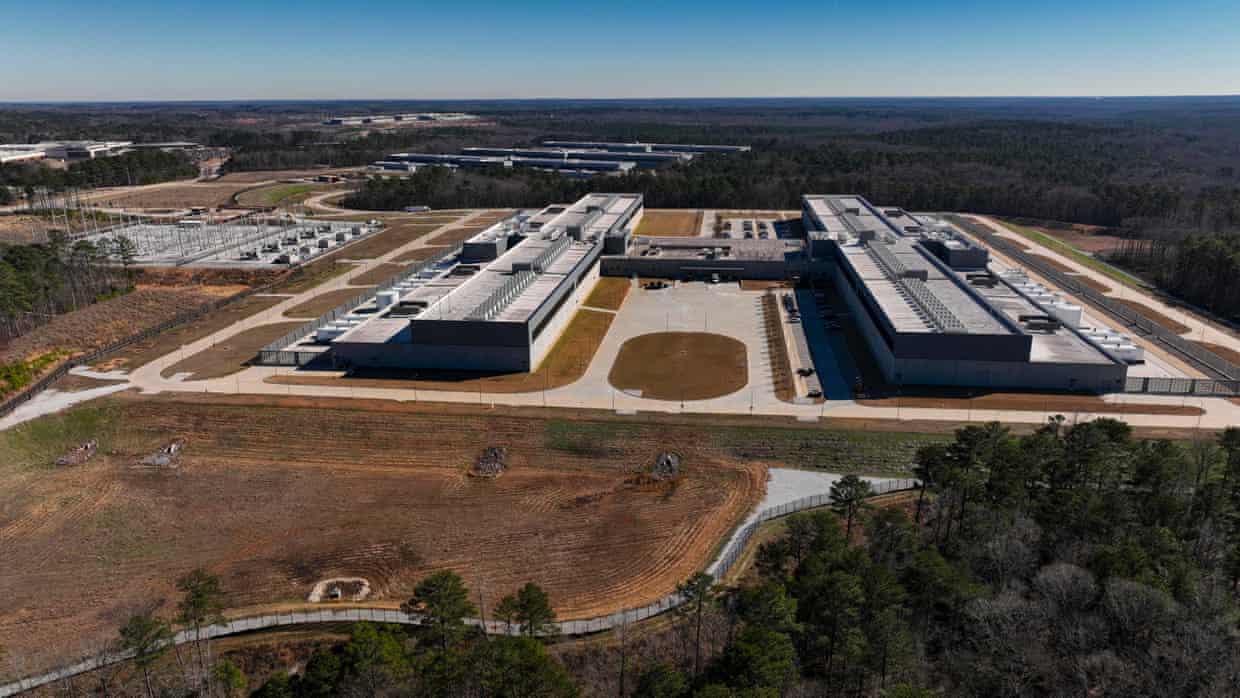
Lawmakers in several states are exploring passing laws that would put statewide bans in place on building new datacenters as the issue of the power-hungry facilities has moved to the center of economic and environmental concerns in the US.In Georgia a state lawmaker has introduced a bill proposing what could become the first statewide moratorium on new datacenters in America. The bill is one of at least three statewide moratoriums on datacenters introduced in state legislatures in the last week as Maryland and Oklahoma lawmakers are also considering similar measures.But it is Georgia that is quickly becoming ground zero in the fight against untrammelled growth of datacenters – which are notorious for using huge amounts of energy and water – as they power the emerging industry of artificial intelligence.The Georgia bill seeks to halt all such projects until March of next year “to allow state, county and municipal-level officials time to set necessary policies for regulating datacenters … which permanently alter the landscape of our state”, said bill sponsor state Democratic legislator Ruwa Romman
Ruud makes timely exit from Australian Open as Shelton storms into last eight
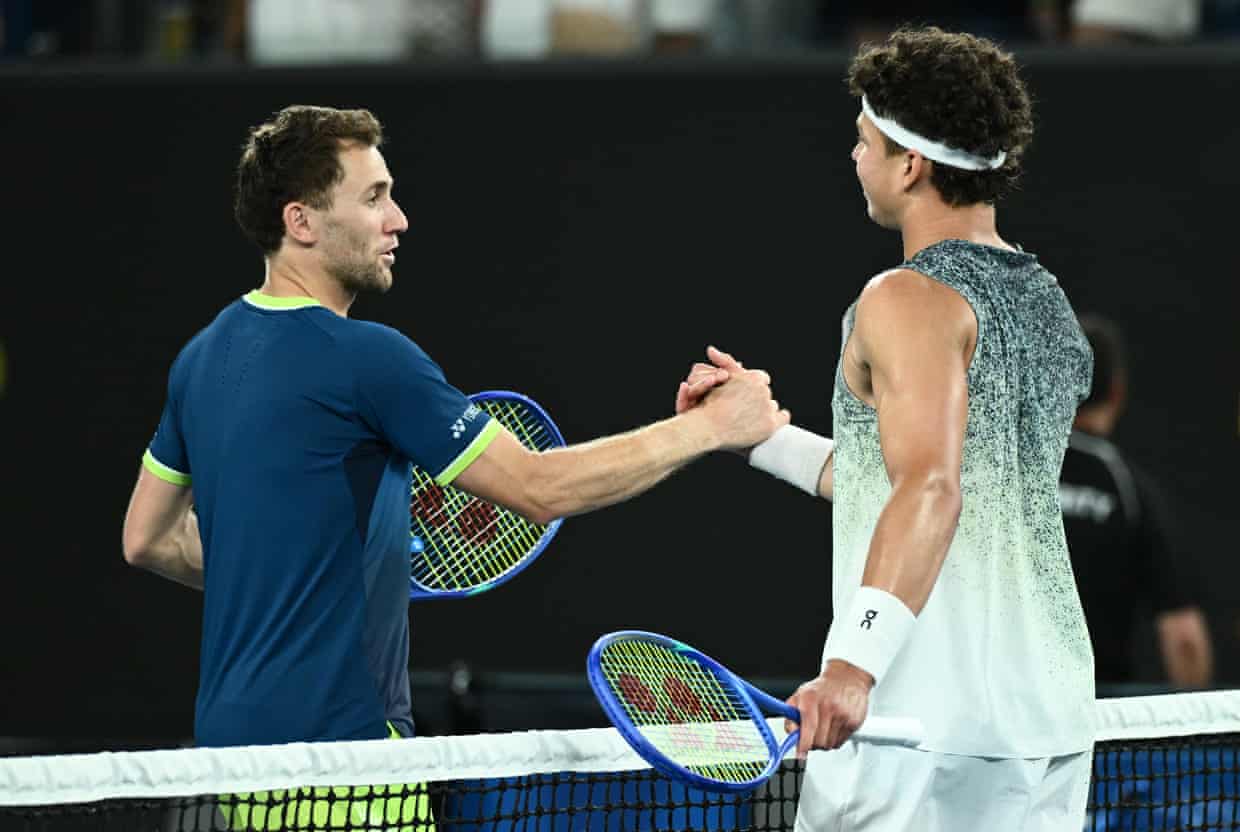
Casper Ruud suffered a frustrating 3-6, 6-4, 6-3, 6-4 defeat to Ben Shelton in the fourth round of the Australian Open on Monday night, but the silver lining of the three-time grand slam finalist’s loss is that he will finally be able to return home.Ruud, the 12th seed, has had one eye on events back home during his time in Melbourne owing to the fact that his wife, Maria, is heavily pregnant with their first child and is due to give birth this weekend. Ruud had repeatedly stated that he would withdraw and immediately begin the long journey home to Norway if she went into labour during the tournament.Ruud said last week: “She’s due later in the tournament, so we’ll see. It’s not until the final weekend of the tournament, the due date

Always in reserve: Dawson’s moment beckons at T20 World Cup after decade ‘on call’ for England
Liam Dawson watched as England won two World Cups and reached the final in another but his global tournament debut will surely come against Nepal on 8 FebruaryLiam Dawson has been around for England’s finest white-ball moments in the last decade. He was an uncapped inclusion in the 2016 World T20 touring party, when Eoin Morgan’s fresh-faced team were denied right at the end by Carlos Brathwaite’s remember-the-name sixes. He was there as a squad member on that golden day at Lord’s in 2019, too, and a travelling reserve when England won the T20 World Cup in Australia three years later.But, remarkably, the 35-year-old is still waiting for his debut at a global tournament. It’s been an international career spent on call, limited to 33 appearances across formats, his left-arm spin and handy batting there to use in case of emergency
Labour’s Burnham veto has made a tricky Manchester byelection much harder
Rebuffed Burnham can return to honing his stature and attack lines
Sajid Javid calls on Nigel Farage to apologise for alleged schoolboy racism
Starmer had no good options on Burnham – but blocking him is a big risk
Labour must avoid ‘psychodrama’, says Mahmood, as NEC meets to decide if Burnham can stand

Meet ‘Amelia’: the AI-generated British schoolgirl who is a far-right social media star