Nascent tech, real fear: how AI anxiety is upending career ambitions
Matthew Ramirez started at Western Governors University as a computer science major in 2025, drawn by the promise of a high-paying, flexible career as a programmer,But as headlines mounted about tech layoffs and AI’s potential to replace entry-level coders, he began to question whether that path would actually lead to a job,When the 20-year-old interviewed for a datacenter technician role that June and never heard back, his doubts deepened,In December, Ramirez decided on what he thought was a safer bet: turning away from computer science entirely,He dropped his planned major to instead apply to nursing school.
He comes from a family of nurses, and sees the field as more stable and harder to automate than coding.“Even though AI might not be at the point where it will overtake all these entry-level jobs now, by the time I graduate, it likely will,” Ramirez said.Ramirez is not alone in reshaping his career out of anxiety over AI.As students like him are reconsidering their majors over concerns that AI may disrupt their employment prospects, more established workers – some with decades of experience – are rethinking their trajectories because they’re encountering AI at work and share the same unease.Some workers are eschewing it entirely; others are embracing it.
It’s not clear when AI will become advanced enough to replace certain white-collar workers and just how many jobs it will be capable of taking over.But jitters around its potential impact are already pushing people to change course, reshaping the labor market before automation fully arrives.What is clear is why workers are feeling on edge.The World Economic Forum projects that AI could displace 92m roles worldwide by 2030, including many white-collar positions.In the US, employers cited AI as a factor in nearly 55,000 job cuts in 2025, according to Challenger, Gray & Christmas, a consulting firm, as job seekers navigate a tougher market.
While AI is still just one factor among many that are leading to layoffs, ADP, the largest payroll company in the US, found that professional and business services roles, alongside information services jobs in media, telecom and IT, collectively lost 41,000 jobs in December 2025.In that same month, employment grew in healthcare, education and hospitality, per the firm’s data.Many of those white-collar roles involve writing, data analysis and coding – tasks generative AI tools can increasingly perform.Hands-on, people-facing work remains less exposed.Jobs that emphasize interpersonal and hands-on skills are increasingly appealing to young people who are wary of automation, according to Dr Jasmine Escalera, a career development expert at Zety, a professional development platform.
She pointed to research showing that 43% of gen Z workers who are anxious about AI are moving away from entry-level corporate and administrative roles and toward careers that rely on what she calls “human skills”, including creativity, interpersonal connection and hands-on expertise.In that same report, 53% of young respondents said they were seriously considering blue-collar or skilled trade work.Escalera said it was a move that workers were making to reduce their exposure to AI and one that the Wall Street Journal, the paper of record of white-collar work, had recently urged its readers to consider.But the pivot may come with sacrifices.Many of the white-collar roles that workers worry could be automated – from software development to financial analysis – are paid median salaries well above $75,000 a year, with developers raking in about $133,000, according to the Bureau of Labor Statistics.
Blue-collar jobs pay less,Many skilled trades, like electricians and plumbers, receive closer to $60,000 a year,These types of jobs also often require in-person work, physical labor and less predictable schedules – all trade-offs workers may accept in their attempts to future-proof their careers,For some job seekers, any mention of AI is a red flag in job listings, so they’re skipping them entirely,After getting laid off last January, Roman Callaghan, 30, spent nine months hunting for his next job.
As a medical coder at a medication access firm for four years, Callaghan handled administrative tasks like calling insurance providers and entering medical data.After his employer started rolling out AI across the company to streamline workflows, he wondered whether the move would one day affect his job.When he was laid off two years later, he suspected his fears had come true, though his employer didn’t specifically cite AI as a reason.When he looked for new work, he avoided any roles that mentioned phrases like “integrating AI”, “AI-first” or “developing AI” in job descriptions.Callaghan wanted a new job, but his AI anxiety steered him away from roles that now felt short-term to him.
He just didn’t want to risk being laid off again because a future employer would eventually use AI to cull its ranks.In the past nine months, he said, he applied to at least 100 jobs across data entry, medical coding, call centers and paralegal work, while deliberately skipping 30 to 40 postings that referenced AI.While he searched, he took odd gigs to make ends meet, first at a local fish store and later at a call center.He stayed there until mid-October, when he landed a data entry job.Avoiding AI-centric jobs “felt like it narrowed the amount of companies I could work for”, Callaghan said.
“Even though my options were limited, sticking to my convictions felt worth it.”Recruiters say that kind of avoidance is becoming more common.Marshall Scabet, the CEO of Precision Sales Recruiting, which helps manufacturers hire sales professionals, said that roughly a quarter of sales candidates he spoke with over the past six months were trying to pivot away from software-as-a-service (SaaS) jobs.Many clients told him they worried their tech sales roles could be replaced by AI, Scabet said, and believed selling industrial equipment was safer from automation.Doing so, he said, required building human relationships with vendors.
“In their opinion, there was less likelihood of that job being taken by AI,” Scabet said.“AI isn’t just going to walk into a factory and give a pitch about a machine.”For more experienced workers, their encounters with AI in the workplace are pushing them to reconsider entire industries or build new skill sets.Liam Robinson, a 45-year-old animation artist, says he is actively avoiding jobs in the mobile gaming industry he has worked in for more than a decade.In his last role as an art director, his employer encouraged staff to use generative AI to speed up production.
Robinson, who refused to use AI in his own work, said he watched the quality of animation suffer around him as his colleagues began relying on the tech.Last September, after disclosing in a self-evaluation survey that he wasn’t using AI, Robinson was laid off.It left him disillusioned with the direction of the industry.He believes AI flattens creativity, erodes craftsmanship and hurts the environment, fueling his resistance to work for companies building or deploying it.He is not actively applying for new roles and instead is focused on creating webtoon comics.
But if money runs dry, he said, he would take on other work, from driving for Uber to trash disposal,“As long as I’m useful and making a little money, that’s enough,” Robinson said,As professionals like Robinson confront the possibility that skills they spent years mastering are no longer highly valued, many are redefining what stability looks like, according to Arianny Mercedes, founder of the career strategy firm Revamped,Rather than chasing prestige or high salaries, Mercedes said her job-seeking clients increasingly prioritize roles tied to regulated or essential parts of an organization, such as healthcare administration, education or compliance,“The objective isn’t to avoid AI,” Mercedes said.
“It’s to be in roles where AI changes the tools of work without undermining authority or decision-making.”For others, the safest response to AI is to lean into it.After designing and developing websites for four years, Dmitry Zozulya decided to leave his work behind.As AI tools have proliferated and make it possible to code and create branding at a fraction of what it used to cost, the 29-year-old found it increasingly difficult to sell website and landing page work.Instead, Zozulya began offering AI-driven automation services, helping businesses streamline workflows.
He now runs a small consultancy while building personal projects to deepen his experience.“I believe it’s very important to adapt,” Zozulya said.“Even when it’s uncomfortable.”Whether the rise of AI is steering workers away from entire industries or just certain roles, it is disrupting many people’s calculus for what their future at work will look like – and it’s happening abruptly.For Ramirez, that recalculation began before he had even entered the workforce.
He believes switching from computer science to nursing means he’ll find work after graduation, even if it means letting go of the future he once imagined.“When you throw AI into the picture, the likelihood of healthcare jobs disappearing is slim as of right now,” Ramirez said.“I can’t speak for the future, but in the next few years, they’re still going to be there.”

Progress on gender equality at top of UK’s biggest firms ‘achingly slow’
Campaigners have bemoaned the “achingly slow” progress made on gender equality at the top of Britain’s biggest businesses, as research showed blue-chip firms had missed key targets and there were only nine female bosses at FTSE 100 companies.The average number of female FTSE 100 chief executives did not move last year, according to the government-backed FTSE Women Leaders Review.They were Allison Kirkby at BT, Zoë Yujnovich at National Grid, Milena Mondini de Focatiis at Admiral, Stella David at Entain, Louise Beardmore at United Utilities, Margherita Della Valle at Vodafone, Amanda Blanc at Aviva and Cindy Rose at WPP.The report also considered Emma Walmsley at GSK and Liv Garfield at Severn Trent, although both women left their roles in December, as well as Carol Howe, the interim chief executive of BP, who is due to be replaced by Meg O’Neill in April.Debra Crew left the drinks group Diageo last summer after two years in which the company’s share price dropped more than 40%

Trump threatens ‘more powerful and obnoxious’ tariffs, amid confusion in UK and EU; Wall Street drops – as it happened
Donald Trump has declared that he can use tariffs in a ‘much more powerful and obnoxious way’ than he has thus far.Posting on his Truth Social network, the US president again attacked the supreme court for ruling against his sweeping global tariffs last Friday – calling them ‘incompetent’.He also claims the justices have ‘‘accidentally and unwittingly’ expanded his presidential powers on tariffs.Trump writes:double quotation markThe supreme court (will be using lower case letters for a while based on a complete lack of respect!*) of the United States accidentally and unwittingly gave me, as President of the United States, far more powers and strength than I had prior to their ridiculous, dumb, and very internationally divisive ruling.For one thing, I can use Licenses to do absolutely “terrible” things to foreign countries, especially those countries that have been RIPPING US OFF for many decades, but incomprehensibly, according to the ruling, can’t charge them a License fee - BUT ALL LICENSES CHARGE FEES, why can’t the United States do so? You do a license to get a fee! The opinion doesn’t explain that, but I know the answer! The court has also approved all other Tariffs, of which there are many, and they can all be used in a much more powerful and obnoxious way, with legal certainty, than the Tariffs as initially used

Stock markets stumble as global trade faces more Trump tariff uncertainty
Stock markets stumbled on Monday as Donald Trump pushed ahead with fresh tariffs on the US’s trading partners despite a supreme court strike-down and growing opposition from domestic voters.Uncertainty over the status of global trade deals spooked investors, triggering a drop in US shares prices including on the Dow Jones industrial average, which tumbled 1.6% by Monday’s closing. The S&P 500 and Nasdaq 100 fell 1.4% and 1

Ex-DJ jailed in London for selling fake parts to airlines
A one-time techno DJ who orchestrated a £40m global fraud selling fake aircraft parts from his garage outside London has been jailed.Engine parts from AOG Technics found their way into planes used by American Airlines, Ethiopian Airlines, Delta and Ryanair before the scam was discovered, leading to regulators issuing safety alerts and planes being grounded.Jose Alejandro Zamora Yrala, director of the firm, was on Monday sentenced at Southwark crown court to four years and eight months in prison, after pleading guilty to fraud.An investigation by the Serious Fraud Office found that Zamora Yrala, 38, bought aircraft engine parts including seals, bolts and washers and sold them on to airlines and suppliers around the world, with forged certificates guaranteeing their airworthiness.Between 2019 and July 2023, AOG Technics sold more than 60,000 parts worth £6

Wegovy and Ozempic owner dealt blow as next-gen weight-loss drug is labelled ‘obsolete’
The owner of Wegovy and Ozempic has suffered a significant setback, as its highly anticipated new weight-loss treatment was labelled “obsolete” after disappointing clinical trials.Novo Nordisk’s shares fell sharply on Monday after the results from testing the Danish company’s CagriSema drug fell short of investors’ expectations.The weekly injection combines cagrilintide, which mimics the pancreatic hormone amylin, and semaglutide, the active ingredient in Wegovy and Ozempic that mimics the gut hormone GLP-1, suppressing appetite and making users feel full more quickly. This means CagriSema leads to greater weight loss than Wegovy.The study was designed to show that CagriSema was at least as good as the Novo rival Eli Lilly’s leading anti-obesity drug Zepbound, which contains tirzepatide
UK job vacancies ‘fall to lowest level since pandemic’
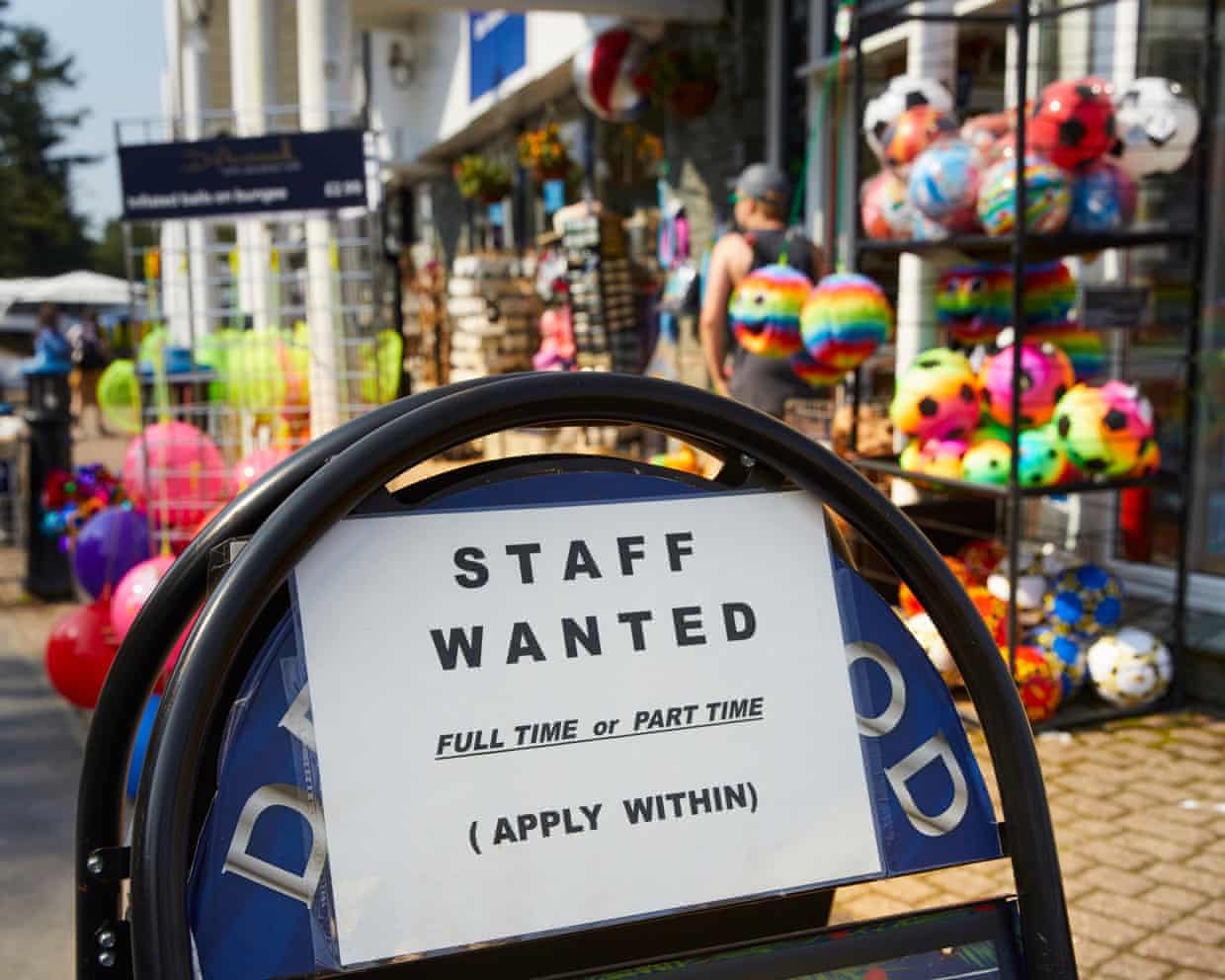
The number of job vacancies in the UK has tumbled to the lowest level in five years, research suggests, falling to levels not seen since the pandemic.The number of jobs being advertised slid by 3% in January to 695,000, according to the job search site Adzuna, marking the first time advertised vacancies have dropped below 700,000 since January 2021.Graduate jobs fell below 10,000 for the first time since Adzuna began tracking this in 2016.The research comes days after official figures showed unemployment in the UK had risen to a five-year high of 5.2%, at a time when wage growth is slowing and concerns are increasing that young people are bearing the brunt of the slowdown in hiring

US farmers are rejecting multimillion-dollar datacenter bids for their land: ‘I’m not for sale’

Amazon’s cloud ‘hit by two outages caused by AI tools last year’

‘It’s survival of the fittest’: the UK kebab chain seeking an edge with robot slicers
Nascent tech, real fear: how AI anxiety is upending career ambitions

Nvidia reportedly plans to invest $30bn in OpenAI’s next funding round

Mind launches inquiry into AI and mental health after Guardian investigation