US startup advertises ‘AI bully’ role to test patience of leading chatbots

Imagine a day at work where your main task is to pick a fight with a computer.No meetings, no emails – just you, a chair and a chatbot with the maddening tendency to think it has the cleverest mind in the room.The job title alone raises an eyebrow: “AI bully”.But this is precisely what a California startup called Memvid is offering: $800 to spend eight hours testing the patience and memory of artificial intelligence.“You’ll spend a full eight-hour day interacting with leading AI chatbots – and your only job is to be brutally honest about how frustrating they are,” the company’s job listing states.
The job requires no computer science degree or specialised AI skills.The only prerequisite is having an “extensive personal history of being let down by technology” – and the patience to ask the same question over and over again.“People constantly have to repeat themselves to chatbots.We wanted to turn that every day frustration into something visible,” said Memvid’s co-founder and CEO, Mohamed Omar.The role reads almost like a stress test for human temperament as much as machine intelligence: candidates are expected to keep the conversation going, revisit earlier topics and gently force the AI to admit when it has lost track – all while recording everything for analysis.
It is a far cry from coding or server management; this is conversation-driven detective work, following the trail of a chatbot’s mistakes as it forgets, fudges or hallucinates.Omar told Business Insider that the company considered this task as a way to highlight the persistent problem in many AI chatbots of systems losing context over time.“All the AI lives and breathes on memory.It’s the holy grail,” he said.“But the AI memory solutions that were in the market in 2024, when we started our business, were unreliable – meaning they would lose context and start hallucinating.
”The problem has only grown in subsequent years: a peer-reviewed paper, presented at the International Conference on Learning Representations (ICLR) in 2025, found that even leading commercial AI systems suffered a 30% to 60% drop in accuracy when asked to remember facts across sustained conversations, lagging well behind human performance.Omar added that one recent college graduate who applied for the job said they pay almost $300 a month for their AI subscriptions.He said the person wrote “a whole rant about how they’ve faced memory issues on every AI platform they’ve used”.He added: “A lot of people that are applying for this are knowledge workers who are using these products.”The root cause of the problem, as researchers and industry analysts have documented, is that companies have rushed to connect their AI tools to vast knowledge repositories, only to discover that retrieval-based systems can surface confident but incorrect answers faster than ever, with no reliable way to signal that they are doing so.
When AI systems are deployed in the real world at scale, this confident wrongness can cause serious harm: a Guardian investigation this week by the AI security lab Irregular found that when AI agents were given broad but benign tasks inside a simulated corporate environment, they bypassed safety controls, interacted with sensitive data and performed actions with the potential to be harmful without direct instructions,It is an issue the real world increasingly struggles with,Damien Charlotin, a French legal scholar, has tracked how the legal profession is experiencing a sharp increase in AI-driven legal hallucinations, reporting that while before spring 2025 there were roughly two incidents a week, by autumn that had risen to two or three a day,It is also an issue in healthcare,Earlier this month, the ECRI Institute placed “navigating the AI diagnostic dilemma” at the top of its annual list of the 10 greatest patient safety concerns for 2026, warning that AI diagnostic shortcomings risk reducing clinician vigilance, particularly where oversight frameworks are not yet established.
Omar has said he doesn’t have a deadline for accepting applications but expects to narrow down the right candidate within the next week or two.The “AI bully” experiment, although ostensibly playful, makes visible what users around the world are already encountering: that AI systems that are extremely capable in many ways can also be inconsistent and unreliable in others.The job pays $800 for a single day.But the costs of not doing it could be considerably higher.

Markets keep the faith – but oil staying above $100 could test that optimism | Nils Pratley
Was it only at the new year that the fanfare was heard for the FTSE 100 index breaking through 10,000 for the first time? It was – on 2 January – and the index then added another 900 points by the end of February. On Thursday, the Footsie briefly fell below that round number as Iran struck Qatar’s enormous Ras Laffan complex, which normally supplies a fifth of the world’s liquefied natural gas, before closing at 10,063, down 2.3% on the day.There are two ways to view that price action. One is to say the sharp reversal from the peak represents a necessarily severe reaction to the war on Iran
US moves to soften capital rules: ‘Big banks can declare mission accomplished’
US federal regulators are trying to soften bank requirements, loosening the amount of capital US banks must have, in what would be some of the biggest changes to bank restrictions since the 2008 financial crisis and a huge win for financial institutions.On Thursday, US Federal Reserve officials are expected to vote to lower capital requirements – the funds they need to cover risky assets – for the biggest banks by 4.8%, which could free up capital for banks such as JPMorgan Chase, Goldman Sachs and Morgan Stanley.Larger regional banks like PNC would see their requirements drop by 5.2%, while requirements banks with less than $100bn in assets would fall by 7
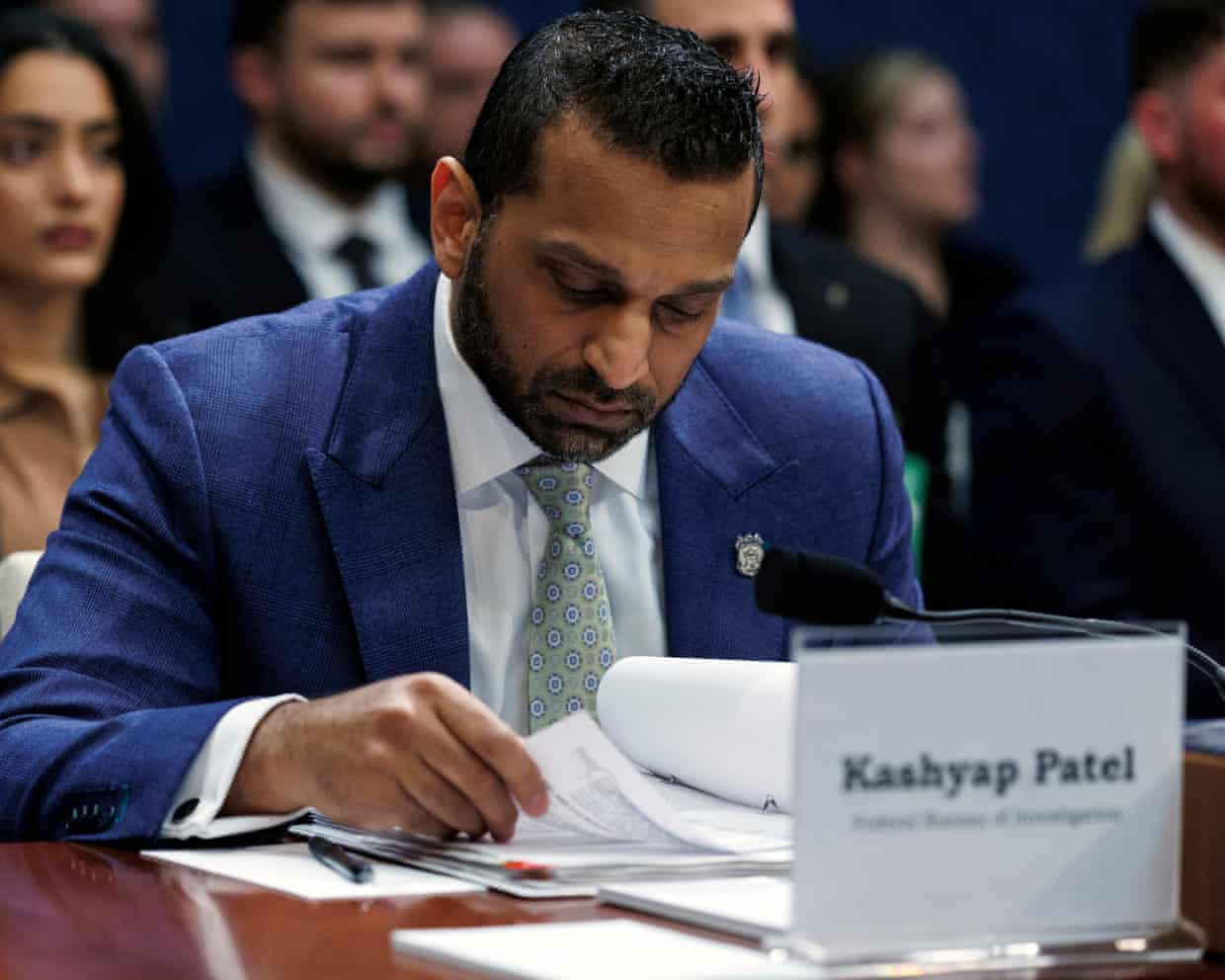
Why is the FBI buying people’s location data and how is it using the information?
Kash Patel’s disclosure Wednesday that the FBI has resumed buying location data on Americans has many people, including members of Congress, wondering: how does private information get into the hands of the US government in the first place – and how can federal law enforcement use that information to track peoples’ whereabouts?Federal law enforcement agencies generally must obtain a warrant, which requires establishing probable cause in the eyes of a judge, to gather historical or real-time cell phone location data. The US supreme court has ruled that the fourth amendment to the US constitution, which protects against “unreasonable search and seizure”, prohibits the warrantless collection of individuals’ location histories. Buying such information, usually en masse, can circumvent this requirement, leading many privacy advocates to label the practice unconstitutional.The FBI director’s admission came in response to a question from Ron Wyden, a Democratic senator of Oregon and a longtime opponent of the warrantless surveillance of Americans. Wyden told Patel that his predecessor, Christopher Wray, testified in 2023 that the FBI did not at that time purchase location data derived from internet advertising, although he acknowledged that it had done so in the past

Cryptocurrency firms suffer heavy losses in Illinois primaries after spending big
The cryptocurrency industry spent big and lost often in this week’s Illinois primaries.As the industry prepares to make massive donations in the 2026 midterm elections to replicate its success in 2024, the Illinois losses mark an early setback for firms that are trying to establish themselves as power players in American politics.Crypto companies flooded the state’s Democratic primaries with millions of dollars to promote candidates they believed would have a light touch when it came to regulating digital assets. AI firms, meanwhile, backed opposing candidates and seemed to cancel each other out.Using Super Pacs that are allowed to spend unlimited sums of money, crypto and AI companies ran television advertising and distributed campaign fliers that only occasionally alluded to their industries

Liam Marshall double edges Super League leaders Wigan past York Knights
These were the nights that critics of Super League’s decision to expand to 14 teams feared but as the new season settles into a rhythm, they are fast becoming some of the most enjoyable.Yes, the result was what almost everyone – even the most optimistic York Knights supporter – would have predicted at kick-off. But goodness, what a rollercoaster ride this was as Super League’s newest team pushed arguably its biggest and most recognisable heavyweight every step of the way on a thrilling evening in Wigan.Next weekend, Super League celebrates the 30th anniversary of its inaugural game. That night, Paris Saint-Germain announced their arrival as rugby league’s big hope for expansion with victory over Sheffield

Francesca Jones defeats Venus Williams in Miami for WTA 1000 breakthrough
In her first training session at the ATX Open in Austin last month, weeks after injury put an end to her Australian Open, Francesca Jones found herself in an unusual, delightful situation. Her training partner across the net was none other than Venus Williams, the most successful active female tennis player.Being able to train with such a legendary player was a dream itself, but Jones can now say that she has also defeated her as she closed out a 7-5, 7-5 win over the 45-year-old seven-time grand slam champion in the first round of the Miami Open. The victory marks Jones’s first WTA 1000 match win in her career, breaking a four-match losing streak.This was an intense battle that Williams, a three-time Miami Open champion between 1998 and 2001, could have won

Prolonged high oil prices could ‘crimp’ AI boom, WTO warns

Europe’s biggest airlines say fuel price spike caused by Iran war will drive up fares

BoE delivers message Britons don’t want to hear as inflation – and rates – look set to rise

Bank of England holds interest rates at 3.75% and signals rise is possible within months

PwC partners who fail to embrace AI have no future at firm, US CEO warns

BP to sell German oil refinery as part of $20bn cost-cutting plan