Inside China’s robotics revolution
Chen Liang, the founder of Guchi Robotics, an automation company headquartered in Shanghai, is a tall, heavy-set man in his mid-40s with square-rimmed glasses.His everyday manner is calm and understated, but when he is in his element – up close with the technology he builds, or in business meetings discussing the imminent replacement of human workers by robots – he wears an exuberant smile that brings to mind an intern on his first day at his dream job.Guchi makes the machines that install wheels, dashboards and windows for many of the top Chinese car brands, including BYD and Nio.He took the name from the Chinese word guzhi, “steadfast intelligence”, though the fact that it sounded like an Italian luxury brand was not entirely unwelcome.For the better part of two decades, Chen has tried to solve what, to him, is an engineering problem: how to eliminate – or, in his view, liberate – as many workers in car factories as technologically possible.
Late last year, I visited him at Guchi headquarters on the western outskirts of Shanghai,Next to the head office are several warehouses where Guchi’s engineers tinker with robots to fit the specifications of their customers,Chen, an engineer by training, founded Guchi in 2019 with the aim of tackling the hardest automation task in the car factory: “final assembly”, the last leg of production, when all the composite pieces – the dashboard, windows, wheels and seat cushions – come together,At present, his robots can mount wheels, dashboards and windows on to a car without any human intervention, but 80% of the final assembly, he estimates, has yet to be automated,That is what Chen has set his sights on.
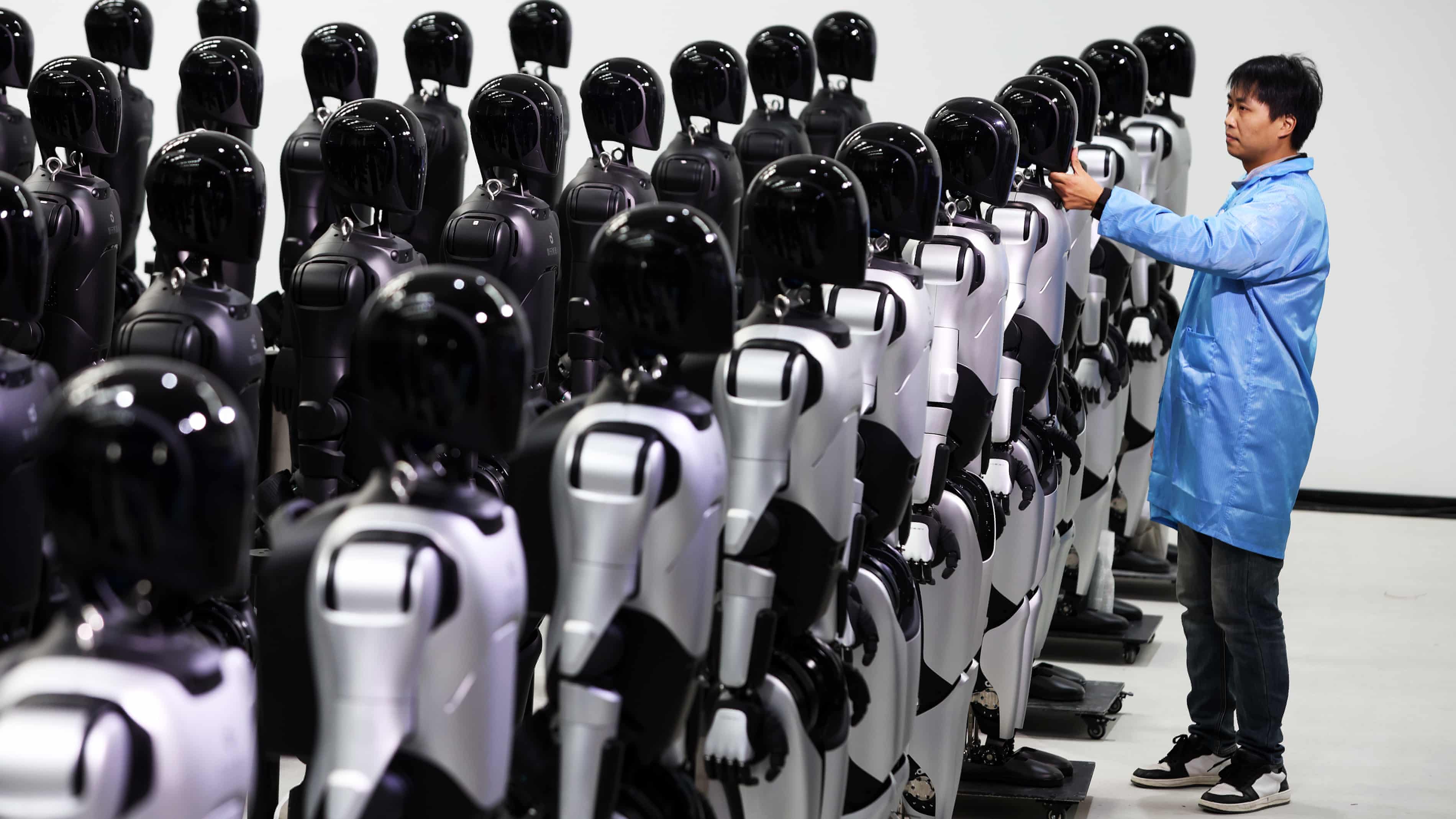
As in much of the world, AI has become part of everyday life in China.But what most excites Chinese politicians and industrialists are the strides being made in the field of robotics, which, when combined with advances in AI, could revolutionise the world of work.The technology behind China’s current robotics boom is deep learning, the mathematical engine behind large language models such as ChatGPT, which learn by discerning patterns from huge datasets.Many researchers believe that machines can learn to navigate the physical world the way ChatGPT learned to navigate language: not by following rules, but by absorbing enough data for something like human dexterity to emerge.The aim, for many technologists, is the development of humanoid robots capable of performing factory labour – work that employs hundreds of millions of people worldwide.
The resources being pumped into achieving this goal are staggering.In 2025, China announced a £100bn fund for strategic technologies including quantum computing, clean energy and robotics.Major cities have invested their own resources into robotics projects, too.There are now roughly 140 Chinese firms hoping to build humanoids.Some of the frontrunners made their debut in February, at the lunar new year festival gala, a state-choreographed spectacle loosely comparable to the Super Bowl in terms of bombast and national significance.
Hundreds of millions watched as robots performed comedy sketches and martial arts routines.The speed of progress has been startling.Last year, the robots were doing a synchronised cheerleading routine.This year, they did cartwheels and parkour.The intended message was clear: the robots are coming, and China will be the nation building them.
A world in which AI-powered humanoid robots are produced at scale still seems to belong in the realm of science fiction.Late last year, I visited 11 robotics companies in China across five cities to try to grasp just how close we are to the robot future.I met many ambitious entrepreneurs, who were operating in an environment so deeply integrated with municipal governments that the distinction between private and public was losing its meaning.All of them were engaged, in different ways, in the race to build and commercialise robots capable of replacing human workers – and some of them already have eager western buyers.Inside one of the Guchi Robotics warehouses, a team of employees from General Motors was testing Guchi’s wheel-installation machines ahead of a shipment to Canada.
The hull of a white GM truck occupied a raised platform at the centre of the room.The truck, surrounded by four large robotic arms and a jungle of wires, sat inside a yellow safety enclosure made of steel bars.I watched on the sidelines as a bearded GM engineer tinkered with a control panel outside the steel cage.The engineer, an American man whom I’ll call Jack, worked in GM’s “manufacturing optimisation” division.“To be grim, anything that eliminates people from the production line is basically my job,” Jack told me.
General Motors sets job-reduction targets for his division each year, he said, which requires eliminating a set number of factory workers across all plants in North America.His team chose Guchi over a German-based competitor – itself 95% owned by a Chinese company – because the other couldn’t offer a moving assembly line, Jack explained.The purchase of the Guchi machines, he said, would eliminate 12 assembly operators on the line at a single factory.(General Motors did not confirm the job-reduction targets, but a spokesperson said it implements technology to help improve safety, efficiency and quality, “particularly for physically demanding or repetitive tasks.”)An irony of the Trump administration’s mission to revive industrial production within the US is that much of the machinery required to make America great again comes from the country that motivated America’s industrial revival in the first place.
China now accounts for more than half of the world’s new factory robot installations annually.Chen thinks Chinese and American engineers are comparable in skill and talent.“The difference is really just cost and speed, and how many people you can throw at a problem – we might have 1,000 who can do this work, and they might have 100,” he said.Chen and I walked to the end of the warehouse, where we now had a frontal view of the GM truck.After watching Jack work for a bit, Chen pointed me to the robotic arms on each side of the car body: “You see those? This is the screwdriving robot.
Even if manufacturing does come back to North America, they won’t be putting workers on the line to fasten screws any more.They’ll use robots.”I wasn’t so sure.Wasn’t one reason that Americans elected Trump because they wanted their blue-collar jobs back? Chen thought this was pure illusion.The world had changed, and so had young people.
Chen told me to think about China, where factory culture is deeply ingrained but young Chinese are increasingly reluctant to tolerate the drudgery,“It’s just how people are wired now,” If even Chinese people aren’t willing to do factory work any more, Chen was saying, why would Americans?One week after my visit to Guchi HQ, I met Chen in north-west Beijing, where the city’s top universities are located,He had invited me to a meeting at the head office of Galbot, one of China’s most hyped humanoid robotics startups,One of its wheeled humanoids appeared in a skit at this year’s lunar new year jamboree, where it handed a male actor a bottle of water from a shelf and folded laundry.
Since its founding in 2023, Galbot has pursued a less showy strategy than many of its competitors: building robots that can perform mundane tasks such as picking up items and setting them down elsewhere safely and reliably.The founder, Wang He, told a Chinese reporter recently that their robots are already deployed in several Chinese car factories, though videos appear to show them in highly controlled settings.Galbot’s “pick-and-place” robots might seem a lot dumber than their backflipping rivals, but a crucial difference is that the robot acrobats operate according to pre-programmed instructions: they are feats of motion control and balance, but they do not go off-script.The kind of technology being developed at Galbot is what roboticists call a vision-language-action model (VLA), which aims to allow machines to operate in unfamiliar and fluid environments, just as humans do.For now, Galbot’s robots cannot reliably do what, for humans, would be trivial tasks – say, washing the dishes – but Wang, has told Chinese reporters he aims to have 10,000 robots handling basic retail and factory work in three years.
(Some AI pioneers, such as Yann LeCun, are extremely sceptical that the current paradigm of deep learning will deliver the results companies such as Galbot hope for,)The purpose of Chen’s visit was to see how Galbot’s robots could be deployed inside an electric vehicle factory, one of the most complex manufacturing environments in the world,Such a feat requires training the robots on a glut of factory scenarios, but there is no ready-made database waiting to be drawn upon,For Galbot to have any chance of deploying their robots in a factory, they need a specialist with decades of complex manufacturing experience who can define the right tasks for the humanoid, what data it needs to learn, and even fill in what the robot cannot yet do,That is what Chen offers to do.
We rode an elevator up to the top of a tower, and filed into a meeting room with a view of Peking University’s lush green campus.A senior Galbot engineer arrived soon after and began to give Chen an overview of the company’s latest developments.Galbot robots had recently been deployed in 10 pharmacies around Beijing, he said, dispensing medication 24 hours a day.Powered by Nvidia chips, they cost about 700,000 yuan (£76,000).At one point, the engineer paused on a slide discussing the technology behind Galbot’s humanoids.
Before the rise of deep learning, the engineer pointed out, industrial roboticists like Chen trained their machines by hand.Programmers wrote explicit instructions for every movement.When something went wrong, they debugged the code and added another line to handle new scenarios.Deep learning promises to replace handwritten instructions with the more flexible VLA model.A prime bottleneck to creating such models – a big reason why the “ChatGPT moment” for robots hasn’t yet arrived – is the scarcity of data.
Researchers have two ways to collect this data.One is through a manual process called teleoperations, where humans guide a robot to do a precise task sometimes hundreds of thousands of times.Each task records a package of data, including visual information, hand positioning, torque, depth, among others, called an “action sequence” that will later be used to train the VLA.The method is labour-intensive, which is why Galbot prefers the second: building virtual environments.“It’s like Avatar,” the engineer told us, referring to the blockbuster film.
“I don’t have to physically step on to the battlefield, I just lie in my pod, and can simulate it all.”The engineer showed us real-life videos of Galbot robots being tested as store clerks, elderly care companions and robot dogs navigating live street traffic for deliveries.The delivery robots, the engineer claimed, could be ready in “two to three years” if they devoted sufficient resources to it.(They hadn’t decided yet.) After learning of all the possibilities, Chen could barely contain his excitement.
He proposed a plan to train Galbot’s humanoids to drive a screw.Human workers do this instinctively, but breaking it down for an unscripted robot reveals numerous micro-decisions – finding the hole, lining up the screw, applying the right amount of pressure and torque, and knowing when to stop.The engineer told Chen that Galbot robots could already grasp and manipulate tools like a screwdriver, but he wasn’t yet sure it could align the screw or know how hard to turn it.“Let’s define responsibilities,” Chen reassured him.“What you can reliably handle, and what I’ll take over.
”The two sides agreed on a target: to be viable in the factory, the Galbot humanoid would need to fasten a screw in less than eight seconds.The engineer leaned back, slightly overwhelmed.“You guys have such a wide range of expertise in engineering.”“Different genes,” Chen replied smoothly.“We can solve the industry’s problems together.
”After the meeting, I walked a block north to a nearby mall, where Galbot had stationed one of its retail robots behind a kiosk in a promotional display.The G1 model is white and mannequin-like.There was still a human worker standing by, presumably in case something went awry.I ordered a Pocari Sweat, a Japanese energy drink, on a tablet.The G1 swivelled toward the shelf, its mechanical arms jutting out to the sides like wings, before one pincer closed around my drink and picked it up.
It deposited the bottle on to the counter from slightly too high, so the drink, though it didn’t fall over, bounced a few centimetres to the side.Chen had emphasised, throughout our time together, that this technology was moving faster than I could imagine.But my experience with the G1 robot – essentially a glorified, semi-competent vending machine – made me sceptical.Two months later, in February, I watched the lunar new year gala from my apartment.Galbot’s robot appeared in a pre-recorded segment, and it looked different.
The pincers were gone, replaced by 10 articulated fingers,The arms were no longer bulky but lithe and anthropomorphic,When the robot reached for a water bottle on the shelf, it moved much faster and more assuredly than before,How much of this was edited or stage-managed, I do not know,But I got a taste of what Chen was feeling.
If you have seen a Chinese robot dance or do kung fu, chances are it was made by Unitree.Last year, the company shipped more than 5,500 humanoid robots, more than any company in the world.Recently, a viral video appeared showing a concert by the Chinese pop star Wang Leehom in Chengdu, where Unitree robots served as backup dancers.Elon Musk reposted it with a single word: “Impressive.” The viral performances serve as good marketing for China.
But Unitree’s main customers are labs and universities, including Oxford, Carnegie Mellon, UC San Diego and Boston Dynamics, which buy the robot and develop software to make them more intelligent,A spokesperson told me Unitree wants their robots to eventually enter factories and homes so they can “take on dangerous, repetitive, and tedious work for people”,Late one evening, I was in a cab in the city of Ningbo, when I got a message from a Unitree spokesperson,We had planned to meet at their headquarters in Hangzhou, about an hour by train, the next morning, but the company had abruptly scheduled an “important event” for tomorrow that would shut down all the roads near the office,There are not many things in China that can stop traffic and bend corporate timelines

NHS was ‘on brink of collapse’ during pandemic, Covid inquiry finds
The NHS “teetered on the brink of collapse” during the Covid pandemic and only managed to survive thanks to the “superhuman” efforts of healthcare workers, an official inquiry has concluded.In a damning assessment of how the UK’s healthcare systems dealt with the unprecedented pressure of the pandemic, the Covid-19 inquiry chair, Heather Hallett, said the impact of the virus was “devastating” due to the NHS being in a “parlous state” before the outbreak.She said Covid patients did not always receive the care they needed, with some diagnoses and treatments coming too late to save lives.“Healthcare systems coped with the pandemic, but only just,” said Lady Hallett, a former court of appeal judge. “On a number of occasions, they teetered on the brink of collapse and only coped thanks to the almost superhuman efforts of healthcare workers and all the staff who support them

‘She didn’t want that pain’: Paola Marra’s brother despairs of Lords block on assisted dying bill
Two years after Paola Marra, on the eve of her death, appealed to politicians to change the law on assisted dying, the terminally ill adults (end of life) bill is stuck in the House of Lords. For her brother, the second anniversary of her death will be spent protesting outside parliament.Marra died aged 53 on 20 March 2024. She documented her solo journey from north London to Dignitas in Switzerland in photographs and a short film by the photographer Rankin, released posthumously, as well as in a powerful interview with the Guardian.The Canadian-born former music industry and charity worker ended her life after suffering with terminal breast and bowel cancer

Ministers announce huge expansion of electronic tagging in England and Wales
Tens of thousands of offenders will be released from prisons in England and Wales wearing tags that track their location in real time as part of the biggest expansion of electronic tagging in British history, ministers have announced.The prisons minister, James Timpson, said a new pilot scheme would track domestic abusers and stalkers, alerting authorities if they approached their victims, while other offenders will wear geolocation tags that will enable probation officers to track their live location.Under the plans, the vast majority of ex-offenders leaving prison will be tagged under a “presumption … as part of intensive supervision with the Probation Service”, but probation officers will have fewer meetings with “low-risk” prisoners to focus on the most prolific and high-risk offenders such as terrorists, murderers and prolific sex offenders.“This is the biggest expansion of tagging in British history and means the most dangerous offenders will now be watched more closely than ever before,” said Lord Timpson.The government has taken the dramatic move after an overcrowding crisis in prisons, which last year saw tens of thousands of prisoners released early under an emergency government scheme

Watchdog takes over running of home for adults with learning disabilities
The charity watchdog has taken control of a learning disability care home in Northamptonshire that is under investigation after residents’ families raised concerns over its management, including payments of £1m to a trustee.The Charity Commission has appointed an interim manager to run William Blake House, which faces potential insolvency in three weeks’ time if it cannot head off a winding-up order brought by the tax authorities over £1.6m in unpaid tax bills.The move, which freezes out the current board of trustees, is a victory for an activist group of families whose adult children are residents at the home. They campaigned for change after discovering the parlous state of the charity’s finances last autumn

Women and girls bearing brunt of water shortages globally, UN warns
Women and girls are bearing the brunt of water shortages and a lack of sanitation around the world, hindering the economic and social development of poorer countries, the UN has warned.Women are responsible for collecting water in more than 70% of rural households that do not have access to mains water across the developing world. Women and girls collectively spend 250m hours a day collecting water globally.The climate crisis is exacerbating the problem, according to a new report from the UN. A 1C rise in temperature reduces incomes in female-headed households by 34% more than in male-headed ones, while also causing women’s weekly labour hours to increase by an average of 55 minutes relative to men’s

Kent meningitis outbreak has been contained, health officials believe
Health officials increasingly believe they have contained the fatal outbreak of meningitis in Kent, with no cases emerging that are not linked to the original cluster of 20.In another boost to efforts to contain the infection, the bug that caused it has been identified as a known strain of meningitis B, the Guardian understands.That should mean that the MenB vaccine offered to 5,000 students living in University of Kent halls of residence in Canterbury, hundreds of whom received it on Wednesday, will prove a good match.There is growing confidence among the NHS, the UK Health Security Agency (UKHSA) and county council public health staff tackling the outbreak that the people infected in Kent, many of whom visited a nightclub on 5, 6 or 7 March, have not passed it on to anyone outside the area.“All cases to date are linked to the current outbreak in Kent,” a UKHSA spokesperson said

Bank of England tipped to raise UK interest rates twice this year to fight inflation shock from Middle East crisis, as oil and gas prices rise – as it happened

Oil and gas prices jump after Iran and Israel attack gasfields

Essex police pause facial recognition camera use after study finds racial bias

US startup advertises ‘AI bully’ role to test patience of leading chatbots

‘The one medal I don’t have’: confident Keely Hodgkinson targets a first world title

Striking gambit: Erling Haaland invests in new world chess championship