AI needs to augment rather than replace humans or the workplace is doomed | Heather Stewart

“Who wouldn’t want a robot to watch over your kids?” Elon Musk asked Davos delegates last week, as he looked forward with enthusiasm to a world with “more robots than people”.Not me, thanks: children need the human connection – the love – that gives life meaning.As he works towards launching SpaceX on to the stock market, in perhaps the biggest ever such share sale, the world’s richest man has every incentive to talk big.Yet as Musk waxed eccentrically about this robotic utopia, it was a reminder that major decisions about the direction of technological progress are being taken by a small number of very powerful men – and they are mainly men.In the cosy onstage chat, the World Economic Forum’s interim co-chair, Larry Fink, failed to ask Musk about whichever tweak of internal plumbing allowed his Grok chatbot to produce and broadcast what a New York Times investigation estimated was 1.
8m sexualised images of women in just nine days,The Meta boss, Mark Zuckerberg, wasn’t in the Swiss mountains, perhaps because he didn’t fancy facing questions about the $70bn he has fruitlessly poured into the metaverse, his plan for us all to hang out in a virtual world with imaginary mates,Even if he had put in an appearance, it seems unlikely he would have been pressed on the next big thing: Meta’s smart glasses, which are already, entirely predictably, being used to film women covertly,The International Monetary Fund’s managing director, Kristalina Georgieva, told Davos delegates that the failure to regulate tech was one of her greatest concerns, saying: “Wake up: AI is for real, and it is transforming our world faster than we are getting ahead of it,”Rather than childcare robots, though, the way most people are likely to encounter AI in the near term, is in the labour market, where Georgieva warned of a coming “tsunami” as jobs are transformed or eliminated.
The IMF is calling on governments to invest in education and reskilling to prepare populations for the changing jobs market; but also to implement tough competition policy, so the benefits of innovation do not end up concentrated in too few hands; and strong welfare safety nets.In a blogpost published just ahead of Davos, Georgieva warned: “The stakes go beyond economics.Work brings dignity and purpose to people’s lives.That’s what makes the AI transformation so consequential.”Business surveys suggest that outside the tech sector, leaders are enthusiastic about the potential of AI, but are not yet feeling the benefits.
A PWC poll of UK chief executives, published to coincide with the start of the WEF, for example, showed that 81% were making AI their top investment priority but only 30% had seen any cost reductions as a result.That means in the months ahead, there will be intense pressure to find savings, with the focus likely to be on the wage bill.Chairing a WEF session on “jobless growth”, Erik Brynjolfsson, director of Stanford’s digital economy lab, pointed to recent work he and colleagues did, suggesting workers in the US aged 22-25 are already experiencing AI-related job losses, especially in sectors where AI “automates rather than augments labour”.Brynjolfsson believes that this dichotomy is a crucial one, which gets to the heart of why Musk’s robot dreams have a dystopian edge.Four years ago Brynjolfsson wrote a paper called The Turing Trap.
He argued that the Turing test, which posited that the ultimate accolade for a technology was to replicate human intelligence by seeming human, was the wrong goal.Instead, he argues, “as machines become better substitutes for human labour, workers lose economic and political bargaining power and become increasingly dependent on those who control the technology.In contrast, when AI is focused on augmenting humans rather than mimicking them, then humans retain the power to insist on a share of the value created.”Brynjolfsson urges policymakers to use tax incentives and regulation to nudge companies towards developing technologies that enhance humans’ abilities – putting powerful tools in their hands – rather than replacing them completely.That was broadly the picture presented by the Microsoft chief executive, Satya Nadella, in an upbeat session about the future of AI, in which he talked up the benefits for the global south, describing a world in which doctors are freed up by tech to spend more time with patients, for example.
Nevertheless, he warned that the technology risked losing its “social permission” if it could not be shown to be making people’s lives better, rather than just enriching a small number of powerful tech firms,“We, as a global community, have to get to the point where we’re using this to do something useful that changes the outcomes of people and communities and countries and industries, right? Otherwise I don’t think this makes much sense,” he mused,Certainly, “social permission” for AI to swallow up energy, water and capital may be hard to come by, if the way many people encounter it – aside from in a sea of misogynistic online slop – is as the reason for their career going off the rails,And that’s why trades unionists are rightly calling for an urgent conversation about how the benefits of increased productivity, if indeed they materialise, can be shared with society, not hoarded by the tech bros,As Liz Shuler, president of the US union federation the AFL-CIO put it, “if we can all agree that this is to make our jobs better and safer, easier, more productive, then we’re all in.
But if you’re looking to just de-skill, dehumanise, replace workers, put people out on the street with no path forward, then absolutely you’re going to have a revolution.”

Ignore the snobbery and get into blended whisky
We have Robert Burns to thank for perhaps the greatest poem about any dish ever – a poem so good that it inspires an entire nation to dedicate an evening of each year to eating haggis, even though most people find it kind of gross.The Guardian’s journalism is independent. We will earn a commission if you buy something through an affiliate link. Learn more.No? If the “Great Chieftan o’ the Puddin-race” were that delicious, we’d all be eating it all the time, surely? And yet Burns’ Address to a Haggis is enticing enough to dispel any such doubts just once a year

Helen Goh’s recipe for Breton butter cake with marmalade | The sweet spot
A Breton butter cake is a proud product of Brittany’s butter-rich baking tradition: dense, golden and unapologetically indulgent. True to its origins, my version uses salted butter, with an added pinch of flaky salt to sharpen the flavour. It also takes a small detour from tradition: a slick of marmalade brings a fragrant bitterness, while a handful of ground almonds softens the overall richness and lends a tender crumb. The result is still buttery and luxurious, but with a brighter, more aromatic edge.Brief stints in the freezer help firm up the dough between layers, making it easier to spread the marmalade without disturbing the base

Gordon Ramsay says tax changes will make restaurants ‘lambs to the slaughter’
The celebrity chef Gordon Ramsay has accused the government of cooking up a kitchen nightmare at restaurants across the country with tax changes that he says will make hospitality businesses “lambs to the slaughter”.Ramsay, whose company operates 34 restaurants in the UK including Bread Street Kitchen, Pétrus and Lucky Cat, said the industry was “facing a bloodbath”. He said restaurants were closing every day as a result of rising business rates, which came on top of higher energy, staffing and ingredient costs and little growth in consumer spending.“I’ve never seen it so bad,” Ramsay told the Standardnews site. “When I look ahead to April, when the budget measures come in, I think those of us in hospitality are lambs to the slaughter

No more sad sandwiches and soggy salads: here’s how to make a proper packed lunch
Even if you have no truck with Blue Monday, Quitter’s Day or any of the other new-year wheezes concocted by enterprising marketeers, the last weeks of January can feel like a bit of a confused slog. Seasonal colds and lurgies abound. The weather is generally at its rain-lashed and blackly overcast worst. Well-intentioned attempts at self-improvement or abstemiousness are starting to creak in the face of a desire for whatever scraps of midwinter comfort we can find.Nowhere is this more apparent than when it comes to food and, more specifically, the daily puzzle of how to have something nourishing as a working lunch

Rum is booming but only Jamaican classics have the true funk
After Hurricane Melissa hit Jamaica last October, rum lovers anxiously awaited news from the island’s six distilleries. Hampden Estate, in the parish of Trelawney to the north, was right in the hurricane’s path, and the furious winds deprived its historic buildings of their roofs and the palm trees of their fronds. Then came more alarming rumours: the dunder pits had overflowed.The Guardian’s journalism is independent. We will earn a commission if you buy something through an affiliate link

Rachel Roddy’s recipe for pasta e fagioli with coconut, spring onion, chilli and lemon | A kitchen in Rome
Throughout the 1990s and into the early 2000s, under the banner of story, art and folklore, the Roman publishing house Newton Compton published a series of 27 books about regional Italian cooking. Some, such as Jeanne Carola Francesconi’s epic 1965 La Cucina Napoletana, were reprints of established books, while others were specially commissioned for the series. There is considerable variation; some of the 20 regions occupy 650 densely filled pages, sometimes spread over two volumes, while other regions have 236 pages with larger fonts, with everything in between. All of which is great, although I can’t help feeling affectionate towards the regions with 14-point font.In the face of the vast variation of regional culinary habits, knowledge and rituals, I also feel affectionate towards the common traditions; those that are specific to a place, but at the same time that cross local and national borders, as well as for the stories of the ingredients

‘They’re trying to milk us’: leaseholders tell of soaring charges amid Labour reform delays

Teachers in England driving homeless pupils to school and washing clothes, research shows
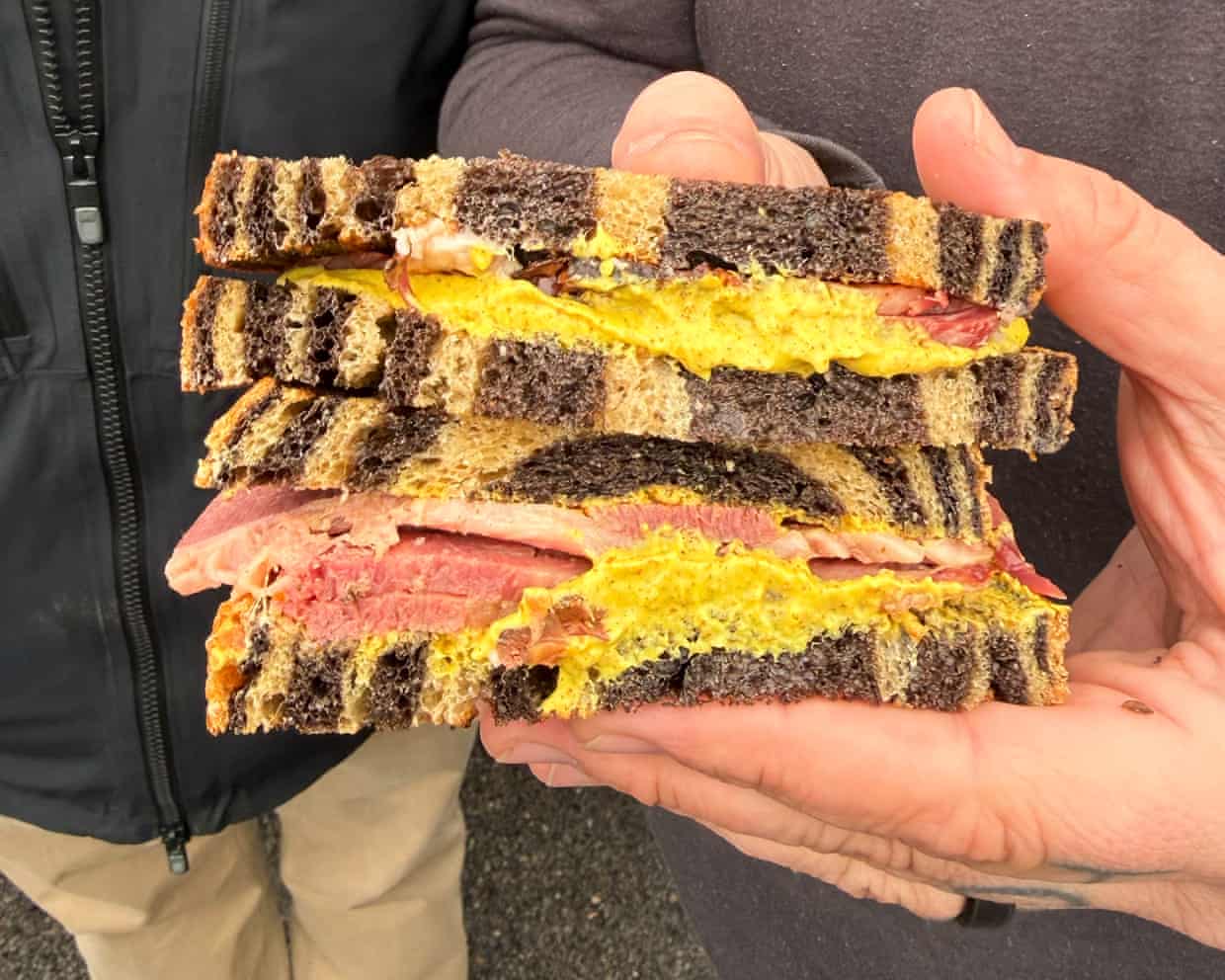
High on ... mustard? Cannabis industry teams up with chefs in push to stand out

Reform UK’s private health insurance plan would cost £1.7bn, Streeting to say

The ADHD grey zone: why patients are stuck between private diagnosis and NHS care

Seeing red over the Greens’ advocacy of ‘buy the supply’ housing policy | Letters