‘Acceptance of mediocrity’: Middlesex gaze south enviously with golden years long gone
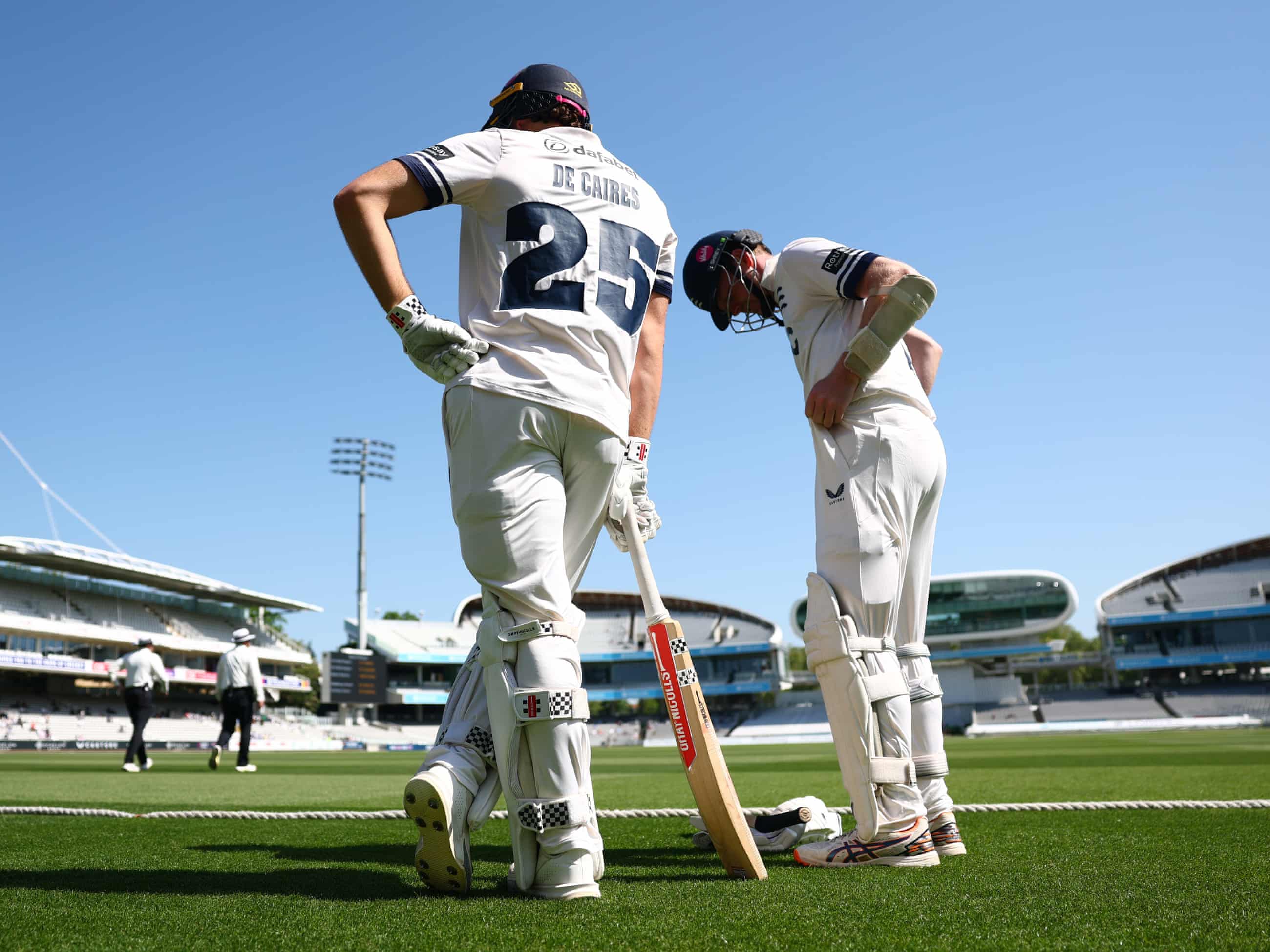
With their last title a decade ago, young players moving on and coach churn, Middlesex are no longer even the most famous team that call Lord’s homeMiddlesex is unlike every other English county in at least one very important way.It doesn’t actually exist.It was abolished by the London Government Act of 1963, persisted, in dotage, as a postal subdivision, until Royal Mail put it to sleep in 1996.Today, you’ll find it on the tiles of Swiss Cottage Tube station – which are embossed with its badge of three seaxes – the pediment of the Sessions House in Clerkenwell, the mailing addresses of people who just won’t let go, the minutes of Spelthorne council, the titles of three hospitals, a university, assorted sports teams and tournaments, and the cricket club.Those who don’t know any better will tell you English cricket is a country pursuit.
It’s not.Sport England’s latest data showed 250,000 Londoners played at least once last year.That’s around 20% of the adult playing population in England and Wales.Walk from Lord’s into the playing fields in Regent’s Park and you will find five, six, seven games going on all at once on the public pitches.Over the road at Fab’s Food & Wine they always have the Indian Premier League on in the afternoons, streaming on a mobile phone.
The guy who runs it tells me he is a Royal Challengers Bengaluru fan; I ask if he knows which county plays at the ground around the corner,“No idea,”Middlesex CCC has a catchment area that stretches over 17 London boroughs, and includes one of the largest, most diverse, and enthusiastic cricket communities in the country,Last year they pulled in a grand total of 44,415 paying spectators for the County Championship,Now that the MCC is running its own professional team, the London Spirit, Middlesex aren’t even the most famous team playing in their own ground.
Time was, and not so long ago, when they were one of the greatest clubs in the game, and would have fancied themselves a match for anyone, anywhere,In the golden years, under the leadership of Mike Brearley and Mike Gatting, they won the County Championship seven times in 18 seasons,The last of their 13 titles was won a decade ago, in 2016, when they went unbeaten through the season,Only two of the team playing Durham this weekend were a part of that one, too, Sam Robson and Toby Roland-Jones,“Jeez,” says Robson, “10 years goes by so fast, hey? It doesn’t feel that long ago.
But yeah, there are other times when you reflect because it has been mentioned lately that it’s 10 years since and you realise, you know, Jeez, a lot has changed.” The players are phlegmatic.“There have been so many little dramas that the playing group have just sort of got used to it,” Robson says, “and have grown pretty resilient.”Middlesex were relegated the next season.They’ve spent seven of the eight seasons since in the second division, they bounced up and down again in 2022 and 2023.
Their T20 side has won nine games out of 42 in the last three years.South of the Thames, Surrey have never been stronger.They are the richest, and most successful, team in the country, pulling in total crowds above 80,000 just for their championship matches.North of it, there’s a sense that Middlesex are, as Gatting, Mark Ramprakash, Mike Selvey and a group of former players recently wrote in an open letter to the membership, “drifting towards irrelevance”.“I understand the former players feel frustrated that performance isn’t what it was,” says the club chair, Richard Sykes.
Frustrated isn’t the word.Furious might be.One I talk to for this article says that club have been “toxic off the field for some time”, another says that he believes they are facing an “existential threat”.There is a lot of talent.They have a crop of young players who have come through the local system, and Robson describes the trio of Sebastian Morgan, Naavya Sharma and Caleb Falconer, as “definitely three of the more promising young players that we’ve had at the club for many years”.
But Ramprakash says he worries that good as they are, they may start to ask if they’re “at the right club to pursue their ambitions in the game”.They wouldn’t be the first.In recent years, the club have lost John Simpson, Martin Andersson, Steve Eskinazi and Ethan Bamber.It’s one thing to see players go, another to see them improve when they do.Simpson has grown into one of the most successful wicketkeeper batsmen in the country as captain of Sussex, and the batting averages of Eskinazi and Andersson have almost doubled since they moved.
At a certain point, reporting all this becomes a study in the viciousness of parish politics.Middlesex’s have become especially messy.In 2023 they were sanctioned for financial mismanagement, and put into special measures by the ECB.Since then they became embroiled in one interminable legal wrangle with their former CEO Richard Goatley, and then another with his successor Andrew Cornish, who is currently suspended on full pay awaiting the results of an investigation into alleged misconduct, which he denies.They’ve also burned through three coaches in the space of a year, after sacking Richard Johnson, hiring Dane Vilas as a temporary replacement, and then appointing Peter Fulton this year.
All this was done against the recommendations of at least some members of their own cricket committee, which had included Gatting, Ramprakash and other former players,Sykes says the cricket committee was “refreshed” last year,Others say it was “disbanded”,Ramprakash, who had been working as a consultant batting coach, quit in complaint against “the apparent absence of transparent process and accountability in recent cricket related decisions”,“We want the club to do better,” Ramprakash explains.
“I think there’s been an acceptance of mediocrity for quite some time,And I think it’s a great shame,And of course, the people who signed that letter, when they were players, they set high standards, and I think that they look at the club right now and they don’t see particularly high standards,” Ramprakash is quick and keen to stress that the letter wasn’t aimed at the players, despite how it was reported at the time,Robson is adamant that he and the rest of the men in the changing room never imagined it was.
Two separate independent reports have been commissioned into the running of the club in the last seven years.One, by the chair of the governance and ethics committee, raised concerns about the club’s administration, the other about their cricket, and in particular the pathways through the age grade to the academy and senior teams.That one is still used as a point of reference at the club, even though the man who was in charge of those pathways for much of that time, Alan Coleman, is now the director of cricket.The entire club seems to be caught in an awkward position.Lord’s, of course, is one of their biggest advantages.
But they don’t own it, which means they rely on the England and Wales Cricket Board for approximately 60% of their funding.The good news is that given the private investment in the Hundred, there is lots of that to go around.Except the club are caught in a peculiar catch-22.The ECB insists that the Hundred money can only be used to pay down debt or invest in capital assets.Middlesex have no debts and no capital assets.
They’ve been allowed £2m to top up their reserves, but otherwise they can’t get at any of the £24m available,Even though, as one former player said, “they don’t have a pot to piss in”,“We don’t have our own ground so we can’t commercialise anything or generate revenues,” Sykes says,“Until this year Middlesex has never even had any incentive to sell a single ticket because MCC bore all that financial upside and risk and just paid us a fixed fee,” But Sykes has a plan.
He believes the club need to build their own ground in the outer reaches of north London,Last year the club spent £400,000 trying to drum up private investment in it,They had a partner lined up, only to find out at the last minute that the deal would have broken their agreement with the ECB,Sykes is convinced it is the right idea; no one else I talk to seems to agree with him,Regardless, the only way to do it would be to persuade the membership to demutualise the club, which everyone thinks is extremely unlikely to happen.
“We’re going to spend the next several months holding members’ forums leading up to an indicative vote at the next AGM,” Sykes insists.He is adamant that it is the only way “or we just accept the alternative of managing a steady decline”.Some who love the club would say that’s already well under way.

‘I am invoking Martha’s rule’: how a woman saved her father from near death in hospital
For six awful days last summer, as her father, David, got progressively sicker in the cardiac ward of the John Radcliffe hospital in Oxford, Karen Osenton would read the poster above his bed telling patients about their right under Martha’s rule to ask for a second opinion.Her father, a retired engineer in his early 70s who was normally extremely fit, was by then thin, jaundiced and could barely lift his head from the pillow. But his bed was right beside the nurses’ station, surely they would notice if he needed more urgent treatment?David had first gone to his GP more than a month earlier complaining of extreme breathlessness, and over the following weeks he had become increasingly thin and weak with suspected heart failure. But it had taken repeated visits to the accident and emergency ward, being sent home each time, before he was finally given a bed in a specialist cardiac unit last July.“Every day we saw him he got worse,” says Karen, a teacher from Aynho, in West Northamptonshire

Martha’s rule may have saved more than 500 lives in England since 2024
More than 500 people have received potentially life-saving care thanks to Martha’s rule, which gives hospital patients the right to seek a second opinion about their health.They were moved to intensive care or a specialist unit after they, a loved one or a member of NHS staff triggered the patient safety mechanism, which the NHS in England began using in 2024.Martha’s rule lets patients, relatives and staff call a helpline run by the hospital if they are worried about the person’s condition or treatment and ask for a “rapid review” of their care.In the 18 months between September 2024 and February 2026, a total of 524 adults and children about whom concerns had been raised were moved to an intensive care or high-dependency unit, a specialist hospital or a specialist ward at the hospital where they were already an inpatient.Wes Streeting, the health secretary, said the figures proved that Martha’s rule is “already having a life-saving impact”

Solicitors report late flood of no-fault evictions before ban in England
Solicitors say they have been inundated with requests to serve last-minute section 21 no-fault eviction notices before they are banned when the Renters’ Rights Act comes into force in England on Friday.The legislation, which has been hailed as the biggest change to renting in a generation, bans no-fault evictions, limits rent increases and abolishes fixed-term tenancies.On the eve of the new rules, solicitors said they were working long hours to keep up with the sudden demand for eviction notices, while Citizens Advice said thousands of people facing a no-fault eviction had approached it for help in the last month.In March, the service helped 2,335 people dealing with a no-fault eviction, up 16% on the same time last year, as well as more than 1,800 people dealing with disrepair such as damp and mould, and more than 1,000 with rent increases.Thackray Williams, a London- and Kent-based law firm, said it had received a wave of last-minute instructions from landlords looking to evict their tenants and sell their properties because of the legislation

Austerity to blame for the fall in healthy life expectancy | Letters
A major cause of the fall in healthy life expectancy (People in UK spend fewer years in good health than a decade ago, study finds, 27 April) is austerity and the continued cuts to social and health spending. In our report Still Digging Deeper: The Impact of Austerity on Inequalities and Deprivation in the Coalfield Areas, which covers Scotland, England and Wales for the period 1984-2024, we highlight how public expenditure cuts since 1984 have disproportionately impacted coalfield areas of the UK.Since 2010, austerity has been stepped up, and we have calculated that welfare reforms and benefit cuts amounted to £32.6bn over the period of 2010-21. Furthermore, in 2025-26 coalfield local authorities had a combined funding gap of £447m

Why routine cancer tests have age limits | Brief letters
Jane Ghosh asks why the NHS’s routine screening for bowel and breast cancer has upper age limits (Letters, 28 April). Screening – testing because of risk, not symptoms – stops when the chance of helping you drops below the chance of harming you. Diagnostic testing is done at any age.Dr John Doherty Stratford-upon-Avon, Warwickshire Re Jane Ghosh’s letter about the NHS stopping routine bowel and breast cancer testing after the early 70s, it’s important to know that people over the age thresholds can request a bowel cancer test every two years or breast cancer screening every three years. Remembering to do so is a different story

UK researchers develop tool to identify people most at risk of obesity-related diseases
A new tool that can shed light on who is most at risk of obesity-related diseases could help identify people who would benefit most from weight-loss medications, researchers have said.Recent data suggests about two-thirds of adults in England are overweight or obese – a situation that has caused concern among health experts.Now researchers have developed a tool that, they say, offers an accurate and personalised approach to identifying those at risk of obesity-related conditions.They add it could be useful for prioritising who should receive interventions, such as weight-loss jabs, given that access on the NHS is limited and currently based simply on having a high body mass index (BMI) and particular obesity-related health problems.Prof Nick Wareham, of the University of Cambridge, a co-author of the study, said the measure was not about extending the use of particular therapies

Exxon and Chevron quarterly earnings fall despite soaring oil prices

Firm bookings, fast refunds: easyJet and On The Beach aim to reassure jittery travellers with holiday pledges

Parents already have controls over smartphones – they should use them | Letters

‘Awkward and humiliating’: UK job hunters share frustration with AI interviews

Allen and Wu toil in 100-minute frame ‘embarrassment’, Higgins leads Murphy

Lando Norris takes Miami GP sprint pole as lightning fears loom over F1 return