Sabastian Sawe’s sub-two marathon feat is the Roger Bannister moment of our time | Sean Ingle
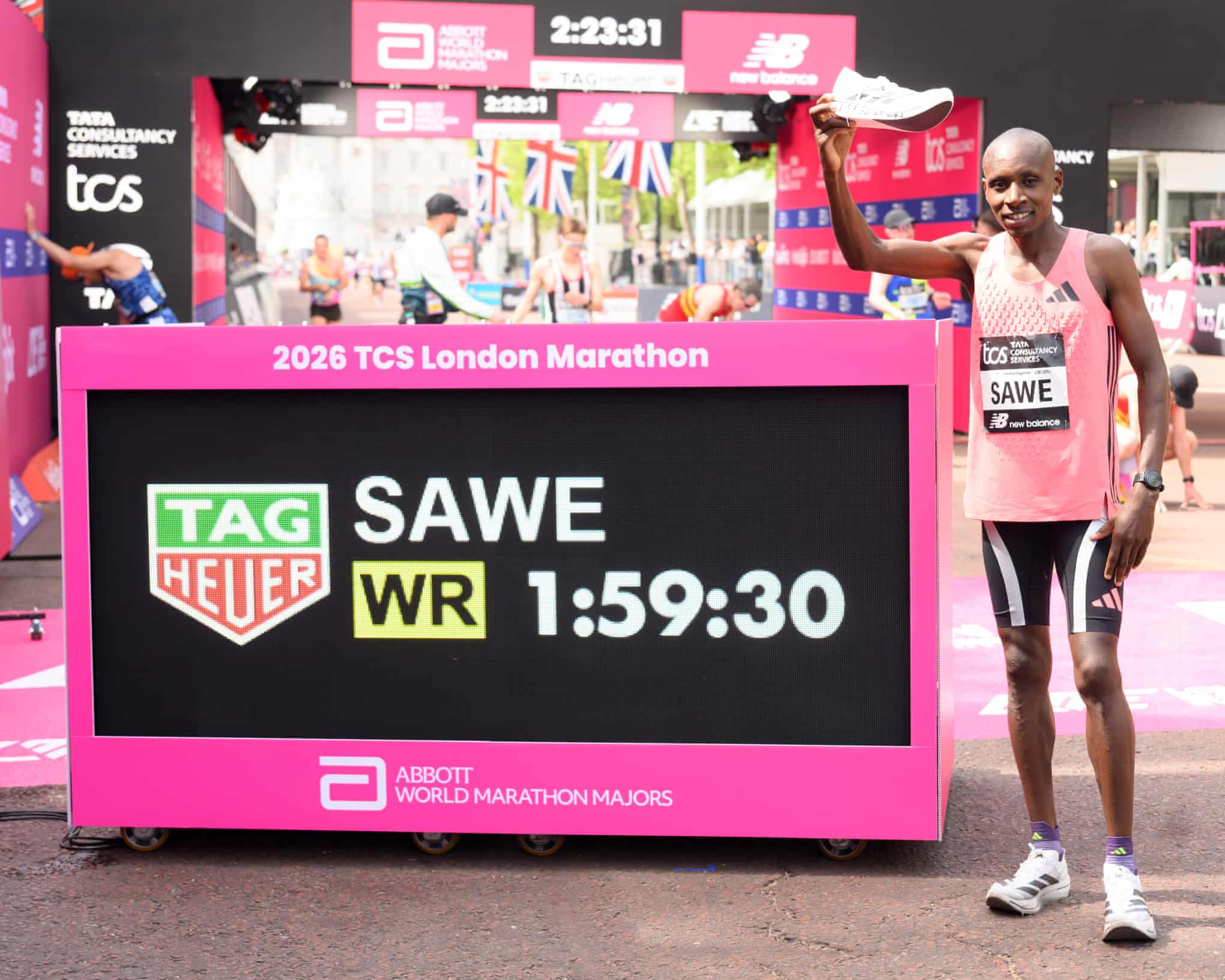
A few years ago at the London Marathon, organisers wheeled out an industrial-sized treadmill called the Tumbleator.Then they tempted curious onlookers with a simple question: can you keep up with Eliud Kipchoge? The answer was obvious.But that didn’t stop people trying.Most lasted a few seconds before comically flying off the back into crash mats.The Tumbleator has a fresh poster-boy now: Sabastian Sawe, who on Sunday claimed track and field’s last holy grail by running a sub two-hour marathon.
Imagine sprinting 17 seconds for 100 metres, and then sustaining it across 26.2 miles.Or setting your treadmill at 4min 33sec per mile pace and carrying on for 1hr 59 min 30sec.It sounds ridiculous, impossible, laugh-out-loud stupid … until you realise that is what Sawe did in London.Afterwards, in all the superlatives and search for perspective, the London Marathon’s race director Hugh Brasher made an extraordinary suggestion.
Sir Roger Bannister’s four-minute mile had been the greatest sporting moment of the 20th century, he told us.And, just maybe, we had witnessed its 21st-century equivalent.Your first instinct might be to flinch.But Brasher is not someone to be glibly dismissed.His father, Chris, paced Bannister to that famous 3:59.
4 mile in May 1954, before setting up the first London Marathon with John Disley in 1981,Hugh also has a deep appreciation of the heritage of multiple sports,So is he right? My first instinct is to separate sporting moments – such as Rory McIlroy winning the Masters for the first time – which are bound up with personality, atmosphere and expectation, and sporting feats, which are often against the clock,I have been fortunate to witness many great sporting moments in the flesh and sub-two is up there with Super Saturday at London 2012, Novak Djokovic outlasting Roger Federer in the longest Wimbledon final, Zinedine Zidane’s head-butt at the 2006 World Cup final and Usain Bolt at three Olympic Games,Just don’t ask me to rank them.
However, if we are talking about a sporting feat, it is a different conversation.And here I am not sure Sawe has a 21st-century equal – even if Bolt’s 9.58sec 100m world record and Michael Phelps’s eight Olympic gold medals in Beijing run it close.Sunday’s landmark was not only unexpected, dramatic and historic.It was also one of those once-in-a-generation moments where a sport is immediately divided starkly between a before and an after.
Before Sub-Two.After Sub-Two.Just like Bannister’s time.And, just like running 3:59 for a mile, the idea of a sub-two marathon was once a pipedream.When Paul Tergat became the first runner under 2:05 in 2003, he dismissed the idea as fantastical.
“I believe records are set to be broken, and to fall lower is possible,” he said,“But what remains impossible is running a marathon in under two hours,”Admittedly Tergat did add: “Maybe time will chide me,” He also could not have foreseen the era of supershoes, which allow athletes to train more often at greater intensities as well as race faster,Or the arrival of Maurten hydrogels, which allow athletes to consume large amounts of carbohydrates without gastric problems.
On Sunday, Sawe ran in 97-gram Adidas shoes and also consumed 325g of carbs, which meant he didn’t hit the wall.Those developments have been gamechangers.Even so, what other sporting feat can you imagine generating similar global headlines? A women’s four-minute mile? A tennis or golf grand slam in a single year? Perhaps.But the list is short.So what next for Sawe and the marathon? Here there is a historical precedent worth remembering.
In April 1954, John Landy described the four-minute mile barrier as “a brick wall”,A month later, in Oxford, Bannister ran 3:59,4,By June, Landy had obliterated that old record by running 3:58 flat,Après moi, le déluge.
There are faster courses than London, including Berlin, Chicago and Valencia.The march of technology will also continue.Clothing will become lighter, the sports nutrition will get better, shoe foams will become springier.Nick Anderson, a coach who has trained world level athletes and was part of the elite London marathon set-up, also points to another factor – that top middle-distance runners are moving to 26.2 miles earlier and earlier.
“They’ve got great running mechanics.They’re fast.They’ve got real speed, but the endurance engine allows them to work for two hours and they train so well,” he says.“So I think you are going to see further minutes off the world record.That said, they still need the absolute perfect storm – the right temperatures, very little wind, and then the right athletes there as well for the race to unfold, so that you get a genuine race in the last 10km.
”I have been fortunate enough to meet Bannister and Sawe and the similarities were uncanny.Both were distinctively modest about their achievements and had to have their recollections of their performances teased out of them.I remember Bannister telling me about the flash of anger he felt after a false start by Brasher, his first pacemaker.And feeling so full of energy on the first lap that he was shouting: “Faster” at Brasher.Then the fear at the end of the 62.
4sec third lap when the record appeared to be slipping away, before that surge of adrenaline carried him into sporting immortality.Sawe told me he only realised he was running under two hours when he saw the finish line.“I was so excited and tried to push and finally I did it,” he said.If Sawe is as clean an athlete as he promises, then he is a worthy successor to Bannister.And so, undoubtedly, is Sunday’s staggering achievement.

Europe’s smaller airports ‘under threat’ if fuel shortages cause many cancellations
Europe’s smaller airports may not survive if jet fuel shortages triggered by the Middle East crisis lead to widespread route cancellations, the industry’s trade body has warned.Although airlines insist there are currently no supply problems within the normal four- to six-week horizon, the US-Israel war on Iran and the effective closure of the strait of Hormuz have doubled the price of jet fuel, prompting some carriers to cancel flights.The Airports Council of Europe said regional airports were the most exposed and faced an “existential threat” if airlines cut capacity and raised fares, as demand on their routes was generally more price-sensitive – demonstrated when Lufthansa axed 20,000 summer flights operated by its regional subsidiary, CityLine.Olivier Jankovec, the director general of ACI Europe, said that smaller regional airports had still not recovered since the Covid pandemic, with traffic still 30% below 2019 levels, while larger ones had bounced back to growth.He said: “The current levels of jet fuel prices and the prospect of a new cost of living crisis mean that many regional airports across our continent are likely to face both a supply and demand shock

Barclays cuts back risky lending after £228m hit from UK mortgage firm MFS
Barclays is pulling back from lending to risky borrowers, as its chief executive warned of increasing numbers of fraud cases and the bank took a £228m hit from the failure of a mortgage lender.The mortgage lender Market Financial Solutions (MFS) collapsed in February amid allegations of fraud, and the UK’s financial regulator has since launched an investigation into the scandal.Barclays provided banking services to MFS and said the £228m hit had pushed total credit impairment charges to £823m in the first three months of 2026, up from £643m a year earlier.Last year the British bank reported a £110m loss over the US sub-prime auto lender Tricolor, which collapsed amid fraud allegations.The chief executive, CS Venkatakrishnan, said: “This [alleged] fraud, as with the one in Tricolor, indicates to us the importance of strong financial controls at borrowers and the difficulty ex-ante of identifying fraud

‘They’re supposed to be handmade’: zine creators fight to resist AI influence
The self-published zine has long been central to cultural revolutions, from queer activism to Black feminism and the riot grrrl punk movement, producing titles such as Sniffin’ Glue and Sweet-Thang along the way. But now the traditionally analogue art form faces a new shift: artificial intelligence.AI may seem incompatible with the these cult DIY booklets, but some creatives, designers and artists have begun to experiment with the technology, causing alarm in parts of the underground publishing world. It has been their Dylan-goes-electric moment.“AI is eliminating a lot of people’s ability to think critically for themselves,” says Rachel Goldfinger, a Philadelphia-based video editor and illustrator who has published an anti-AI zine

MacBook Pro M5 review: serious power, still long battery life
Apple’s Macs have been on a roll this year with the brand new budget MacBook Neo and a faster MacBook Air M5, but now it’s time for its workhorse MacBook Pro to be upgraded with the fastest, most powerful M-series chips.The Guardian’s journalism is independent. We will earn a commission if you buy something through an affiliate link. Learn more.The latest MacBook Pro comes in two screen sizes and a large range of chip and configuration options

‘Like cutting the head off a hydra’: how Mary Cain exposed Nike’s disgraced coaching team
“As someone who has lost touch with reality, I like to hold a firm grasp on it now,” Mary Cain says while we walk through a palm-tree spotted campus in California.She’s telling me why she insisted she write her own memoir, This is Not About Running, without ceding the narrative to a ghostwriter, as happens with many athletes. “My story is so complicated … there are so many bad actors that I think it forces the reader to embrace nuance, and I don’t think you see that very often.”At 29, Mary Cain is a decade removed from her experience as the United States’ highest hope for a middle-distance track star since Mary Decker smashed women’s world records up and down the stat sheet in the 1970s and 80s.Cain set four different national high school records as a teen, and as a 17-year old made the world championships in the 1500m, finishing 10th in a field of pros

The Breakdown | Celebrating elite speed machines who can send rugby into the stratosphere
As Kenya’s Sabastian Sawe crossed the line to complete his world-record London Marathon sprint on Sunday the BBC’s commentator Steve Cram almost swallowed his microphone. “Absolutely incredible. I’ve never seen anything like that. What a finish.” Running 26

US supreme court hears whether smartphone location data warrants infringe users’ privacy

Elon Musk and Sam Altman face off in court over OpenAI’s founding mission

If it’s only AI that’s keeping you up at night, maybe you’re doing OK | Letters

Musk and Altman’s bitter feud over OpenAI to be laid bare in court

UK departments at odds over energy demands of AI datacentres

Cannes AI film festival raises eyebrows – and questions about future