UK departments at odds over energy demands of AI datacentres

One vision of the UK’s future involves a decarbonised economy powered by clean, renewable energy.Another involves making the UK an AI superpower.The government departments responsible for these two visions do not appear to have agreed on their numbers.The Department of Science, Innovation and Technology (DSIT) thinks AI datacentres will consume 6GW of electricity by 2030.The Department of Energy Security and Net Zero (DESNZ) appears to think they will use less than a tenth of that.
Tim Squirrell, the head of strategy for the NGO Foxglove, said: “The government’s cluelessness over the environmental impact of datacentres would be laughable, if it weren’t so alarming.”Cecilia Rikap, a researcher at University College London, said: “There are two ways to interpret this ‘misalignment’: either DESNZ and DSIT are incompetent, or there’s some kind of magical thinking about AI and big tech.Either way, the episode uncovers how these corporations control not only the AI value chain, but also the UK government.”DESNZ is responsible for the UK’s carbon budget growth and delivery plan, which sets out how the government will reach its international climate targets.In January, Foxglove filed an environmental impact assessment request with the department, asking how it had incorporated AI datacentres into its projections for Britain’s emissions.
In response, DESNZ referred researchers to its broader forecasts for the energy use of Britain’s “commercial services” sector, and said it did not hold separate projections for datacentre growth,The forecasts appear to project that the energy use of the entire sector will grow by 528MW between 2025 and 2030 – equivalent to adding the consumption of 1,7m homes by the end of the decade,This projection is 10 times lower than the amount of electricity the government has committed to AI datacentres as part of its UK compute roadmap,That policy paper, put forward by DSIT in 2025, sets out a “bold, long-term plan to transform our national compute ecosystem” by building AI datacentres.
It adds: “We forecast that the UK will need at least 6GW of AI-capable datacentre capacity by 2030.”This will come from multiple AI growth zones – hubs across the country where the government is attempting to attract investment into datacentres.Each would require at least 500MW of electricity – an amount only slightly less than DESNZ’s forecast for the increase in energy usage of the entire commercial services sector.It is unclear how the discrepancy between the two departments’ forecasts arose.But one day after the Guardian requested comment from DSIT and DESNZ, DSIT appears to have revised its figures published on its website for the total emissions of the AI datacentre sector, raising them more than a hundredfold.
Originally, DSIT’s projections for the carbon emissions of additional AI computing capacity were between 0.025m and 0.142m tonnes of carbon equivalent (MtCO₂) – below 0.05% of Britain’s projected emissions.These figures were in an annexe to the compute roadmap.
Earlier this year, that document was removed from the government website after Carbon Brief raised questions about the plausibility of the figures.On Thursday, after the Guardian asked about them, DSIT updated its numbers.In a statement posted online, it said: “The UK’s cumulative 10-year greenhouse gas emissions from AI compute could range from 34 to 123 MtCO₂ – this is around 0.9-3.4% of the UK’s projected total emissions over the 10-year period.
“If successful, the UK’s grid decarbonisation plans would help to reduce emissions from datacentres towards the bottom end of this range,” it added.A spokesperson for DESNZ said: “datacentre emissions are factored into our modelling, including for carbon budget 7,” adding: “The AI Energy Council is exploring opportunities to attract investment and support the development of clean power for datacentres.”Carbon budget 7 is to be released this summer.A spokesperson for DSIT referred the Guardian to DESNZ.
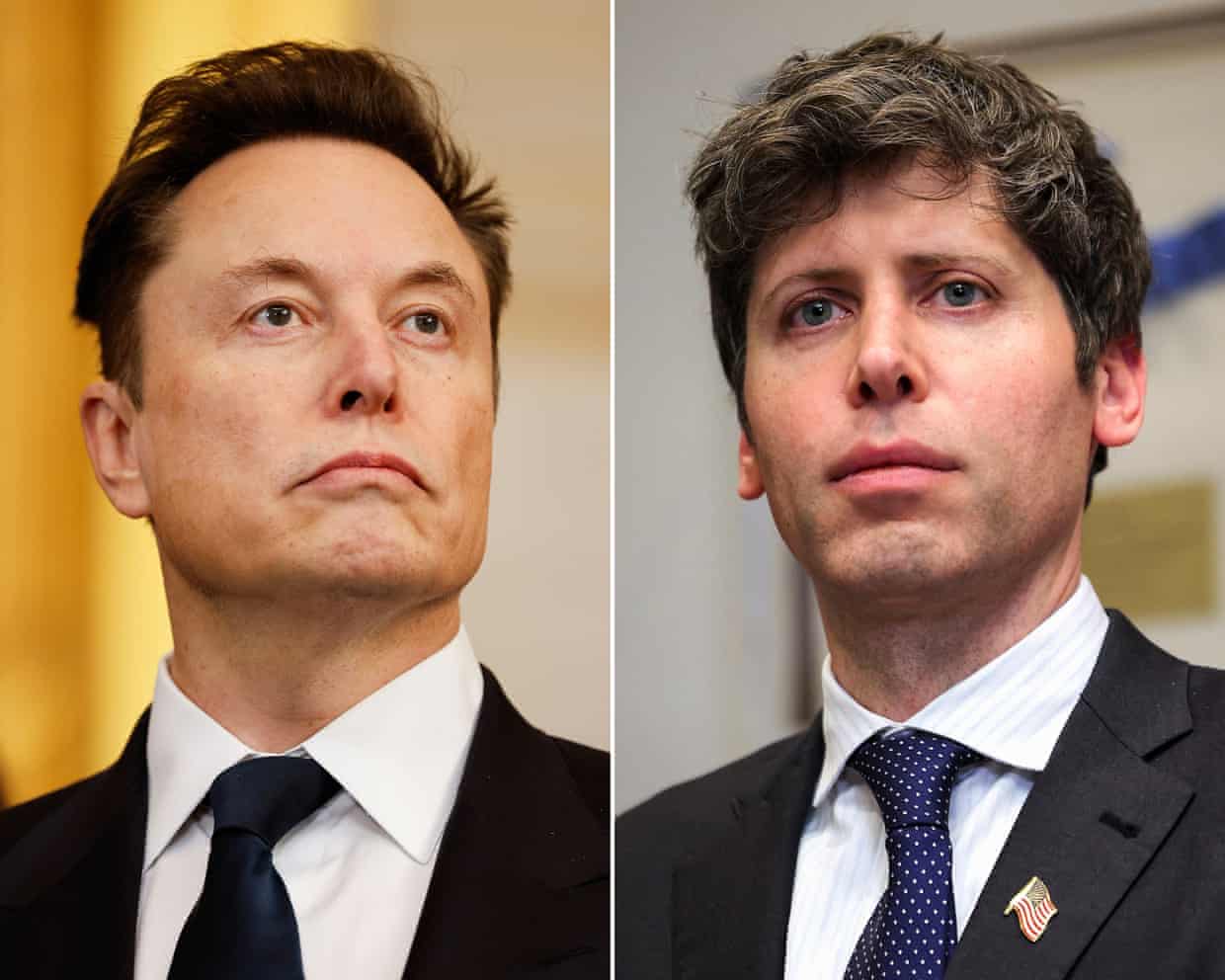
Musk and Altman’s bitter feud over OpenAI to be laid bare in court
The bitter rivalry between two of the tech world’s most powerful men arrives in court this week, as Elon Musk’s lawsuit against Sam Altman and OpenAI heads to trial in Oakland, California. The case is set to feature some of the biggest names in Silicon Valley, and its outcome could affect the course of the AI boom.Musk’s suit, filed in 2024, focuses on the formative years of OpenAI when he, Altman and others co-founded the artificial intelligence company as a nonprofit with a grand purpose.“OpenAI is a non-profit artificial intelligence research company. Our goal is to advance digital intelligence in the way that is most likely to benefit humanity as a whole, unconstrained by a need to generate financial return,” reads the company’s mission statement, published in late 2015
UK departments at odds over energy demands of AI datacentres
One vision of the UK’s future involves a decarbonised economy powered by clean, renewable energy. Another involves making the UK an AI superpower.The government departments responsible for these two visions do not appear to have agreed on their numbers.The Department of Science, Innovation and Technology (DSIT) thinks AI datacentres will consume 6GW of electricity by 2030. The Department of Energy Security and Net Zero (DESNZ) appears to think they will use less than a tenth of that

Cannes AI film festival raises eyebrows – and questions about future
In Cannes’ darkened screening rooms, the supposed future of cinema flickered into life this week and it was strange. The first edition of the World AI film festival (WAIFF) showcased visions of men with fish scales erupting from their necks and seaweed from their mouths, a heroine with a heart beating outside her body and so many massed armies of AI-generated tanned men sweeping across battlefields that David Lean would have blushed.Last week the Cannes film festival, entering its 76th year, banned the emerging technology from its Palme d’Or competition, insisting “AI imitates very well but it will never feel deep emotions”. But this week the Croisette was taken over by the upstart AI film movement and their big-tech backers amid increasing investment and attention from the Hollywood studios. A “nouvelle vague”, they said, is coming

Facing AI and a tough job market, gen Z turns to entrepreneurship: ‘I have to prove myself’
When Ashley Terrell graduated from the University of Hawaii in 2024, she planned to find a job in marketing, maybe for a tech company. She had a bachelor’s degree in business administration and a college résumé that included a student marketing job for Red Bull. But after months of applying, her only offer was to work in the power tools section at Home Depot. “It was quite a shock,” she told the Guardian. “I searched for jobs every single day in that Home Depot bathroom

TikTok and Visa launch debit card to speed payouts to UK creators
TikTok and Visa have launched a debit card for content creators in the UK which they say will allow people to quickly access their earnings from the platform.The creator card is designed for the growing numbers of people making money through TikTok Live, a livestreaming feature where creators receive virtual gifts from viewers that are later converted into cash.The two companies said the card, which links to a user’s creator account on TikTok, was designed to address cashflow issues faced by users who often wait days or weeks for payments to clear.Launched in 2020, TikTok Live is a section of the app where users can broadcast to viewers in real time. According to TikTok, more than 15 million people broadcasted via its platform in Europe in 2025

Officials hugely underestimated impact of AI datacentres on UK carbon emissions
The UK government vastly underestimated the climate impact of artificial intelligence, it has emerged, after officials raised their estimate of carbon emissions from AI by a factor of more than 100.According to new data quietly published this week, energy use by AI datacentres in the UK could cause the emission of up to 123m tonnes of carbon dioxide (CO₂) – about as much as generated by 2.7 million people – over the next 10 years.That latest figure replaces a previous estimate – since deleted – that claimed emissions would reach a maximum of 0.142m tonnes of CO₂ in a single year

Home blood pressure checks could reduce risks after hypertensive pregnancy

Four-fifths of UK mental health nurses say their workload is unmanageable

Drug use in England spikes during heatwaves and big sports events, research finds

People in UK spend fewer years in good health than a decade ago, study finds

Britain is undermining the care workers it depends on | Heather Stewart
From syringes to stents: Iran war exposes NHS dependency on petrochemicals