Khawaja and Carey rise up to fill the gaps as England squander Australia’s gifts | Geoff Lemon
Chalk it up to fates or fortune or a quirk of probability, whatever your inclination.If Australia’s first day of the Adelaide Test was a jigsaw puzzle hurled into the air, most of the pieces landed face up in the right place.It has been a pattern for Australia in this Ashes series: monstered by England’s bowlers in Perth, only to create an even greater collapse; sliding in Brisbane, rescued by the lower order.England, meanwhile, brought a gameplan built on the surety that they couldn’t win in Australia with medium-fast seamers and a keeper up to the stumps, then lost to medium-fast seamers with a keeper up to the stumps.They were given the gift of no Pat Cummins, no Josh Hazlewood, no Nathan Lyon (in Brisbane) and still managed to lose twice in six days.
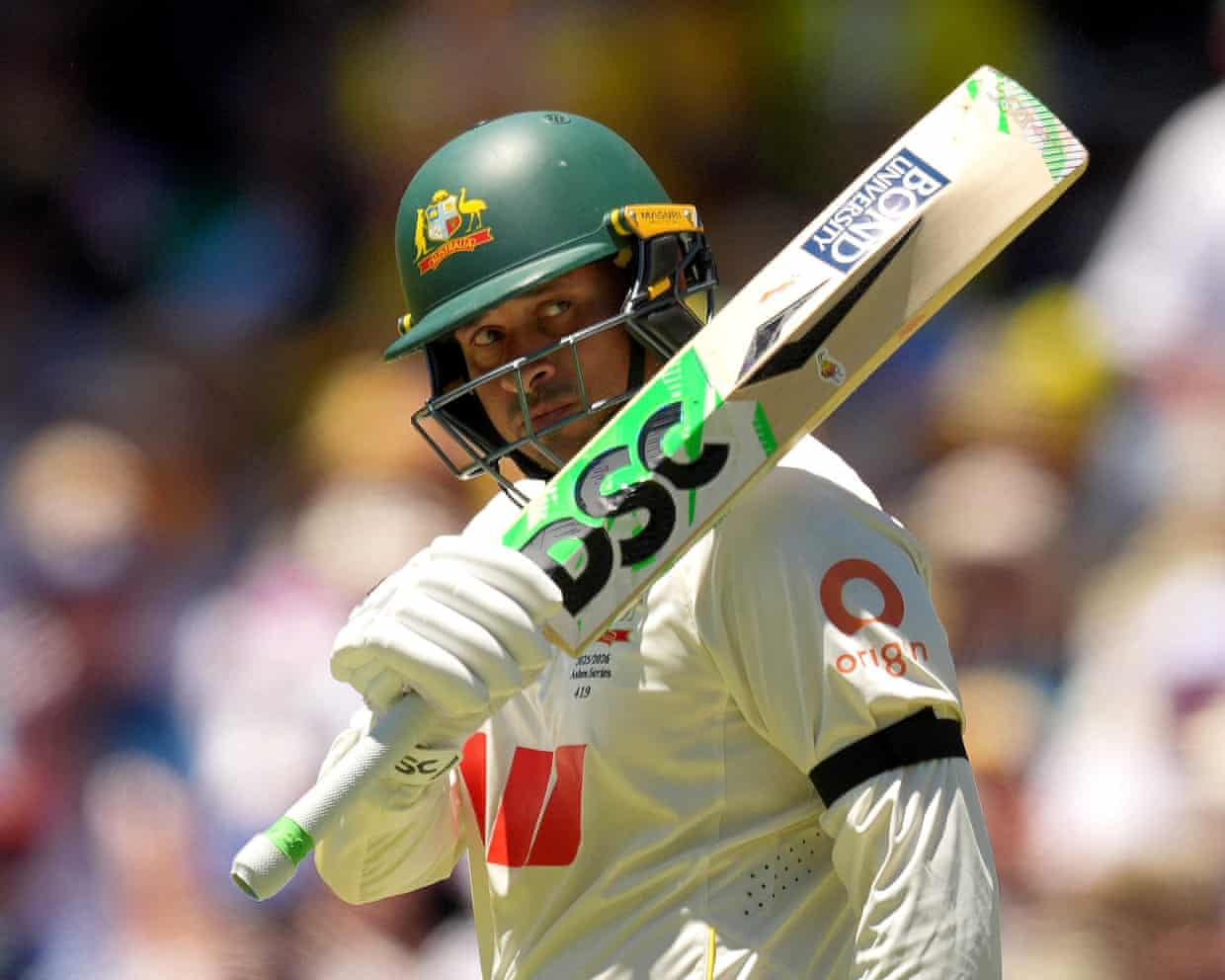
Their third encounter brought the next gift: Steve Smith missing with an inner-ear problem, their own personal Ghost of Ashes Past replaced in the middle order by a creaking, squinting opener whom Australia had already tried to drop,Out of politeness, England had to drop him too,In the cordon, on five runs, when the score would have been 50 for three,A couple of hours earlier, Usman Khawaja’s career had been as good as over, with selectors finding a shiny new toy called the Travis Head Dashing Opener™ action figure,Two hours later, Khawaja had been twice reprieved, first by Smith’s lack of balance with an inner-ear condition, then by Harry Brook’s lack of balance at slip.
The move down the order had only spared him nine overs at the top, but that meant he almost entirely dodged Jofra Archer’s fierce opening spell, a potentially critical non-matchup given Khawaja’s poor recent years against quality pace.Liberated, with nothing to lose, Khawaja played perhaps his most fluent and confident innings since his last comeback through the middle order in 2022.Josh Tongue was not much slower than Archer, but Khawaja picked off his errors while using Ben Stokes’s short ball to get his signature pull shot going.He saw Will Jacks’s vulnerability as a day-one spinner and thumped him accordingly.There was a half century after lunch, amid a vital rebuild with Alex Carey after some Christmas giveaways.
Marnus Labuschagne must have still been thinking of toasties.The all-rounder Cameron Green might have been thinking of his millions of dollars from the IPL auction.He had told reporters that he was mistakenly listed in the auction as a batter, and his shot second ball suggested he might be right.This is still a good chance of being Khawaja’s last Test, with Smith to return and the rest of the order not guaranteed to change, so a century that could have been both comeback and farewell would have been one hell of a story.But straining against late-career limitations left it too distant.
Steve Waugh in his last Test was raging against the dying of the light, dreaming of one last ton, out instead slog-sweeping a spinner to deep midwicket for 80.Khawaja, six months older, was out slog-sweeping a spinner to deep midwicket for 82.Still, it was defining for the team, and another example of how discombobulation hasn’t bothered these Australians.Lose your best bat minutes before the match? The replacement has it covered.A weird batting order to follow? No problem either.
Carey as wicketkeeper would traditionally bat at No 7, while the plan at the start of the series was to bed in Green at No 6.The vacancy created by Head’s move was at No 5, where Josh Inglis normally bats as keeper for Western Australia.And yet, instead of filling that gap with Inglis, Australia brought him in at No 7 and moved Green and Carey up.Nothing feels normal about placing an active wicketkeeper ahead of an off-duty one batting as a specialist, but on this occasion it worked, perhaps because Carey was fresh in the first innings.He got the century that Khawaja missed, scoring in his usual enterprising way, creating a huge Adelaide moment as home- town crowds swelled the standing room areas.
Smith may be Australia’s best bat in career terms, but Carey may be their most convincing one right this moment, after his second century this year and consistent runs even on the fraught surfaces of the Caribbean tour,In the end, he shepherded Australia’s score from 85 when he arrived to 321 when he was out, and more might be added for the final two wickets on the second morning,Smith wasn’t there, five of the top seven made scores of little substance, yet Australia are still on top, with far more runs than looked likely at several stages,For another day, the pattern continued: be it dodgy fielding or dodgy technology, things keep working out for the home team,England’s only path to change that is a brute-force reset: take two wickets, bat five sessions in the heat.
Anything else leaves it up to the fates, or fortune, or a quirk of probability.Don’t trust any of them.

Rights group challenges trans-inclusive swimming policy at Hampstead Heath
Rules permitting trans women to share female changing facilities and swim in a women-only pond are discriminatory and unlawful, the high court has heard.The City of London Corporation is breaching equality legislation by allowing trans people to use the single-sex ponds on Hampstead Heath, according to a claim brought by the rights group Sex Matters. It is seeking permission to challenge the admission regulations.Daniel Stilitz KC, for the City of London, said Sex Matters had “steamed in”, bringing a premature legal action at a time when its officials were actively consulting pond users on its entry rules.Public bodies are redrafting their policies on single-sex spaces in response to the supreme court’s ruling in April that the legal definition of a woman is based on biological sex

Will resident doctors lose support over latest strike? | Letters
“Striking resident doctors are digging in. History suggests this will go on and on” says the headline on Denis Campbell’s analysis piece (16 December). As a retired public health research and policy adviser and the parent of a doctor currently in core training, I agree that it is likely to go on and on – but not because doctors are stubborn. It will persist because the numbers do not add up and too much of the response has been political posturing rather than workforce planning.This year, around 30,000 doctors competed for just 10,000 specialty training posts, leaving thousands unable to progress

When ‘How are you?’ becomes a painful question to answer | Letter
It’s not just Germans like Carolin Würfel (16 December) who face a challenge with the question “How are you?” When I was diagnosed with metastatic prostate cancer, that question went from being a routine conversation-opener to something much trickier.The convention, in Britain at least, is to answer something like “Oh, not bad…” Frankly, things are very bad, so I’m stuck between the dishonesty of the ritual reply and the full truth, which is a lot to fling back at someone offering an innocent greeting. I’ve developed the more nuanced response “All right today”, which I use if I really am doing all right in the general context of things.Some days are genuinely rotten, in which case it remains a struggle to work out what to say, but the rest of the time I try to respond relative to my “new normal”. Some days I still have joyous events and upbeat feelings, in which case I’d stretch to a buoyant “Pretty good today”, but always I feel compelled to append the word “today” as a matter of honesty about the future
Study finds 10% of over-70s in UK could have Alzheimer’s-like changes in brain
One in 10 people in the UK aged 70 and older could have Alzheimer’s-like changes in their brain, according to the clearest, real-world picture of how common the disease’s brain changes are in ordinary, older people.The detection of the proteins linked with the disease is not a diagnosis. But the findings indicate that more than 1 million over-70s would meet Nice’s clinical criteria for anti-amyloid therapy – a stark contrast to the 70,000 people the NHS has estimated could be eligible if funding were available.Experts, including those from Alzheimer’s Research UK, have said the findings from the first-ever population-based research into the disease have huge potential for early and accurate diagnosis.“High-quality studies like this are crucial to enhancing our understanding of how blood tests for Alzheimer’s could be used in clinical practice,” said David Thomas, the head of policy and public affairs at Alzheimer’s Research UK

Soaring demand causing shortage of flu jab appointments across England
Soaring demand has caused a major shortage of flu jab appointments across England, the Guardian can reveal.NHS leaders have issued urgent pleas to the public to get their flu jabs and help the health service cope with a crippling “flu-nami”, which last week led to hospitals in England treating record numbers of seriously ill patients with flu.But the biggest pharmacy chains have no bookable appointments available in many of their city centre branches amid dwindling stocks of the flu vaccine.The shortages were revealed as resident doctors in England began five days of strike action after rejecting the government’s latest offer to resolve the long-running dispute over pay and jobs.Older people; those with long-term health conditions; pregnant women; and children are eligible for the flu jab on the NHS

New flu strain putting severe pressure on healthcare across Europe, says WHO
An intense surge in flu cases driven by a newly dominant virus strain is sweeping across Europe, placing healthcare systems in several countries under severe pressure, the World Health Organization has said.The WHO said on Wednesday that at least 27 of the 38 countries in its European region were reporting “high or very high influenza activity”, with more than half of patients with flu-like symptoms testing positive in six countries including Ireland, Serbia, Slovenia and the UK.It said the flu season had begun roughly four weeks earlier than in previous years and urged populations to curb transmission by getting vaccinated, staying home if unwell, and wearing a mask in public if they had respiratory symptoms.The WHO said the new seasonal flu variant – A(H3N2) sub-clade K – was driving the infections, accounting for up to 90% of all confirmed flu cases in the European region, but added that there was no evidence it was causing more severe disease.Hans Henri Kluge, the WHO’s regional director for Europe, said: “Flu comes around every winter, but this year is a little different

US date rape survivors file lawsuit accusing Hinge and Tinder of ‘accommodating rapists’

Water levels across the Great Lakes are falling – just as US data centers move in

Boost for artists in AI copyright battle as only 3% back UK active opt-out plan

Google AI summaries are ruining the livelihoods of recipe writers: ‘It’s an extinction event’

UK Treasury drawing up new rules to police cryptocurrency markets

YouTube channels spreading fake, anti-Labour videos viewed 1.2bn times in 2025