Tension at the tennis: inside the high-stakes world of racket stringing
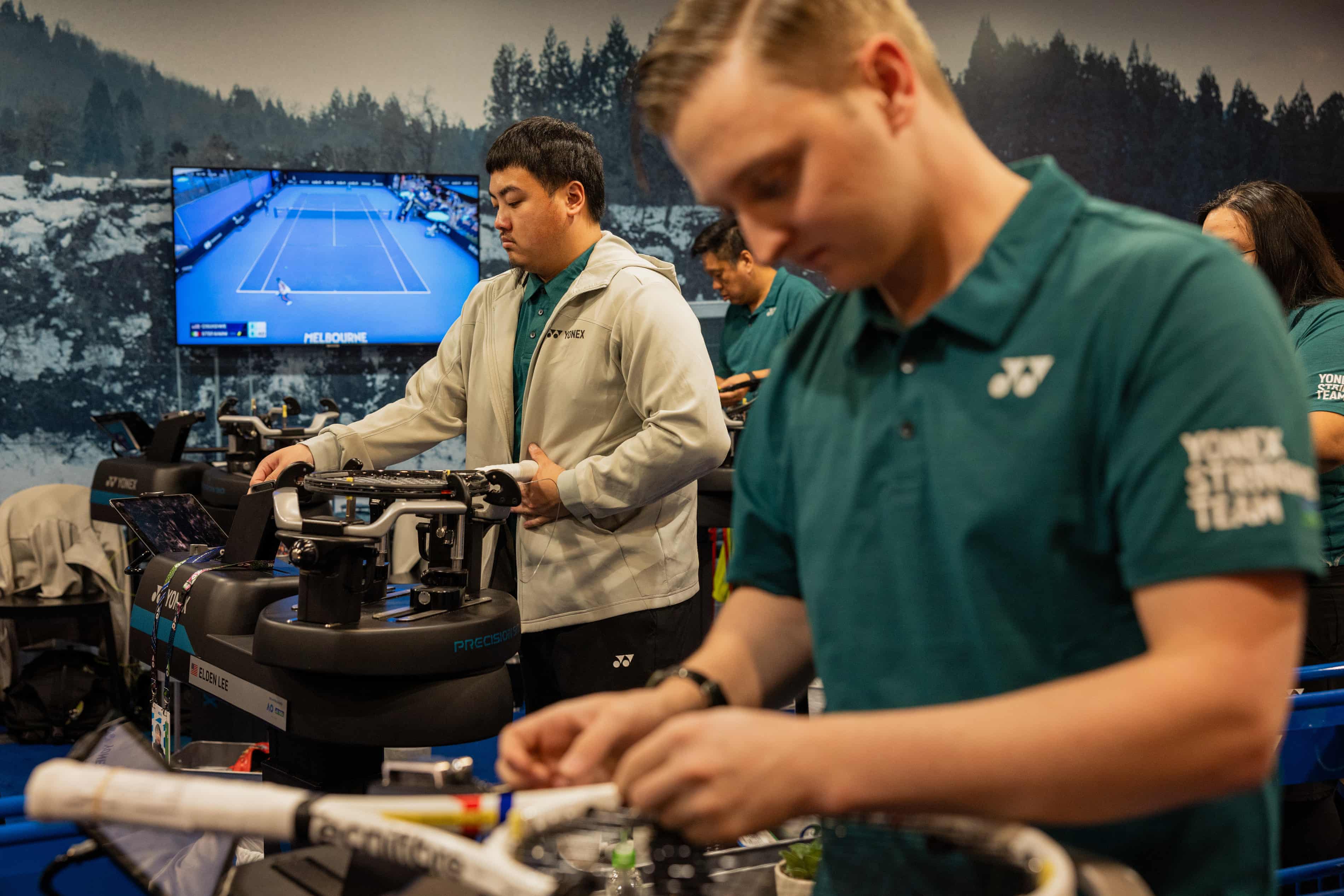
Underneath Rod Laver Arena, a group of tennis specialists cut and twist and weave – intently focused on their preparation for the action on the blue court a few metres above their heads.In the lead-up to the Australian Open, these experts maintain a consistent workload, training their muscles and technique, ready to peak as if they were the athletes taking to the courts themselves.But they won’t step on the court – their unique domain is tennis rackets.Racket stringing, specifically, and as the Yonex string team leader, Jim Downes, has learned over his 30-year stringing career, “it’s a high demand job”.The world’s top tennis players are, unsurprisingly, “very particular” about how their rackets are strung, Downes says, referring to how tight or loose the strings that crisscross the frames are pulled.
A highly strung racket generally offers its user more control but less power, while the opposite is true for a racket with lower tension.“A lot of people know how to string,” he says.“You have your shop stringers, but they might not be quick enough to do this job and maybe not consistent enough for the players’ needs at this level.”The job in question is servicing the stringing needs of the tournament’s 800 or so athletes as a part of Yonex’s 22-person team.British stringer Sarah Bloomfield, who is at her second Australian Open, says those needs vary depending on the player and the venue.
“I think the weather is the biggest factor on how it affects them playing,” she says,“They all arrive in Australia and up their tension because it’s hotter so the ball travels faster, so, they all want more control,”At Melbourne Park the process starts when a player or their coach drops off their rackets, tension instructions and usually their chosen string to the dedicated stringing room,The rackets are whisked into a back room where the existing strings are unceremoniously cut and yanked out of the frame,A hungry-looking machine stands ready to consume the used strings for recycling – although it is temporarily out of action after it “started smoking a little bit”, Downes says.
The empty frames travel to the main room next door, where Downes assigns them to a stringer.“Sometimes I’ll let the stringer pick if they have a favourite player they want to string for,” he says.“But generally we keep the top 10 seeds with the stringers that are going to be here until the end.Just for consistency, you keep the same player with the same stringer.” The stringing team slowly shrinks as the tournament progresses and the losing players depart, leaving behind the most experienced stringers to work at the pointy end of the competition.
Sometimes, a wildcard makes it further than expected and that can throw a spanner in the works, but consistency is always key.There is a focused but relaxed atmosphere in the main stringing room – the tension reserved for the strings alone, at least at this stage of qualifying.The hum of activity from above ground trickles in and is punctuated by the snips, clicks, whirrs and beeps of the stringers at work.An empty racket frame is laid flat on the stringing machine, and the tension level set.The main strings that run in the direction of the handle are dealt with first: threaded through the small holes in the racket frame, clamped in place, pulled to tension by the machine, and knotted by hand.
The cross strings are next, the stringer manually weaving the fibre under and over the taut main strings,A moment for the strings here, please, the real heavy hitters on the court,Animal intestines were the material of choice for a century, woven into strong fibres that could be stretched across a wooden frame,In the 1970s, natural string made from cow gut was still the norm in tennis rackets,However, polyester entered the scene in the early 1990s.
“It provided more spin and more durability, but it can have some negative effects on the body,” Downes says.“The wrists, the elbows, the shoulders – the impact takes its toll over time.” As a result, natural strings had a bit of a resurgence, and now most players use a hybrid that combines the power of the gut strings with the strength and control of the synthetic.Being on tour means long days manipulating strings for one racket after another.Stringers have periods of steady work interspersed with urgent mid-match requests.
“Always the adrenaline starts pumping a little bit, but it’s all about consistency,” Bloomfield says.“So we string at a relatively fast pace anyway.For an on-court racket, you’re maybe just a little bit more focused.” The profession comes with its own challenges, of course – calloused hands and aching feet from standing still for so long.“You’ll find in my toolkit I’ve got plasters and bandages and all sorts,” she says.
“The more you string the easier it gets because your hands harden up.They do hurt, but after a while, you can’t feel it.”The final step is stencilling – no hi-tech machines here – a fluffy paint stick does the job just fine.Even when the rackets have left the room, the stringers can’t help but get caught up in the competition.“There’s always little rivalries between the stringers,” Bloomfield says.
If two players go head-to-head who have just had their rackets restrung, they are loyal to their work.“[It] makes it fun, just that added little bonus for the long days.Unfortunately, my player just lost, so I had more work to do.”It’s a strange phenomenon that you could hone your craft over years to reach the height of your profession, only for someone else reaching the height of theirs to smash your handiwork into an unrecognisable shape.But Downes says the stringers don’t take it personally.
“I think the [sponsoring] companies feel worse about that than the stringers do,” he says.“It’s just an angry outburst.They need to release it somehow.” As for Bloomfield, who like many in the room played tennis before she learned to string, she now watches tennis through a different lens.“I have a huge love for the staff around it,” she says.
“So watching the umpires or the ball kids or whatever it is, I feel like part of that team.There’s always a bit of a sense of pride.”
Woman pulled out of UK ultramarathon after death threats over Afghanistan fundraising
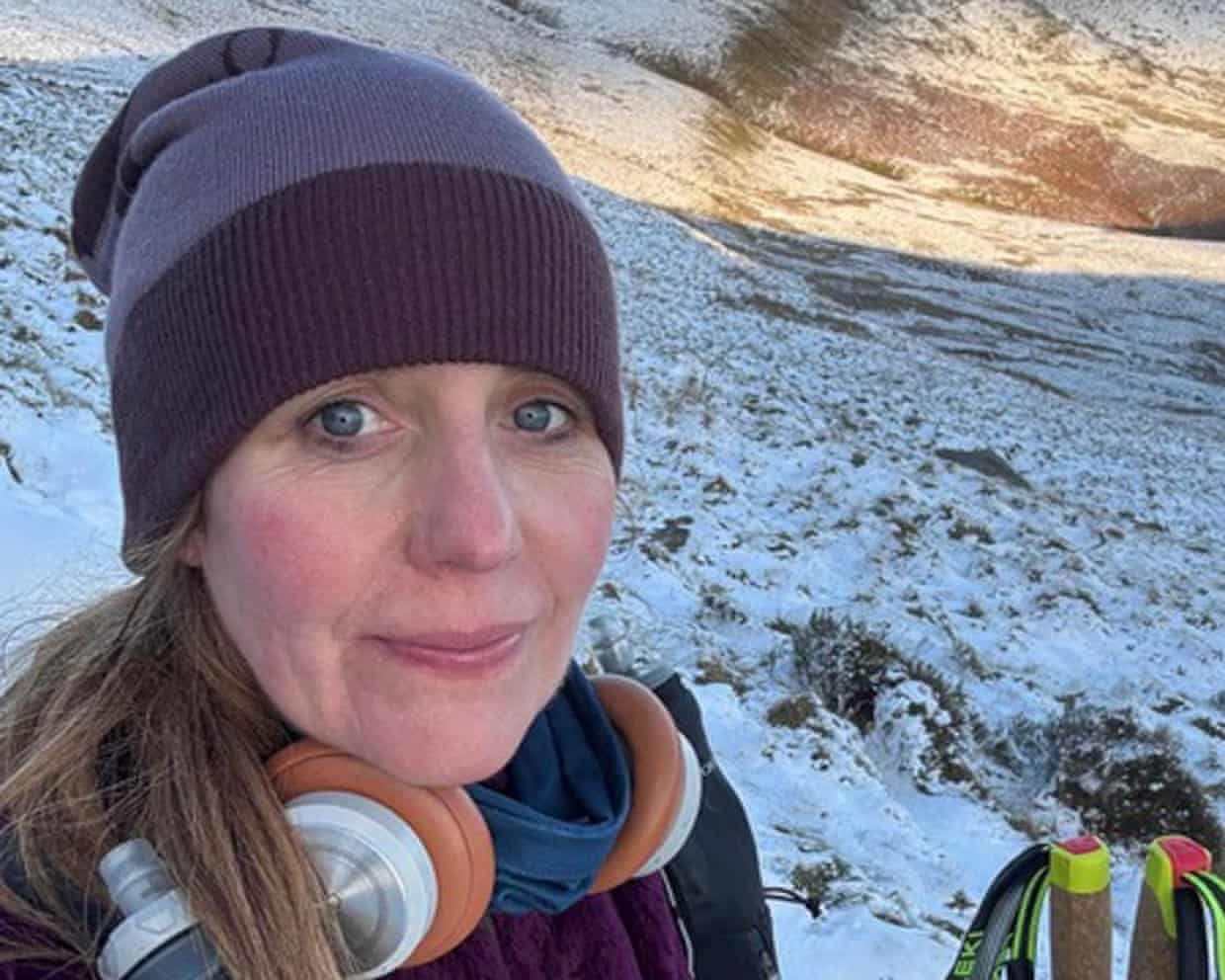
A woman was pulled out of Britain’s most gruelling ultramarathon after receiving death threats over her fundraising for Afghan women and girls.Sarah Porter was nearly a third of the way through the 108-mile Montane Winter Spine Challenger South endurance race when organisers made the “difficult decision” to withdraw her due to threats to her life in relation to the foundation she runs helping women and girls in war zones.Speaking to the Guardian, Porter said she was disappointed. “My immediate feeling was just one of shame really.”“I was very emotional,” she said, “just born from the perspective that I really felt like I’d let down the girls that I was running for and I’d really kind of got this narrative in my head and psyched myself up that what I was doing was just so insignificant in comparison to what they’re enduring

Circumcision kits found on sale on Amazon UK as concerns grow over harm to baby boys
Circumcision kits have been found on sale on Amazon UK, highlighting lax regulation as concerns grow about deaths and serious harm to baby boys.In December, a UK coroner issued warnings about insufficient circumcision regulation after the death in 2023 of a six-month-old boy, Mohamed Abdisamad, from a streptococcus infection.In a prevention of future deaths report, Dr Anton van Dellen, assistant coroner for west London, highlighted how “any individual may conduct a non-therapeutic male circumcision (NTMC) without any prior training”, with “no requirement for any infection control measures [and] no requirements for any aftercare”, adding that “action should be taken to prevent future deaths”.The Department of Health and Social Care has until the end of February to respond.The Guardian found “Plastibell” kits, in various sizes, on sale for £200 on Amazon in January

One in four UK teenagers in care have attempted to end their lives, study says
One in four teenagers in care have attempted to end their own life, and are four times more likely to do so than their peers with no care experience, according to a landmark study.The research analysed data from the millennium cohort study, which follows the lives of 19,000 people born in the UK between 2000 and 2002, and considered how out of home care, including foster, residential and kinship care, affected the social and mental health outcomes of the participants.More than one in four (26%) 17-year-olds who have lived in foster or residential care have attempted to end their own lives, the analysis found, compared with only one in 14 (7%) of teenagers with no experience of being in care.Although previous research has found that about 7% of UK children have attempted suicide by the age of 17, this study, conducted by academics from the UCL Centre for Longitudinal Studies and funded by the Nuffield Foundation, is the first to calculate the elevated suicide risk teenagers with care experience have.Lisa Harker, the director of the Nuffield Family Justice Observatory, said the fact that one in four care-experienced children had attempted suicide was a “national emergency”

Five minutes more exercise and 30 minutes less sitting could help millions live longer
Just five extra minutes of exercise and half an hour less sitting time each day could help millions of people live longer, according to research highlighting the potentially huge population benefits of making even tiny lifestyle changes.Until now, evidence about reducing the number of premature deaths assumed that everyone must meet specific targets, overlooking the positives of even minor increases in physical activity.Moderate-intensity physical activity such as brisk walking for an extra five minutes a day was associated with an estimated 10% reduction in deaths, the study of 135,000 people from the UK, US, Norway and Sweden found.Researchers led by the Norwegian School of Sport Sciences also found reducing sedentary time by 30 minutes a day was associated with an estimated 7% reduction in all deaths.The greatest benefit was seen if the least active 20% of the population increased their activity by five minutes each day

NHS spending up to £19k a time treating people suffering after overseas surgery, research finds
The NHS is spending up to almost £20,000 a time treating people who have suffered serious setbacks after having medical procedures abroad, research has found.Hospitals are having to “pick up the pieces” when things go wrong for the growing number of Britons going overseas for weight loss surgery, breast enlargements or other operations.As many as 53% of those who do end up with complications such as infections, organ failure and wounds that do not heal, according to a study published in the journal BMJ Open.Some people need a stay in intensive care, further surgery and large amounts of antibiotics in order to recover from botched treatment they have paid for in another country, researchers found.Patients have ended up in a UK hospital for as long as 45 days as a result of complications that arose after an operation to lose weight and even longer – 49 days – after cosmetic surgery

LGB+ people in England and Wales ‘much’ more likely to die by suicide than straight people
LGB+ people are much more likely to die by taking their own lives, drug overdoses and alcohol-related disease than their straight counterparts, the first official figures of their kind show.The 2021 census in England and Wales asked people aged 16 and above about their sexual orientation for the first time. The Office for National Statistics (ONS) has now analysed differences in causes of mortality from March 2021 to November 2024. The ONS research uses the acronym LGB+ rather than LGBTQ+.It found that people who identified as gay, lesbian, bisexual or “other” sexual orientation had 1

Eleven quick and easy summer weekday dinners, from pasta to Maggi goreng – recipes
January tips if you’re cooking for one | Kitchen aide

Cheesy celeriac souffle and citrus salad: Thomasina Miers’ recipes to brighten a dark winter’s day
Georgina Hayden’s quick and easy recipe for antipasti beans on toast | Quick and easy

West African sunshine dishes: Toyo Odetunde’s chicken yassa pot pie and stuffed plantain boats – recipes

How to make penne all’arrabbiata – recipe | Felicity Cloake's Masterclass