Decision to allow UK exports to Armenian firm under review over Russian links

Ministers are reviewing a decision to allow a British company to export hi-tech equipment to Armenia after the Guardian uncovered links to the Russian military supply chain.Cygnet Texkimp, based in Cheshire, was weeks away from exporting two machines that produce carbon fibre “prepreg”, a lightweight material that can be used in a range of civil and military applications.Whitehall officials told Cygnet last year that it did not require a special licence for the shipment, signalling that the government’s routine vetting process for exports had raised no concerns about how the equipment could be used and by whom.But the trade minister, Chris Bryant, said he was putting the deal on ice, pending a review, over concerns that the machines could be deployed for military purposes.The material they produce can be used in the production of missiles and drones, crucial weapons in the war in Ukraine.
The decision comes after Liam Byrne, chair of the House of Commons business committee, wrote to Bryant to highlight a Guardian report outlining the links between Cygnet’s Armenian client, Rydena LLC, and the Russian military,Rydena was established two years into the full-scale invasion of Ukraine by former executives of Umatex, a Kremlin-owned company that has emerged as one of the most important suppliers to Vladimir Putin’s war machine,Experts have warned that the Rydena founders’ past involvement in the Kremlin’s military supply chain should raise concerns about whether Cygnet’s hardware could be used to supply carbon fibre to Russia, circumventing sanctions designed to turn the screw on Putin,Rydena has previously denied that it does any business with Russia or with sanctioned entities, while both it and Cygnet have said the equipment will be used for civil applications,In a letter to Byrne, Bryant confirmed that the government is reconsidering its decision to permit the export to go ahead.
Bryant said: “We are currently reviewing an earlier determination that the export was not subject to licence as the goods were not considered to be controlled (a ‘No Licence Required’ decision).”He added that the decision followed close consultation with Cygnet Texkimp, “as a result of which we have determined that some elements of the production equipment should be considered as subject to dual-use controls”.Dual-use controls cover equipment that can be used for both civil and military applications, to prevent apparently innocent export contracts being used to disguise deals for equipment that can be used in war.Cygnet said that it had consistently followed export rules and applied for a licence because it recognised that its “prepreg” machine could potentially be categorised as “dual use” but said that the government had told it that no licence was required.Bryant said the Department for Business and Trade had “reopened the licence application, which will have to be assessed before any export is permitted.
I can confirm that no export has yet taken place.”Bryant signalled Cygnet Texkimp’s 50-year history in hi-tech manufacturing, with a long record of complying with export licences and a good relationship with the Export Control Joint Unit (ECJU).The unit brings together government departments and the intelligence services to hunt for red flags raised by potential export deals.The government has so far declined to say whether the ECJU was aware of the Rydena executives’ past work for Umatex, which is disclosed on their profiles on the professional networking site LinkedIn.“You can be assured that I will continue to take a close direct interest in this case,” Bryant said.
In a subsequent evidence session with Byrne’s business select committee on Wednesday, Bryant said the government was planning to strengthen export licensing laws to improve controls on goods being diverted to Russia.A spokesperson for Cygnet Texkimp said: “At the outset of this order, we proactively engaged with the relevant UK authorities and voluntarily submitted an application for an export licence because we recognised that certain elements of the equipment, namely a prepreg machine, could potentially be categorised as ‘dual use’.“We acknowledge the UK government’s decision to review its earlier guidance that a licence was not required.We will await the outcome of this process.Cygnet Texkimp has always operated in full compliance with UK export control regulations and remains committed to maintaining an open, constructive and transparent dialogue with the relevant authorities at all times.
”

Diagnosing mental health conditions need not be a case of yes/no | Letters
Lucy Foulkes explores the possibility that the rising numbers of young people receiving a diagnosis of mental illness or ADHD are subjects of overdiagnosis (Are we really overdiagnosing mental illness?, 22 February). She posits that changes in terminology, increasing societal awareness and reductions in stigma are all factors in the increase in diagnoses.However, there is another way of looking at this issue. If we treat ADHD as binary (you have it or you do not), we are missing the possibility that we all lie somewhere on a continuum with diagnosed ADHD towards one end (and perhaps an ability to focus and concentrate at the other). A diagnosis of ADHD then depends on where the line is drawn

‘Violent bully’ who broke partner’s neck and left her paralysed jailed for 16 years
A “violent and controlling bully” who broke his partner’s neck, leaving her paralysed and her life “destroyed”, has been sentenced to 16 years in prison.Robert Easom, a landscape gardener, violently assaulted Trudi Burgess, a schoolteacher and former singer, when she threatened to leave him after enduring eight years of coercive, controlling behaviour.A court heard that Easom, 57, pinned Burgess down in a rage and pushed her head into her body until her neck snapped. He denied a charge of causing grievous bodily harm with intent but was found guilty after 27 minutes of deliberation by a jury at Preston crown court in November.He had admitted causing the injury but denied intending to cause her serious harm

European girls aged 13-15 have world’s highest rate of tobacco use for age group
Teenage girls in Europe have the highest rate of tobacco use in their age group around the world, while one in seven adolescents across the continent use vapes and e-cigarettes, figures show.The data, based on analysis by the World Health Organization (WHO), shows that Europe is on course to maintain its status as the world’s biggest consumer of tobacco up to 2030, and reveals “particularly concerning” trends of tobacco use among women and young people.Four in 10 adult female smokers around the world – about 62 million women – live in Europe, while 4 million teenagers aged 13 to 15 across the continent use tobacco products.For vapes and e-cigarettes, Europe has the highest prevalence of teenage regular users, at 14.3% of children aged between 13 and 15

Vegetarians have ‘substantially lower risk’ of five types of cancer
Vegetarians have a substantially lower risk of five types of cancer, a landmark study on the role of diet has revealed.The research, using data from more than 1.8 million people who were tracked over many years, found that vegetarians had a 21% lower risk of pancreatic cancer, a 12% lower risk of prostate cancer and a 9% lower risk of breast cancer compared with meat eaters. Combined, these cancers account for around a fifth of cancer deaths in the UK.Vegetarians also had a 28% lower risk of kidney cancer and a 31% lower risk of multiple myeloma, according to the study published in the British Journal of Cancer

Kinship carers in England to be given financial support in government pilot
Grandparents who step in to provide full-time care for their grandchildren to prevent them being taken into care will be given guaranteed financial support under a government pilot scheme.Charities welcomed the trial as groundbreaking and said if fully rolled out across England it had the potential to transform the lives of tens of thousands of children looked after under “kinship care” arrangements.Kinship carers are grandparents, aunts and uncles, older siblings or close family friends who take on full parental responsibility when a child loses their birth parents as a result of death, a family court order, severe illness or imprisonment.Campaigners have fought for more than two decades to establish financial recognition of the role and personal sacrifices that kinship carers make. Some carers say they have felt ignored and exploited as a “cheap option” despite saving the state billions it would otherwise have had to spend on foster or residential care
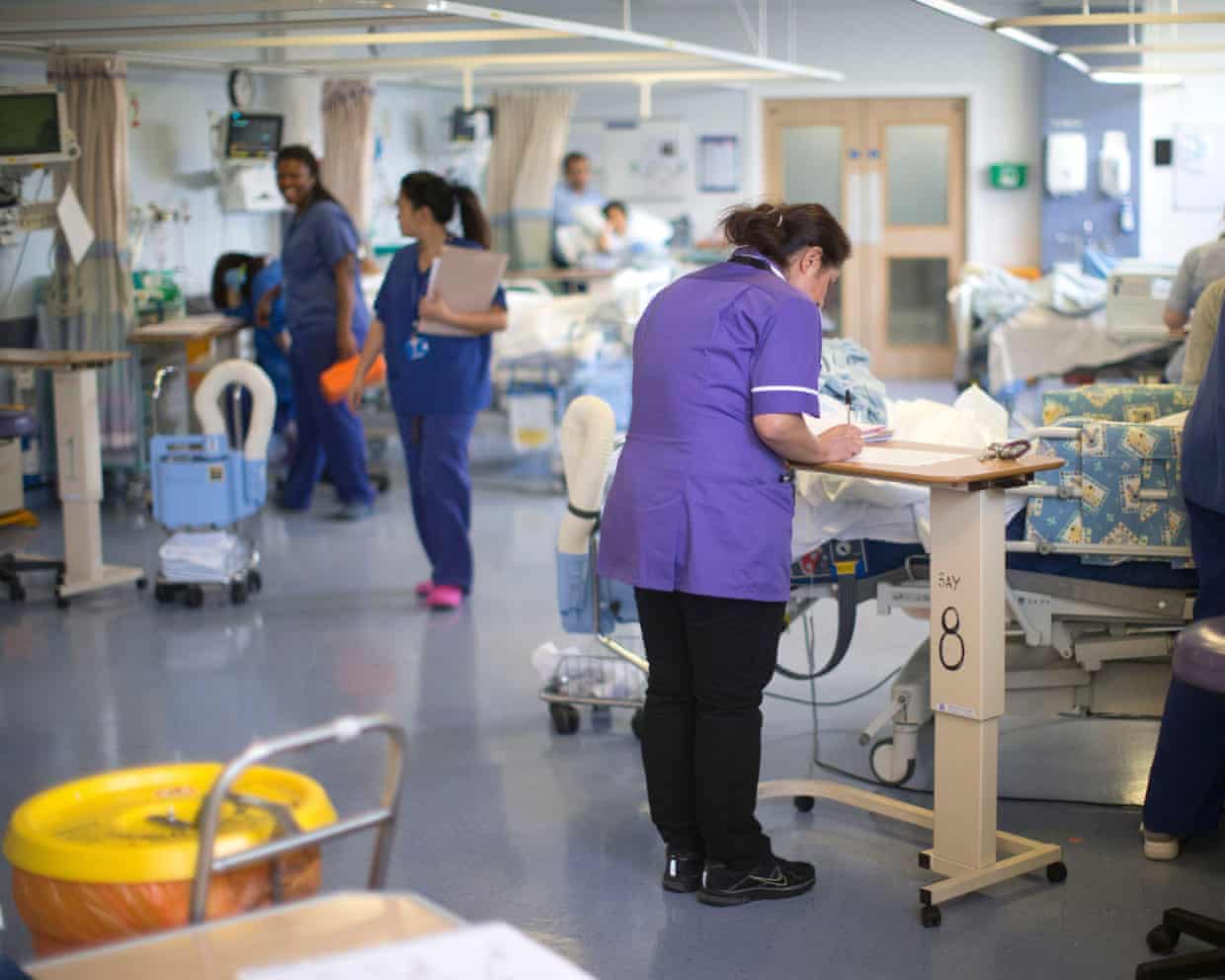
Drop in overseas workers is ‘car crash’ for UK hospitals and care homes, say experts
Hospitals and care homes in the UK face “an impending car crash”, experts have warned, as research shows the number of overseas nurses and carers has collapsed.Analysis of Home Office quarterly data reveals the number of overseas nurses granted entry to the UK has fallen by 93% over three years. Just 1,777 overseas nurses were granted entry in 2025, compared with 26,100 in 2022.Visas for workers in the caring personal service occupations category – which includes care workers, but also nursing auxiliaries, ambulance staff and dental workers – had the steepest decline in new workers from overseas in absolute terms.The figure fell from 107,847 workers granted entry in 2023 to just 3,178 in 2025, a 97% decline over two years

Square Mile strikes back: how the City of London is fighting disinformation about crime

Harrods faces legal action over £1-a-head dining charge not going to staff

Suicide forum found to be in breach of Online Safety Act after failing to block UK users

OpenAI announces $110bn funding round that would value firm at $840bn

Formula One to revise controversial rule at centre of Mercedes engine row

Oleksandr Usyk to defend title against kickboxer at Pyramids of Giza in Egypt