Thames Water lenders float new £10bn rescue plan
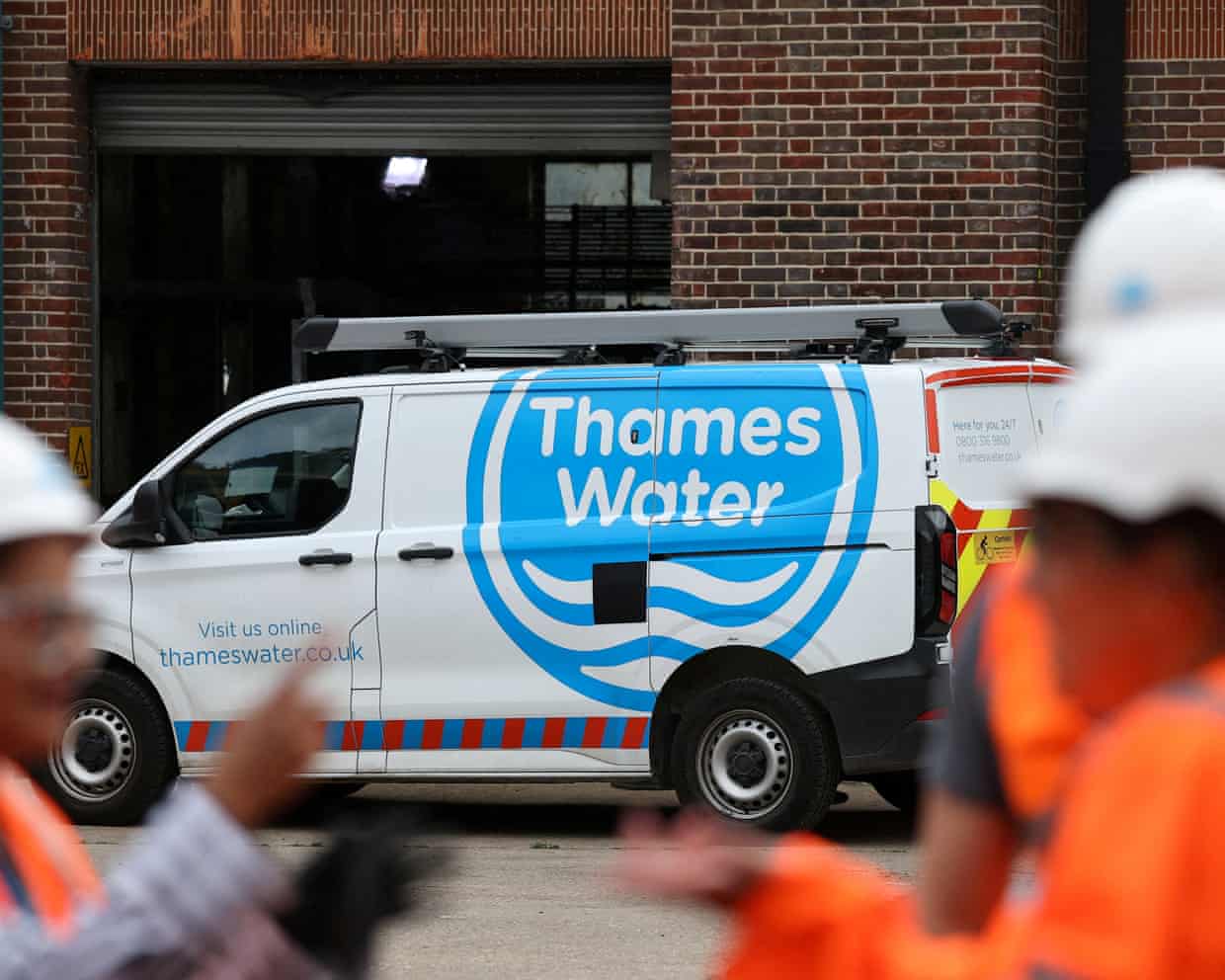
Thames Water’s lenders have put forward a £10bn rescue plan that would involve paying off the troubled water company’s hundreds of millions of pounds-worth of fines for leaks and pollution, as part of an effort to stave off financial collapse.A group of private equity firms and investment groups said they would inject about £3.35bn of cash into Thames Water and raise £6.65bn in debt, in exchange for the company not falling into a government-handled administration, in effect a temporary nationalisation.Bills for Thames Water’s 16 million customers in south-east England are already due to rise steeply until 2030 but the rescue plan would, at least, hold them at that level rather than pushing them even higher.
Britain’s biggest water company has been on the brink of collapse for more than two years as it struggles under the weight of £17.6bn in debt, built up over decades since privatisation.It has, in effect, been in the hands of its lenders, which include the US hedge funds Elliott Management and Silver Point Capital, since shareholders pulled out in 2024.The supplier has been dogged by poor environmental performance over the same period, with sewage leaks provoking public and political outrage and adding huge costs in the form of fines.Last year, the Guardian revealed that bosses were asking to be spared billions of pounds-worth of costs and fines to try to attract new investors.
On Monday, its lenders said the new rescue plan would involve paying off all of its existing fines in full, and making an upfront payment to cover future underperformance against Ofwat’s targets.The company would still be subject to future fines for pollution and leaks from Ofwat and the Environment Agency.The plan needs to be approved by Ofwat and the company’s board, but would involve about 30% of Thames’ existing debts to its senior creditors being wiped out in return for continuing to operate as a private company.Its smaller group of “class B” junior creditors would be wiped out entirely.The plan would also mean that Thames Water would not pay dividends to its investors until at least 2035.
Last year, the company was handed an £18m fine for breaking dividend rules, for paying out cash to investors despite having fallen short in its services to customers and its environmental record.The consortium also said customers would receive a share of the proceeds if it sells Thames Water for a significant profit.Last year, Thames Water, which employs about 8,000 people, was ranked the worst water company in England by the Environment Agency, after sewage pollution hit a new peak.The pollution scandal has returned to the spotlight in recent weeks after the Channel 4 drama Dirty Business told the story of how private companies have been allowed to contaminate Britain’s rivers and waterways.Thames Water came close to being taken into temporary government control in 2025 when it was forced to gain court approval for £3bn of high-interest loans.
Since then, it has been working on a second deal to reorganise the rest of its debts and pass formal ownership to its lenders.But talks have dragged on over months, with Thames surviving by gradually tapping into the £3bn of emergency funding.As well as the US hedge funds, the group of lenders also includes more traditional investors such as Aberdeen and Insight Investment.The rescue package will also need the approval of Emma Reynolds, the environment secretary, as well as other regulators including the Drinking Water Inspectorate and the Environment Agency.A spokesperson for the consortium of lenders, known as London & Valley Water (L&VW), said the plan came after “constructive discussion and detailed feedback from regulators”.
They said the plan was designed to “establish a route back to full compliance as quickly as possible” and would give “clear accountability” for reducing sewage spills.The rescue deal is the latest attempt to avoid being placed into a special administration regime, a form of temporary nationalisation, after a previous buyout attempt by US private equity firm KKR collapsed last June.Thames Water said there was “no certainty” that the plan would be accepted.“At this stage, the company’s board, Ofwat, other regulators and relevant investment committees have made no decision to accept and take forward the L&VW proposal to implementation,” the company said.An Ofwat spokesperson said: “We continue to engage with L&VW and are reviewing their plans carefully to assess whether they deliver a turnaround in the company’s operational performance and strengthen its financial resilience to the benefit of customers and the environment.
”

AI has exposed age-old problems with university coursework | Letter
The frustration many academics are expressing about artificial intelligence and critical thinking is understandable (‘I wish I could push ChatGPT off a cliff’: professors scramble to save critical thinking in an age of AI, 10 March). But from my experience working with students on academic writing, blaming AI risks masking a problem that universities have lived with for years.In my work with students, I have long seen the ways in which thinking can be outsourced when assessment allows it: essay mills, shared past papers, model essays passed between cohorts, or heavy reliance on tutors and friends to structure assignments. Artificial intelligence did not invent this behaviour. It has simply industrialised a shortcut that already existed
Trump administration reportedly set to be paid $10bn for brokering TikTok deal
Donald Trump’s administration is reportedly poised to be paid $10bn by investors as part of a deal to create a US-controlled version of TikTok.The $10bn, considered by the US government as a sort of transaction fee, will be paid by the administration-friendly investors who took control of TikTok’s US operations from its Chinese parent company, ByteDance, according to reporting that first appeared in the Wall Street Journal.The investors in the popular social media app include software company Oracle; MGX, an investment firm based in the United Arab Emirates; and private equity business Silver Lake. These entities, along with other backers, paid $2.5bn to the US treasury when the deal closed in January and are set to make further payments in the unusual arrangement until the total hits $10bn

Meta and Google trial: are infinite scroll and autoplay creating addicts?
It was as “easy as ABC”, claimed the lawyer prosecuting a landmark social media harm case against Meta and Google which heard closing arguments this week. The defendants were guilty, said Mark Lanier, of “addicting the brains of children”. Not true, replied the tech companies. Meta insisted providing young people with a “safer, healthier experience has always been core to our work”.Features such as autoplay videos, infinite scrolling and constantly chirruping alerts woven into the fabric of online platforms were central to the six-week trial in Los Angeles, which has been compared to the cases against tobacco companies in the 1990s

New study raises concerns about AI chatbots fueling delusional thinking
A new scientific review raises concerns about how chatbots powered by artificial intelligence may encourage delusional thinking, especially in vulnerable people.A summary of existing evidence on artificial intelligence-induced psychosis was published last week in the Lancet Psychiatry, highlighting how chatbots can encourage delusional thinking – though possibly only in people who are already vulnerable to psychotic symptoms. The authors advocate for clinical testing of AI chatbots in conjunction with trained mental health professionals.For his paper, Dr Hamilton Morrin, a psychiatrist and researcher at King’s College in London, analyzed 20 media reports on so-called “AI psychosis”, which describes current theories as to how chatbots might induce or exacerbate delusions.“Emerging evidence indicates that agential AI might validate or amplify delusional or grandiose content, particularly in users already vulnerable to psychosis, although it is not clear whether these interactions can result in the emergence of de novo psychosis in the absence of pre-existing vulnerability,” he wrote

Fake rooms, props and a script to lure victims: inside an abandoned Cambodia scam centre
It is as if you have walked into a branch of one of Vietnam’s banks. A row of customer service desks, divided by plastic screens, with landline phones, promotional leaflets and staff business cards. A seated waiting area and a private meeting room. All of it features the OCB bank’s logo, or its trademark green colour.This is not a genuine bank branch, however

Apple cuts China App Store commission fees after government pressure
Apple announced late on Thursday it would lower the commission fees collected in its App Store in mainland China. The move follows pressure from regulators in the tech company’s second-largest market, as well as global scrutiny of its payment requirements.Fees for in-app purchases and paid transactions will be lowered to 25% from 30% starting on Sunday, Apple said in a statement on its blog for developers.“Apple is making changes to the App Store in China following discussions with the Chinese regulator,” the company’s announcement reads. “As of March 15, 2026, changes will be made to the commission rates that apply to the China mainland storefront of the App Store on iOS and iPadOS
Labour MPs have no reason to oppose new welfare reforms, says minister

UK not obliged to support every demand of ‘transactional’ US president, minister says

UK complicit in desecration of international law in Gaza, says Corbyn-led tribunal
Phil Woolas obituary
Row over university fees shows UK’s ‘reset’ with EU may not be so simple

Digital ID won’t work if you live in rural areas | Letters