Will Great Britain’s offshore wind subsidy auction mean lower energy bills?
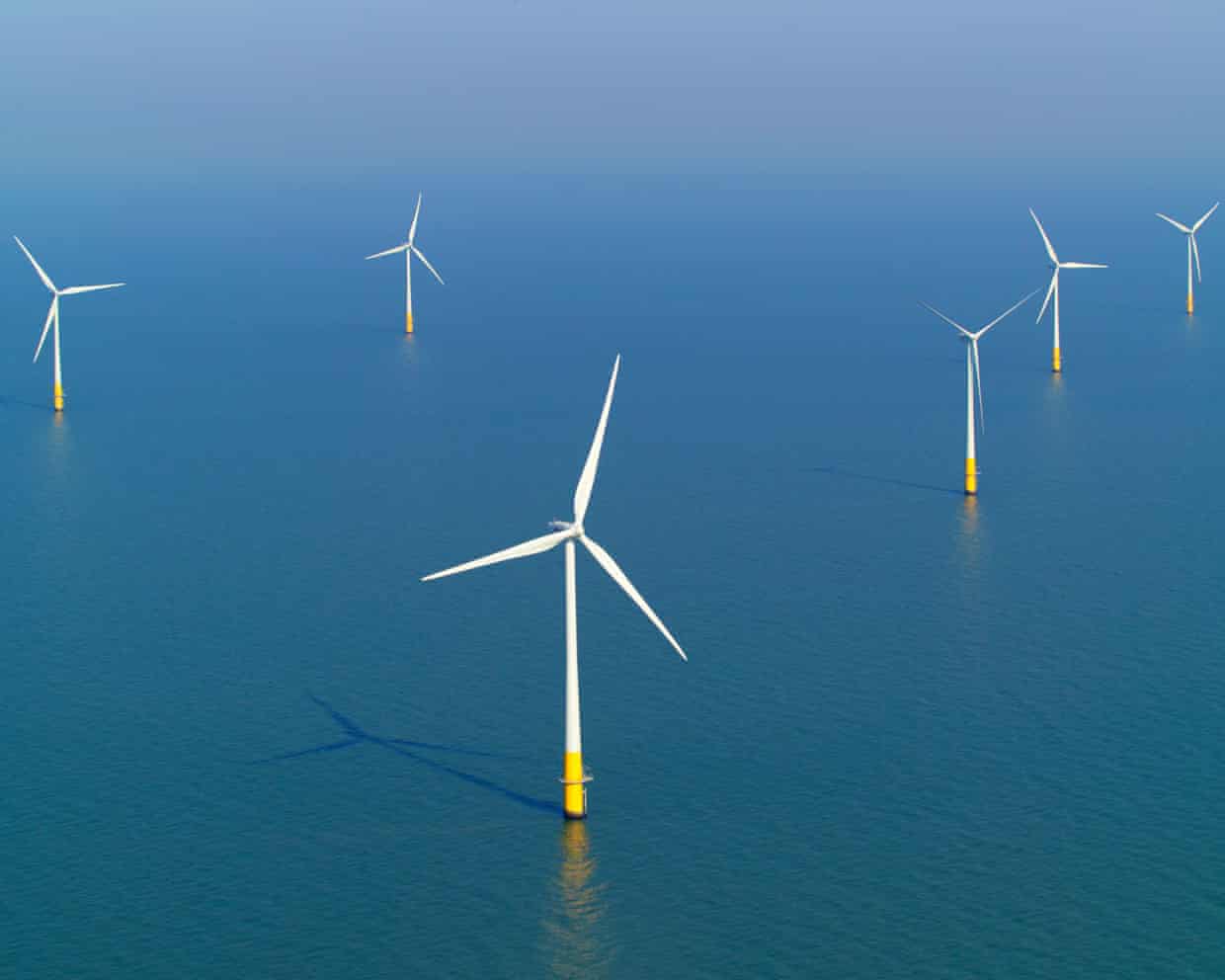
Great Britain has secured enough new offshore wind to power 12m homes after the most competitive – and financially generous – subsidy auction on record.The competition to secure renewable energy support contracts was considered a crucial test of the government’s pro-growth agenda and its ambition to achieve a clean power system by 2030.In response, Ed Miliband, the energy secretary, said the “historic auction” had proved the government’s doubters wrong.The biggest single procurement of offshore wind in the UK and mainland Europe would now bring forward investment of £22bn into the sector and create 7,000 new jobs, he added.Here we look at how the renewable energy auction promises to help the British government meet its clean energy targets.
The UK pioneered the “contracts for difference” scheme, which supports new renewable electricity projects via a “reverse auction” in which the lowest bids win.This helps to incentivise the multibillion-pound upfront costs of investing in low-carbon energy, such as solar, wind and nuclear power projects.It also helps to ensure that only those schemes that offer the best value for money receive support at the lowest cost to consumers.The latest auction is the seventh of its kind to be held in the UK in the last 11 years, and the format has been replicated elsewhere in Europe and globally.Over the summer, clean energy developers submitted closed bids indicating the lowest price they could accept for each megawatt of electricity produced by their project.
About 25 offshore wind projects were eligible to bid in the latest auction – the equivalent of more than 24 gigawatts (GW) of electricity capacity, or enough to power 20m homes when the windfarms are running at their full potential.In the end, funding was awarded to 8.4GW of offshore wind capacity.The Low Carbon Contracts Company administers the scheme for the government and awards contracts to the best bids.If the market price for electricity is below the “strike price” set in the support contract, a levy on household energy bills is used to top up the payments received by developers.
If the wholesale market price soars above the strike price, developers are contractually bound to pay back the difference to consumers.Initially these contracts guaranteed revenues for 15 years but in the latest auction the government offered 20-year contracts in the hope that developers would submit lower bids in exchange for a longer period of support.It was considered the last realistic chance for Labour to meet the clean energy targets it set out ahead of its election victory.The party promised to lower energy bills by creating a virtually carbon-free electricity system by 2030.To do this it plans to double Britain’s onshore wind power, triple its solar power and quadruple its offshore wind power capacity.
The plan to become a “clean energy superpower” relies heavily on the government’s particularly ambitious offshore wind targets at a time when the industry has faced rising costs,Currently the UK has about 27,6GW of offshore wind capacity either in operation, under construction or which holds a government contract – enough to power the equivalent of over 27m homes when running at full capacity,The government would need to add at least 16GW of offshore wind over the next two years to reach its offshore wind target of between 43GW to 50GW,The government is under pressure to bring forward investment in energy infrastructure, with half the existing gas and nuclear capacity expected to be retired by 2035 and demand for electricity forecast to double by 2050.
The government believes so,Official figures show that electricity generated by the latest generation of offshore windfarms will be 40% less expensive than the power produced by a new gas-fired power plant,In official figures published on Wednesday, the government said the cost of building and operating a new gas-fired power station was £147 per megawatt hour, while the auction price for offshore wind was £90,91 per megawatt hour on average,Industry experts said before the auction that if the government could bring forward investment in renewable energy at a level below £94-£95/MWh in 2024 prices then it would meet its targets at no extra cost to consumers.
In the end, the contracts were awarded at £89,49-£91,20/MWh,The current market price for electricity bought in advance is about £74/MWh, suggesting bill-payers would have to offer top-ups to developers to match the strike price if they began operating today,However, analysis by Aurora Energy Research and the consultancy Baringa found that an increase in renewable energy today would lower the future wholesale price – more than offsetting the impact of higher levies to support renewable energy and “keeping household energy bills effectively neutral through to 2035”.
However, there are still some threats to energy bills.The cost of connecting these giant windfarms to the UK’s National Grid and transporting the electricity to areas of high energy demand is paid through bills and is expected to rise in the years ahead.If the construction of these transmission projects does not keep pace with the build-out of renewables it raises the risk that turbines will be paid to turn off if there is not enough grid capacity to carry the electricity, which would also be paid for through bills.The auction results will keep the government’s progress towards its 2030 offshore wind target on track – but it will still need to procure another 8GW of offshore wind in next year’s auction to hit its goal of growing the country’s offshore wind capacity to 43-50GW by the end of the decade.Although it is technically feasible for projects that are successful next year to build their projects in time to begin generating power for the UK by 2030, industry insiders have expressed concern that the “practical realities of construction and supply chains” could mean that future projects struggle to meet the government’s timeline.
The pressure will be on the industry to keep producing record-breaking investments in the years ahead – and at a cost that provides value for money to consumers, too.Before the auction, Reform said it would cancel all renewable energy contracts if it came to power in the 2029 election.Nigel Farage’s party wrote directly to energy companies and claimed there was “no public mandate for the real-world consequences” of the clean power agenda and that all subsidies would be scrapped.The threat raised eyebrows within the renewable energy industry but is not thought to have reduced the appetite for contracts in the latest auction.Developers are understood to be confident that the legal safeguards built into the private company contracts would be enough to prevent a Reform government from scrapping the scheme.
Industry insiders believe it is more likely that the party would take aim at older subsidy regimes, such as the renewables obligation, used by existing projects.

Falling inflation this year should smooth way for more interest rate cuts, says Bank of England policymaker - as it happened
Time to wrap up…The UK handed out record offshore windfarm contracts today, in what has been hailed as a breakthrough moment for the government’s ambition to get clean power by 2030.12 new offshore projects were awarded contracts after ministers increased the amount of funding available to developers to help them deliver their plans without raising bills for consumers.The funding was awarded to 8.4 gigawatts (GW) of offshore windfarm capacity, or enough to generate clean electricity for more than 12m British homes before the end of the decade. They were awarded a contract price of between £89
Will Great Britain’s offshore wind subsidy auction mean lower energy bills?
Great Britain has secured enough new offshore wind to power 12m homes after the most competitive – and financially generous – subsidy auction on record.The competition to secure renewable energy support contracts was considered a crucial test of the government’s pro-growth agenda and its ambition to achieve a clean power system by 2030.In response, Ed Miliband, the energy secretary, said the “historic auction” had proved the government’s doubters wrong. The biggest single procurement of offshore wind in the UK and mainland Europe would now bring forward investment of £22bn into the sector and create 7,000 new jobs, he added.Here we look at how the renewable energy auction promises to help the British government meet its clean energy targets
Saks Global files for bankruptcy after takeover leads to financial collapse
Beleaguered high-end department store conglomerate Saks Global filed for bankruptcy protection on Tuesday, a month after missing the deadline on a $100m interest payment, in one of the largest retail collapses since the pandemic.Barely a year after a deal brought the chains Saks Fifth Avenue, Bergdorf Goodman and Neiman Marcus together, Saks Global said it had filed for chapter 11 bankruptcy “to facilitate its ongoing transformation”.Such a move can provide a company with more time to restructure its finances without having to shut down. Saks Global said early on Wednesday its stores would remain open for now after it finalised a $1.75bn financing package and appointed a new CEO
BP to take hit of up to $5bn on green energy as it refocuses on fossil fuels
BP has said it expects to write down the value of its struggling green energy business by as much as $5bn (£3.7bn), as it refocuses on fossil fuels under its new chair, Albert Manifold.The oil company said the writedowns were mostly related to its gas and low-carbon energy divisions in its “transition businesses”, but added that wiping between $4bn and $5bn off their value would not affect its underlying profits when it reports its full-year results in February.The company has been trying to sell a stake in its solar business, Lightsource, and cancelled hydrogen projects in the UK, Oman and Australia.BP’s shares fell by as much as 1

McKinsey asks graduates to use AI chatbot in recruitment process
McKinsey is asking graduate applicants to “collaborate” with an artificial intelligence tool as part of its recruitment process, as competence with the technology becomes a requirement in competing for top-level jobs.The blue-chip consultancy is incorporating an “AI interview” into some final-round interviews, according to CaseBasix, a US company that helps candidates apply for posts at leading strategic consulting companies.In an online post, CaseBasix said candidates in “select final rounds” in the US have been asked to complete tests using McKinsey’s internal AI tool, Lilli. They are required to carry out practical consulting tasks with the help of Lilli.“In the McKinsey AI interview, you are expected to prompt the AI, review its output, and apply judgment to produce a clear and structured response

Coca-Cola reportedly abandons plans to sell Costa Coffee chain
Coca-Cola has reportedly abandoned plans to sell its Costa Coffee chain after bids from private equity firms failed to meet its expectations.The US soft drinks company halted discussions with remaining bidders in December, according to the Financial Times, ending a months-long auction process.It first emerged in August that Coca-Cola was working with bankers on a review of Costa that could lead to the chain being sold off in a cut-price deal, of roughly half what it paid for the business.Coca-Cola had high hopes for Britain’s largest coffee chain when it bought it for £3.9bn in 2018 from Whitbread, the owner of Premier Inn hotels

Circumcision kits found on sale on Amazon UK as concerns grow over harm to baby boys

One in four UK teenagers in care have attempted to end their lives, study says

Five minutes more exercise and 30 minutes less sitting could help millions live longer

NHS spending up to £19k a time treating people suffering after overseas surgery, research finds

LGB+ people in England and Wales ‘much’ more likely to die by suicide than straight people

Football fan took his own life after using illegal ‘predatory’ betting sites, inquest told