US farmers say Trump’s $12bn package not enough to undo damage from tariffs
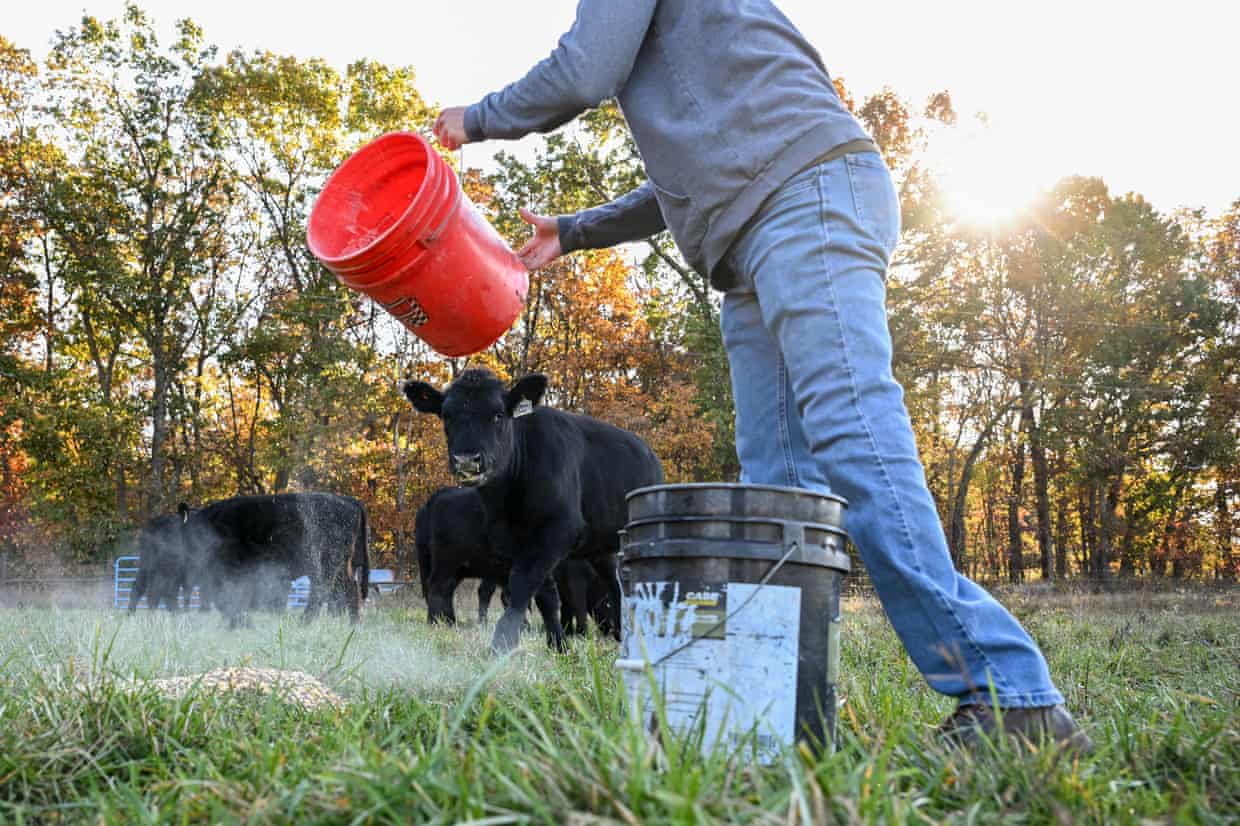
Donald Trump, having promised to “NEVER LET OUR FARMERS DOWN”, appeared to come through for them this month when he unveiled a $12bn aid package.Industry leaders say thousands of farms will still go bust this year.While the US president has vowed to increase domestic farm production, and even claimed this formed a “big part” of his plan to lower grocery prices for Americans, many US farmers are grappling with mounting financial issues – compounded by Trump’s agenda.Grain farmers, in particular, have been hit by trade disruptions caused by tariff hikes, and $11bn of the US Department of Agriculture’s Farmer Bridge Assistance Program will go to row-crop farmers.Trump’s trade war with China has hit soya bean farmers the hardest, as China bought 54% of US soya bean exports last year, according to the American Soybean Association.
But the one-time payments do little to assuage the financial stressors that row-crop farmers have faced for the past three years because of rising input costs and lower crop prices.This year alone, US crop farmers have lost $34.6bn, before crop insurance and other government support, according to the American Farm Bureau.Neither row-crop, nor specialty producers, who raise fruits and vegetables, made money in 2025, and the 2026 outlooks are bleak.While federal aid was welcomed, Dan Wright, president of the Arkansas Farm Bureau, said it falls short of what is needed.
He said: “A program that provides roughly $50 an acre will not save the thousands of family farms that will go bankrupt before the end of the year.”US agriculture secretary Brooke Rollins framed the package as short-term support, as the Trump administration works on creating trade and farm safety nets.Tariffs monies will fund bridge-loan program.Farmers have been hit by Trump’s trade war with China in both of his presidential terms.According to Reuters, the first time Trump was in the White House, the administration paid out $23bn to help farmers affected by simmering tensions between Washington and Beijing.
In 2025, farmers are expected to receive $40bn in economic and disaster aid.Farmers are not the only ones under pressure.Tractor maker John Deere said it expects a pre-tax tariff hit of around $1.2bn in fiscal 2026, compared with nearly $600m in 2025.Earlier this year the US and China found their way to a tentative trade truce, with China agreeing to buy at least 12 million metric tons of US soya beans.
Whether it fully complies with the pledge remains to be seen.Over the next several weeks, farmers will meet with their bankers for loans to buy seed, fertilizer and other inputs for spring planting.Many are likely to carry over debt from operating loans taken out last year.Agricultural credit conditions have fallen for crop farmers, according to the Kansas City Federal Reserve Bank, and weaker farm income has reduced farmer liquidity, and increased financing demand.Jeff Rutledge has raised corn, soya beans and rice in north-east Arkansas for 30 years, with his father and grandfather.
Farmers try to rotate between crops, but futures prices – agreed rates for assets to to be bought at a later date – will also influence his spring planting decisions.Currently, corn and rice prices are down compared to last year, and soya bean prices are up slightly.Next year will be the second straight year that Rutledge will look to plant the crops that will lose him the least amount of money.“It’s just almost a repeat of last year, only with worse conditions,” he said.His farm hasn’t been profitable since 2021’s harvest.
Farmers may seek to plant more soya beans in 2026, even though export demand for that crop is lower, and it’s less profitable than corn, according to Arlan Suderman, chief commodities economist at StoneX,Soya beans are cheaper to plant, require fewer inputs, and generally take less care than corn,For those carrying over debt from previous years, planting soya beans is “something that banks might pressure farmers to do in some areas of the country”, said Suderman,Farm bankruptcies are likely to top 1,000 this year, with Arkansas hit harder than any other state: well above 2019’s peak of 599 filings, but below the peak during the 1980s farm crisis of almost 6,000 in 1987,While farmers are under financial stress, Suderman doesn’t expect a repeat of the 1980s farm crisis.
Although China has been a big importer of US agriculture goods, for the past 20 years the country has sought to reduce its dependence on the US for soya beans by sourcing the legume from Brazil and other countries, Suderman said.“President Trump may have sped up the end of that cycle, but they were on that move anyway.”Part of the new safety net promised by the administration may be an increase in biofuels under the Renewable Fuels Standard.The Environmental Protection Agency is expected to announce an increase in the total renewable fuel requirements for 2026 and 2027.The key piece to the new rules will be biomass-based diesel production blending requirements.
Farmers are expecting a significant increase in production under the new guidelines, which could help offset some of the export market losses.The farm economy outlook is pessimistic going into 2026, but Suderman suggested that it could change dramatically if China turns back to US agricultural exports – and the EPA pushes for more domestic biofuel production.If those two events happen, “then I think that we could start healing the ag economy and move [in] a positive direction toward recovery”, he said.

Starmer has no coherent social mobility plan, says top government adviser
Keir Starmer has no coherent strategy to tackle entrenched inequalities harming the life chances of millions of people, the government’s social mobility commissioner has said.A report warned last week that young adults in Britain’s former industrial heartlands were being left behind as a result of failed or abandoned promises by successive governments.The Social Mobility Commission (SMC), a government advisory body, said big cities such as Manchester, Edinburgh and Bristol were starting to thrive but that opportunities were “overconcentrated”.In a Guardian interview, the commission’s chair, Alun Francis, urged Starmer to outline a bold vision to tackle “the defining social mobility challenge of our generation”.He said: “We have a government that talks quite a lot about social mobility, but mainly about individuals – often about [the] social mobility of themselves or their colleagues … But what we don’t have is a coherent approach to social mobility as a useful concept that you can build a strategy around

Christmas burnout: why stressed parents find it ‘harder to be emotionally honest with children’
Advent calendars, check. Tree and decorations, check. Teachers’ presents, nativity costumes and a whole new ticketing system for the PTA’s Santa’s grotto, check. But the Christmas cards remain unwritten, the to-do list keeps growing, and that Labubu doll your child desperately wants appears to have vanished from the face of the earth.If you’re feeling frayed in the final days before Christmas, you’re not alone

Labour admits 60% of parents wrongly targeted in HMRC child benefit fraud crackdown
More than 60% of parents who had their child benefit stopped by HMRC using incorrect Home Office travel data were not fraudulently claiming the support from abroad, it has emerged.The scale of the government’s anti-fraud fiasco is four times higher than previously admitted, with 15,000 of the 23,500 parents targeted by HMRC now identified as legitimate beneficiaries living in the UK.It means 63% of parents targeted in the anti-fraud debacle first reported by the Detail and the Guardian were legitimate claimants.The government’s admission was revealed in a written answer to a parliamentary question tabled by the Conservative MP for Fylde, Andrew Snowden.Dan Tomlinson, the exchequer secretary to the Treasury, told Snowden in his written answer that figures revealed that, as of 30 November, 14,994 of the 23,794 cases where benefit had been suspended had since “been confirmed to be eligible to child benefit”

‘We’ve got more in common than what divides us’: a Muslim-Jewish kitchen in Nottingham counters hate and hunger
As antisemitism and Islamophobia rise, a community centre brings people together over shared meals, offering an antidote to food poverty, social isolation and divisionDonate to the Guardian Charity Appeal 2025 hereCommunities are our defence against hatred. Now, more than ever, we must invest in hopeIt’s 2.30pm on a Wednesday afternoon and the Himmah Hub, a community centre in Nottingham, is abuzz with activity. Crates of leftover supermarket food are being carried inside, trestle tables assembled, and volunteers are arriving to prepare meals that will be served in a few hours’ time to anyone who needs one – a queue has already begun to form outside.This is the Salaam Shalom kitchen, known as SaSh, a joint Muslim-Jewish project set up in 2015, and based on one of the core tenets of both faith groups: bringing people together through food
NHS to trial potentially life-saving treatment for deadly liver disease
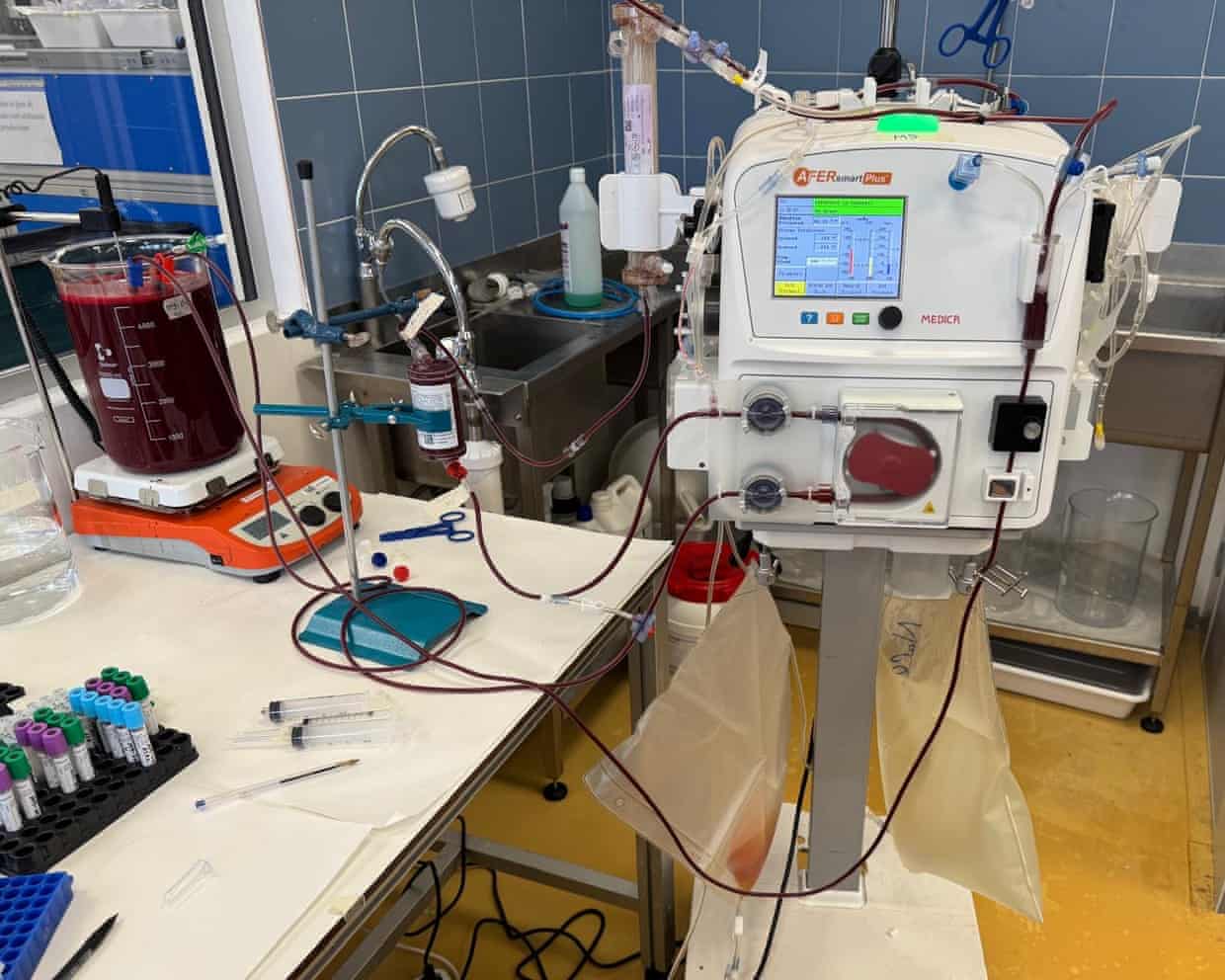
The NHS is to trial a potentially life-saving new treatment for a deadly liver disease that causes the body’s vital organs to fail.Thirteen major hospitals will use a device that cleans patients’ blood that has become corrupted by toxins as a result of them developing acute-on-chronic liver failure (ACLF).ACLF is a severe and hard-to-treat form of liver disease linked to obesity, alcohol and hepatitis, in which patients suddenly deteriorate and have to be admitted to intensive care. Three out of four people affected are only diagnosed when it has already become life-threatening.Seven out of 10 people with the disease die within 28 days and only a handful of those affected are eligible for a liver transplant, which is the only existing way to reverse ACLF

Pressure grows on DWP over ‘misleading’ response to carer’s allowance scandal
Senior officials who oversaw a flawed benefits system that plunged hundreds of thousands of carers into debt are under mounting pressure over their “misleading” response to the scandal.Prof Liz Sayce, the chair of a scathing review into the government’s treatment of unpaid carers, last week called for an overhaul of management and culture at the Department for Work and Pensions (DWP).Days after the publication of the review, the DWP’s top civil servant in charge of carers’ allowance, Neil Couling, said carers themselves were at fault for the decade-long failures.His comments, revealed by the Guardian, have prompted a key adviser to the Sayce review and a leading carer’s charity to declare a lack of confidence in the department’s pledge to fix the issues.Prof Sue Yeandle, the UK’s leading expert on unpaid carers, said ministers and senior officials had issued “really misleading” claims that the failures affected only a small number of people

UK consumers saving less as taxes squeeze incomes, data shows

Bosses at City & Guilds handed million-pound bonuses after training firm is privatised

Extremists are using AI voice cloning to supercharge propaganda. Experts say it’s helping them grow

A tape measure, a metal detector and a spirit level: 25 surprisingly useful things you can do with your phone

‘It’s not up to me is it?’ McCullum wants to stay on despite England’s Ashes defeat

Rob Cross opens up on struggles after second-round win against Ian White