UK consumers saving less as taxes squeeze incomes, data shows

UK consumers saved less money during the third quarter of the year as higher taxes squeezed disposable incomes,The households’ saving ratio – which estimates the percentage of disposable income Britons save rather than spend – dropped 0,7 percentage points to 9,5%, the Office for National Statistics said,That is the lowest rate for more than a year.
Real household disposable income per capita dropped 0.8% as taxes on income and wealth grew.Elliott Jordan-Doak, an economist at the consultancy Pantheon Macroeconomics, said the saving rate was still well above its average of 6.5% between 2015 and 2019.“But pre-budget uncertainty likely led consumers to pull back on spending in the fourth quarter as fiscal worries dominated the headlines for months on end,” he said.
It comes just weeks after the chancellor, Rachel Reeves, announced the government will freeze personal tax thresholds for a further three years, a move that will raise billions of pounds for public finances but will drag more workers into higher tax bands,The ONS confirmed on Monday that growth slowed to 0,1% in the third quarter, from 0,2% in the second quarter,The second quarter figure was revised down from a previous estimate of 0.
3% growth.Danni Hewson, of the broker AJ Bell, said the revision showed “just how difficult it is for the government to deliver on its pro-growth promises”.“It’s clear there are huge challenges to overcome if the UK’s growth story is going to become more compelling,” she said.“Persuading people to spend a bit more and encouraging businesses to dust off any expansion plans they’d set aside will require more than just a period free of destabilising speculation.“It will require inspirational leadership and a commitment to delivering some of the growth-focused changes that are already in the mix.
”Business groups have blamed Reeves’s £25bn increase in employer national insurance contributions (NICs) – announced in her 2024 budget – alongside the extended period of uncertainty before this year’s budget for putting the brakes on the economy,Last week, the Bank’s monetary policy committee voted to cut interest rates by a quarter point to 3,75%, the lowest level since early 2023,The cut was widely expected after official data showed inflation fell last month to an annual rate of 3,2%, from 3.
6% in October, helped by weaker food prices.That remained well above the Bank’s 2% target, set by the government, but suggested the Bank believed the worst of the inflation “hump” had passed.Jordan-Doak said that consumer spending could be stronger going into the new year after the government abandoned plans to increase income tax.“GDP growth should accelerate in the first quarter, with the budget now in the rear-view mirror,” he said.“That will boost the demand for labour and assuage households’ fears of a labour market slowdown.
”

Starmer has no coherent social mobility plan, says top government adviser
Keir Starmer has no coherent strategy to tackle entrenched inequalities harming the life chances of millions of people, the government’s social mobility commissioner has said.A report warned last week that young adults in Britain’s former industrial heartlands were being left behind as a result of failed or abandoned promises by successive governments.The Social Mobility Commission (SMC), a government advisory body, said big cities such as Manchester, Edinburgh and Bristol were starting to thrive but that opportunities were “overconcentrated”.In a Guardian interview, the commission’s chair, Alun Francis, urged Starmer to outline a bold vision to tackle “the defining social mobility challenge of our generation”.He said: “We have a government that talks quite a lot about social mobility, but mainly about individuals – often about [the] social mobility of themselves or their colleagues … But what we don’t have is a coherent approach to social mobility as a useful concept that you can build a strategy around

Christmas burnout: why stressed parents find it ‘harder to be emotionally honest with children’
Advent calendars, check. Tree and decorations, check. Teachers’ presents, nativity costumes and a whole new ticketing system for the PTA’s Santa’s grotto, check. But the Christmas cards remain unwritten, the to-do list keeps growing, and that Labubu doll your child desperately wants appears to have vanished from the face of the earth.If you’re feeling frayed in the final days before Christmas, you’re not alone

Labour admits 60% of parents wrongly targeted in HMRC child benefit fraud crackdown
More than 60% of parents who had their child benefit stopped by HMRC using incorrect Home Office travel data were not fraudulently claiming the support from abroad, it has emerged.The scale of the government’s anti-fraud fiasco is four times higher than previously admitted, with 15,000 of the 23,500 parents targeted by HMRC now identified as legitimate beneficiaries living in the UK.It means 63% of parents targeted in the anti-fraud debacle first reported by the Detail and the Guardian were legitimate claimants.The government’s admission was revealed in a written answer to a parliamentary question tabled by the Conservative MP for Fylde, Andrew Snowden.Dan Tomlinson, the exchequer secretary to the Treasury, told Snowden in his written answer that figures revealed that, as of 30 November, 14,994 of the 23,794 cases where benefit had been suspended had since “been confirmed to be eligible to child benefit”

‘We’ve got more in common than what divides us’: a Muslim-Jewish kitchen in Nottingham counters hate and hunger
As antisemitism and Islamophobia rise, a community centre brings people together over shared meals, offering an antidote to food poverty, social isolation and divisionDonate to the Guardian Charity Appeal 2025 hereCommunities are our defence against hatred. Now, more than ever, we must invest in hopeIt’s 2.30pm on a Wednesday afternoon and the Himmah Hub, a community centre in Nottingham, is abuzz with activity. Crates of leftover supermarket food are being carried inside, trestle tables assembled, and volunteers are arriving to prepare meals that will be served in a few hours’ time to anyone who needs one – a queue has already begun to form outside.This is the Salaam Shalom kitchen, known as SaSh, a joint Muslim-Jewish project set up in 2015, and based on one of the core tenets of both faith groups: bringing people together through food
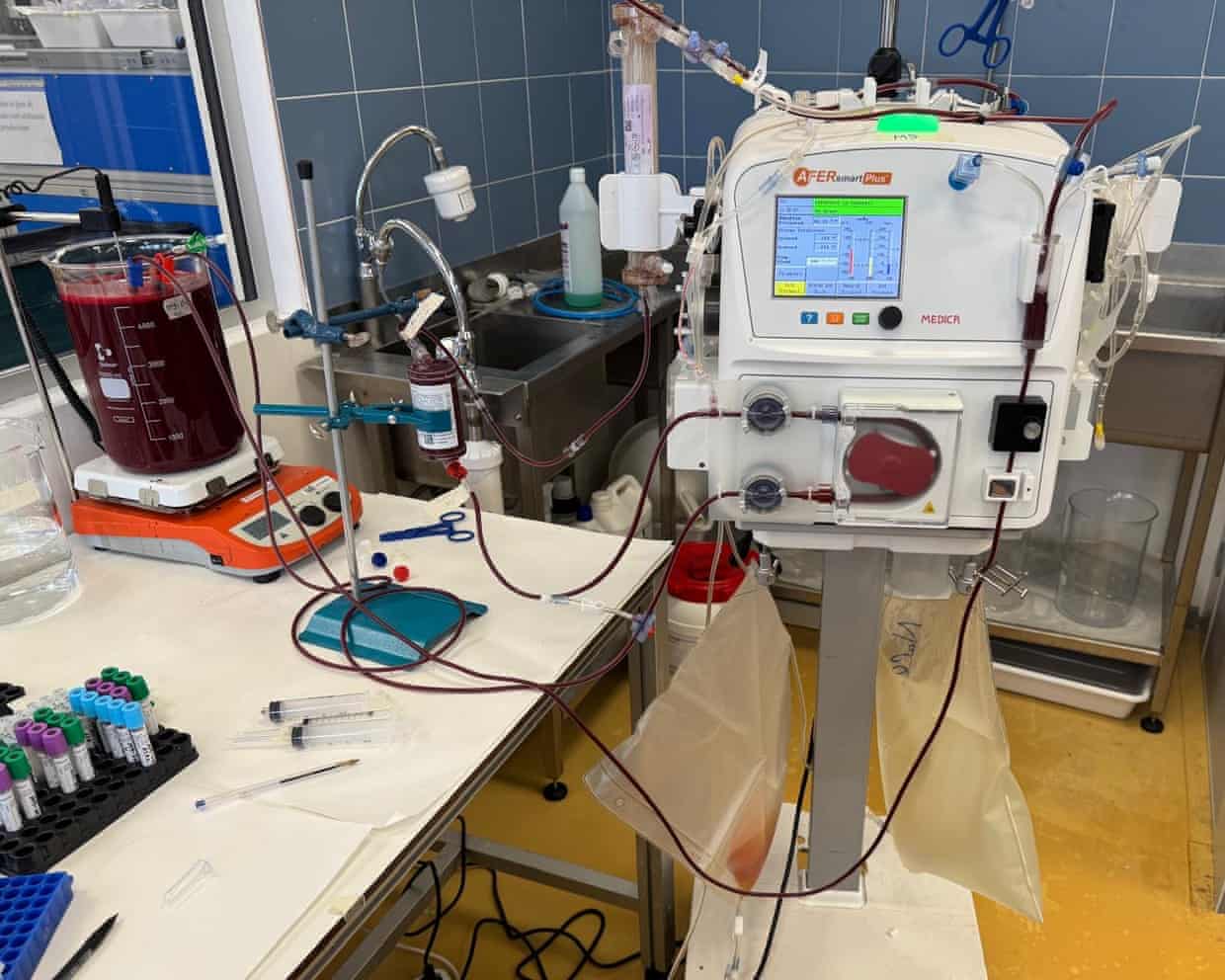
NHS to trial potentially life-saving treatment for deadly liver disease
The NHS is to trial a potentially life-saving new treatment for a deadly liver disease that causes the body’s vital organs to fail.Thirteen major hospitals will use a device that cleans patients’ blood that has become corrupted by toxins as a result of them developing acute-on-chronic liver failure (ACLF).ACLF is a severe and hard-to-treat form of liver disease linked to obesity, alcohol and hepatitis, in which patients suddenly deteriorate and have to be admitted to intensive care. Three out of four people affected are only diagnosed when it has already become life-threatening.Seven out of 10 people with the disease die within 28 days and only a handful of those affected are eligible for a liver transplant, which is the only existing way to reverse ACLF

Pressure grows on DWP over ‘misleading’ response to carer’s allowance scandal
Senior officials who oversaw a flawed benefits system that plunged hundreds of thousands of carers into debt are under mounting pressure over their “misleading” response to the scandal.Prof Liz Sayce, the chair of a scathing review into the government’s treatment of unpaid carers, last week called for an overhaul of management and culture at the Department for Work and Pensions (DWP).Days after the publication of the review, the DWP’s top civil servant in charge of carers’ allowance, Neil Couling, said carers themselves were at fault for the decade-long failures.His comments, revealed by the Guardian, have prompted a key adviser to the Sayce review and a leading carer’s charity to declare a lack of confidence in the department’s pledge to fix the issues.Prof Sue Yeandle, the UK’s leading expert on unpaid carers, said ministers and senior officials had issued “really misleading” claims that the failures affected only a small number of people

The Guide #222: From Celebrity Traitors to The Brutalist via Bad Bunny – our roundup of the culture that mattered in 2025

From Avatar to Amadeus: your complete entertainment guide to the week ahead

Jimmy Kimmel on a tumultuous year: ‘Don’t know what the American way even is any more’

Jimmy Kimmel on Trump’s speech: ‘Surprise primetime episode of The Worst Wing’

Stephen Colbert on Susie Wiles’s candid interviews: ‘She dished, bish’

The 50 best albums of 2025: No 3 – Blood Orange: Essex Honey