MPs question UK Palantir contracts after investigation reveals security concerns
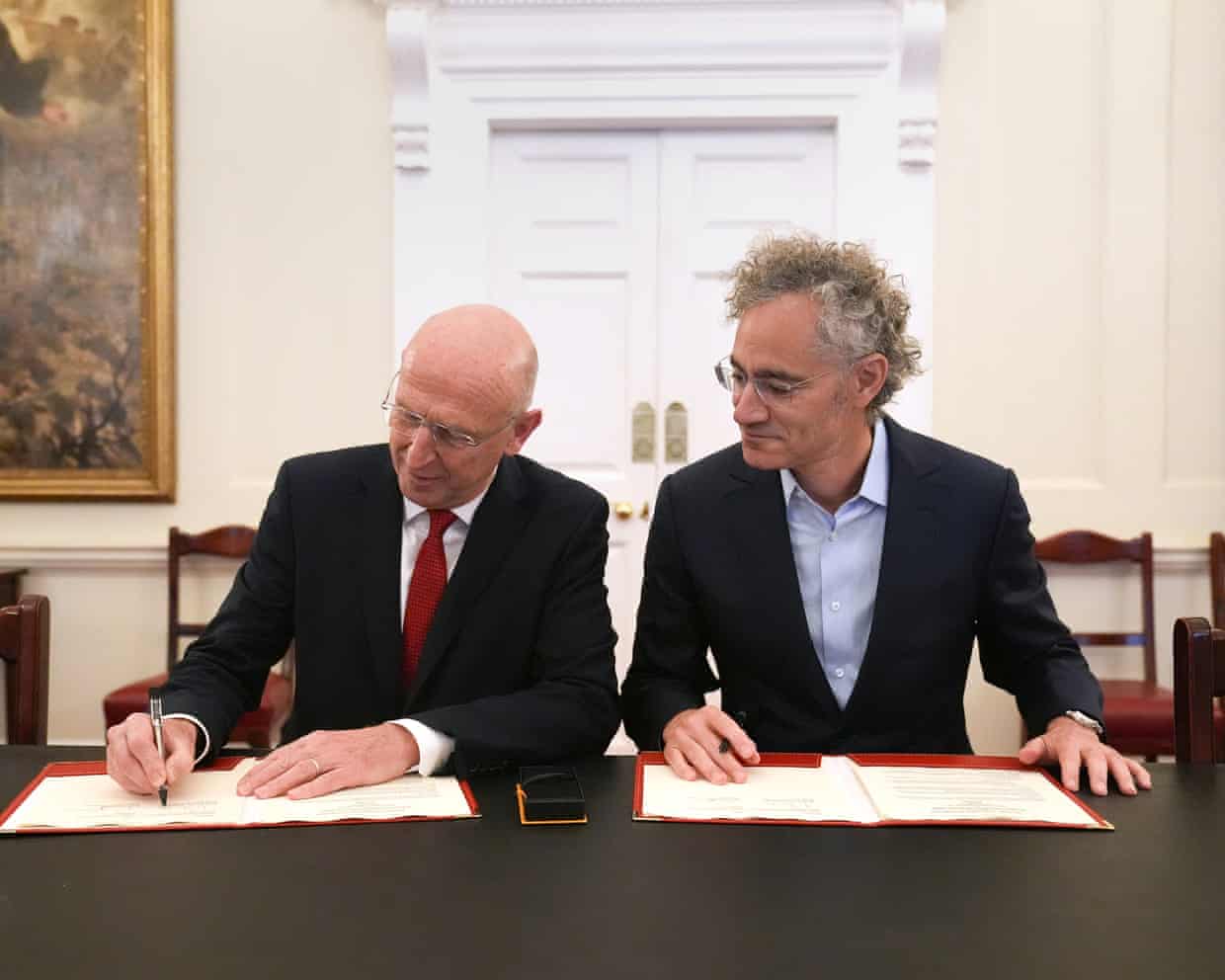
UK MPs have raised concerns about the government’s contracts with Palantir after an investigation published in Switzerland highlighted allegations about the suitability and security of its products.The investigation by the Zurich-based research collective WAV and the Swiss online magazine Republik details Palantir’s efforts, over the course of seven years, to sell its products to Swiss federal agencies.Palantir is a US company that provides software to integrate and analyse data scattered across different systems, such as in the health service.It also provides artificial intelligence-enabled military targeting systems.The investigation cites an expert report, internal to the Swiss army, that assessed Palantir’s status as a US company meant there was a possibility sensitive data shared with it could be accessed by the US government and intelligence services.
British MPs have voiced concerns over the US data company in light of the report.“Palantir … is an organisation that the British government, in terms of the NHS, in terms of contracts, should stay very far away from … I think the Swiss army is right to be suspicious,” said the Labour MP Clive Lewis.The government “needs to undertake transparent due diligence” on the conduct of Palantir and other big tech companies, said Rachael Maskell, the MP for York Central.“I know there were certainly questions in the NHS about Palantir’s capabilities.It’s clearly been handed a lot of money to do the federated data platform.
I, as a politician, want to know that these companies are making ethical choices,And if they’re not – whether around weaponry, minerals or the climate – I think we as parliament should be given greater transparency around this,”The year-long investigation is based on freedom of information requests to Swiss government departments,It details how Palantir went on a seven-year “shopping trip” trying to convince Swiss authorities to use its products and was rejected at least nine times by different agencies,In response to a query from the Guardian, a Palantir spokesperson said: “There is no basis to the claim in the report by the Swiss army about potential access to sensitive data and no truth to it whatsoever.
“We run a business that is predicated on the trust of our customers, which means we also do everything possible – from contractual, procedural, to technical controls – to ensure that our customers are in full control of their data, their operations and their decisions when using Palantir software.”In 2020, in the early days of the pandemic, Palantir pitched its services to Swiss health authorities – while touting its work with the NHS, which had just begun to use its tools to manage Covid-19 data.“We are already doing this in other countries, such as Great Britain, but we feel a special obligation to Switzerland and the federal chancellor,” it wrote.Switzerland’s Federal Office of Public Health (FOPH) ultimately chose not to work with Palantir in managing the pandemic.The exact reasons for this were redacted: it hired a competitor instead.
In meeting minutes obtained by the journalists, the office stated: “Problem: Communications.FOPH demands that Palantir be questioned.”At the same time, Palantir was trying to win contracts with the Swiss army.These meetings began in 2018.In 2020, it submitted a bid for the “IT system of the army’s intelligence service” and was rejected for unspecified reasons.
In 2024, it tried again.By this time, the UK’s Ministry of Defence had signed its first £75m contract with Palantir for data tools.After a meeting between Palantir’s European head and a Swiss army commander, the army commissioned an internal report to evaluate the products Palantir was offering.That report, authored by army experts, concluded that it remained unclear – based on their information about Palantir’s products – whether or not US intelligence would be able to access data shared with Palantir as it was a US company, despite Palantir’s official reassurances otherwise.The finding is “explosive”, wrote the journalists.
“Firstly, because it comes from a high-ranking body of the army and, secondly, because the Swiss Federal Department of Defence (VBS) employs certified cryptologists.”Experts in the Swiss army also found other issues with Palantir’s offerings to the military, both in terms of its cost and the fact that using Palantir’s technologies might require Palantir specialists to be permanently onsite, which could “limit the army’s ability to act in crisis situations”.The Swiss army decided not to contract Palantir.Less than a year after it commissioned the report, the UK military would sign a £750m deal with Palantir to “boost military AI and innovation”.WAV and Republik’s findings have generated debate across Europe, especially in Germany.
The head of Germany’s domestic intelligence service, Sinan Selen, warned European security services to be cautious in any use of US software in public comments last week without naming Palantir specifically.Several German states including Bavaria, Hesse and Baden-Württemberg in recent months have chosen Palantir analysis software for their police forces or, as is the case with North Rhine-Westphalia, paved a legal path toward using it or comparable services.The MP Konstantin von Notz, an intelligence expert with the opposition Greens and former head of Germany’s parliamentary oversight committee for the secret services, has been vocal in his opposition to Palantir.In an emailed statement to the Guardian after the Swiss revelations, Von Notz underlined his view that the German interior minister, Alexander Dobrindt, who has said he is reviewing whether to allow police across the country to use the US software, “must finally say goodbye to Palantir”.Von Notz welcomed the Swiss decision to do without the “highly controversial US company which has close ties to Donald Trump”.

Larry Ellison gives personal guarantee for Paramount takeover of Warner Bros Discovery
The tech billionaire Larry Ellison has agreed to provide a personal guarantee of more than $40bn for Paramount Skydance’s fight to gain control of Warner Bros Discovery, amid an extraordinary corporate battle over the entertainment giant.WBD urged shareholders to reject a $108.4bn hostile takeover bid from Paramount – which is controlled by the Ellisons – last week, having agreed to sell its storied movie studios, HBO cable network and streaming service to Netflix in a $82.7bn deal earlier this month.WBD also accused Paramount of having “consistently misled” investors by claiming its offer had a “full backstop” – a safety net to ensure it has sufficient funds – from the Ellisons

Paramount sweetens bid for Warner Brothers with Ellison guarantee; UK economy growth downgraded – as it happened
Media news: Paramount has improved its hostile takeover offer for Warner Brothers, as it wrestles with Netflix to take control of the movie studio, streaming and cable operator.Paramount is now offering a personal financial guarantee worth more than $40bn from Oracle chairman Larry Ellison, the father of Paramount CEO David Ellison. This guarantee is designed to resolve doubts about the financing of Paramount’s offer.It is alaso beefing up its reverse break-up fee (payable if Paramount can’t get the deal past regulators) to $5.8bn, to match Netflix’s

Activist group says it has scraped 86m music files from Spotify
An activist group has claimed to have scraped millions of tracks from Spotify and is preparing to release them online.Observers said the apparent leak could boost AI companies looking for material to develop their technology.A group called Anna’s Archive said it had scraped 86m music files from Spotify and 256m rows of metadata such as artist and album names. Spotify, which hosts more than 100m tracks, confirmed that the leak did not represent its entire inventory.The Stockholm-based company, which has more than 700 million users worldwide, said it had “identified and disabled the nefarious user accounts that engaged in unlawful scraping”

Chinese robotaxis due in London next year as Lyft and Uber reveal tie-ups
Chinese robotaxis are due to be on the streets of London next year after the US ride-hailing companies Lyft and Uber announced tie-ups with Beijing-based Baidu to deploy its self-driving technology.Lyft is the third firm to announce plans to introduce self-driving taxis to the UK capital next year, after Uber and Waymo, the main operator of robotaxis in the US.Its ride-hailing services are the major rival to Uber’s in the US and Canada, and this year Lyft expanded into Europe after acquiring the Freenow app in the summer.While Uber had signed a deal to work with Baidu in the summer in other global markets, it had not until now said that the Chinese tech company’s Apollo Go cars were planned for London. It had previously announced its services would be operated with self-driving technology from the UK-US firm Wayve

Stars urge UK government not to scrap Sport England brake on playing field selloff
Sports playing fields and facilities in England are at risk of being built over en masse with devastating consequences for local communities, sports stars and governing bodies have warned.The former England footballer Jill Scott along with Olympic gold medallists Mo Farah, Alex Yee and Matthew Pinsent, are among 88 signatories to an open letter saying they are “deeply concerned” about proposed government planning reforms, and say they would hit poorest communities hardest.The letter, which has also been signed by the Football Association, the RFU, the LTA and UK Athletics, comes amid proposals to end Sport England’s statutory right to be consulted on housing developments on playing fields as part of the government’s plans to hit its target of building 1.5m homes.“We are deeply concerned that proposed planning reforms could remove the statutory protections that help safeguard England’s playing fields and sports facilities,” the letter warns

Enchantingly old-school Mr Vango can thrill with Welsh Grand National win
When jumping fans of any age talk about a “proper, old-fashioned steeplechaser”, they have a strapping colossus of a horse in mind, with the strength to keep jumping and powering on through the deepest of winter ground when lesser rivals have cried enough. A horse like Pendil or The Dikler in the 1970s, Desert Orchid or Carvill’s Hill a decade or so later, or Denman lugging top weight to victory in the Hennessy – when it still was the Hennessy, back in 2009.Or, in the here and now, a horse like Mr Vango, the second-favourite for Saturday’s Welsh Grand National at Chepstow. Even in a year when Harry Redknapp has a live runner in the King George VI Chase at Kempton a day earlier, a win for Mr Vango this weekend would quite possibly be the most popular and heartwarming result of the entire festive racing programme.Everything about Sara Bradstock’s nine-year-old is defiantly, and enchantingly, old-school, from his massive frame and engine to the amount of time he has been given to develop and mature

The Guide #222: From Celebrity Traitors to The Brutalist via Bad Bunny – our roundup of the culture that mattered in 2025

From Avatar to Amadeus: your complete entertainment guide to the week ahead

Jimmy Kimmel on a tumultuous year: ‘Don’t know what the American way even is any more’

Jimmy Kimmel on Trump’s speech: ‘Surprise primetime episode of The Worst Wing’

The 50 best albums of 2025: No 3 – Blood Orange: Essex Honey

The Hodge report into Arts Council England: ‘Not exactly a ringing endorsement’