H
trending
H
HOYONEWS
HomeBusinessTechnologySportPolitics
Others
  • Food
  • Culture
  • Society
Contact
Home
Business
Technology
Sport
Politics

Food

Culture

Society

Contact
Facebook page
H
HOYONEWS

Company

business
technology
sport
politics
food
culture
society

© 2025 Hoyonews™. All Rights Reserved.
Facebook page

The world’s most sublime dinner set – for 2,000 guests! Hyakkō: 100+ Makers from Japan review

about 19 hours ago
A picture


Japan House, LondonThe fruit of a two-year odyssey through the workshops of artisans using ancient techniques, this delightful show features rippling chestnut trays, exquisitely turned kettles and vessels crafted from petrified leatherAs a retort to the doom-mongering prognostications of AI’s dominance over human creativity, it is momentarily comforting to tally up the things it cannot do.It cannot throw a pot, blow glass, beat metal, weave bamboo or turn wood.Perhaps, when it has assumed absolute control of human consciousness and the machinery of mass production, it will be able to.But for now, throwing a vessel and weighing its heft in your hand, or carving a tray and sizing up its form with your eye are still the preserve of skilled craftspeople, using techniques their distant ancestors would recognise.On show at London’s Japan House is the work of more than 100 pairs of eyes and hands, constituting an overwhelming profusion of human creativity, corralled into an exhibition of laconic simplicity.

About 2,000 objects – bowls, trays, cups, metalwork, glassware and some perplexing bamboo cocoons – are grouped according to their makers on long, softly lit display tables,At first glance, you might think you have stumbled into an especially refined John Lewis homeware department, but then you notice the delicate black and red lacquer work, the gleaming gold on the inside of a perfectly shaped sake cup, the intricacy of the bamboo and some eccentrically shaped vessels, like alien seedpods, that look like ceramics but turn out be a kind of petrified leather,Craftsmanship that gives practical and beautiful shape to raw materials has been part of Japanese life for centuries,Yet historically, the products of formal crafts such as urushi (lacquerware) and metalwork were conceived as costly artefacts to be admired, well out of reach of ordinary people,It wasn’t until the 1920s that the folk craft movement, known as mingei, refocused attention on the unassuming beauty of hand-crafted utilitarian objects.

Today, despite the prevalence of industrial production, artisans across Japan continue to create everyday utensils and vessels, employing traditional methods that respond to the particular qualities of their chosen material.No two crafts are the same, and each artisan brings a unique imprimatur to the process of creation.In a two-year odyssey, the exhibition’s curator, Nagata Takahiro, travelled the length of Japan, seeking out craftspeople hunkered in country sheds and city flats, shaping clay, beating metal and working wood, quietly getting on with creating.The aim was to get a sense of the numbers and experiences of people involved in sustaining traditional Japanese crafts.It turned out to be an extensive and thriving network, with artisans using social media to showcase their wares and connect with buyers, galleries, craft fairs and other makers.

Shinichi Moriguchi spends his time crafting chestnut wood trays known as wagatabon, traditional utensils dating from the Edo period with distinctive chisel marks inscribed vertically across the wood grain,Chestnut wood is especially resistant to water and decay and the chiselled lines resemble rippling waves, conjuring a sense of beauty and strength,No two surfaces are alike,Moriguchi lives in Kyoto and runs an atelier in the surrounding mountains, teaching students the craft of wagatabon carving,“It only requires simple tools – a wooden mallet and chisels – so anyone can learn,” he says.

Before becoming a metalsmith, Yumi Nakamura worked in interior design, so her approach to craft is inflected by a strong awareness of space and how objects appear in settings,Her kettles and tea vessels are exquisitely sculptural, with slim, exaggeratedly curved handles,Although the process of hammering and shaping sheets of metal can be arduous, she marvels at how objects can be drawn out from inanimate matter,“Unlike ceramics or glass, metalwork lets you keep touching the form,” she says,“You can keep hammering for ever, so deciding when to stop is crucial.

” Reflecting different strengths and physiques, the hammer marks also embody the maker’s character.Amplifying the now cliched notion of wabi-sabi, which has come to be routinely applied to anything involving weathered natural materials, the exhibition features a glossary of terms that crystallise singularly Japanese concepts, such as anbai, meaning “balance” or “adjustment”.Originally it was used to describe the seasoning of food, but here it relates to how the quality of an object hinges on its form and colour.Shibui (literally “bitter”) means subtly elegant, while ibitsusa refers to “irregularity”, which is to be cherished as evidence of the human hand, imparting an expressive quality that cannot (yet) be reproduced by machines.Short films document some of the craftspeople at work, showing how base materials are effortfully transformed into elegant artefacts.

As with the potter’s wheel television intervals of yore, there is a seductively ASMR (autonomous sensory meridian response) quality to watching how a bowl or spoon is made, but the films also convey a wider sense of the artisans’ lives, their daily routines and their locales, since the nature of place also shapes approaches to design.Specialising in porcelain, ceramic artists Yamamoto Ryōhei and Hirakura Yuki share a home and studio in Arita, in western Kyushu, where porcelain was first produced in Japan more than 400 years ago.Near their home is the site of the oldest kiln in Arita.Discarded pottery shards are strewn around the ground, yet despite their age, the fragments retain a surprising freshness.The couple began to research and replicate historic pieces, refining their making techniques and gradually developing a style that became their own.

“The human eye is always searching for something,” says Ryōhei.“When you’re unsure whether you’re seeing a design or not, your imagination starts working.”What emerges is how intrinsically and intimately craft is part of human existence, passed down through generations, changing yet somehow unchanged.Programming director Simon Wright quotes a line from the 13th-century Japanese writer Kamo no Chōmei: “The flow of the river never ceases, and yet the water is never the same.” Hyakkō: 100+ Makers from Japan, Japan House, London, until 10 May
societySee all
A picture

Senior opponents of assisted dying bill urge Lords not to deliberately block it

Senior opponents of assisted dying legislation have called on peers not to hold up the progress of the bill through parliament, warning there was a serious danger of the Lords losing democratic legitimacy.Many supporters now admit the bill is in serious danger of running out of time in the Lords before the end of the parliamentary session, meaning it will fail to pass, because of the slow pace of considering more than 1,000 amendments means the bill will probably run out of time for a vote.In a letter to the Guardian, two former ministers, Justin Madders and Dame Nia Griffith, and another select committee chair, Debbie Abrahams, who previously opposed the substance of the bill have now urged peers not to deliberately filibuster it.Just 80 of more than 1,150 tabled amendments have been covered during three days of debate. However, some opponents of the bill say the lengthy consideration of amendments is normal for a complex issue and that it has been up to peers to attempt to address a series of significant concerns about the bill, including from key professional bodies like the Royal College of Psychiatrists

about 13 hours ago
A picture

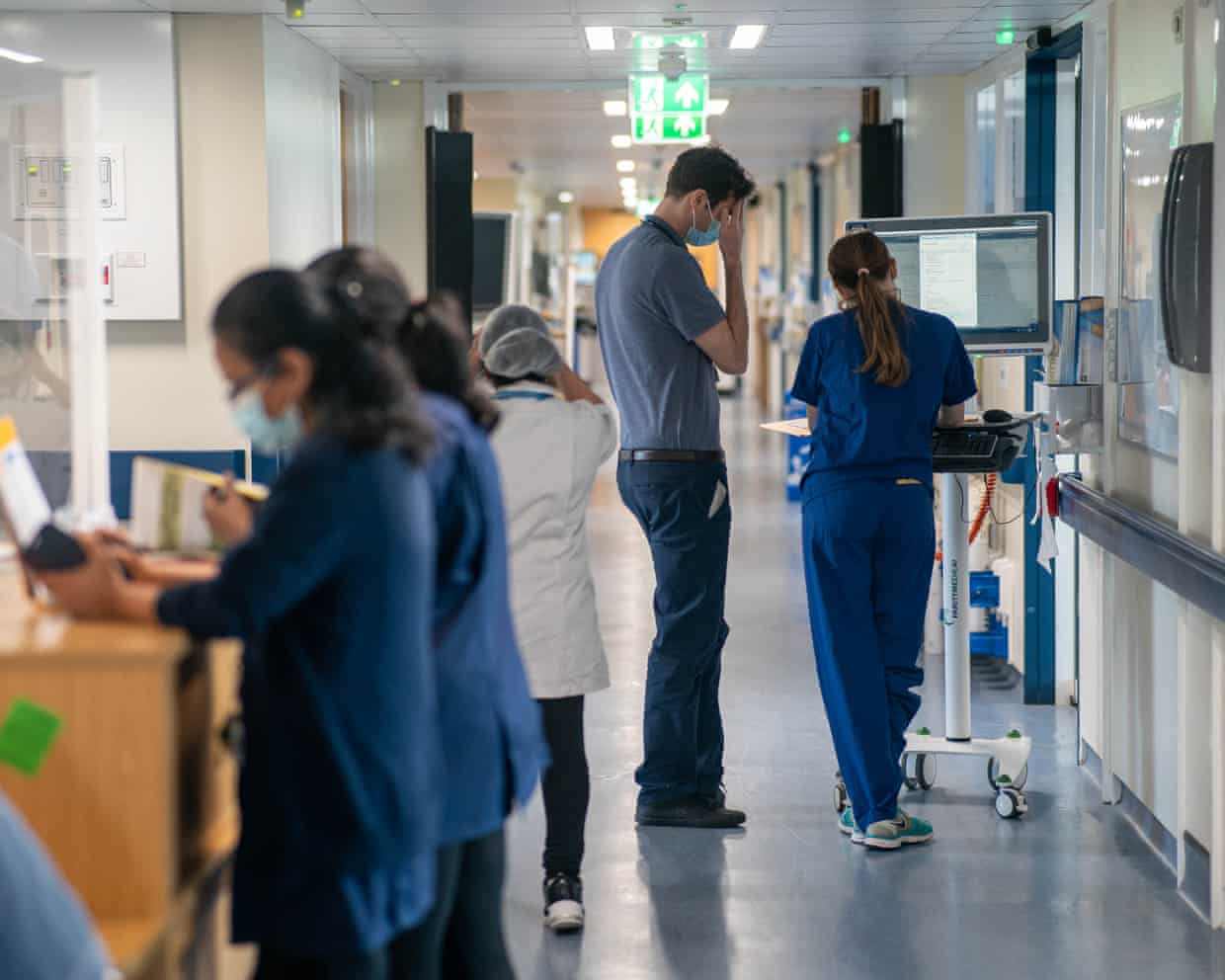
‘We don’t have enough rooms to isolate’: NHS doctor reveals impact of rise in flu cases

As cases of flu rise sharply across the UK, the Guardian spoke to Amir Hassan, an emergency medicine consultant and the divisional medical director at Epsom and St Helier University hospitals NHS trust, who shared his views.“We’re seeing increased numbers of patients coming through, a lot of them with respiratory-type illnesses. It means we need to try to isolate these patients and treat them – so they’ll come in with shortness of breath, [and a] cough.And while the numbers are going up, we’re still getting the other patients coming in with falls and heart attacks and trauma. It puts pressure on the emergency department, and it puts pressure on the wards because you’re increasing the number of respiratory patients you’re managing

about 13 hours ago
A picture

NHS ‘facing worst-case scenario’ as hospital flu cases jump 55% in a week

The NHS is facing its “worst-case scenario” for flu cases this month across England after the number of people in hospital with the illness increased by 55% in a week.An average of 2,660 patients a day were in an NHS hospital bed with flu, up from 1,717 last week and the highest ever for this time of year. By comparison, in the same week last year the number of patients in hospital with flu stood at 1,861, compared with 402 in 2023.Prof Meghana Pandit, the NHS national medical director, said the number of patients in hospital with flu was “extremely high for this time of year”.“With record demand for A&E and ambulances and an impending resident doctors strike, this unprecedented wave of super flu is leaving the NHS facing a worst-case scenario for this time of year – with staff being pushed to the limit to keep providing the best possible care for patients,” Pandit said

about 15 hours ago
A picture

Starmer says resident doctors would be irresponsible to strike in face of flu crisis

Keir Starmer has said resident doctors would be irresponsible to push ahead with strikes next week after NHS England said a surge of “super flu” cases had left the service facing its worst-case scenario this winter.Ministers presented the British Medical Association with a fresh offer on training places on Wednesday night in a last-ditch attempt to avert strikes.The BMA is consulting its members on the proposals, raising hopes of a breakthrough, despite its leaders saying they do nothing to address their concerns on pay.The prime minister urged resident doctors – formerly known as junior doctors – to “do the responsible thing, accept the offer that’s on the table, and we can all move forward”.“They are being irresponsible in my view

about 15 hours ago
A picture

‘This country’s divided’: how a Sunderland charity is changing that – one house, park and shop at a time

Far-right rhetoric fuelled rioting here in 2024, but Back on the Map is helping to unite the community, through good accommodation, new shops, and an aim to genuinely uplift and improve people’s lives Donate to the Guardian Charity Appeal 2025 here Communities are our defence against hatred. Now, more than ever, we must invest in hopeWhen 47-year-old shop assistant Claire Carter was younger, her mother told her to “never live on the long streets” – terrace-lined roads about half a mile long that lead from the centre of Hendon, Sunderland, to the sea. These six streets have a reputation for being “full of wrong ’uns, full of stolen cars, places getting smashed up”, she says. Close by is Fletcher’s News & Booze, the shop where Tommy Robinson hosted a book signing in 2017 that ended in physical fights and 21 arrests.Sunderland more widely has been a key site for far-right politics: in 2024 violent anti-Muslim riots broke out after misinformation spread on social media, suggesting that the man behind fatal stabbings at a children’s dance class in Southport was an illegal migrant

about 21 hours ago
A picture

Online child sexual abuse surges by 26% in year as police say tech firms must act

Online child sexual abuse in England and Wales has surged by a quarter within a year, figures show, prompting police to call for social media platforms to do more to protect young people.Becky Riggs, the acting chief constable of Staffordshire police, called for tech companies to use AI tools to automatically prevent indecent pictures from being uploaded and shared on their sites.Riggs, who is the National Police Chiefs’ Council lead for child protection and abuse, said: “I know that these platforms, with the technology that’s out there, could prevent these harms from occurring in the first instance.”She added that technology used by children should come with inbuilt protections, such as mobile phones that allow them to only access safe platforms and websites.Police statistics show that 122,768 child sexual exploitation offences in England and Wales were recorded in 2024, an increase of 6% on the previous year

1 day ago
sportSee all
A picture

Sports Personality of the Year 2025: Lionesses square off on six-strong shortlist

about 23 hours ago
A picture

‘It can be brutal’: Gian van Veen learns to fly with the stars after dartitis

about 23 hours ago
A picture

‘Dadgummit, let’s freaking go’: 44-year-old grandfather Rivers could start for Colts

1 day ago
A picture

NHL warns top players will not show up for Winter Olympics if venue is unsafe

1 day ago
A picture

Mets all-time home run leader Pete Alonso reportedly agrees $155m deal with Orioles

1 day ago
A picture

Etzebeth accepts 12-week ban but claims eye-gouge ‘was never intentional’

1 day ago