AI could give us our lives back – if we don’t blow it

The other day I pulled into the parking lot of a client’s offices and in the spot next to me was a woman sitting in her car blasting music.She caught me looking and rolled down her window and said, “I’ll be inside in a minute … Just enjoying my last few moments of freedom!”Is this way we want to live? No, it’s not.Elon Musk recently predicted work will be optional.“It’ll be like playing sports or a video game or something like that,” he said.Sounds nice.
We may well be at the beginning of a change never before seen by humans, mainly because it will be so fast.In just a few short years, it’s clear that AI will be replacing millions, maybe hundreds of millions, of jobs.According to Musk, “Anything digital, anyone sitting at a computer producing files, that’s what goes first.”People are terrified about losing their jobs.But should we be?Let’s assume that AI does have the effect that some like Musk are predicting.
Millions of jobs are replaced by agents,Countless office workers are upended by bots placing orders, reconciling accounts, sending out emails, replying to messages, applying cash receipts, writing proposals, creating invoices and doing all the other things that office workers have been doing for more than century,Let’s also assume that Musk’s other prediction comes true: because of the abundance created by AI, there will be some type of universal income,According to Musk, and others, companies will be so productive and so profitable, governments will simply tax a greater share of corporate earnings and then redistribute those taxes back to the people,Putting aside the very real human ability to screw up such a concept and turn any fair system into an unfair one, the assumption is that most people will have enough income to afford both necessities and luxuries without having to work.
Let me repeat: without having to work,No getting up early and commuting on public transit,No sitting in front of a monitor for 10 hours a day or dealing with co-workers or being scrutinized by your boss,No uncomfortable clothing, pointless meetings, Teams calls, performance evaluations,No office politics, fluorescent lighting, loss of privacy, noisy co-workers, “reply all” emails, stinky refrigerators and smelly toilets.
No more “great resignation”, “barely minimum Mondays”, “coffee badging” or “quiet quitting”.Isn’t this what we want? Look at any movie or TV show where people are going to work – Severance, The Office, Glengarry Glen Ross, The Apartment, Joe Versus the Volcano, The Devil Wears Prada.Are workers portrayed as happy or miserable? Satisfied or stressed? Or are they shown as miserable, bored, feckless robots punching in and punching out in order to receive their meager paycheck in order to enjoy their aimless, fruitless, miserable lives?The human species was never created to work in an office.Ask anyone who’s retired if they wish they were back at work and most would look at you like you’re crazy.People on their deathbeds never say they regret not spending more time at work.
We like to read, play, watch TV, nap, hunt, ski, be with our families.It’s not natural to replace these very human activities with sitting in a cubicle reading reports all day.For those who think that the meaning of life is being in an office, I’m sure that, even in a world of AI, this can be accommodated.We humans are great at filling up the hours until we die.In 1913, the original IRS tax code was 400 pages.
Today it’s more than 75,000.We are always making work for ourselves.But maybe AI will change the way we perceive of our lives.Maybe when technology is doing all of the crap things humans do, those same humans can step back and find other purposes in their existence.Instead of being afraid of the future, maybe it makes more sense to embrace it.
Thanks to AI, humans may finally get the chance to let the machines relieve of us all the mindless, stupid, inane things we’ve been doing in our office,We just have to hope that humans don’t blow the opportunity,
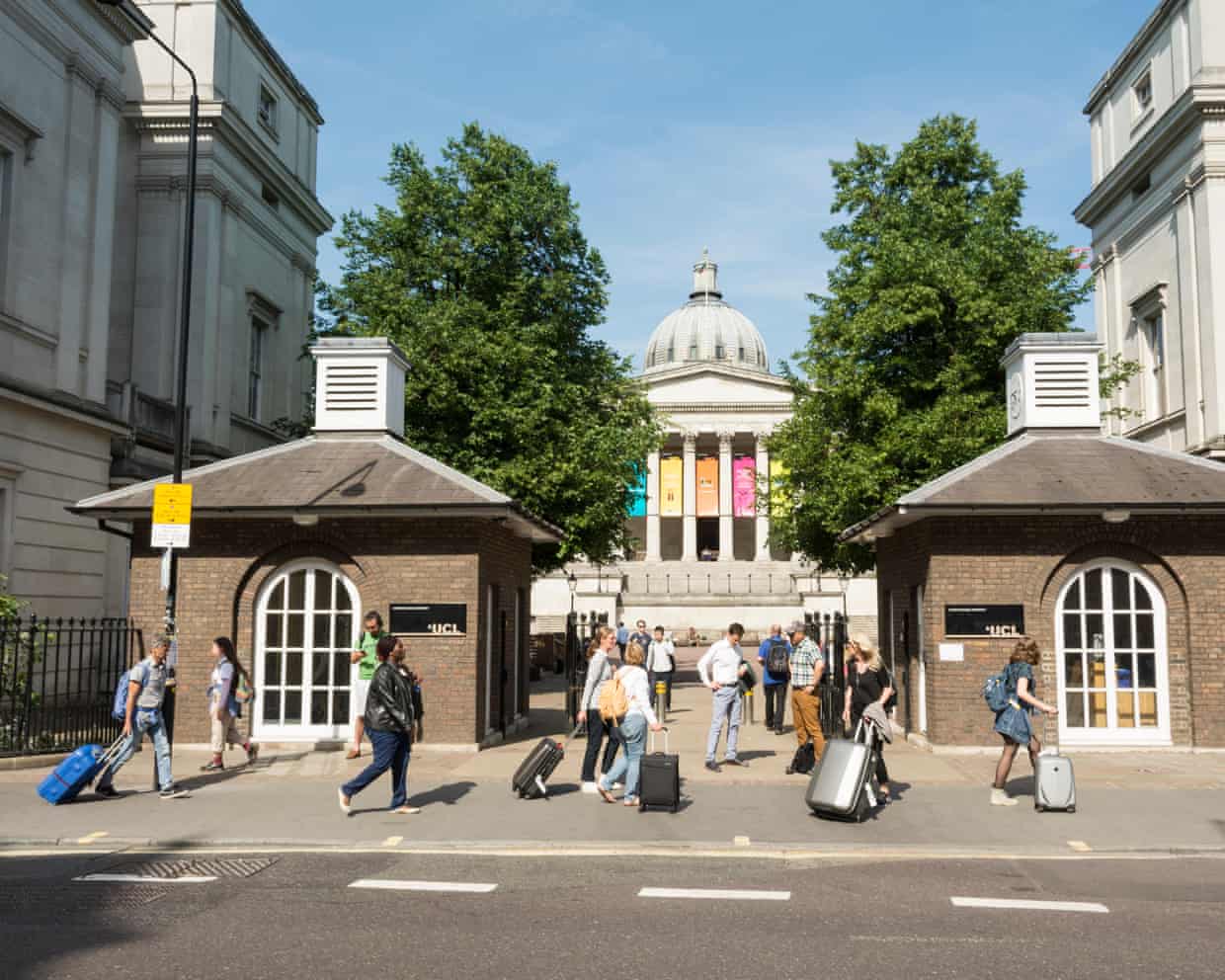
Row over tuition fees cut for European students threatens Starmer’s EU reset
Britain is in a standoff with Brussels over a demand to cut university tuition fees for European students, in a row that threatens to scupper Keir Starmer’s planned EU reset.EU officials say European students should pay “home” fees of about £9,500 a year in England and Wales as part of the negotiations over a youth mobility scheme, rather than the higher international rate, which can rise above £60,000. European students would also pay the domestic rate in Scotland, which is set at £1,820 a year, although most Scottish students qualify for free tuition. Fees for Irish students In Northern Ireland are generally capped at £4,855.However, British negotiators say they have been blindsided by the demand, which they say was not mentioned in the framework agreement signed last year and would cost British universities an estimated £140m a year
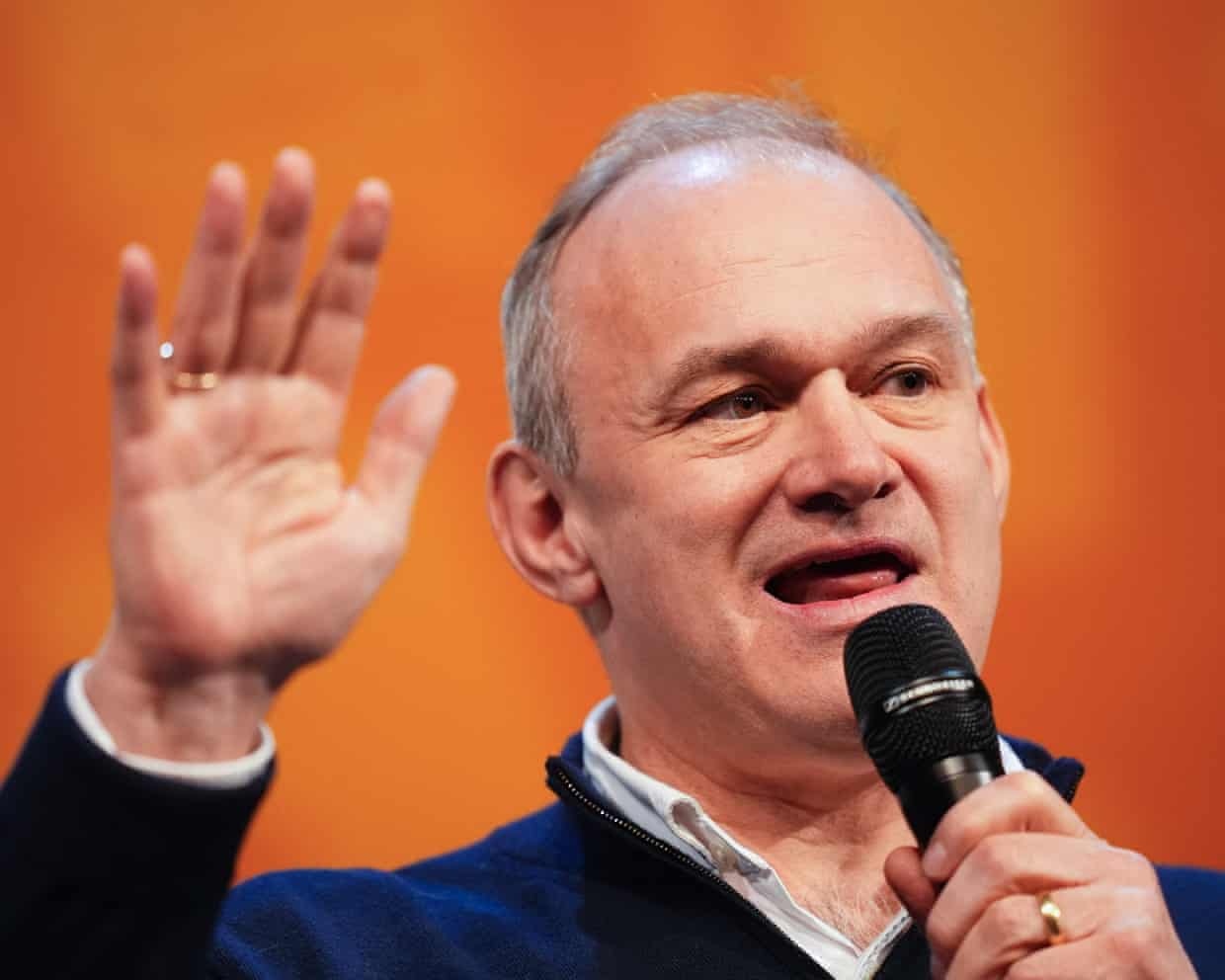
UK needs nuclear deterrent independent from US, Ed Davey to say
Britain should have a completely independent nuclear deterrent as it can no longer rely on the US, Ed Davey is expected to say on Sunday.In a speech at the Liberal Democrats spring conference, the party leader will argue that the UK should manufacture and maintain its nuclear weapons in Britain, a move that Davey acknowledges will cost billions.Davey’s speech will come amid his claims that the US president, Donald Trump, has made his support for European security “conditional” on his personal whims.“While Trump is in charge, we certainly cannot rely on America as a dependable ally in the way we used to,” Davey will say. “And we can no longer bet our nation’s security on the hope that the US won’t produce new versions of Trump in the future

Reform UK government would replace top civil servants with those ‘more likely to implement party’s priorities’
A Reform UK government would expect to dismiss the top civil servant in every government department and replace them with people seen as more likely to implement the party’s priorities, the Guardian has learned.Senior Reform figures have concluded that the current crop of permanent secretaries, the lead civil servant in each department, are not up to the necessary standard. Some would be replaced by outsiders, and others by existing officials viewed as more suitable.The plan has prompted warnings that a shift towards a less stable and more politicised civil service could result in the loss of significant expertise and of institutional memory, and would make government less effective.Nigel Farage’s party has promised it will enact a radical programme

Phil Woolas, former Labour minister, dies of brain cancer aged 66
The former Labour MP minister Phil Woolas has died of brain cancer, his family and close friends have announced.Woolas, 66, was elected to parliament to represent Oldham East and Saddleworth as part of Labour’s landslide victory in the 1997 general election. He remained in Westminster for New Labour’s entire 13-year stretch in power.In government, Woolas held several ministerial roles, including being the minister of state for local government, the environment, and borders and immigration, positions that he held sequentially until Labour’s fall from power.In a statement announcing his death on Saturday, his family and close friends said: “For more than a year he battled the brain cancer glioblastoma

‘We are a completely different political party’: inside the Greens’ membership boom
It is, as one Green activist put it, a never-ending series of “constantly good problems to have”. But how does a party adapt to the sudden trebling of its membership? And when a majority of people in an organisation are new, is it even the same thing anymore?The basic facts alone are startling. Before Zack Polanski took over as leader last September, the Greens in England and Wales had around 66,000 members. They are now at 215,000, and still rising at speed.This means the party has many more people to knock on doors and fold leaflets, as seen with the vast numbers of canvassers the party could call on in winning last month’s Gorton and Denton byelection

Wealthy British nationals fleeing Gulf conflict bypass UK to avoid tax bills
Wealthy UK nationals fleeing war in the Gulf are seeking sanctuary in countries such as Ireland and France to avoid hefty tax bills back home.In the face of possible demands from HM Revenue and Customs, high-net-worth individuals who had been living in the United Arab Emirates and neighbouring countries are hoping to wait out the missile and drone attacks elsewhere rather than return to the UK.With only about three weeks remaining in the current financial year, many overseas residents have already “spent” their allocation of days in Britain without incurring tax liabilities. Some are seeking guidance from HMRC on whether they would be granted 60 extra days under an “exceptional circumstances” provision.Nimesh Shah, the chief executive of advisory firm Blick Rothenberg, said: “I’ve had a disproportionate number of calls from people wanting to leave the UAE in recent weeks

Benjamina Ebuehi’s recipe for caramelised white chocolate and rhubarb cheesecake | The sweet spot

Noma chef resigns amid allegations of physical abuse of staff

Light red wines for spring drinking

Rachel Roddy’s recipe for risotto in bianco | A kitchen in Rome

‘Highly problematic behavior’: Noma residency in LA starts with PR crisis

Before sunrise: while Sydney sleeps, suhoor meals attract a lively social scene during Ramadan