Labour must learn lessons from history as automation hits jobs market | Richard Partington
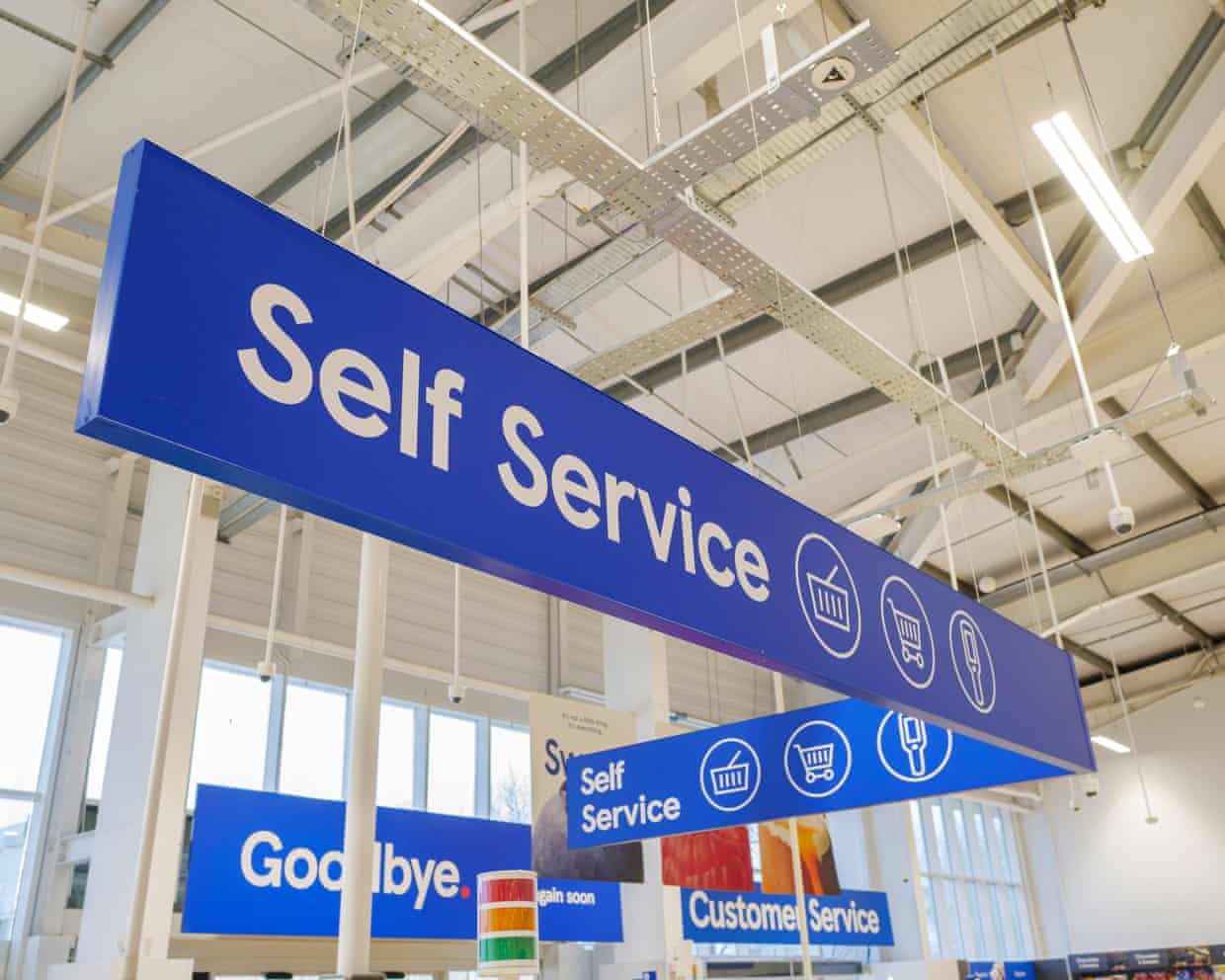
Walk through a supermarket and the technology is everywhere.Self-service checkouts, electronic shelf labels, handheld barcode scanners and the video screens showing you – caught by AI facial recognition cameras – leaving the shop.In an economy struggling for growth, the encroachment of these machines in our everyday lives could be an early sign of a new dawn – a tech-driven renaissance in activity after years of flatlining growth in productivity and stalled business investment.No bad thing.On the other hand, it could be the glimpse of a dystopian future that is already beginning to take shape.
Of retailers using tech with low running costs instead of low-paid, but relatively more expensive, humans,A productivity boom,But who for?In the past year unemployment in Britain has risen to the highest rate in a decade, excluding the height of the Covid pandemic,Meanwhile economic output has maintained a reasonable, if pedestrian, pace of growth,Put those two things together and rising levels of productivity – output per hour of work – is the mechanical consequence.
Much of the gains are down to tumbling employment in low-paying sectors – retail in particular, where jobs are being shed and hiring frozen in the face of rising labour costs,Bosses have blamed the government,This year’s £25bn hike in employer national insurance contributions (NICs) and living wage increases are among reasons the British Retail Consortium (BRC) gives for a 10% jump in the cost of employing people in full-time entry-level retail roles,The trade association also complains about Labour’s employment rights bill and packaging costs hitting jobs,At this time of year, retailers typically take on hordes of staff for the festive season.
However, this year has not matched the usual pattern.Figures from the jobs website Adzuna showed retail vacancies fell by almost 6% in November, typically the key month for hiring.Openings are at the lowest point in a decade, excluding the Covid pandemic.Much of this is down to feeble consumer demand and the boom in online retail.However, the rise of the machines is also playing a role.
Industry surveys show investment in automation rank second as the most common response to Labour’s business tax changes, after raising prices.Taken together, it is hardly surprising retail employment has collapsed by more than 350,000 in the past decade.Young people applying for lower-skilled, entry-level positions – which also happen to be easier to automate – have borne the brunt.Within Labour circles, there is an unspoken logic to driving up the cost of employment.For too long, firms have relied on paying poverty-level wages to turn a profit.
UK firms have lagged behind in the G7 investment league tables for decades,Economists reckon some of that is down to a lower relative cost of employing labour versus capital – especially in volatile economic times,Recently, however, the balance has shifted,Employment costs are up; access to immigrant labour is down, and workforce participation has fallen amid rising levels of ill-health and early retirement,Much of this is the outcome of policy choice.
“The higher your employment costs, regulation, and risk around hiring – the more likely you are as a business to consider options to automate,” says Tera Allas, a professor at the Productivity Institute, a research organisation.So far, the data shows the UK is still in the foothills of the turnaround.Business investment has not exploded, but is rising – with a 1.5% increase in the third quarter.Meanwhile productivity rose 1.
1% compared with a year earlier,Although still short of the 2% pre-2008 financial crisis annual average productivity growth, that is better than the flatlining of investment of recent years,Successive governments have treated productivity as a silver bullet to Britain’s decades of economic underperformance,None, however, would have campaigned for any gains to come at the expense of workers,There is also an irony in the prospect of a “jobs-lite boom” under Labour – a party tracing its roots, however thinly today, to the struggle of organised labour amid the galloping productivity gains of the Industrial Revolution.
In the early 19th century, factory owners investing in steam-driven power looms, knitting frames and mill engines fuelled a productivity boom.At first, the spoils went largely to the capitalists – in a period later described as “Engel’s pause”, after the philosopher Friedrich Engels, to describe the years of wage stagnation as Britain became the world’s richest economy.Many angry workers turned to rebellion.In the long run, living standards rose as workers shifted into new occupations.The Luddites were on the wrong side of history.
However, progress was not without social upheaval, nor taken for granted.There were struggles for employment rights and pay through the nascent trade union movement – culminating in political representation and the creation of the modern welfare state.There are clear parallels today.This month, Andrew Bailey warned that job displacement similar to the Industrial Revolution was highly probable – with the Bank of England governor calling for the UK to have “training, education, [and] skills in place” to help those at risk.Allas says there are reasons to be hopeful, not least because new technologies typically help to create new forms of work – enabling people to leave behind menial tasks.
Businesses, too, worry about the consequences of losing their pipeline of middle managers if all the entry-level work is automated out.“Humans are infinitely resilient.We have a capability to learn and we’ll figure out how to learn in new ways,” she says.However, there will be serious problems if the transition is not managed well.Workers will demand to be brought along, not left behind.
For Labour there are a few lessons from history.

I was there: Red Roses lifted the Rugby World Cup with a roar like no other
Recalling the moment that England’s captain, Zoe Aldcroft, lifted the Rugby World Cup still brings goose bumps. Twickenham was bathed in September sunshine, there was not one empty green seat and when the Gloucester-Hartpury star raised the silverware with gold streamers and fire pyrotechnics, the roar from the crowd was a sound unmatched at any other women’s rugby game I have attended.England had rewarded the home fans, executing the perfect gameplan against Canada, the in-form team who were the underdogs despite knocking out the six-time champions New Zealand in the semi-final. The stadium was sold out with a women’s rugby record of 81,885 creating an electric atmosphere. Future World Cup finals will be sell-outs with a party-feel celebration but I am unsure if anything will be able to replicate the feeling on 2025 final day for everyone invested in women’s rugby

MCG curator concedes pitch went ‘too far’ in favouring bowlers amid criticism over short Boxing Day Test
The MCG’s head curator has conceded staff went “too far” in preparing a pitch that favoured the bowlers too heavily in the Boxing Day Test, saying he was in a “state of shock” while watching the match unfold.But the stadium’s chief executive is standing by the under-fire curator after the Test match between Australia and England finished within two days.Cricket Australia is bracing for a heavy financial loss from the match, only a month after the Ashes opener in Perth also ended with three days to spare. It is the first time the same series has had multiple two-day Tests in 129 years.Millions of dollars in refunds will be handed to patrons who had purchased tickets for day three, which had been sold out and could have attracted a third successive crowd of more than 90,000

PDC world championship: James Hurrell stuns Stephen Bunting in thriller
By the end, the room had gone still and quiet. The air was warm and smelled faintly of spilled pints. The chants of “One Stephen Bunting” had long since died away, and all that was left was one Stephen Bunting: three darts in his hand and no more tricks up his sleeve. No place left to run.And so as James Hurrell pinned tops to win 4-3 and claim the biggest victory of his life, there was just the merest whiff of anticlimax to it all: a seismic shock that also somehow felt like the most natural thing in the world

Tommy Freeman hat-trick topples Bath and sends Northampton to Prem summit
The champions have been mugged at home by the team they deposed. Well, not quite the team. Northampton rung the changes for this match, but the understudies proved the stars of the show to terrorise their hosts. Six tries, a hat-trick for Tommy Freeman and the lead, no less, of the Prem for good measure.The bookies gave Northampton a 20-point head start for this one

Bowen and Curtis bag famous home win in Welsh National with Haiti Couleurs
It is seven years and counting since Native River became the last horse trained in Britain to win the Cheltenham Gold Cup, but the beleaguered home team has conceivably emerged from the first two days of the Christmas programme with not one, but two realistic contenders for next year’s race, after Haiti Couleurs put up a magnificent performance to win the Welsh Grand National here under 11st 13lb on Saturday.Or, as Haiti Couleurs’ connections might prefer it, England has a chance with Friday’s King George winner, The Jukebox Man, and Wales has a shout with Haiti Couleurs, who is trained by Rebecca Curtis in Pembrokeshire and ridden by Sean Bowen, the champion jockey, who was born just down the road from her yard.Bowen gave another demonstration on Haiti Couleurs of what is now his trademark ability to seize the initiative in a race and not let go. His mount was a little free behind the pace on the first circuit, and despite his big weight and the distance still left to travel, Bowen did not hesitate to allow him to stride on into the lead.Haiti Couleurs did not see another rival from there, and there were definite echoes of Native River’s front-running performance under a similar burden in this race in 2016, 15 months before his Gold Cup victory, as the eight-year-old powered clear with O’Connell turning for home and then held him at bay with an unflinching gallop from two out

Bristol survive scare but Newcastle off the mark in Prem as Spencer seals bonus
In the end Bristol had too much. A display of equal parts grit and skill by Newcastle threatened a huge festive upset in the freezing-cold south-west, but two tries by the elusive Louis Rees-Zammit and some classically fluent attacking by Pat Lam’s buoyant team eventually enabled them to overpower their spirited visitors.After the Bears ruined Harlequins’ Christmas at Twickenham last Saturday, sticking 40 points on the London club in Big Game 17, they were widely expected to ease to victory against the Prem’s bottom side, who were yet to muster a bonus point after seven matches. The question seemed to be not if Bristol would win, rather by how many.But the work Newcastle are doing under the head coach, Alan Dickens, now assisted by the former Wales international Stephen Jones, is beginning to bear fruit
‘It restored my hope’: how community action is confronting racism in Belfast

‘The NHS would collapse within hours’: BME staff say Britain fails to appreciate their roles

Foreign medics shunning NHS because of anti-migrant rhetoric, says top doctor

Abuse survivors need safe housing above all | Letters

Blood test could predict who is most at risk from common inherited heart condition

Inside the US’s psychedelic church boom, where taking drugs is legal