Georgia leads push to ban datacenters used to power America’s AI boom
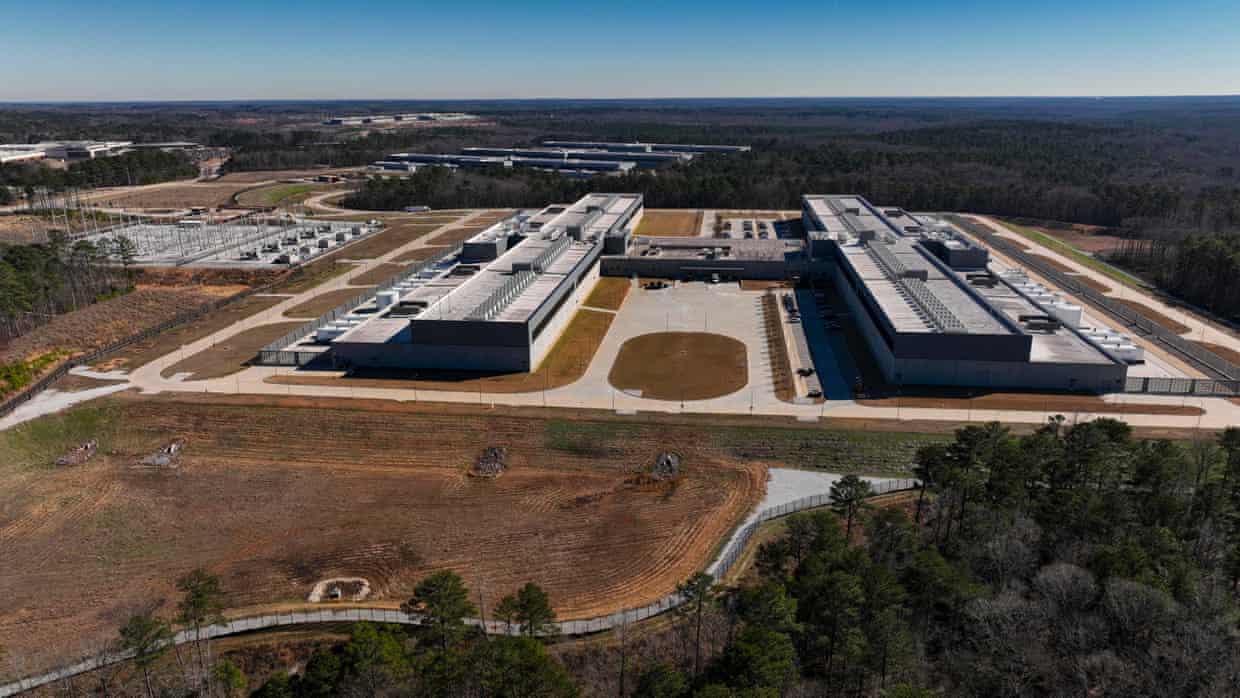
Lawmakers in several states are exploring passing laws that would put statewide bans in place on building new datacenters as the issue of the power-hungry facilities has moved to the center of economic and environmental concerns in the US.In Georgia a state lawmaker has introduced a bill proposing what could become the first statewide moratorium on new datacenters in America.The bill is one of at least three statewide moratoriums on datacenters introduced in state legislatures in the last week as Maryland and Oklahoma lawmakers are also considering similar measures.But it is Georgia that is quickly becoming ground zero in the fight against untrammelled growth of datacenters – which are notorious for using huge amounts of energy and water – as they power the emerging industry of artificial intelligence.The Georgia bill seeks to halt all such projects until March of next year “to allow state, county and municipal-level officials time to set necessary policies for regulating datacenters … which permanently alter the landscape of our state”, said bill sponsor state Democratic legislator Ruwa Romman.
It comes at a time when Georgia’s public service commission – the agency that oversees utility company Georgia Power – just last month approved a plan to provide 10 additional gigawatts of energy in the coming years.It was the largest amount of electricity sought for a multi-year plan in the commission’s history, was driven by datacenters and will mostly be supplied by fossil fuels.The 10-gigawatt plan – enough to power about 8.3m homes – in turn comes as the Atlanta metro area led the nation in datacenter construction in 2024.This accelerated growth has already led at least 10 Georgia municipalities to pass their own moratoriums on datacenter construction, with Atlanta suburb Roswell becoming the most recent earlier this month.
Municipalities in at least 14 states have done the same, according to Tech Policy Press,Bernie Sanders, the Vermont independent democratic socialist senator, proposed a national moratorium last month,“What we’re seeing is, as communities are learning more about this aggressive industry’s presence … [they] want to have time to thoroughly investigate all potential harms,” said Seth Gladstone, spokesperson for Food and Water Watch,The rampant development of datacenters to power AI raises several concerns for residents and activists alike,One is their impact on the cost of electricity.
“In the public’s mind, datacenters and utility bills are inextricably linked,” said Charles Hua, founder and executive director of PowerLines, an organization that works on lowering utility bills and involving communities in decisions about energy,Hua noted that the relationship between the two varies, depending on each state’s market and regulatory system,In Georgia, he said, the Georgia Power utility company makes profit off new capital investments – so it has incentive to keep building new power plants,This approach has led Georgia’s rates to go up by a third in the last several years alone,Meanwhile, he said, the power company doesn’t have incentive to make the electrical grid more efficient – which “could actually lower prices”, Hua said.
But datacenter concerns in Georgia also include water use and lost tax revenue.Republicans in the state legislature have introduced bills this year to protect consumers from increases in their utility bills and to end tax breaks for the centers.A Democrat has proposed that datacenters make public how much energy and water they use each year.Romman is also running for governor.If elected, she would become the first Palestinian American elected to statewide office in Georgia and break the near quarter-century hold Republicans have on the office.
Her bill, HB 1012, has a Republican co-sponsor in state representative Jordan Ridley, who said he signed onto the measure because he wanted to give local governments time to develop zoning regulations on datacenters, since “it seems like they’re being built across the state”.“Every local government has zoning codes and … they need public input.That takes time,” Ridley said.At the same time, Ridley added, “datacenters … provide tax revenue and high-paying jobs.I’m not against datacenters.
”Romman’s bill is not just a policy proposal; it’s also a political one.In a statement, she wrote that the moratorium “would provide time for Georgians to vote on the majority of the Public Service Commission seats who make final decisions on energy-related projects”.Georgia is one of 10 states that elect their utility regulators.Voters in the state elected progressive Democrats Alicia Johnson and Peter Hubbard to the five-member commission in November, leading the agency to lose its all-Republican makeup for the first time in nearly two decades.Another seat is up for a vote this November.
The calculus: if the commission becomes majority-Democratic, it will no longer give a rubber stamp to electricity demands from Georgia Power driven by tech companies seeking to build datacenters.Hubbard, now in his new position, recently wrote an editorial asserting that Georgia voters “see data centers receiving tax breaks as their power bills go up.They see local communities struggle with competition for water supplies and high voltage transmission lines that reduce property values.And they see how the PSC approved every request placed before it by the monopoly electric utility.“This is why opposition to data centers is growing in Georgia; because Georgians oppose being treated as collateral damage by the unregulated growth of data centers that will push their power bills even higher.
”There’s another political implication to Romman’s bill.Paul Glaze, spokesperson for Georgia Conservation Voters, said if the bill crosses from the House to the Senate, “it may be a preview of the potential general election” later this year.“The question is, in communities where datacenters are coming, who are voters going to trust to have their back?” Glaze said.“Anyone serious about statewide office should have a clear position on this.”
Treasury announces business rate support package worth more than £80m a year – as it happened
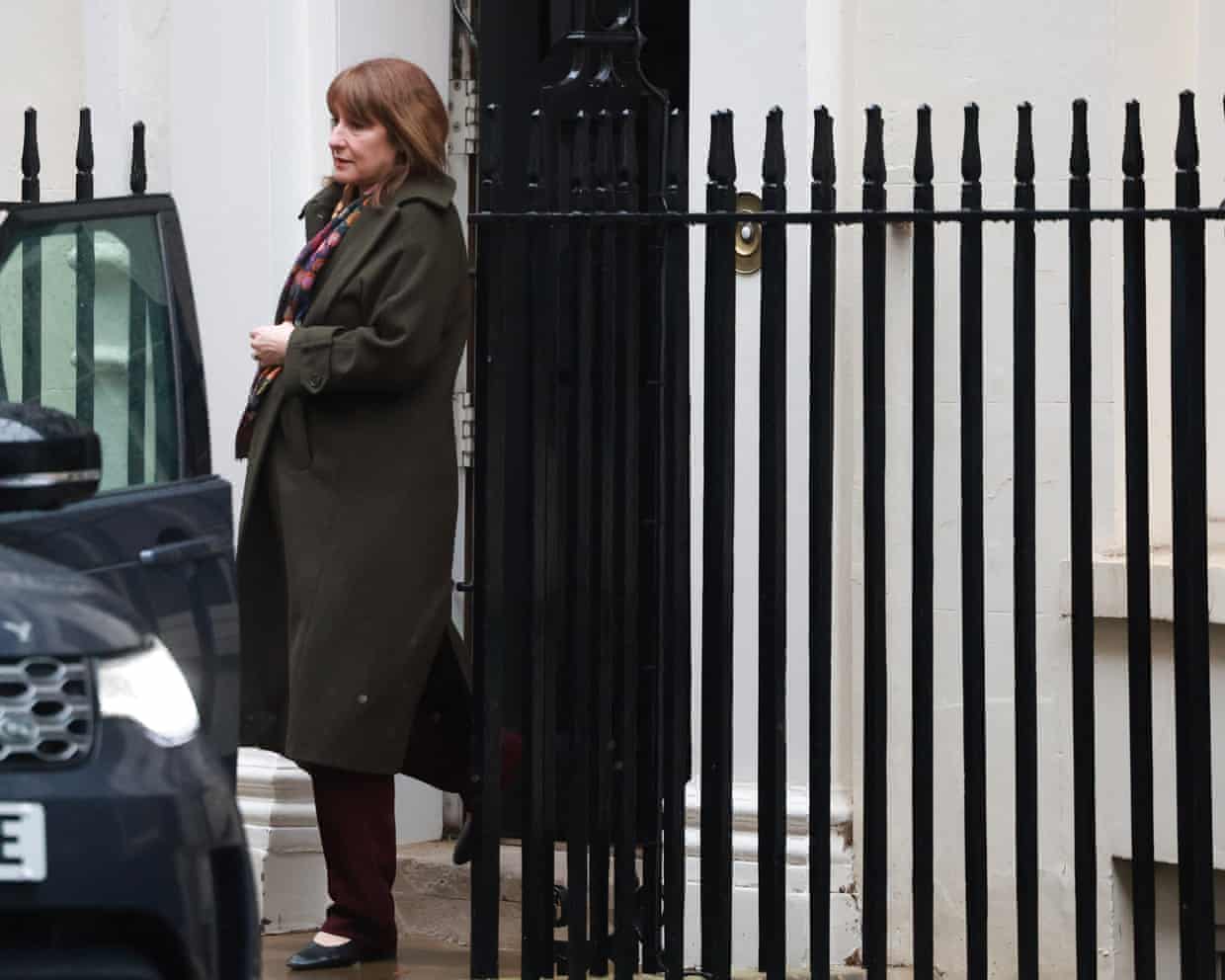
The Treasury has unveiled a support package worth more than £80m a year for pubs and live music venues in England and Wales, in a climbdown that follows a fierce backlash against plans to overhaul business rates.Trade bodies had warned that Rachel Reeves’s changes to business rates, announced at the chancellor’s November budget, would trigger widespread closures and job losses in the hospitality sector, particularly in pubs.On Tuesday, the government announced financial support to mitigate the effect of the rates shake-up, after officials admitted that they had not foreseen its total financial impact.The package, final details of which were still being hammered out on Monday night, is expected to be worth more than £80m a year, over three years, for pubs and gig venues.Dan Tomlinson, the exchequer secretary to the Treasury, said every pub in England and Wales would get 15% off its new business rates bill from 1 April, worth an average of £1,650 for each

Pubs and live music venues to get support after business rates backlash
The Treasury has unveiled a support package worth tens of millions of pounds for pubs and live music venues in England and Wales, in a climbdown that follows a fierce backlash against plans to overhaul business rates.Trade bodies had warned that Rachel Reeves’s changes to business rates, announced at the chancellor’s November budget, would trigger widespread closures and job losses in the hospitality sector, particularly in pubs.On Tuesday, the government announced financial support to mitigate the effect of the rates shake-up, after officials admitted that they had not foreseen its total financial impact.The package, final details of which were still being hammered out on Monday night, is expected to be worth nearly £100m for pubs and gig venues.Dan Tomlinson, the exchequer secretary to the Treasury, said every pub in England and Wales would get 15% off its new business rates bill from 1 April, worth an average of £1,650 for each

How ICE is using facial recognition in Minnesota
Immigration enforcement agents across the US are increasingly relying on a new smartphone app with facial recognition technology.The app is named Mobile Fortify. Simply pointing a phone’s camera at their intended target and scanning the person’s face allows Mobile Fortify to pull data on an individual from multiple federal and state databases, some of which federal courts have deemed too inaccurate for arrest warrants.The US Department of Homeland Security has used Mobile Fortify to scan faces and fingerprints in the field more than 100,000 times, according to a lawsuit brought by Illinois and Chicago against the federal agency, earlier this month. That’s a drastic shift from immigration enforcement’s earlier use of facial recognition technology, which was otherwise limited largely to investigations and ports of entry and exit, legal experts say

UK ministers accept $1m from Meta amid social media ban consultation
Ministers have accepted $1m (£728,000) from Meta, the US tech and social media company, to build AI systems for defence, national security and transport, sparking warnings about the UK government’s “alarmingly close relationship with Trump-supporting US tech giants”.The money from Mark Zuckerberg’s company will be used to pay experts to “develop cutting-edge AI solutions … to support national security and defence teams”, the Department for Science, Innovation and Technology (DSIT) announced on Tuesday.The money will pay for four British AI experts, coordinated by the government-funded Alan Turing Institute, to “play a pivotal role in rewiring our healthcare, police, transport systems and more”, said Ian Murray, the minister for data and digital government.The move comes after Meta executives had 50 meetings with ministers in the last two years for which data was available, one of the highest levels of direct access of any technology company, a Guardian investigation found.The government is consulting on a ban on social media use by under-16s, which would have a major effect on Meta’s Instagram platform

Sri Lanka v England: third men’s cricket one-day international – live
Gone! Rashid lures Hasaranga into a chip which just isn’t timed. Duckett takes the catch as if he’d never dropped one a few minutes ago.41st over: Sri Lanka 263-7 (Rathnayake 94, Hasaranga 9) Hasaranga fancies this. Facing Curran, he plays himself in for two balls, then strokes a gorgeous off-drive on the up for four, folowed by a pull for four more. Eleven off the over!40th over: Sri Lanka 252-7 (Rathnayake 92, Hasaranga 0) Meanwhile Rathnayake motors on into the 90s

Elina Svitolina humbles Coco Gauff to set up Sabalenka semi in Australian Open
Coco Gauff is known across her sport for her mental toughness and problem-solving abilities, her tendency to grind out victories from unenviable positions. However, down 1-6, 0-3, 0-30 on Tuesday night and sinking quickly, the 21-year-old has rarely looked as helpless on a tennis court as when she expressed her despair to her support team: “She’s outdoing me in everything,” she said.This time, there was no way back for the third seed as Elina Svitolina ended a courageous, focused performance by securing the most significant result of the Australian Open so far, completely dismantling Gauff 6-1, 6-2 to reach her first semi-final in Melbourne.Svitolina, the 12th seed, will next face Aryna Sabalenka, the world No 1 and two-time Australian Open champion. Earlier on Tuesday, Sabalenka dismantled the 29th seed Iva Jovic 6-3, 6-0 to reach her fourth consecutive semi-final here

‘Mother of all deals’: EU and India sign free trade agreement

First of its kind ‘high-density’ hydro system begins generating electricity in Devon

Scotland-France ferry could relaunch amid £35bn Dunkirk regeneration plan

National insurance hike and energy bills behind food price rise, say UK retailers

Bank of Scotland fined £160,000 over account for sanctioned Putin ally

Gold price jumps above $5,000 an ounce for first time amid Trump turmoil