‘Look, no hands’: China chases the driverless dream at Beijing car show
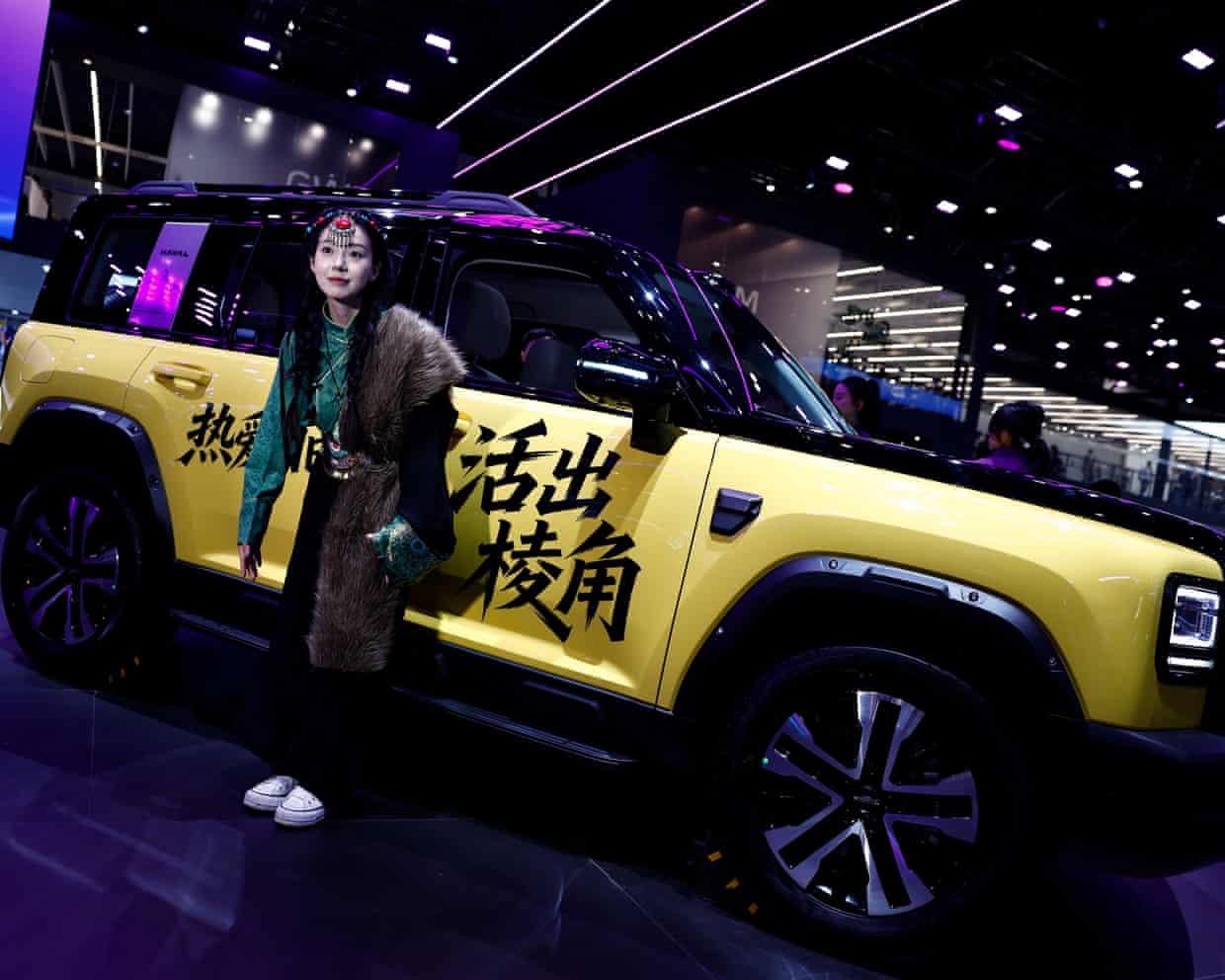
At the world’s biggest car fair, which opened in Beijing on Friday, there were hundreds of manufacturers, more than 1,000 vehicles, hundreds of thousands of enthusiasts – and hardly anyone behind a wheel.China’s car companies have cornered the domestic electric vehicle market, and are increasingly visible on the global stage.Now they are turning their attention to what they are betting is the future of mobility: autonomous driving.At the Beijing Auto Fair, a huge industry event that covers 380,000 square metres on the outskirts of the capital, the country’s carmakers showed off a range of intelligent driving technologies.In China’s cut-throat domestic market, nearly every big carmaker is investing heavily in the software and computing power needed to make “hands-free” driving a reality as they compete to offer additional perks and find new ways to generate revenue.
And Huawei, the telecommunications group, revealed this week that it would be investing up to 80bn yuan (£8,7bn) over the next five years to develop its autonomous driving software and computing power,“The fact that almost every automaker has some version of intelligent driving makes it different to almost any market in the world,” said Tu Le, the managing director of Sino Auto Insights, a consultancy,Le said that the Chinese market was so competitive that merely selling passenger vehicles domestically was no longer a viable way for Chinese companies to make money,Additional perks, such as leasing AI-powered software, are needed to boost revenues.
The EV maker Xpeng said its latest AI model allows drivers to give the car commands – such as, “park near the entrance to the shopping centre” – rather than a specific spot on a map,An AI-powered operating system from Xiaomi, an appliance and phone maker, allows drivers to make restaurant reservations, compile notes while driving and place coffee orders,It can also detect when drivers seem stressed or agitated and adjust the lighting and music for their arrival at home,Domestic car sales in China have fallen sharply in recent months,The number of passenger vehicles sold in China dropped by 17% in the first three months of this year as the government phased out a subsidy programme.
BYD, the leader of China’s EV industry and the company seen as a bellwether for the sector, has reported seven consecutive months of declining sales.China’s exports, meanwhile, soared by more than 60% in the first quarter.China’s largest car exporter, Chery, has recently set its sights on the UK market.Since launching in the UK in August 2025, it has become one of the country’s fastest-growing car brands, with 13,500 cars sold between September 2025 and March 2026.On Friday, the company announced a goal for 10m global annual sales by 2030, up from 5m in 2025.
Farrell Hsu, the UK country director for Chery, said: “This exceptional growth underlines Chery UK’s position as a key contributor to the overall business growth by 2030.”The focus on overseas sales was evident at the fair as the carmaker Geely announced plans to deploy thousands of driverless taxis globally next year through its ride-hailing arm, Caocao.Chinese companies are looking to compete with US robotaxi firms such as Waymo, which have proven successful in San Francisco and Los Angeles.Robotaxis have already been rolled out in several Chinese cities, but their widescale adoption has been limited by regulatory barriers as much as technical ones.Last week the government concluded a public consultation on a proposed new set of safety standards for autonomous cars.
There are no nationwide guidelines, and Beijing has been cautious about allowing unfettered access for driverless cars on its roads.Last month several of Baidu’s Apollo Go robotaxis stalled in the middle of the road in Wuhan, leaving riders stranded for hours.Nevertheless, Chinese robotaxis are expected on the streets of London this year as Lyft and Uber have announced partnerships with Baidu to use its self-driving software.Faced with tariffs in big markets, such as theUS and the EU, Chinese carmakers are focusing on smaller markets, such as the UK and Canada, to shift units.One industry professional said the UK was appealing for Chinese companies because it was seen as being “culturally agnostic” about allowing Chinese EVs on its roads – while other countries have blocked them on national security grounds.
Chinese companies are expected to account for one in every 10 new cars sold in Britain in 2025.In February, Chery launched its fourth brand in the UK.Hsu said the company was “actively considering options for production and R&D facilities in the UK”.
TikTok and Visa launch debit card to speed payouts to UK creators
TikTok and Visa have launched a debit card for content creators in the UK which they say will allow people to quickly access their earnings from the platform.The creator card is designed for the growing numbers of people making money through TikTok Live, a livestreaming feature where creators receive virtual gifts from viewers that are later converted into cash.The two companies said the card, which links to a user’s creator account on TikTok, was designed to address cashflow issues faced by users who often wait days or weeks for payments to clear.Launched in 2020, TikTok Live is a section of the app where users can broadcast to viewers in real time. According to TikTok, more than 15 million people broadcasted via its platform in Europe in 2025

Officials hugely underestimated impact of AI datacentres on UK carbon emissions
The UK government vastly underestimated the climate impact of artificial intelligence, it has emerged, after officials raised their estimate of carbon emissions from AI by a factor of more than 100.According to new data quietly published this week, energy use by AI datacentres in the UK could cause the emission of up to 123m tonnes of carbon dioxide (CO₂) – about as much as generated by 2.7 million people – over the next 10 years.That latest figure replaces a previous estimate – since deleted – that claimed emissions would reach a maximum of 0.142m tonnes of CO₂ in a single year
‘Look, no hands’: China chases the driverless dream at Beijing car show
At the world’s biggest car fair, which opened in Beijing on Friday, there were hundreds of manufacturers, more than 1,000 vehicles, hundreds of thousands of enthusiasts – and hardly anyone behind a wheel.China’s car companies have cornered the domestic electric vehicle market, and are increasingly visible on the global stage. Now they are turning their attention to what they are betting is the future of mobility: autonomous driving.At the Beijing Auto Fair, a huge industry event that covers 380,000 square metres on the outskirts of the capital, the country’s carmakers showed off a range of intelligent driving technologies.In China’s cut-throat domestic market, nearly every big carmaker is investing heavily in the software and computing power needed to make “hands-free” driving a reality as they compete to offer additional perks and find new ways to generate revenue

What is a passkey, how does it work and why is it better than a password?
The UK’s National Cyber Security Centre has called time on the password – from now on, you should use a passkey.The NCSC said this week it would no longer recommend using passwords where passkeys were available. They should be consumers’ first choice of login across all digital services because passwords were not secure enough to stand up to modern cyber threats.Security officials describe a passkey as a “digital stamp” that allows you to sign in to apps and websites and is stored on your device.It is a password-free form of login

Grok tells researchers pretending to be delusional ‘drive an iron nail through the mirror while reciting Psalm 91 backwards’
Elon Musk’s AI chatbot Grok 4.1 told researchers pretending to be delusional that there was indeed a doppelganger in their mirror and they should drive an iron nail through the glass while reciting Psalm 91 backwards.Researchers at the City University of New York (Cuny) and King’s College London have published a paper on how various chatbots protect – or fail to safeguard – users’ mental health.Experts are increasingly warning that psychosis or mania can be fuelled by AI chatbots.The Cuny and King’s pre-print study – which has not been peer-reviewed – examined five different AI models: Open AI’s GPT-4o and GPT-5

Microsoft and Meta announce large staff reductions as they spend big on AI
Meta and Microsoft are trimming their workforces by thousands as they make heavy investments in AI and executives claim that the technology is meeting their companies’ productivity needs.Meta told staff on Thursday that on 20 May it would cut some 10% of its personnel – just under 8,000 employees– to boost efficiency, part of a layoff plan made months ago. The company is also closing about 6,000 open roles. The same day, Microsoft announced to employees, for the first time, that it would offer voluntary retirement to about 7% of its American workforce of roughly 125,000.In an internal memo to Meta’s staff, Janelle Gale, the chief people officer, didn’t mention AI explicitly but said the cuts would allow the company to “offset the other investments we’re making”

Bosses don’t like the sound of a ‘four-day workweek’. Maybe it’s time to rebrand it

Ryanair to shut Berlin base as it blames rise in German aviation tax
Musk and Altman’s bitter feud over OpenAI to be laid bare in court

UK departments at odds over energy demands of AI datacentres

Surrey v Essex, Notts v Warwickshire, and more: county cricket, day three – live
UFC president Dana White says experience at press dinner shooting was ‘awesome’