Aryna Sabalenka shocked by Sorana Cirstea’s comeback win at Italian Open
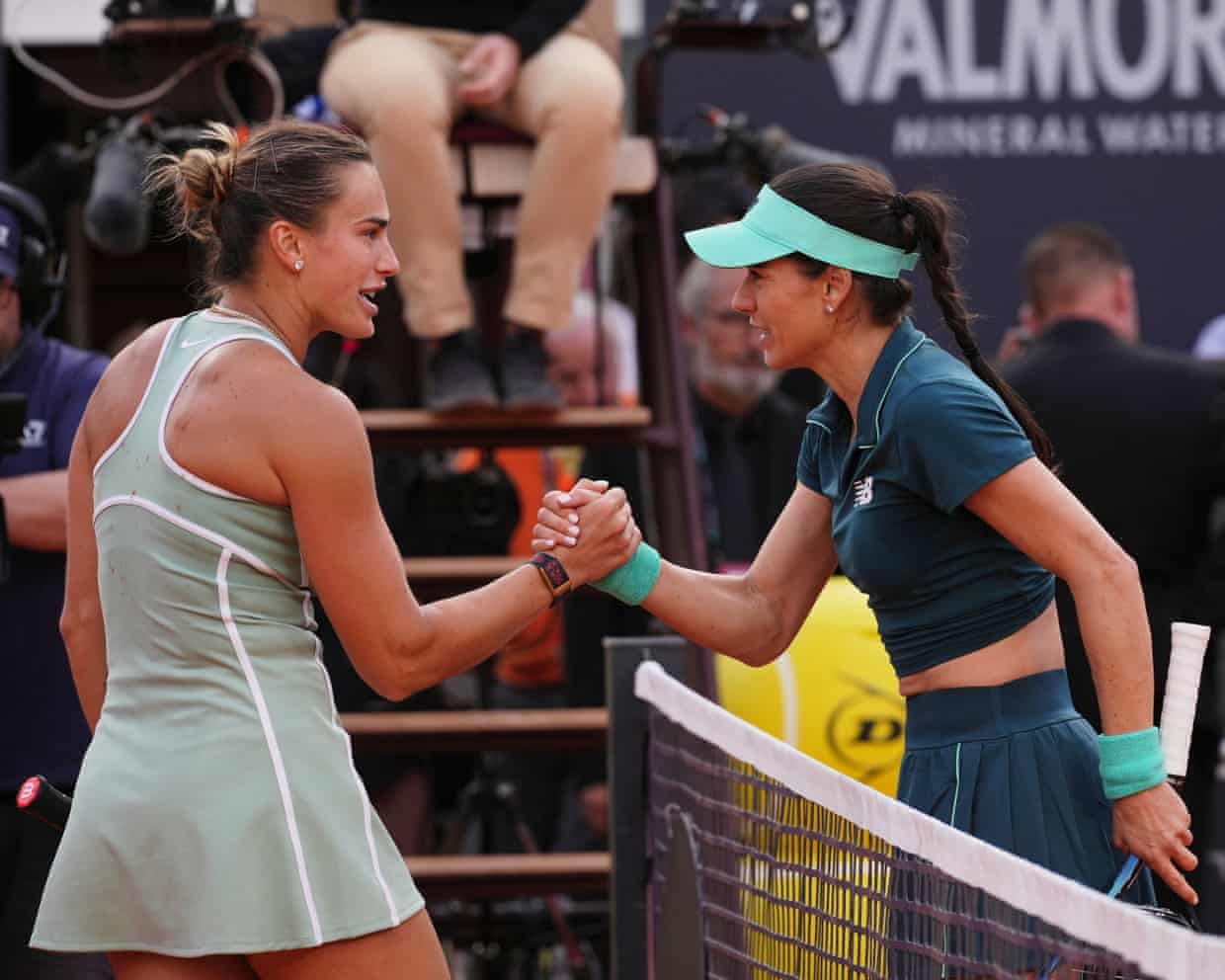
Aryna Sabalenka, the world No 1, suffered her earliest defeat in more than a year as she was toppled in the third round of the Italian Open by the soaring Romanian veteran Sorana Cirstea, who brilliantly held her nerve to close out a 2-6, 6-3, 7-5 win,The defeat marks a second successive surprise loss for Sabalenka, who started the clay-court season in some of the best form of her career after consecutive victories at the WTA 1000 events at Indian Wells and Miami,Until her quarter-final defeat to Hailey Baptiste at the Madrid Open last week, where Baptiste spectacularly saved six match points, Sabalenka had started the year by winning 26 of her first 27 matches,This is also the first time Sabalenka has lost before the quarter-final stage at any tournament since February 2025 and she will head to the French Open having failed to reach the semi-final in any clay-court tournament this year,Sabalenka also has fresh injury concerns to address after struggling with a lower back injury in the final stages of the match.
Cirstea, meanwhile, continues to save the best tennis of her entire career for her farewell tour,Cirstea, 36, will retire from professional tennis at the end of this season but she has performed at a consistently high level from the start of the season,Despite being a constant presence near the top of the sport for 17 years, Cirstea has never broken the top 20, peaking at No 21 in 2013,She sits at No 14 in the live WTA Race and this is the first time that Cirstea has ever beaten a No 1 player,She had lost all 12 sets in prior meetings with the No 1 player.
As was the case with Novak Djokovic a day earlier during his surprise three-set defeat to the men’s No 79, Dino Prizmic, this result seemed unlikely early on as Sabalenka rolled through the first set,However, Cirstea recovered impressively, playing with fearless aggression in the final two sets as she controlled the majority of points and forced an erratic Sabalenka behind the baseline,Down a break at 3-4 in the final set, Sabalenka received a medical timeout on her lower back,Even as she visibly struggled with her back, Sabalenka fought hard and she provided herself with an opportunity to turn the match around, pulling Cirstea back to 5-5 from 3-5 down,Cirstea composed herself and then forced herself back on to the front foot, winning the final two games to close out an enormous victory.
Although tennis players are mandated to participate in a press conference if they are requested by the media, Sabalenka’s back injury meant she simply provided some quick quotes to a WTA representative.“I feel like I didn’t play well from the beginning till the end,” she said.“I started really well, but then I kind of dropped the level.Felt like my body was limiting me from performing on the highest level.She stepped in and played incredible tennis.
Didn’t really give me many opportunities.Yeah, that was a tough one.But I guess we never lose; we only learn, so it’s OK.”Sabalenka said she would use the coming days to address the physical discomfort she struggled with.“I’d say that probably it’s like my lower back, connected to the hip, which was kind of like limiting me from full rotation.
I guess we are just going to have some days off.We’re going to spend it on recovery.That’s the plan I believe for now,” she said.Jannik Sinner began his pursuit of a record-extending sixth consecutive Masters 1000 title by easing through his second-round match with a comfortable 6-3, 6-4 win over Sebastian Ofner of Austria.Sinner, who is also attempting to follow Djokovic by becoming the second man in history to win every Masters 1000 title, had few problems adjusting to slow, heavy conditions at night in front of a packed home crowd.
The men’s No 1 broke Ofner’s serve early in both sets and navigated his service games with ease, facing no break points in the match,He will face either Jakub Mensik or Alexei Popyrin in round three,Cameron Norrie, meanwhile, believes he is still well positioned for a strong performance at the French Open despite being shocked by his standard of play during Saturday’s frustrating 6-3, 7-5 loss to Thiago Agustín Tirante in the second round of the Italian Open,Norrie, the British No 1, started the match with a slew of unforced errors, immediately falling 3-0 behind,Those tense early struggles set the tone for a difficult day against one of the most explosive players on the tour.
Tirante’s massive first serve consistently scaled 140mph, peaking at 148mph, which the world No 69 backed up by dominating the baseline with his heavy forehand.Norrie, who had beaten Tirante two weeks ago at the Madrid Open, will next compete at the Geneva Open, which takes place a week before the French Open main draw begins.“I’m feeling so good physically, mentally,” he said.“This loss is just going to make me hungry, I think, but I was shocked with my level because I’ve been playing so well in practice, I can’t prepare better.So I’m excited and ready to play again.
“I would’ve liked to stay here and play and have a chance to win the tournament,I felt my level was there, but it’s OK,I’ll learn from that and next time I’ll be a bit more brave and trust my tennis and trust how well I’m playing,”

AI-powered surveillance company Palantir created a chore coat. Great, now I have no choice but to burn mine | Van Badham
It’s taken me years to find a chore coat with a cut that flatters my big tits but, now that I finally own one, I want to incinerate it.Such is the power of brand contamination; infamous data surveillance megacorp Palantir has decided to bang a logo on a chore coat to sell as corporate merch.Chore coats are the traditional short denim or twill jacket of the 19th-century French working class. Palantir, however, is a company whose public words and commercial-in-confidence activities are inspiring local calls to have its contracts cancelled and its business banned.The gentle French garment is now as cursed as whatever “Marie Amazonette” will ever wear to the Met Gala

‘Being human helps’: despite rise of AI is there still hope for Europe’s translators?
In February 2022, while he was plugging away at rendering the US writer Dana Spiotta’s novel Wayward into French, the literary translator Yoann Gentric decided he needed a bit of light relief. He would test whether AI could put him out of work.Gentric had been grappling with a short non-verbal sentence that described the book’s protagonist’s feelings upon opening a window: “Bright, sharp night air, bracing.” He put the prompt into DeepL, a neural-network-powered machine translation engine that regularly outperforms Google Translate in accuracy assessments.The proposed translation was reassuring, with his job security in mind: L’air de la nuit, vif et vif, était vivifiant (The night air, lively and lively, was enlivening

UK schools should remove pupils’ online photos as AI blackmail threat grows, say experts
UK schools should remove pictures of pupils’ faces from their websites and social media accounts because blackmailers are using them to create sexually explicit images, experts have said.Child safety experts and the UK’s National Crime Agency (NCA) warn that criminals are using AI to manipulate photos of children and then demand cash not to publish them.They are recommending educational institutions remove identifiable pictures of children from their websites and social media accounts – or consider not using them at all.The Internet Watch Foundation (IWF) said an unnamed UK secondary school had recently been subjected to a blackmail attempt after criminals used the institution’s website or social media accounts to take photos of schoolchildren and then, using AI tools, turned them into child sexual abuse material (CSAM). The blackmailers sent the images to the school and threatened to publish them online if they did not receive money

Meta sues Ofcom over fines regime for breaches of Online Safety Act
Meta has launched a legal challenge against the UK’s media regulator over the fees and fines regime it is enforcing under landmark digital safety legislation.The Facebook and Instagram owner is claiming that Ofcom’s methodology for calculating the charges is flawed and should not be based on a company’s global revenue. Breaches of the Online Safety Act can be punished by fines of up to 10% of qualifying worldwide revenue (QWR) or £18m – whichever is higher.In the case of Meta, which reported revenues of $201bn last year, Ofcom could in theory impose a fine of $20bn for breaches. Under regulations introduced in September, Ofcom’s fees will also be based on a proportion of an organisation’s QWR and apply to businesses that made more than £250m of this revenue a year

‘No one has done this in the wild’: study observes AI replicate itself
It’s the stuff of science fiction cinema, or particularly breathless AI company blogposts: new research finds recent AI systems can independently copy themselves on to other computers.In the doom scenario, this means that when the superintelligent AI goes rogue, it will escape shutdown by seeding itself across the world wide web, lurking outside the reach of frantic IT professionals and continuing to plot world domination or paving over the world with solar panels.“We’re rapidly approaching the point where no one would be able to shut down a rogue AI, because it would be able to self-exfiltrate its weights and copy itself to thousands of computers around the world,” said Jeffrey Ladish, the director of Palisade research, a Berkeley-based organisation which did the study.The study is one more entry in a growing catalogue of unsettling AI capabilities revealed in the past months. In March, researchers at Alibaba claimed to have caught a system they developed – Rome – tunnelling out of its environment to an external system in order to mine crypto

Europe’s AI translation industry told it risks reputation by partnering with US firms
AI companies in Europe risk losing their world-leading status in the field of machine translation, industry figures have said, after the decision by one of the continent’s leading startups to partner with Amazon’s cloud computing division provoked alarm.While businesses in the EU have generally lagged behind the US and China in AI adoption, a small group of European companies have cornered the global market for high-quality machine translations for professional use.The biggest success story is Cologne-headquartered DeepL, an online translator that regularly outperforms Google Translate in accuracy assessments. Used by governments, courts and half of the Fortune 500 list of highest-earning US companies, last year it was reported to have recorded revenues of $185.2m

‘Degree of complacency’: are supply chains prepared for impact of ongoing Iran war?

Advisers urge JP Morgan investors to vote to split chair and CEO positions

Mistaking AI behaviour for conscious being | Letter

What I saw at the Musk-OpenAI trial: petty billionaires, protests and a stern judge

England v New Zealand: first women’s cricket ODI – live

Nottinghamshire v Surrey, Glamorgan v Somerset, and more: county cricket – live