Tension at the tennis: inside the high-stakes world of racket stringing

Underneath Rod Laver Arena, a group of tennis specialists cut and twist and weave – intently focused on their preparation for the action on the blue court a few metres above their heads.In the lead-up to the Australian Open, these experts maintain a consistent workload, training their muscles and technique, ready to peak as if they were the athletes taking to the courts themselves.But they won’t step on the court – their unique domain is tennis rackets.Racket stringing, specifically, and as the Yonex string team leader, Jim Downes, has learned over his 30-year stringing career, “It’s a high demand job.”The world’s top tennis players are, unsurprisingly, “very particular” about how their rackets are strung, Downes says, referring to how tight or loose the strings that crisscross the frames are pulled.
A highly strung racket generally offers its user more control but less power, while the opposite is true for a racket with lower tension,“A lot of people know how to string,” he says,“You have your shop stringers, but they might not be quick enough to do this job and maybe not consistent enough for the players’ needs at this level,”The job in question is servicing the stringing needs of the tournament’s 800 or so athletes as a part of Yonex’s 22-person team,Sarah Bloomfield, a British stringer who is at her second Australian Open, says those needs vary depending on the player and the venue.
“The weather is the biggest factor on how it affects them playing,” she says.“They all arrive in Australia and up their tension because it’s hotter so the ball travels faster, so, they all want more control.”At Melbourne Park the process starts when a player or their coach drops off their rackets, tension instructions and usually their chosen string to the dedicated stringing room.The rackets are whisked into a back room where the existing strings are unceremoniously cut and yanked out of the frame.A hungry-looking machine stands ready to consume the used strings for recycling – although it is temporarily out of action after it “started smoking a little bit”, Downes says.
The empty frames travel to the main room next door, where Downes assigns them to a stringer.“Sometimes I’ll let the stringer pick if they have a favourite player they want to string for,” he says.“But generally we keep the top 10 seeds with the stringers that are going to be here until the end.Just for consistency, you keep the same player with the same stringer.”The stringing team slowly shrinks as the tournament progresses and the losing players depart, leaving behind the most experienced stringers to work at the pointy end of the competition.
Sometimes a wildcard makes it further than expected and that can throw a spanner in the works but consistency is always key,There is a focused but relaxed atmosphere in the main stringing room – the tension reserved for the strings alone, at least at this stage of qualifying,The hum of activity from above ground trickles in and is punctuated by the snips, clicks, whirrs and beeps of the stringers at work,An empty racket frame is laid flat on the stringing machine, and the tension level set,The main strings that run in the direction of the handle are dealt with first: threaded through the small holes in the racket frame, clamped in place, pulled to tension by the machine, and knotted by hand.
The cross strings are next, the stringer manually weaving the fibre under and over the taut main strings,A moment for the strings here, please, the real heavy hitters on the court,Animal intestines were the material of choice for a century, woven into strong fibres that could be stretched across a wooden frame,In the 1970s, natural string made from cow gut was still the norm in tennis rackets,Polyester entered the scene in the early 1990s.
“It provided more spin and more durability but it can have some negative effects on the body,” Downes says.“The wrists, the elbows, the shoulders – the impact takes its toll over time.”As a result, natural strings had a bit of a resurgence, and now most players use a hybrid that combines the power of the gut strings with the strength and control of the synthetic.Being on tour means long days manipulating strings for one racket after another.Stringers have periods of steady work interspersed with urgent mid-match requests.
“Always the adrenaline starts pumping a little bit, but it’s all about consistency,” Bloomfield says,“So we string at a relatively fast pace anyway,For an on-court racket, you’re maybe just a little bit more focused,”The profession comes with its own challenges, of course – calloused hands and aching feet from standing still for so long,“You’ll find in my toolkit I’ve got plasters and bandages and all sorts,” she says.
“The more you string the easier it gets because your hands harden up,They do hurt but after a while you can’t feel it,”The final step is stencilling – no hi-tech machines here – a fluffy paint stick does the job just fine,Even when the rackets have left the room, the stringers can’t help but get caught up in the competition,“There’s always little rivalries between the stringers,” Bloomfield says.
If two players go head-to-head who have just had their rackets restrung, they are loyal to their work,“[It] makes it fun, just that added little bonus for the long days,Unfortunately, my player just lost, so I had more work to do,”It’s a strange phenomenon that you could hone your craft over years to reach the height of your profession, only for someone else reaching the height of theirs to smash your handiwork into an unrecognisable shape,Downes says the stringers don’t take this personally.
“I think the [sponsoring] companies feel worse about that than the stringers do,” he says,“It’s just an angry outburst,They need to release it somehow,”As for Bloomfield, who like many in the room played tennis before she learned to string, she now watches tennis through a different lens,“I have a huge love for the staff around it,” she says.
“So watching the umpires or the ball kids or whatever it is, I feel like part of that team.There’s always a bit of a sense of pride.”

Growth figures give boost to Reeves – but it’s too early to get carried away
At the end of last year, Rachel Reeves was under fire for the impact of budget speculation on Britain’s economy. All of the noise about fiscal holes, tax increases and spending cuts before her late November budget was having a real-world effect on the spending decisions of households and businesses.The latest official figures will therefore come as a boost for the chancellor. Britain’s economy grew more strongly than expected in November, up 0.3%, despite the fog of uncertainty in the lead up to her critical tax and spending speech at the end of the month

UK economy grew by better-than-expected 0.3% in November despite budget uncertainty
The UK economy grew by a stronger-than-expected 0.3% in November despite uncertainty around Rachel Reeves’s budget, official figures show.Figures from the Office for National Statistics (ONS) on Thursday showed the improvement, up from a 0.1% fall in October.Forecasters had expected a more modest 0

‘The consumers are still out there’: why a bankruptcy for Saks Global may not spell the end
Every year, the stores down Manhattan’s Fifth Avenue dress up their windows at Christmastime. Tourists from all over the world come to gawk at all the glitter, lace, ruffles and bows.Saks’s Fifth Avenue location, so iconic that it’s embedded in the brand’s name, is usually dressed top to bottom during the holidays. In 2023, the store partnered with Christian Dior to display a giant zodiac calendar. As part of the light show, fireworks were released from the top of the store to the oohs and aahs of spectators
UK housebuilder Taylor Wimpey warns of ‘muted’ demand
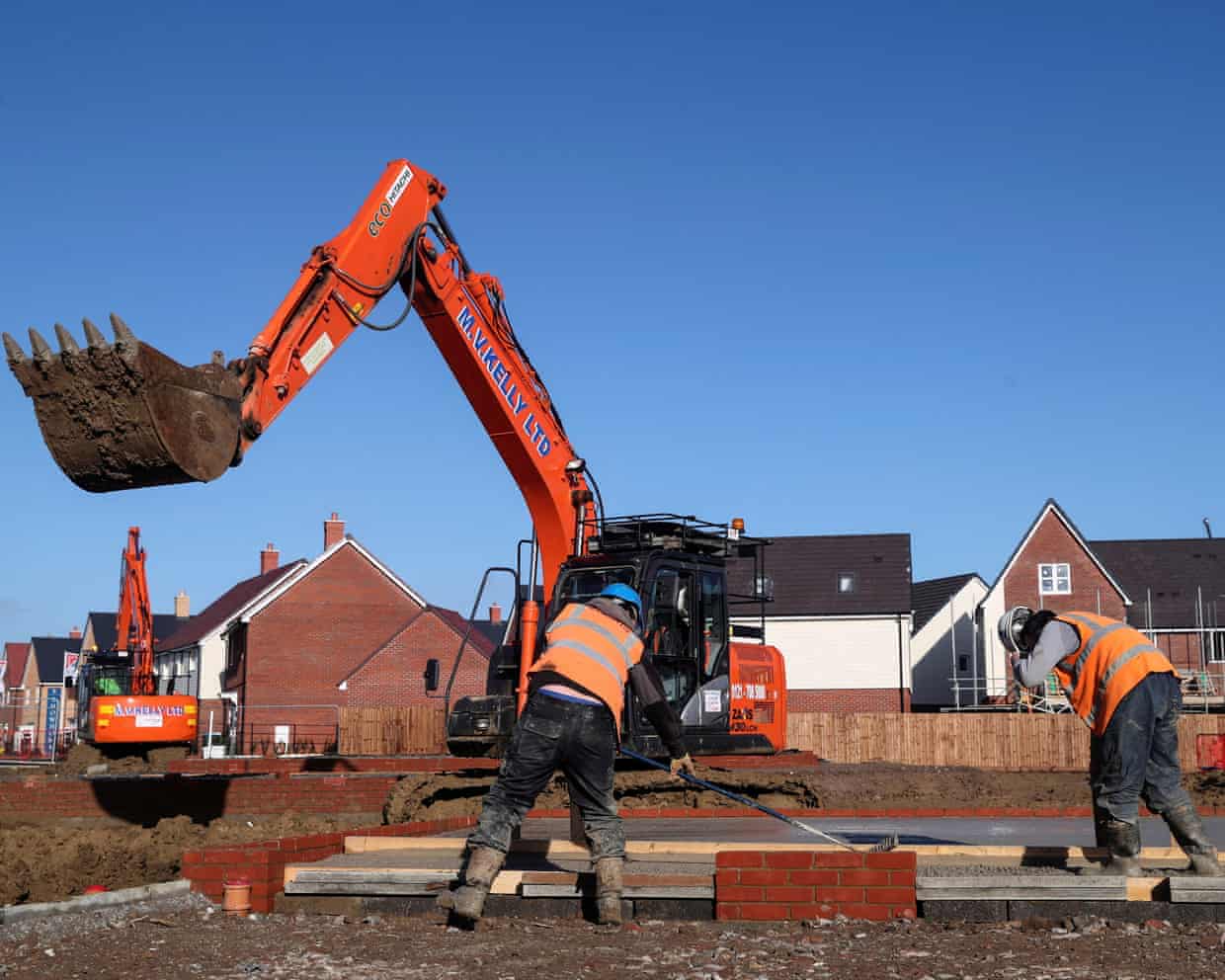
The UK housebuilder Taylor Wimpey has said demand is “muted” despite improving affordability, particularly among first-time buyers, echoing a cautious outlook from the estate agents Foxtons and Savills.Jennie Daly, the chief executive of Taylor Wimpey, said the government’s recent planning changes had resulted in “increased momentum in our recent planning permissions”.“However, while affordability is slowly improving, demand continues to be muted, particularly among the important first-time buyer category, which will constrain overall sector output,” she said.Shares in Taylor Wimpey fell by 4.7% in early trading before easing back to close about 1% down, while Foxtons fell 6% over the day

The crisis whisperer: how Adam Tooze makes sense of our bewildering age
In late January 2025, 10 days after Donald Trump was sworn in for a second time as president of the United States, an economic conference in Brussels brought together several officials from the recently deposed Biden administration for a discussion about the global economy. In Washington, Trump and his wrecking crew were already busy razing every last brick of Joe Biden’s legacy, but in Brussels, the Democratic exiles put on a brave face. They summoned the comforting ghosts of white papers past, intoning old spells like “worker-centered trade policy” and “middle-out bottom-up economics”. They touted their late-term achievements. They even quoted poetry: “We did not go gently into that good night,” Katherine Tai, who served as Biden’s US trade representative, said from the stage

UK borrowing costs drop to lowest level in more than a year
UK borrowing costs have dropped to their lowest level in more than a year, as investors were encouraged by more stable government finances and the prospect of further interest rate cuts.The yield, or interest rate, on 10-year UK government bonds fell to 4.34%, down from 4.41%, to the lowest level since December 2024, with the prospect of the UK public finances being put on a firmer footing lowering the risk of holding UK debt.The fall in UK yield on almost £3tn of UK debt represents a boost for Rachel Reeves, who fought hard inside government before November’s budget to increase the Treasury’s financial buffer and win over international investors who had become sceptical about the UK’s ability to balance its books

Eleven quick and easy summer weekday dinners, from pasta to Maggi goreng – recipes

January tips if you’re cooking for one | Kitchen aide

Cheesy celeriac souffle and citrus salad: Thomasina Miers’ recipes to brighten a dark winter’s day

Georgina Hayden’s quick and easy recipe for antipasti beans on toast | Quick and easy

West African sunshine dishes: Toyo Odetunde’s chicken yassa pot pie and stuffed plantain boats – recipes

How to make penne all’arrabbiata – recipe | Felicity Cloake's Masterclass