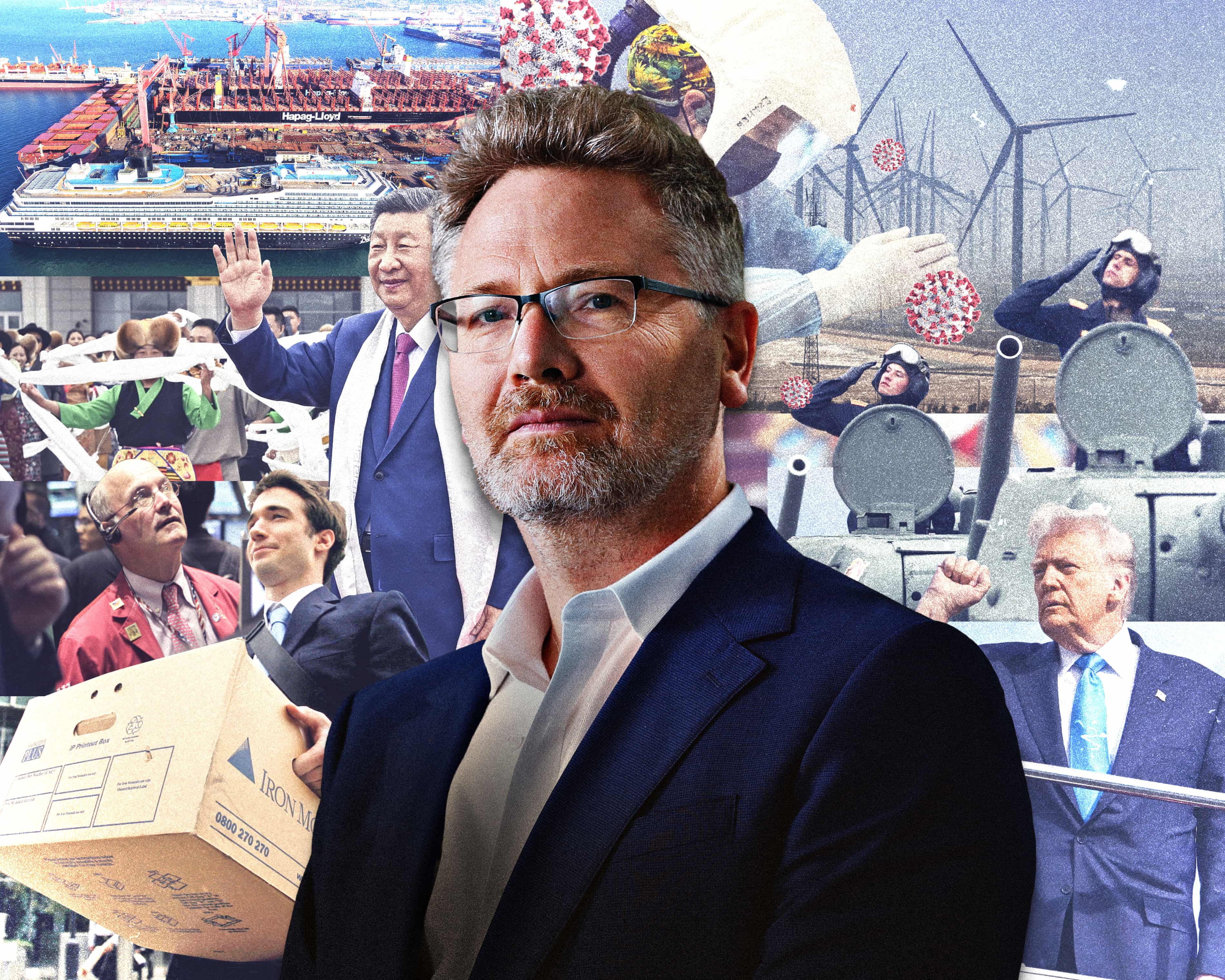
The crisis whisperer: how Adam Tooze makes sense of our bewildering age
In late January 2025, 10 days after Donald Trump was sworn in for a second time as president of the United States, an economic conference in Brussels brought together several officials from the recently deposed Biden administration for a discussion about the global economy.In Washington, Trump and his wrecking crew were already busy razing every last brick of Joe Biden’s legacy, but in Brussels, the Democratic exiles put on a brave face.They summoned the comforting ghosts of white papers past, intoning old spells like “worker-centered trade policy” and “middle-out bottom-up economics”.They touted their late-term achievements.They even quoted poetry: “We did not go gently into that good night,” Katherine Tai, who served as Biden’s US trade representative, said from the stage.
Tai proudly told the audience that before leaving office she and her team had worked hard to complete “a set of supply-chain-resiliency papers, a set of model negotiating texts, and a shipbuilding investigation”.It was not until 70 minutes into the conversation that a discordant note was sounded, when Adam Tooze joined the panel remotely.Born in London, raised in West Germany, and living now in New York, where he teaches at Columbia, Tooze was for many years a successful but largely unknown academic.A decade ago he was recognised, when he was recognised at all, as an economic historian of Europe.Since 2018, however, when he published Crashed, his “contemporary history” of the 2008 financial crisis and its aftermath, Tooze has become, in the words of Jonathan Derbyshire, his editor at the Financial Times, “a sort of platonic ideal of the universal intellectual”.
Though he still teaches history, Tooze is also widely acknowledged as an expert on the infrastructure of global finance and the economics of the green-energy transition.He is the rare commentator who can speak credibly about the political economy of Europe, the US and China, and he has been an outspoken advocate on issues ranging from central-bank reform to Palestinian rights.In addition to being the author of five books, he writes regular columns and essays for outlets like the Financial Times and the London Review of Books, hosts podcasts in English and German, and publishes a wildly popular and influential Substack newsletter called Chartbook, which he sends out daily in English to more than 160,000 subscribers, including Paul Krugman, the Nobel prize-winning economist, and Larry Summers, the former US treasury secretary.Chartbook also goes out in a Chinese-language version that, Tooze estimates, received 30m total impressions last year.Yet for all that, and despite being motivated occasionally by what he calls “an energy of wanting to put the world to rights”, Tooze is not generally regarded as an eager controversialist.
(Last year, Krugman sounded delighted to see “the normally calm Tooze come across as a bit angry” in one of his Chartbook posts.) In person as in his work, Tooze prizes connection and synthesis, a tendency that helps explain why he is equally at home, and equally welcome, talking to activists in South Africa, or senators in Washington, or development economists in the West Bank, or financial executives in London, or Chinese Communist party officials in Beijing, or finance ministers in Berlin.It was notable, then, that after joining the Brussels panel, Tooze didn’t waste much time before stating flatly that the Biden team had “failed in its absolutely central mission, which was to prevent a second Trump administration”.Not only that, he argued, but the dismantling of the liberal world order – something discussed with much rueful lamentation at the conference – had been hastened, not hindered, by the Biden veterans on stage.As he’d written a few months earlier, Tooze saw Biden no less than Trump aiming “to ensure by any means necessary” – including strong-arming allies – “that China is held back and the US preserves its decisive edge”.
“I feel the need to say something,” Tai said, when Tooze was finished.She recalled a parable Martin Sheen had delivered in front of the White House during the 25th anniversary celebration of The West Wing, the haute-liberal political fantasia that remains a touchstone for professional Democrats.Sheen’s story concerned a man who shows up at the gates of heaven and earns an admonishment from St Peter for his lack of scars.“Was there nothing worth fighting for?” St Peter asked the man.Tai turned the question on Tooze: “Where are your scars, Adam? I can show you mine.
”Recalling this exchange several months later, Tooze was still flabbergasted.“I’d be silly if I didn’t admit that it was a bruising encounter,” he told me recently, in one of three long conversations we had over the past year.Nevertheless, he said, “it confirmed my underlying theory about what was going on.These were a group of entirely self-satisfied American liberal elites who were enacting a morality tale in which Sheen and The West Wing and that whole highly sentimental vision of power and politics is a central device.She says this, I think, meaning to sound tough, like, ‘I’m the warrior.
Who are you? You’re just some desktop guy.’ Which just shows how little she understands what I’m saying, which is: ‘You people are a bunch of sentimental schmucks who don’t understand that you lost.If you had any self-respect, you would not be on any podium again, ever, sounding off about anything.Because comrades, if we were in the 30s, I would have taken you out and shot you.You fail like this, you don’t get to come back and show off your wounds.
’”Though it’s difficult to remember now, there was a time when Joseph R Biden was hailed as a president with the transformative potential of a Franklin D Roosevelt or a Lyndon B Johnson.During the 2020 campaign, Biden had positioned himself explicitly as the moderate alternative to both Bernie Sanders and Donald Trump.After the election, however, he quickly made clear that he did not intend to govern as a doddering centrist placeholder.He seemed particularly keen to flatter the aspirations of the left wing of the Democratic party, which, despite Sanders’ defeat, was experiencing its most significant resurgence in half a century.The early days of Biden’s presidency saw what appeared to be a new rapprochement between centrist liberals and the rising left.
Tooze, a self-described “left-liberal”, was perhaps the representative intellectual figure of this development.Some of this had to do with Crashed, which established him as a leading economic commentator and found an admirer in Chuck Schumer, the leader of the Senate Democrats.Some of it also had to do with Tooze’s longstanding interest in climate policy, which was shaping up to be a central focus of the Biden administration.And some of it, too, had to do with a belated but intense engagement with Twitter, which he joined in 2015 at the urging of his daughter (then a teenager) when he was in his late 40s, where he soon gained a huge following.Five years after Biden’s inauguration, the political atmosphere in the US could not be more different.
Yet Tooze remains no less relevant as an intellectual force.Whereas once he had personified the appeal of high-technocratic expertise – the feeling that if you could just read widely enough and understand deeply enough, you might be able to chart a sensible approach to crises like climate change – today Tooze stands as one of the more eloquent analysts of a new and confusing world order.“My basic wager in interpreting modern history is to bias toward the thought that it might be unprecedented,” Tooze told me.“I’m interested in the way the present continuously breaks us.It challenges us.
It does not, when you’re honest and serious about it, confirm what you know.” In The Deluge, his 2014 book about the legacy of the first world war, Tooze described the way early-20th-century world leaders confronted “the radical novelty” of a world in which the US economy was newly dominant.These days, Tooze spends most of his time tracking a dynamic that he believes is similarly unprecedented and consequential: the rise of China as an economic superpower.In Tooze’s view, what he calls the “radicalism of the present” keeps many people, including policymakers, from seeing the world as it actually is.Hence his argument to the Brussels panel that Biden and his staff were not the defenders of the liberal world order that they imagined themselves to be.
Hence, too, the claim he made in this newspaper, a few weeks before the 2024 election, that “Bidenomics [was] Maga for thinking people”.And hence his belief that – even though the past year has seen the darkest warnings of the Biden and Harris campaigns come to gruesome fulfilment – the American liberal obsession with Trump is too often framed in terms borrowed from decades past.“Why can’t we have new bad things?” he asked me at one point.“Like really new, really bad things?”Though he only leads two courses a year at Columbia, Tooze still thinks of himself primarily as a teacher.His job, he told me, “is to help people understand the situation that we’re in, as clearly as we can.
It’s to go, ‘Look at this, look at this: what does this tell us if we pin our eyes open and don’t flinch and don’t blink?’ And then to say that out loud.”A glance at Tooze’s family tree or his sterling CV makes it tempting to imagine his career as an untroubled glide among warm updrafts carrying him along from the day he was born.In conversation he does not obscure his many privileges: the fact, as he puts it, that he is “the product of five generations of university-educated women”, or that his mother’s parents were wealthy cosmopolitans who published influential reports on nutrition and took Le Monde as their daily newspaper, or that his father was a prominent molecular biologist.Yet Tooze’s upbringing was more complicated than that sketch implies.His maternal grandfather, Arthur Wynn, was a civil servant who had also been – as Tooze and his family learned alongside the public in the 1980s – a Soviet spy.
Tooze still speaks fondly of Arthur and his wife, Peggy; they are the joint dedicatees of Wages of Destruction, his 2006 book about Nazi economics.But he also describes Arthur as “a tough, tough, mean son of a bitch”.Tooze describes his father, John, as “a guy that got shit done” and also as someone with a well-deserved reputation for what we now call toxic masculinity: “I regularly would have people come up to me in life-science centres and say, ‘Does your name mean what I think it means?’ And then the reaction would be, ‘I’m sorry,’ or, ‘I hate your father.’”It was John’s work that took the family to Heidelberg in 1974, when Tooze was six years old.West Germany was reckoning with its Nazi past, and Tooze says that the ambient political atmosphere weighed heavily on his youth.
“I spent a lot of time identifying with the perpetrator, asking myself what kind of a Heydrich I would have been.” At that time in that place, the question was far from abstract.“I went to school with Albert Speer’s grandson.We were the big science dignitaries that arrived in the little village outside Heidelberg where the Speers lived, and they made us welcome.My parents were invited to dinner, and the Speers said, ‘Do you need some furniture? Here’s a table.
’ Literally the whole time we were in Germany we were eating off Albert Speer’s table.”The difficult legacy of the difficult men in his family ultimately steered Tooze away from economics, his first academic love.Though he was fascinated by the field, and good at it, he also recognised in it “an absolutely toxic culture”.By the time he graduated he knew he had to leave the discipline.“I had a terrible relationship with my father, and I couldn’t be around that kind of academic man,” he says.
With this resolution in mind, Tooze moved back to West Germany in 1989, just in time to see the Berlin Wall come down.That experience was something other than exhilarating: “I was quite shaken by it, to be honest, because I realised at that point that the West German bubble that I’d grown up with was disappearing before my eyes.” Like Brexit a quarter-century later, Germany’s reunification “massively destabilised” the hybrid identity he’d built for himself.In the newly unified Germany, Tooze did historical research that ultimately prompted him to undertake a doctorate in history at the London School of Economics.The change in field suited him, but it did not exactly settle his existential unease.
It was not until he got a teaching job at Cambridge, after his PhD, that he felt entitled to start assembling a library of his own.“Before that I felt so insecure.I didn’t feel I should own anything permanent.”Though he was writing books for general audiences, even as late as 2015 Tooze was still, in his self-deprecating description, “a secret name that grad students knew about”.Crashed changed all that.
The book had its origins in a seminar on the philosophy of history he taught at Yale, which included a group of students who were involved in left politics.“Working with that cluster really just changed my life,” Tooze says, not least because it reawakened in him a political impulse that had more or less fallen dormant.The class showed Tooze that there was an opening for a comprehensive account that would help his new friends on the left understand what had happened during the financial crisis.Gillian Tett, Tooze’s fellow columnist for the FT and the provost of King’s College, Cambridge, his alma mater, told me that “before 2008, it was incredibly hard to get a picture of how the entire global financial system worked as a single organic unit”.In Crashed, Tooze analysed the global economy as a matrix of interrelated corporate balance sheets, rather than as a point-to-point comparison of national economies.
Tett says that this approach gave him “a very good overarching framework” for analysing how money actually moved around the world, which proved crucial for understanding the crisis.Joseph Stiglitz, a colleague of Tooze’s at Columbia who won a Nobel prize in Economics in 2001, says that being a historian gave Tooze “a big advantage” in analysing the crisis.Modern economics tends to focus on mathematical models, an approach that, while fruitful in some cases, often struggles with multifaceted events like the financial crisis.“The world is complicated, and when you put all the pieces together, the mathematical model becomes so difficult that you can’t understand it,” Stiglitz told me recently.For Tooze, by contrast, “the freedom from the constraints of writing down a fully articulated mathematical model gave him the ability to give a true story of what was going on”.
Crashed was published in 2018, two years after Trump’s first electoral victory prompted many Democrats to reconsider the party’s longstanding embrace of neoliberalism.Against the foundational neoliberal presumption that the point of politics is to serve the market, Tooze supplied a 600-page demonstration of the “irreducibly political” foundations of the global economic system.Crashed was especially popular among Democrats who wanted to argue that Obama’s fiscal caution in the wake of the 2008 crisis was responsible for the rise of Donald Trump.Tooze thinks the situation was more complicated than that, but he makes no secret of the fact that he wrote Crashed “under the influence of left Dems from whom I’d acquired this narrative of the basic conservatism of the Obama response to the crisis”.In 2019, Chuck Schumer, the leader of the Senate Democrats, invited Tooze to Washington DC, to address a caucus luncheon.
Schumer’s interest reflected a new determination on the part of Democrats in Washington to test the Keynesian dictum that “anything we can actually do, we can afford”.Tooze recalls the senator engaging him in a conversation after his keynote.“Schumer said: ‘OK, Tooze, am I hearing you right? Are you saying that what we should be doing here is focusing on a massive investment surge? We should not be prioritising debt as a main concern? I said, ‘Yeah.’ He looked around at three people in the audience and said, ‘Do you hear what this guy’s saying? Next time we have a chance, we go big.’ I walked out and went, ‘Jesus Christ, did that just happen?’”Crashed vaulted Tooze into what he calls a “global existence” that has him travelling frequently and speaking earnestly about the community of people he runs into at conferences and in airport lounges around the world.
Though not a journalist – with a few exceptions, his contemporary histories rely on documents more than interviews – Tooze shares the journalistic impulse to see “policy processes reasonably up close”.He also clearly enjoys being a sounding board for people with the power to set national, continental and even global agendas: “They have the sense that you understand the way in which these pieces move.And so you become a point of confidence, somebody they feel they can speak to openly because you clearly get it,” he told me.When Covid hammered the global economy in March 2020, Tooze recognised echoes of the events he had written about in Crashed.“The crazy thing was,” he told me, “we all knew we were playing a version of 2008, but it wasn’t quite the same and somebody needed to explain how.
There’s a handful of people in the world that are going to try to explain this to people, and one of them is me.” A month later, in the Guardian – and later in his book Shutdown, published in 2021 – he did just that, detailing the unprecedented measures central banks deployed to stave off a total collapse.All through the early months of the pandemic, he says, “there were days when I was publishing two things a day: the Guardian, the New York Times, the FT.This was before I was doing Chartbook.I wasn’t sleeping