The great care home cash grab: how private equity turned vulnerable elderly people into human ATMs

When did care homes come to be seen as recession-proof investments? And who pays the price?On a spring morning in 1987, a 30-year-old man named Robert Kilgour pulled up beside a row of foamy cherry trees in the town of Kirkcaldy, on Scotland’s east coast, to visit an old hotel,The building was four storeys of blackened Victorian sandstone,Kilgour was a big man, a voluble Scot with a knack for storytelling,He already owned a hotel in Edinburgh but wanted to branch into property development and was planning to turn this old place, Station Court, into apartments,A few months after he completed the purchase, however, the Scottish government scrapped a grant for developers that he had been counting on.
He had just sunk most of his personal savings into a useless building in a sodden, post-industrial town.He urgently needed a new idea.Care homes weren’t so different from hotels, Kilgour thought.And the beauty was, their elderly residents were unlikely to get drunk, steal the soap dispensers or invite sex workers back to their rooms.Turning Station Court into a care home seemed like the best way out of a bad situation.
Kilgour arranged a bank loan and in June 1989 he launched Four Seasons Health Care, taking the name from a restaurant in Midtown Manhattan where he had once dined.By sheer luck, Kilgour had found himself at the start of something big.The following year, the government in Westminster started to transfer responsibility for social care on to local councils.This gave businessmen such as Kilgour a huge opportunity.Councils began paying them to provide beds that had previously been supplied by the NHS.
Demand boomed,Kilgour opened three other homes in Kirkcaldy, another overlooking the Firth of Forth, and a further one near Dundee,Alongside running his new business, he juggled the pastimes of an increasingly wealthy man,He raised money for a cancer charity, played tennis, networked ceaselessly and began to dabble in politics, campaigning (and failing) to become one of Scotland’s few Conservative MPs,By 1997, he owned seven care homes across Fife.
That year, he chaired a fundraising appeal to open a new hospice in the grounds of Kirkcaldy’s main hospital,The guest of honour was an irascible TV celebrity called John Harvey-Jones, star of a reality show called Troubleshooter in which he dispensed tough-love advice to underperforming British businessmen,Over tumblers of whisky, Harvey-Jones counselled Kilgour: “He said I was stuck in a regional comfort zone,He said I needed to break out of it and go wider,” Deep down, Kilgour agreed.
He had few contacts in London, where the serious money was,It occurred to him that his best lead might be an accountant he knew called Hamilton Anstead, who had recently left a job at a care company in the south of England,Kilgour invited him up to a hotel in Glasgow and the two men hatched a plan for Anstead to join Four Seasons as a joint chief executive,Kilgour told me all about this over coffee at his private members’ club in Mayfair, a high-ceilinged, low-lit place with clusters of velvet chairs arranged for quiet conversation,He had now entered the “legacy” phase of his life, he said: more concerned with what he was leaving behind than what lay ahead.
He often mentioned the politicians with whom he was on first-name terms, as if showing me the photographs in a well-handled album,Mostly, he seemed happy, but there were aspects of his past that bothered him,Over the course of two years, Kilgour and Anstead built Four Seasons into, if not quite an empire, then a small dominion of 43 homes dotted across Britain,As the business grew, however, their relationship soured,Anstead often felt that Kilgour was more interested in his political career than the minutiae of spreadsheets or suppliers.
(“I’m a strategy and vision person, not a detail person,” Kilgour said.“Hamilton is a brilliant micromanager and I’m an entrepreneur.”)In 1999, the two men decided to sell the company, with the idea that they would stay on as executives.Anstead identified a buyer, a private equity firm called Alchemy Partners.Shortly after they signed the deal, in August that year, he called Kilgour and said they urgently needed to meet.
Anstead put it bluntly: neither he nor the company’s new owners wanted Kilgour to stay on as an executive at Four Seasons,Kilgour felt his temper rising,He was being asked to leave the business he had created from scratch,“He started effing and blinding and calling me all sorts of obscenities,” Anstead recalled,(Kilgour later told me that by this point he was exhausted, and wanted out.
)Alchemy sold Four Seasons in 2004, and the company became notorious as a failed experiment, a byword for the folly of entrusting elder care to private equity,“You could ask me, well, do I feel guilty about what happened?” Kilgour said,“And yes, I do, actually,”Private equity relies on a basic technique known as the leveraged buyout, which works like this: you, a dealmaker, buy a company using just a small portion of your own money,You borrow the rest, and transfer all this debt on to the company you just bought.
In effect, the company goes into debt in order to pay for itself.If it all goes well, you sell the company for a profit and you reap the rewards.If not, it is the company, not you, that is on the hook for this debt.Leveraged buyouts first came to prominence in the 1980s, when dealmakers on Wall Street began targeting underperforming companies and bloated conglomerates in the US.Then, these American businessmen and their British imitators started to scour the world for other places to put this technique to work.
With a dwindling supply of undervalued companies to choose from, some of the sharpest minds in finance found a new and unexpected target: care homes,As people were now living well into their 80s and 90s, financiers began to think of elderly people as recession-proof investments, and assumed that the care home market in Britain and the US would keep growing,In the UK, many of these homes were bankrolled by local authorities, which guaranteed a steady income from the government,Elderly people who paid for their care out of their own pockets typically covered the cost by selling their houses, and the ceaseless increase in property prices endowed them with so much housing equity that they became the human equivalent of ATMs,Care homes were the slot for withdrawing their cash.
It takes a certain kind of mind to look into the world of colostomy bags, incontinence pads and emollient cream and see dollar signs.Nevertheless, from the turn of the 21st century, private equity investment in care homes ballooned in both Britain and the US.Fund managers thought “there are all these affluent baby boomers heading towards retirement.They’ve made a fortune from their houses, or inherited money from their parents, and they all have gold-plated pension schemes,” Nick Hood, a chartered accountant who has studied Britain’s care sector, told me.“They rubbed their hands together and said, ‘Sooner or later, as the demand increases, the prices must go up.
’”In the UK, a stream of deals took place.New companies emerged and new care homes went up, some built out of faded hotels whose clientele had migrated to southern Spain after the advent of cheap air travel.Other businessmen bought crematoriums as well as care homes, in anticipation of their clients’ final billable requirements.“Private equity’s presence in British care homes was negligible 30 years ago,” said Peter Morris, a researcher and associate scholar at the University of Oxford.“Since then, it’s grown inexorably.
”Anstead and Kilgour belonged to a small group of newly minted care home millionaires,At the heart of many of these new fortunes was a technique financiers called “sale and leaseback”,You would take a care home and split it into an operating company, or “opco”, which dealt with everything concerning the business of care, from staff to beds, medicine cabinets and cutlery,On the other side you had the property company, or “propco”, which now owned the physical home,After splitting these in two, you could sell off the propco to someone else, allowing you to quickly raise cash (this was how Anstead and Kilgour initially managed to grow Four Seasons to 43 homes in just two years).
In theory, sale and leaseback was an efficient way of raising money, with estate agents acting as middlemen between fund managers who were buying and selling the homes,“In practice, a lot of the deals were bananas,” Paul Saper, a former healthcare consultant, told me,A care home that no longer owned its own property was like a family that sold its house to a rapacious landlord,If the landlord decided to raise the rent, obviously the family would have less to spend on other essentials,“There’s a phrase my friends use when analysing companies,” Hood told me.
“Hang gliders,” Just as a hang glider coasts through the sky supported only by the spread of its wings, a company can coast along for a while supported only by the stability of its cashflow,But if it is crippled with debt, or locked into escalating rental payments, its cashflow dries up and “it crashes to earth,Because it’s got nothing to keep it up there,”After Anstead and Kilgour sold Four Seasons, it was passed between a string of different owners.
Alchemy sold the company in 2004 to a German insurance firm called Allianz Capital Partners, which then sold it to a Qatari private equity fund in 2006,When the financial crisis arrived in 2008, the care company’s debts had soared to an estimated £1,56bn,As its Qatari owners couldn’t find anyone willing to refinance the company, Four Seasons fell into the hands of its creditors, led by the Royal Bank of Scotland,“It was wonderful for the financiers, who put in these supposedly clever structures that took equity away and replaced it with debt,” said Ros Altmann, a Conservative peer who has studied the sector.
“They were playing financial pass-the-parcel with elderly people’s lives.They could pile on as much debt as they liked, and there was nothing to stop them.”By February 2012, RBS was still looking for a buyer, and word had spread about a bidding war.Among the rivals for control of Four Seasons were a Canadian pension fund, the Abu Dhabi investment authority, a Hong Kong billionaire and four private equity firms including Terra Firma, founded by Guy Hands.After starting on the trading floor at Goldman Sachs, Hands had made his name at the Japanese bank Nomura, buying up trains and pubs, among other things.
He was ambitious and had an uncompromising streak,When his team reached the final, frenetic stages of a deal, Hands would hardly sleep,He was known for having a temper,“I’m not a particularly conciliatory human being,” he told me,In an FT report in 2024, several former colleagues accused Hands of screaming and raging at staff and humiliating junior employees.
(Hands and Terra Firma forcefully denied these accusations,)In 2002, he broke away from Nomura to found Terra Firma, a phrase used by 17th-century Venetian merchants to describe the areas of Italy ruled by Venice,Like a doge surveying his kingdom from across the water, Hands relocated offshore, to the tax haven of Guernsey,Despite his grand ambitions, however, his deals were not always a great success,In 2007, Terra Firma bought EMI, the iconic British music label that had recorded the Beatles at its Abbey Road studios.
The match was ill-fated from the start.Hands had little understanding of the music business or the power that artists exerted over the label, and his clinical approach to profit creation left some musicians cold.Paul McCartney described how EMI became “boring” once it was under Terra Firma’s control, while Radiohead were so incensed by the new management that they released an album on their website, sidestepping the label altogether.Two years into its new ownership, EMI was reporting losses of £1.75bn, and in 2011 Hands surrendered control to its creditors, Citibank.
(Later, Hands insisted to me that the thesis of the deal was still “100% right” and would have made Terra Firma’s investors over £14bn “had Citigroup not seized the company”,)With his reputation now tarnished, Hands was desperate to convince the world that he could still do his job, and soon alighted on the care home sector,In the early months of 2012, Terra Firma held 10 board meetings at which its partners frantically analysed pages and pages of presentations,Their proposition hinged upon a simple premise: they would make Four Seasons into the “IBM of care”, providing reliable, unglamorous services to local councils, much as IBM had sold reliable, unglamorous computer systems to the public sector,In the scramble for acquisition, Terra Firma’s offer won out.
Not everyone was happy.Mark Drakeford, the then first minister for Wales, was concerned that Terra Firma planned to add Four Seasons to a grab bag of unrelated assets: a garden-centre company, a group of wind farms, the Odeon cinema chain and an assortment of motorway service stations in Germany.“Older people are fellow citizens, not commodities,” Drakeford later wrote, likening the transaction to buying a sack of compost or a tub of geraniums.“It just isn’t good enough.”Hands told me he wanted to improve the quality of care at Four Seasons to attract more residents, which in turn would make the business more profitable

F1 drivers demand urgent action after Oliver Bearman’s ‘scary’ crash at Japan GP
Drivers and leading figures within Formula One have called for urgent action given their serious concern over the potential dangers now inherent in the sport after Oliver Bearman was involved in a huge accident at the Japanese Grand Prix.The crash, caused by cars coming at one another at enormously different speeds, was described by the British driver as “scary” and by his Haas team principal as a lucky escape. The race was ultimately won for Mercedes by Kimi Antonelli, the 19-year-old in the process becoming the youngest driver to lead the world championship.“It was a scary moment out there but everything is OK, which is the main thing,” said Bearman, who escaped the massive crash with only bruising. “The adrenaline is wearing off a bit so it’s going to be a long trip home, but I’m absolutely fine

Kimi Antonelli goes back-to-back with victory in Suzuka – as it happened
But that’s about all that’s needed from me. I’ve been Joey Lynch and it’s been great to have your company once again, watching on as Kimi Antonelli won his second-straight race, became the youngest driver to ever lead the F1 Championship, and flirted with breaking Japan’s underage drinking laws.Stay tuned for Giles Richards’ full report from Japan.Due to the cancellation of the Bahrain and Saudi races, the F1 season will now go on a one-month break until it returns on the first weekend in May from Miami.Until then, thanks and success!Youngest

Kimi Antonelli wins Japan Grand Prix to become youngest F1 championship leader
There was an element of good fortune for Kimi Antonelli in taking victory at the Japanese Grand Prix but the youngster demonstrated emphatically that he is ready to close out with the precision of a veteran if given a sniff of a chance. It is a champion’s trait which was suitably marked, as in so doing the 19-year-old has became the youngest driver to lead the Formula One world championship.Antonelli, still a fresh-faced youth, whooped and hollered with abandon when he took the flag, having claimed the win after dropping from pole to sixth at the start. His sheer unrestrained joy at delivering on his undoubted talent and the pleasure he clearly revels in when competing are positively infectious. After his two successive wins, Formula One not only has a new star to celebrate but one who has staked his claim to be considered a potential champion

Aryna Sabalenka edges tense battle with Coco Gauff to triumph in Miami Open final
Aryna Sabalenka had many reasons to believe history could have been grimly repeating itself on Saturday afternoon. Despite starting her Miami Open final against Coco Gauff striking the ball with clear-minded aggression, the complexion of the match rapidly changed. Suddenly, having been pulled into a tense final set, the world No 1 was struggling to hold on.Similar scenarios played out in her two most important matches against Gauff, and both times Sabalenka had crumbled under the pressure in the deciding set. For all her imperfections, though, the Belarusian’s career has been defined by her desperation to improve
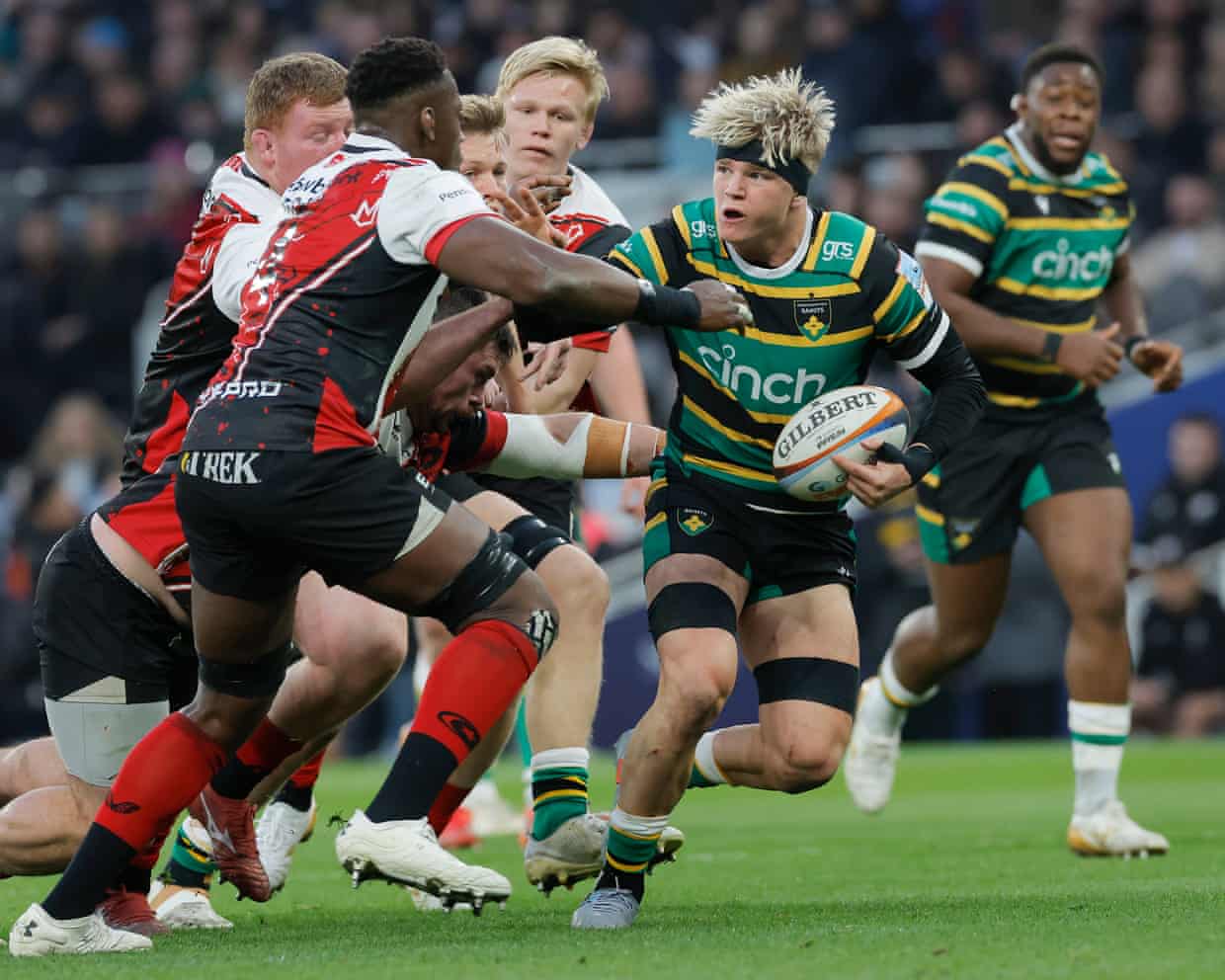
Prem top four looks done and dusted after Northampton repel Saracens comeback
Strange words to write for anyone who has covered this competition for any length of time, but we kind of know who the Prem semi-finalists are going to be. And there’s still six rounds to go.Saracens had to win here at Tottenham Hotspur Stadium against the league leaders to maintain any realistic chance of taking their customary place in the playoffs. This is the last season at the helm for Mark McCall, the man who has guided them through their glory years, before he “moves upstairs”, but it is looking increasingly likely that his era will draw to a close without further silverware. Saracens are mathematically still in it, of course, but, 12 points adrift of fourth spot with those six rounds to play, they will need to call on more than their own prowess to make it

Bristol’s Big Day Out turns sour as Harlequins and Isgró spoil the party
In theory Bristol’s Big Day Out concept in Cardiff had all the right ingredients. Here was a chance to attract a few more floating voters and show them a good time in one of the world’s great stadiums. For the Prem as a whole it also massages the league’s aggregate attendance figures and projects the sense of a tournament growing steadily bigger and better.So much for best-laid plans. The attendance was about 6,000 fewer than the club’s previous game in Cardiff last season and the outcome also did nothing for Bristolian blood pressure as the Bears suffered a serious dent to their playoff chances at the hands of a Harlequins side winless in their previous six matches

Millions of boomer small business owners will soon retire. Will their companies just disappear? | Gene Marks
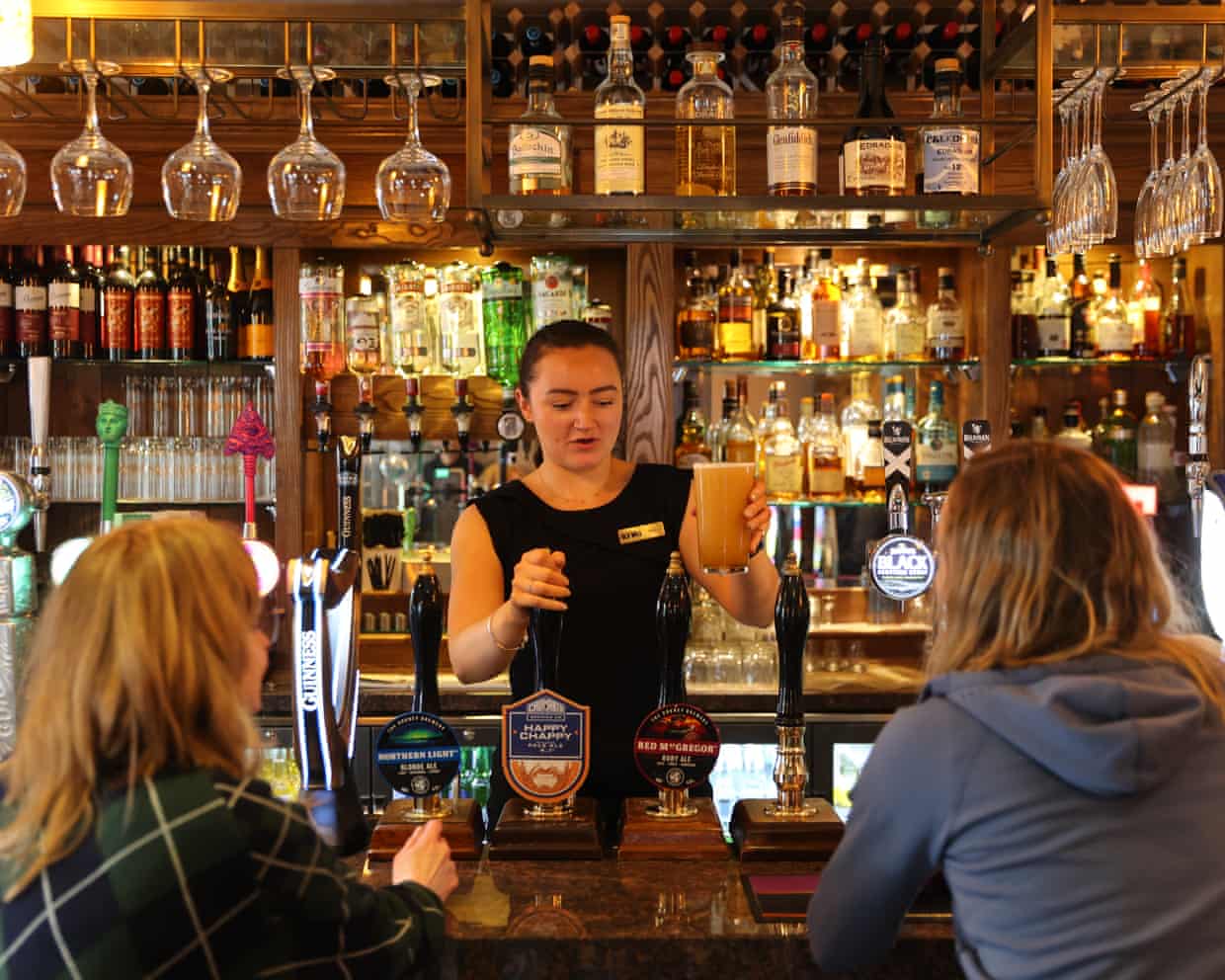
One in five UK hospitality businesses fear collapse as costs surge

How Meta’s victim-blaming failed to sway jurors in landmark social media addiction trial

‘Soon publishers won’t stand a chance’: literary world in struggle to detect AI-written books

Mary Rand obituary

Alfie Barbeary’s late try earns Bath thrilling comeback victory against Sale