Inquiry launched into HMRC anti-fraud scheme that wrongly cut child benefits
The UK’s public spending watchdog has launched an investigation into a controversial government anti-fraud scheme that resulted in thousands of families being wrongly stripped of their child benefit payments,The National Audit Office (NAO) will examine how HM Revenue and Customs designed and implemented a scheme that used flawed Home Office travel records to identify parents suspected of living abroad while still claiming child benefit,The inquiry follows a series of articles in the Detail and the Guardian which exposed how HMRC relied on faulty travel data which recorded outgoing journeys, including airline bookings that were never used, and frequently failed to record return journeys by holidaymakers and business travellers,HMRC took the data in good faith from the Home Office and ended up incorrectly suggesting that families had emigrated and were fraudulently claiming the support from abroad,Among those who hadn’t even flown abroad but were stripped of child benefit was a woman who did not board the plane after her child had an epileptic seizure at the departure gate, and another woman who did not travel to Norway after the wedding she was planning to attend was cancelled.
Some people in Northern Ireland had their benefits stripped after returning via Dublin airport, while others simply had their child benefit frozen because the Home Office had no record of their return to the UK, an issue that neither the Home Office nor HMRC have fully explained.HMRC suspended payments for 23,794 families between July and October last year in an anti-fraud crackdown.Parents received letters referring to past holidays, sometimes as far back as three years ago, for which the Home Office had no record of return journeys.More than 17,000 of those families were found to be legitimate claimants, as of 31 December, while 1,019 (4.3%) were claiming incorrectly.
The number of legitimate claimants is expected to rise, with thousands of cases still unresolved.The NAO investigation will examine the strategy, governance and implementation of the intervention, and how HMRC managed risks in deploying the data-driven system.Andrew Snowden, the Conservative party’s assistant whip, who last year called for a public inquiry and spoke of his own family’s experience with the benefits system, welcomed the NAO investigation.“From the outset, there has been a troubling lack of transparency from the government about how this policy was designed, what data was relied upon, and how thousands of families came to have their payments suspended in error,” the MP said.“Parliament has had to rely on written questions and piecemeal disclosures to understand the scale of the problem.
“It is important for public confidence that we find out who knew what, when, and how they will make sure that this kind of mistake doesn’t happen again.”Internal documents, obtained by the Detail news site, show officials regarded the data-sharing scheme as a success even as thousands of payments were wrongly suspended and most families were later found to be eligible.Despite having issued a number of apologies, HMRC officials maintained that the data-sharing arrangement with the Home Office was working as expected.“Although HMRC has acknowledged some issues in the compliance inquiry processes, the data share aspects of the exercise remain consistent with what was expected and agreed,” stated an internal report sent to the Cabinet Office in mid-November 2025.“The exchange of data between HMRC and the Home Office continues to work as expected and agreed, and we still expect that the inquiry process will find about 64% of cases ineligible [for child benefit],” it said.
By the end of November, the opposite was true, with figures released by HMRC showing at least 63% of cases were found to be legitimate claims of child benefit, rising to 71% by the end of December.HMRC has not released any updated figures since.The internal report justified suspending child benefits before any fraud was proven, a policy HMRC has now abandoned.In a letter to the Treasury select committee, John-Paul Marks, the first permanent secretary and chief executive of HMRC, said he had met the NAO’s comptroller and auditor general to discuss a “revised approach”.The emphasis appears to be focused on supporting taxpayers who are challenged by HMRC with no reference to flaws in Home Office data, the cause of the mistakes.
“[W]e are adopting a careful and controlled approach with strong organisational listening so we can support customers through the journey and understand any issues quickly,” Marks wrote in the letter.“This includes undertaking assurance on our end-to-end customer process before scaling up volumes.“An oversight group will closely monitor the progress of the activity utilising international travel data and will iterate processes where our monitoring and learning suggests that we should make further changes.”He said he would update the committee on progress in the summer, taking into account the findings of the NAO review.

AI has exposed age-old problems with university coursework | Letter
The frustration many academics are expressing about artificial intelligence and critical thinking is understandable (‘I wish I could push ChatGPT off a cliff’: professors scramble to save critical thinking in an age of AI, 10 March). But from my experience working with students on academic writing, blaming AI risks masking a problem that universities have lived with for years.In my work with students, I have long seen the ways in which thinking can be outsourced when assessment allows it: essay mills, shared past papers, model essays passed between cohorts, or heavy reliance on tutors and friends to structure assignments. Artificial intelligence did not invent this behaviour. It has simply industrialised a shortcut that already existed
Trump administration reportedly set to be paid $10bn for brokering TikTok deal
Donald Trump’s administration is reportedly poised to be paid $10bn by investors as part of a deal to create a US-controlled version of TikTok.The $10bn, considered by the US government as a sort of transaction fee, will be paid by the administration-friendly investors who took control of TikTok’s US operations from its Chinese parent company, ByteDance, according to reporting that first appeared in the Wall Street Journal.The investors in the popular social media app include software company Oracle; MGX, an investment firm based in the United Arab Emirates; and private equity business Silver Lake. These entities, along with other backers, paid $2.5bn to the US treasury when the deal closed in January and are set to make further payments in the unusual arrangement until the total hits $10bn

Meta and Google trial: are infinite scroll and autoplay creating addicts?
It was as “easy as ABC”, claimed the lawyer prosecuting a landmark social media harm case against Meta and Google which heard closing arguments this week. The defendants were guilty, said Mark Lanier, of “addicting the brains of children”. Not true, replied the tech companies. Meta insisted providing young people with a “safer, healthier experience has always been core to our work”.Features such as autoplay videos, infinite scrolling and constantly chirruping alerts woven into the fabric of online platforms were central to the six-week trial in Los Angeles, which has been compared to the cases against tobacco companies in the 1990s

New study raises concerns about AI chatbots fueling delusional thinking
A new scientific review raises concerns about how chatbots powered by artificial intelligence may encourage delusional thinking, especially in vulnerable people.A summary of existing evidence on artificial intelligence-induced psychosis was published last week in the Lancet Psychiatry, highlighting how chatbots can encourage delusional thinking – though possibly only in people who are already vulnerable to psychotic symptoms. The authors advocate for clinical testing of AI chatbots in conjunction with trained mental health professionals.For his paper, Dr Hamilton Morrin, a psychiatrist and researcher at King’s College in London, analyzed 20 media reports on so-called “AI psychosis”, which describes current theories as to how chatbots might induce or exacerbate delusions.“Emerging evidence indicates that agential AI might validate or amplify delusional or grandiose content, particularly in users already vulnerable to psychosis, although it is not clear whether these interactions can result in the emergence of de novo psychosis in the absence of pre-existing vulnerability,” he wrote
Fake rooms, props and a script to lure victims: inside an abandoned Cambodia scam centre
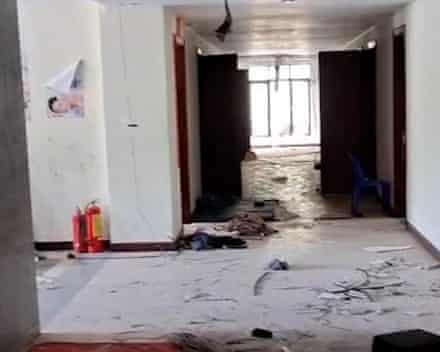
It is as if you have walked into a branch of one of Vietnam’s banks. A row of customer service desks, divided by plastic screens, with landline phones, promotional leaflets and staff business cards. A seated waiting area and a private meeting room. All of it features the OCB bank’s logo, or its trademark green colour.This is not a genuine bank branch, however

Apple cuts China App Store commission fees after government pressure
Apple announced late on Thursday it would lower the commission fees collected in its App Store in mainland China. The move follows pressure from regulators in the tech company’s second-largest market, as well as global scrutiny of its payment requirements.Fees for in-app purchases and paid transactions will be lowered to 25% from 30% starting on Sunday, Apple said in a statement on its blog for developers.“Apple is making changes to the App Store in China following discussions with the Chinese regulator,” the company’s announcement reads. “As of March 15, 2026, changes will be made to the commission rates that apply to the China mainland storefront of the App Store on iOS and iPadOS
US oil prices could see another day of wild fluctuation as Iran war drags on
Chinese-owned Syngenta to build new £100m bioscience hub in UK
Sobering times: alcohol-free beer added to UK inflation basket

European takeover battle hots up with UniCredit’s ‘unfriendly attack’ on Commerzbank

Taxpayer bill for saving Scunthorpe steel furnaces could top £1.5bn by 2028, auditor says
Thames Water lenders float new £10bn rescue plan