‘We almost lost you in the night’ - the life-threatening rise of measles in the UK
Saijal Ladd’s week in hospital remains a blur.The very worst days still feel like a fog, punctuated by two nightmarish memories.First, attempting to speak to a consultant to discuss if she should be rushed to ICU, but being unable to form words through her breathlessness.And later, a family member’s exhausted face mouthing: “We almost lost you in the night.”The 53-year-old had called an ambulance when what she had assumed was flu became so severe she could barely walk, and she experienced diarrhoea and violent vomiting.
It wasn’t flu.In fact, Ladd had caught measles.“My body’s systems had started to shut down,” she says, explaining that her liver and lungs were struggling as they fought the infection.“The clinicians were unsure if I would make it through until morning.” She still sounds disbelieving as she describes crawling to the bathroom before she called an ambulance and looked down to see a rash covering her body.
Ladd, an NHS pharmacist who works for an integrated care board in London, guessed then that she had caught the highly contagious airborne virus.She was shocked – because she felt so desperately sick, but also because she had never considered she might not be vaccinated.Thankfully, her body fought it, but even when she returned home after a week in hospital she could barely walk 50 metres.She needed three months off work.Although this happened 10 years ago, Ladd still carries the trauma.
She can barely bring herself to say the word “death”, but is determined people need to understand measles’ severity.Last month, the UK lost its measles-free status, granted by the World Health Organization (WHO) when there has been an absence of endemic cases in a country for at least 12 months (isolated cases will always occur, but the transmission chain must be broken).In the UK, transmission did stop in 2016 and 2017, but restarted again in 2018.The pandemic brought another lull, but since 2023 transmission has again become continuous, returning with alarming zeal.In 2023 there were 481 cases, spiralling from 63 the previous year.
In 2024 this climbed to 3,681 UK-wide, with 2,911 in England.Last year, outbreaks were smaller, amounting to 957 cases, but remained continuous.The majority of cases were in children aged 10 and under, and half were in London.The pattern is reflected in Europe and coincides with a downward trend in vaccine uptake.The WHO states that herd immunity driven by community-wide vaccination is the only way to prevent measles, with 95% coverage the threshold.
This is high because measles is one of the most infectious diseases, remaining contagious in the air or on surfaces for up to two hours.One sufferer can generate 18 secondary infections.Nine out of 10 unvaccinated people will catch it if exposed.The first measles vaccination was offered in the UK in 1968, and the combined MMR vaccine for measles, mumps and rubella in 1988.Last month it switched to MMRV, including protection for varicella (chickenpox).
It is offered in two doses, first at 12 months and, from last month, topped up at 18 months (formerly, the top-up was scheduled when the child was three years and four months old).Having both doses gives immunity for around 99% of people.The UK’s average coverage in 2024 was 92.3% for the first dose, but 84.4% for the second, falling since the pandemic.
Some pockets have even lower take-up.Hackney, in east London, had just 65.3% for the first dose.Ladd was born in 1972 in rural Kenya, before the WHO’s Expanded Programme on Immunisation began there in 1980.She moved to the UK aged 18 and admits her mother is hazy on whether there was access to a measles vaccine.
Her own children had the MMR vaccine, but she never questioned her own status, even when pregnant (measles in pregnancy can cause premature birth and miscarriage).She urges anyone uncertain to request an MMR catch-up; and indeed, colleagues and friends alerted by her ordeal did.Dr Vanessa Saliba, a consultant epidemiologist at the UK’s Health Security Agency (UKHSA), still sounds shaken by the abrupt return of measles.She describes how “it kicked off towards the end of 2023 with outbreaks in Birmingham and Coventry”.Through 2024 it “seeded virtually all the other regions in the country”.
The largest outbreaks remained in Birmingham and London.Importations of measles found unvaccinated pockets and took off like wildfire.“To some extent, there is an element of chance whether importations take off because it depends who is infected and what their network is like,” Saliba says.In January 2024, it was reported that more than 50 children had been admitted to Birmingham Children’s Hospital.The UKHSA declared a national incident.
Saliba says this proves that equity of vaccine uptake is key.“You need to have consistency in all regions, in all communities,” she says.Davina Barrett’s son Ezra, two, from Walsall, West Midlands, caught measles amid that outbreak.His older brother had received the MMR, but at three months Ezra had been too young.Barrett, 30, a student mental health nurse, recalls Ezra had a cold but “was not getting better”.
Then his rash appeared.Barrett and her husband thought it might be an allergic reaction and took him to A&E.There, they learned of a local measles outbreak.The consultant struggled to insert an IV drip.“He was saying ‘his body’s too shut down’,” recalls Barrett.
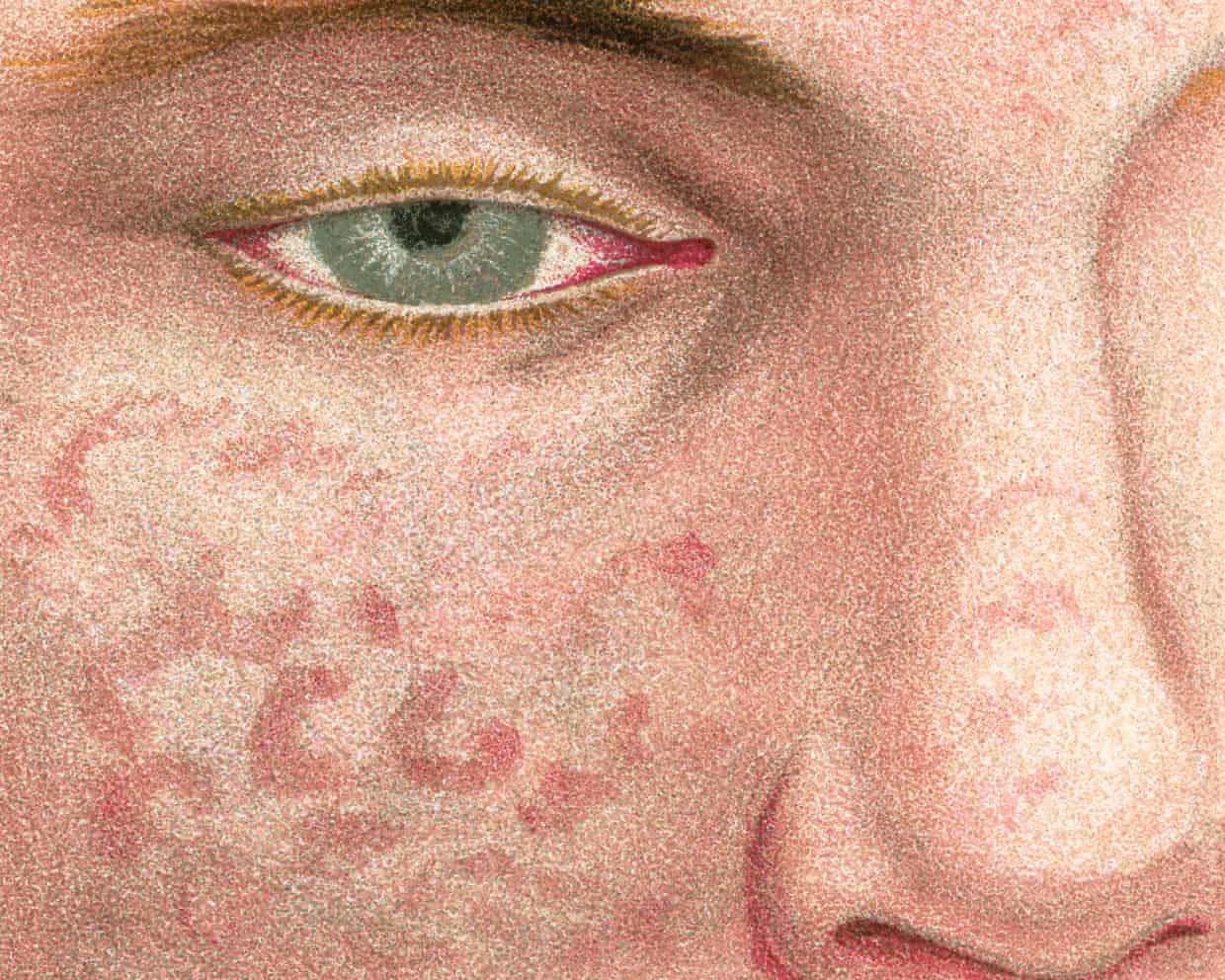
Ezra’s temperature raged.“He wasn’t waking up,” Barrett says.“He ended up being on high-flow oxygen.” Unable to hold him, they placed family photographs by his bed.Measles typically causes cold-like symptoms often accompanied by sore eyes and a high temperature, followed by a rash a few days later that starts on the face.
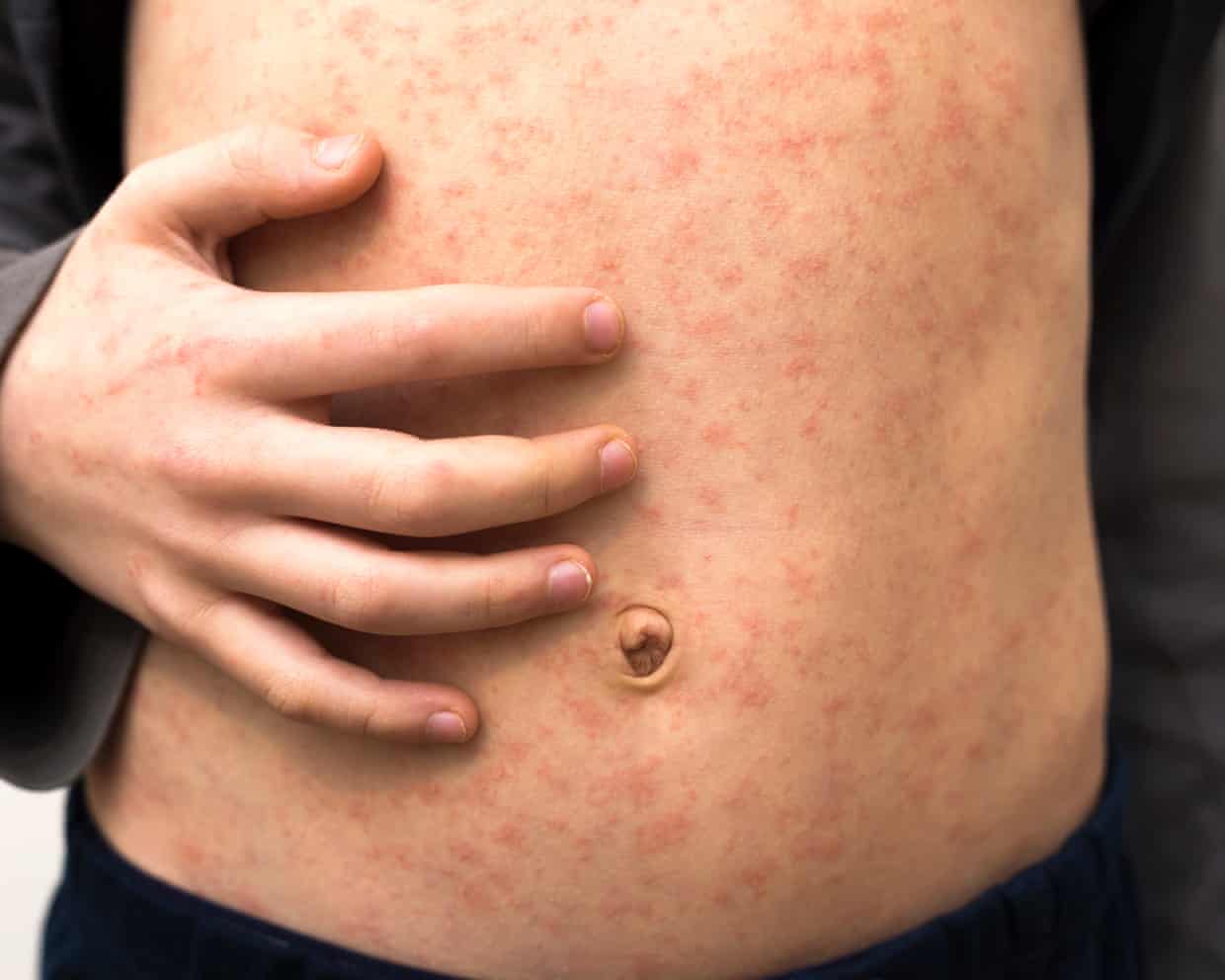
Dr Naveed Asif, a Scottish NHS GP who also practices privately at the London General Practice, describes it on pale skin as “classically a red rash that comes as little spots, usually flat on the skin but it can merge into one”.He adds that “it looks almost as if you burnt yourself”, although those with darker skin may struggle to notice it.White spots inside the mouth may appear earlier.It is “usually mild and self-limiting”, and so although a notifiable disease, can go unreported.Because patients may present with respiratory symptoms before a rash, they might not contact their GP again.
“I always give the caveat that if suddenly a rash appears, we should know about it,” he stresses.For most, paracetamol and keeping hydrated will help, but as Ladd’s and Ezra’s cases demonstrate, measles can be incredibly dangerous.Even in high-income regions measles causes fatality in around one in 5,000 cases.There were two UK deaths in 2025: one an adult, one a child with an underlying immunological problem.In 2024 another child died similarly; and four adults also died, one from the viral condition SSPE (subacute sclerosing panencephalitis), a fatal side-effect that progressively destroys the nervous system, emerging up to eight years after measles in around one per 50,000 cases.
Other complications include severe diarrhoea, pneumonia, ear infection and hearing loss, blindness and encephalitis (inflammation of the brain).Measles is also thought to cause immune amnesia, wiping out the sufferer’s immune system.Ezra was in hospital for around a week and has recovered well, but his speech is delayed.He is now being monitored for hearing loss.Barrett also fears SSPE.
“It’s not like because he’s got better that he’s always going to be better,” she says, her voice wavering.She believes people are avoiding vaccines because they don’t trust them.When she first shared Ezra’s story she received messages challenging her, “saying it’s not true – the MMR would not have helped Ezra.”Saliba agrees that misinformation is a factor.Although she points to surveys that show most parents trust NHS information, other voices can shout louder, amplified by social media.
Parents, Saliba says, “see more of that [misinformation]” and more “will have concerns and questions”.The hashtag #MMR has almost 59,000 posts on TikTok, the subject clearly polarising.(“Please help confused mummy,” posts one.) There is a UK Facebook group called “Concerns about the MMR Vaccine and Autism”, even though claims of a link made in 1998 by Andrew Wakefield were long ago discredited and found to be fraudulent by the British Medical Journal.Doubting voices from US politicians haven’t helped, nor vaccine scepticism generated by the pandemic.
Asif sees more patients who “will flat out admit that they have chosen not to vaccinate”.Saliba believes the bigger driver of the drop in uptake is compromised accessibility to vaccines, especially in high-deprivation areas.She points to 2013-14, when the NHS underwent a major restructure.Health visitors no longer deliver the vaccine – though 12 areas are now trialling their greater involvement.She says GP appointments need to be more flexible.
Dr Ben Kasstan-Dabush, assistant professor of global health and development at the London School of Hygiene and Tropical Medicine, talks passionately about service cuts.“That year-on-year pattern of decline in vaccination coverage overlaps strongly with a period of austerity,” he says.Provision for health visitors and Sure Start centres, often venues for vaccinating, has been slashed.He believes mistrust “can only be challenged and addressed at local levels”.Kasstan-Dabush has witnessed parents insisting on only one vaccine for their one-year-old based on misfounded worry, describing how “heartbreaking” it is to watch them pick and choose between diseases.
He also points to communities harbouring particular concerns, lack of home internet access, or language barriers.Hackney is a clear example, “home to a diverse population” which calls for “tailored engagement with lots of different communities and possibly translated material in a range of languages”.He stresses: “No medicine or pharmaceutical product is free of risk of side-effects … But with a vaccination, the risk is much lower than being infected with measles.” Perhaps vaccines have become “victims of their own success”.We have forgotten what the casualties of disease look like.
This is why Alan Crowther, 60, wants to talk.Born before the vaccine, he caught measles when he was five.“It felt normal,” he says.The year before the vaccine’s introduction, 460,000 cases of measles were reported.But for Alan, sitting close to his guide dog Gabriel at his Derbyshire home, the result was profound hearing loss and blindness caused by nerve damage.
It was six months before his damaged hearing was noticed.Today he has 15% of his hearing left.When he was in his 30s, damaged optical nerves were diagnosed.He has 10% of his sight remaining.To parents reluctant to give their child the vaccine he says simply: “Come and sit with me.
”
Challenges of being a GP in remote areas | Letter
Regarding your report (Lake District village struggles to find GP – despite ad pledging ‘we’ll never run out of beer’, 11 February), Coniston’s situation is not a question of marketing flair but of structural pressure in rural general practice.Findings from a recent survey of our member doctors working in rural and remote areas underline the scale of the challenge. One in four doctors told us that working in a single-handed practice has negatively affected their wellbeing or contributed to burnout.A striking 71% believe rural and remote healthcare is not properly understood by government and policymakers. Doctors have told us that there is a “lack of rural-proofing policy”, with services increasingly centralised and general practice described as “defunded and salami-sliced”
Jess Phillips calls for Epstein files to be catalyst for long-term legislative change
Institutions can be persuaded to take action on violence against women and girls only when some sort of “calamity” or “political scandal” hits the headlines, Jess Phillips has said.Phillips, the minister for safeguarding and violence against women and girls, said she wanted to use the momentum from the Jeffrey Epstein files to push for long-term legislative change and greater support for survivors, rather than quick-fix reactive policy announcements.Writing for the Guardian, the Labour MP for Birmingham Yardley said: “If repentance and sorrow is all we achieve out of the courage of the Epstein victims, we will have failed. Change is all that will suffice.“The long-term strategy of the government must be exactly that – long term
‘We almost lost you in the night’ - the life-threatening rise of measles in the UK
Saijal Ladd’s week in hospital remains a blur. The very worst days still feel like a fog, punctuated by two nightmarish memories. First, attempting to speak to a consultant to discuss if she should be rushed to ICU, but being unable to form words through her breathlessness. And later, a family member’s exhausted face mouthing: “We almost lost you in the night.”The 53-year-old had called an ambulance when what she had assumed was flu became so severe she could barely walk, and she experienced diarrhoea and violent vomiting

‘It matters if you have a parent with an expensive house’: how Australia’s great wealth transfer threatens faith in the fair go
Kim Day has got word that her mother-in-law is dying. At last. It’s good news for one half of Kath and Kim, the noughties comedy series that delighted international audiences with its satirisation-come-celebration of the comforts, proclivities and aspirations of middle Australia. By series three, Kim (Gina Riley) is struggling; she has a new baby and is living in her mother Kath’s (Jane Turner) house in Fountain Lakes – a mottled-brick, wide-lawned every-suburb. But her mother-in-law on the Gold Coast is rich
Social media misleads young on gender transitioning, says UK review leader
The expert who led the review into youth gender identity services has said young people are being misinformed by “unrealistic” portrayals of transitioning on social media.Hilary Cass, the British paediatrician whose review of NHS gender care led to a significant shift including a ban on puberty blockers, warned of “unrealistic images and expectations on social media” when it came to “what transition would really mean and how hard it would be”, including “quite intensive medical treatments” and “sometimes quite brutal surgeries”.Lady Cass told Sunday with Laura Kuenssberg: “There are a tiny number of people who will never be comfortable with their biological sex, with the gender associated with their biological sex. For them, a medical pathway is the only way they’re going to live their life comfortably.“We don’t understand why that is, but we have to try to help those people thrive as much as the young people who are going to grow out of this
More than 60 children infected in north London measles outbreak
More than 60 children have been infected by a measles outbreak in north London, it has been reported.Seven schools and a nursery in Enfield reported the cases, with some children treated in hospital, according to the Sunday Times.There are concerns the outbreak is linked to low levels of MMR vaccination in the capital. For every one infected person, measles can spread to up to 18 unvaccinated people.Dudu Sher-Arami, Enfield’s director of public health who is writing to every parent in the area, said the outbreak posed a serious threat to the wider capital and there was the potential to cause a “much greater and bigger pan-London outbreak” because residents travel across the city
UK considers new Russia sanctions after Navalny frog toxin finding
There’s no end in sight to Starmer’s struggles | Letters
Jonathan Powell rejects overtures to replace McSweeney as Starmer’s chief of staff
UK far right lines up behind Rupert Lowe in challenge to Reform
UK politics: Cooper defends Palestine Action ban despite court ruling it was unlawful – as it happened
Reform and Greens undermining UK commitment to Nato, Cooper says