Alan Milburn launches major UK review into rising inactivity among young people

A major review into rising inactivity among Britain’s young people has been launched by the former health secretary Alan Milburn, with a promise not to shy away from “uncomfortable truths” or “radical” policy solutions,A panel of health, business and policy experts, including the former John Lewis boss Charlie Mayfield, ex-Bank of England chief economist Andy Haldane and social welfare expert Dame Louise Casey, will help draw up recommendations,Milburn has also launched a call for evidence from young people and a wide range of experts to help shape the investigation, saying a “coalition of the concerned” must mobilise to save a generation not earning or learning,He is expected to examine the role of mental health issues and disability, after the number of 16- to 24-year-olds receiving health-related benefits soared, with more than a quarter of young people not in education, employment or training (Neet) now citing long-term sickness or disability,The risk of being Neet is more than double if you come from a disadvantaged background and have low qualifications.
The proportion of Neets is highest in the north-east and north-west of England, followed by the East and West Midlands.“Nearly 1 million young people in Britain are not in education, employment or training – and that number has been rising for four years.This is a national outrage – it’s both a social injustice and an economic catastrophe,” Milburn said.“We need to create a movement – a coalition of the concerned – to help us understand what’s broken and what must change.Every young person, whatever their background, deserves the opportunity to learn or to earn.
“My report will be unafraid to shine a light on uncomfortable truths and recommend where radical change is needed.”Milburn was health secretary from 1999 to 2003 under Tony Blair, and was appointed last year as the lead non-executive director of the Department of Health and Social Care.He will publish an interim report in the spring before the full review in the summer.The findings are expected to complement yet another review, led by the welfare minister, Stephen Timms, which is looking at the personal independence payment, which covers the extra costs of physical and mental disabilities.The Mayfield review into economic inactivity recently reported that a young person on benefits loses out on about £1m in earnings and it costs the state a similar amount to support them.
While a series of reviews, reports and white papers have diagnosed the problems, successive Conservative and Labour governments have struggled to arrest the increase in Neets.In her budget, Rachel Reeves announced £820m to guarantee paid work placements for 18- to 21-year-olds “not earning or learning” for more than 18 months.The government has also announced thousands of apprenticeships.At the launch of the call for evidence at Boxing Futures in Peterborough, Pat McFadden, the work and pensions secretary, said: “Too many young people are being denied the opportunity to reach their full potential, and it is a crisis we cannot ignore.”

My cultural awakening: The Lehman Trilogy helped me to live with my sight loss
I began to notice my sight deteriorating in my 40s, but not just in the way that you expect it to with age. I had night blindness and blind spots in my field of view. At 44, I was diagnosed with retinitis pigmentosa, a genetic eye condition that causes the retina cells to die. I had always been a very visually oriented person: I was a practising architect, and someone who loved to read, draw, go to the cinema and visit art exhibitions. So when black text disappeared on a glaring white page, films became impossible to follow and artworks only took shape once explained to me, I questioned who I would be without my vision

The Guide #221: Endless ticket queues, AI slop and ALL CAPS agony
It’s time for a big old moan. Next week’s newsletter will be a roundup of our favourite culture of the year, a bit of an annual Guide tradition by now, and something that’s great fun to put together.But do you know what’s even more fun? Complaining about things. So, this week’s Guide is devoted to cultural gripes, big and small, of 2025. Here’s what had us seething this year

From Eleanor the Great to Emily in Paris: your complete entertainment guide to the week ahead
Eleanor the GreatOut nowJune Squibb stars in Scarlett Johansson’s directorial debut, which premiered at Cannes and tells the tale of the eponymous Eleanor, a senior citizen recently relocated to New York, who strikes up a friendship with a 19-year old – and then stumbles her way into pretending to be a Holocaust survivor.LurkerOut nowA hit at Sundance, this is the story of a lowly retail employee who happens to strike up a friendship with a rising pop star, becoming the Boswell to his Johnson, if Boswell was part of a pop star’s entourage. But the path of friendship with a famous person never did run smooth, and the uneven power dynamic soon prompts some desperate manoeuvring in this psychological thriller.Ella McCayOut nowEmma Mackey stars in the latest from James L Brooks (his first since 2010), a political comedy about an idealistic thirtysomething working in government and preparing to step into the shoes of her mentor, Governor Bill (Albert Brooks). Jamie Lee Curtis co-stars as Ella’s aunt

Stephen Colbert on Trump’s ‘gold card’: ‘Pay-to-play program for rich foreigners’
Late-night hosts tore into Donald Trump’s new “gold card” immigration program and his many weird tangents about grocery prices.Stephen Colbert opened Thursday’s Late Show with a new Christmas jingle about the president: “He’s making a list, checking it twice, then handing that list to the people at ICE. Donald Trump … ruins everything he touches,” he sang. “And lately he’s been pretty handsy, slapping his face on anything in sight.”On Wednesday, Trump put his face on what Colbert called “his long-promised pay-to-play program for rich foreigners”

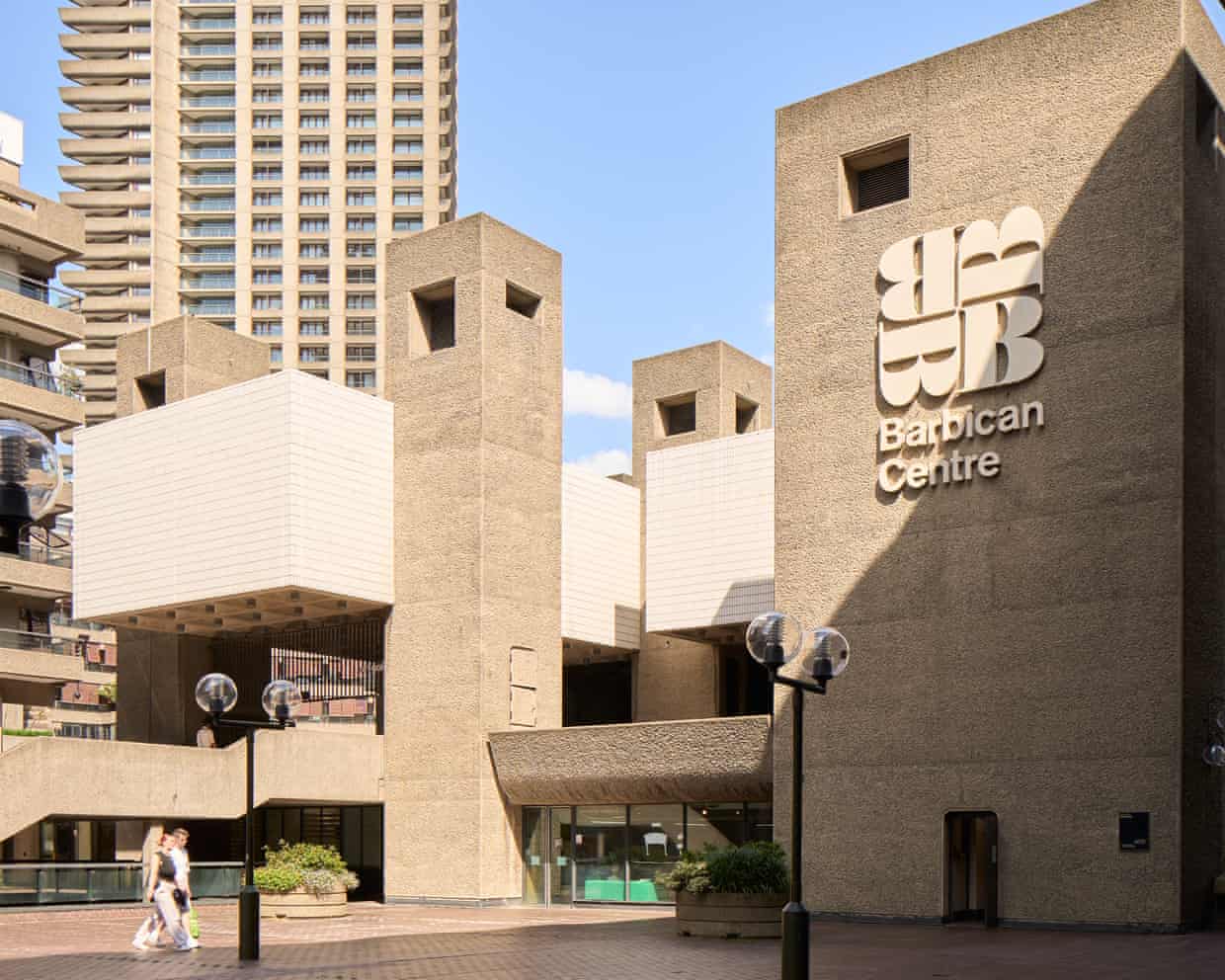
‘Like lipstick on a fabulous gorilla’: the Barbican’s many gaudy glow-ups and the one to top them all
The brutalist arts-and-towers complex, where even great explorers get lost, is showing its age. Let’s hope the 50th anniversary upgrade is better than the ‘pointillist stippling’ tried in the 1990sThe Barbican is aptly named. From the Old French barbacane, it historically means a fortified gateway forming the outer line of defence to a city or castle. London’s Barbican marks the site of a medieval structure that would have defended an important access point. Its architecture was designed to repel
Barbican to close its doors for a year for multimillion-pound renovation
The Barbican will close its doors for 12 months from June 2028 as it undergoes a multimillion-pound renovation that its leaders say will secure its future.The arts organisation’s Beech Street cinemas will remain open but its theatre, music venue, conservatory and visual arts galleries are set to shutter as the overhaul of the 43-year-old building begins in the lead-up to its 50th anniversary in 2032.The main Barbican site will close its doors in June 2028 and reopen in June 2029, but some disruption will happen before that as the foyer, lakeside area and internal control room are all renovated.The conservatory, which is open only for a few hours at the weekend and currently has netting to stop falling glass, will close earlier, in 2027.Philippa Simpson, the director of buildings and renewal at the Barbican, said the work could not be completed while the site was open to the public as it would be too dangerous, but that it was essential to secure the site’s future
Penitent Tice tussles with The Unbearable Lightness of His Being | John Crace

How far must UK go to fend off threat of foreign interference in its elections?

Richard Tice refuses to condemn Reform mayoral candidate’s comments about David Lammy

Starmer’s communications chief to address cabinet on media strategy overhaul

US puts £31bn tech ‘prosperity deal’ with Britain on ice

With Starmer’s enemies short on options, Labour MPs have to make do with gossip