MPs question UK Palantir contracts after investigation reveals security concerns
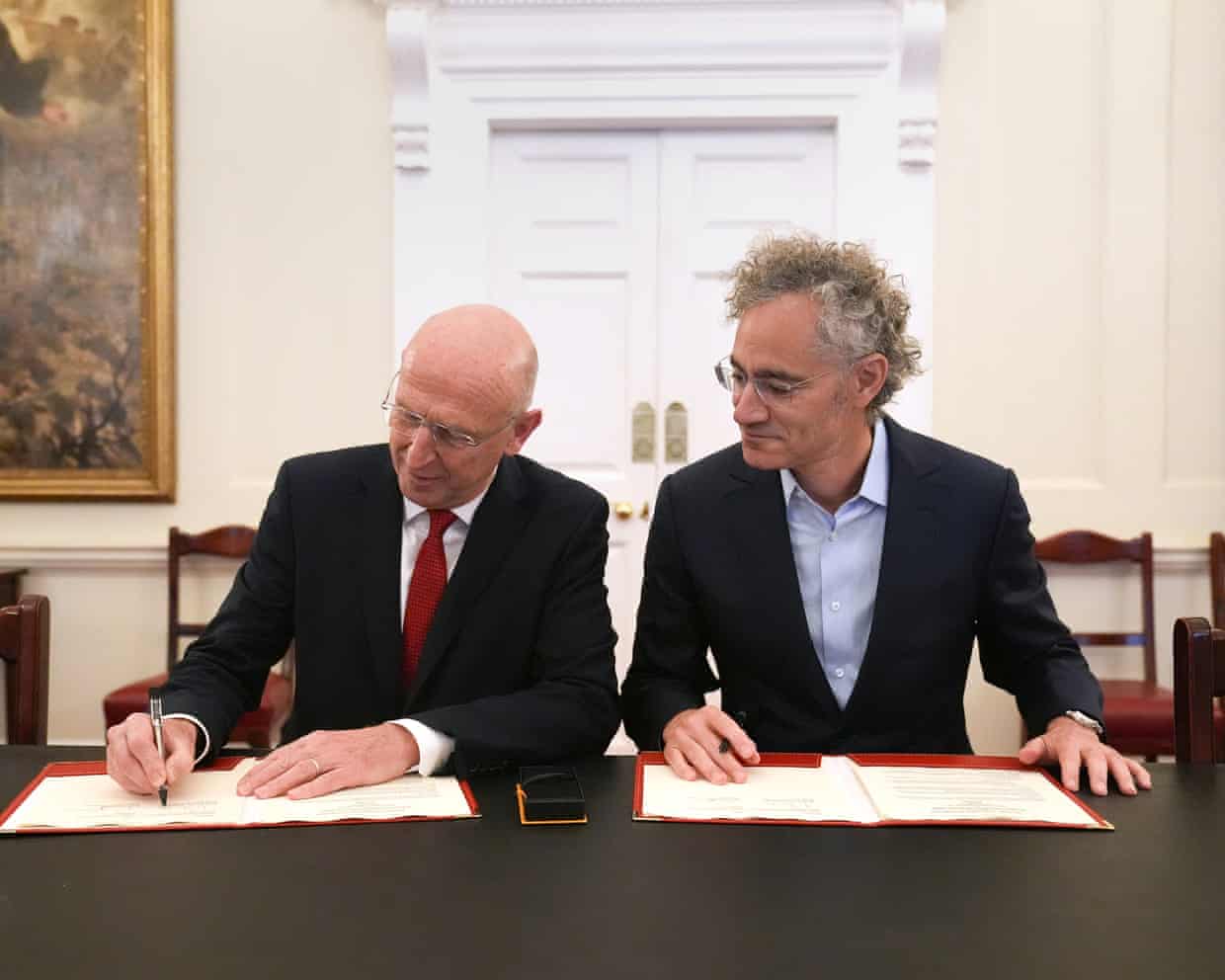
UK MPs have raised concerns about the government’s contracts with Palantir after an investigation published in Switzerland highlighted allegations about the suitability and security of its products.The investigation by the Zurich-based research collective WAV and the Swiss online magazine Republik details Palantir’s efforts, over the course of seven years, to sell its products to Swiss federal agencies.Palantir is a US company that provides software to integrate and analyse data scattered across different systems, such as in the health service.It also provides artificial intelligence-enabled military targeting systems.The investigation cites an expert report, internal to the Swiss army, that assessed Palantir’s status as a US company meant there was a possibility sensitive data shared with it could be accessed by the US government and intelligence services.
British MPs have voiced concerns over the US data company in light of the report.“Palantir … is an organisation that the British government, in terms of the NHS, in terms of contracts, should stay very far away from … I think the Swiss army is right to be suspicious,” said the Labour MP Clive Lewis.The government “needs to undertake transparent due diligence” on the conduct of Palantir and other big tech companies, said Rachael Maskell, the MP for York Central.“I know there were certainly questions in the NHS about Palantir’s capabilities.It’s clearly been handed a lot of money to do the federated data platform.
I, as a politician, want to know that these companies are making ethical choices.And if they’re not – whether around weaponry, minerals or the climate – I think we as parliament should be given greater transparency around this.”The year-long investigation is based on freedom of information requests to Swiss government departments.It details how Palantir went on a seven-year “shopping trip” trying to convince Swiss authorities to use its products and was rejected at least nine times by different agencies.In response to a query from the Guardian, a Palantir spokesperson said: “There is no basis to the claim in the report by the Swiss army about potential access to sensitive data and no truth to it whatsoever.
“We run a business that is predicated on the trust of our customers, which means we also do everything possible – from contractual, procedural, to technical controls – to ensure that our customers are in full control of their data, their operations and their decisions when using Palantir software.”In 2020, in the early days of the pandemic, Palantir pitched its services to Swiss health authorities – while touting its work with the NHS, which had just begun to use its tools to manage Covid-19 data.“We are already doing this in other countries, such as Great Britain, but we feel a special obligation to Switzerland and the federal chancellor,” it wrote.Switzerland’s Federal Office of Public Health (FOPH) ultimately chose not to work with Palantir in managing the pandemic.The exact reasons for this were redacted: it hired a competitor instead.
In meeting minutes obtained by the journalists, the office stated: “Problem: Communications.FOPH demands that Palantir be questioned.”At the same time, Palantir was trying to win contracts with the Swiss army.These meetings began in 2018.In 2020, it submitted a bid for the “IT system of the army’s intelligence service” and was rejected for unspecified reasons.
In 2024, it tried again.By this time, the UK’s Ministry of Defence had signed its first £75m contract with Palantir for data tools.After a meeting between Palantir’s European head and a Swiss army commander, the army commissioned an internal report to evaluate the products Palantir was offering.That report, authored by army experts, concluded that it remained unclear – based on their information about Palantir’s products – whether or not US intelligence would be able to access data shared with Palantir as it was a US company, despite Palantir’s official reassurances otherwise.The finding is “explosive”, wrote the journalists.
“Firstly, because it comes from a high-ranking body of the army and, secondly, because the Swiss Federal Department of Defence (VBS) employs certified cryptologists.”Experts in the Swiss army also found other issues with Palantir’s offerings to the military, both in terms of its cost and the fact that using Palantir’s technologies might require Palantir specialists to be permanently onsite, which could “limit the army’s ability to act in crisis situations”.The Swiss army decided not to contract Palantir.Less than a year after it commissioned the report, the UK military would sign a £750m deal with Palantir to “boost military AI and innovation”.WAV and Republik’s findings have generated debate across Europe, especially in Germany.
The head of Germany’s domestic intelligence service, Sinan Selen, warned European security services to be cautious in any use of US software in public comments last week without naming Palantir specifically.Several German states including Bavaria, Hesse and Baden-Württemberg in recent months have chosen Palantir analysis software for their police forces or, as is the case with North Rhine-Westphalia, paved a legal path toward using it or comparable services.The MP Konstantin von Notz, an intelligence expert with the opposition Greens and former head of Germany’s parliamentary oversight committee for the secret services, has been vocal in his opposition to Palantir.In an emailed statement to the Guardian after the Swiss revelations, Von Notz underlined his view that the German interior minister, Alexander Dobrindt, who has said he is reviewing whether to allow police across the country to use the US software, “must finally say goodbye to Palantir”.Von Notz welcomed the Swiss decision to do without the “highly controversial US company which has close ties to Donald Trump”.
‘It can be quite a thankless job’: why driving examiners are quitting
It has long been a stressful rite of passage for many young people but, in recent years, passing the actual driving test is the easy part. Now, many people seeking a test need to wake up early to snag a date before the bots do and, even then, they are looking at a long and arduous wait.Despite moves from the government to address the issue, an audit report released this week found plans to cut the wait for a driving test to seven weeks by the end of the year would not be achieved until November 2027.One of the main barriers is an exodus of driving examiners. Only a net 83 more driving test examiners have been hired despite 19 recruitment campaigns since 2021, with the average wait for a practical test now at 22 weeks across Great Britain, according to the National Audit Office

Tinsel and Home Alone back in style as TikTok seeks comfort in #90sChristmas
Tinsel, DIY tree decorations, deep burgundy drapes – and Home Alone on VHS. Christmas has gone retro on TikTok, and in people’s living rooms.The app has reported a surge in Christmas decor videos, with an emphasis on nostalgia as users embrace festive looks from bygone eras. For younger TikTokers, that means the 90s.More than 8,000 videos have been posted under the hashtag #90sChristmas, celebrating a look that includes multicoloured tree lights, homemade felt ornaments and – in a post with nearly 4m views – VHS tapes of Christmas classics such as the Macaulay Culkin caper

Elon Musk’s massive 2018 Tesla pay package restored by Delaware court
Elon Musk’s controversial $56bn pay package from Tesla was reinstated by the Delaware supreme court on Friday, two years after a lower court struck down the vast compensation deal as “unfathomable”.The reinstated pay package could be worth as much as $139bn today, according to the New York Times. The decision comes less than two months after Tesla shareholders approved a new plan that could be worth $1tn to Musk, already the world’s richest person, in a decade’s time. Musk’s fortune currently stands at an estimated $600bn.Rescinding the pay deal would be “inequitable”, and would leave Musk “uncompensated for his time and efforts over a period of six years”, the Delaware supreme court justices wrote, echoing arguments from Tesla board members earlier this year

‘A black hole’: families and police say tech giants delay investigations in child abuse and drug cases
Max Osterman was 18 when he connected with a drug dealer on Snapchat who used the handle skyhigh.303. Max would message him whenever he wanted to buy Percocet, and they would meet. After about a year, and just days after their last exchange, Max collapsed. The pills he ordered had been laced with fentanyl
The Com: the growing cybercrime network behind recent Pornhub hack
Ransomware hacks, data theft, crypto scams and sextortion cover a broad range of cybercrimes carried out by an equally varied list of assailants.But there is also an English-speaking criminal ecosystem carrying out these activities that defies conventional categorisation. Nonetheless, it does have a name: the Com.Short for community, the Com is a loose affiliation of cybercriminals, largely native English language speakers typically aged from 16 to 25. Its activities run from crippling the IT systems of British retailers to phoning in bomb threats to schools and encouraging teenage girls to harm themselves

Sony collars Snoopy in £340m deal to take control of Peanuts franchise
Sony has taken control of Charles Schulz’s Peanuts franchise including Snoopy and Charlie Brown in a deal worth C$630m (£340m).The Japanese conglomerate has bought 41% of Peanuts Holdings, which owns the intellectual property Schulz created, from the Canadian children’s entertainment company WildBrain.The deal raises Sony’s total stake, which it began building in 2018, to 80%. The Schulz family owns the remaining 20%.Peanuts, which first appeared as a comic strip in seven newspapers in 1950 and ran daily until the cartoonist’s death in 2000, has gone on to become a global franchise spanning TV, toys, films and theme park attractions

Starmer has no coherent social mobility plan, says top government adviser

Christmas burnout: why stressed parents find it ‘harder to be emotionally honest with children’

Labour admits 60% of parents wrongly targeted in HMRC child benefit fraud crackdown

‘We’ve got more in common than what divides us’: a Muslim-Jewish kitchen in Nottingham counters hate and hunger
NHS to trial potentially life-saving treatment for deadly liver disease

Pressure grows on DWP over ‘misleading’ response to carer’s allowance scandal