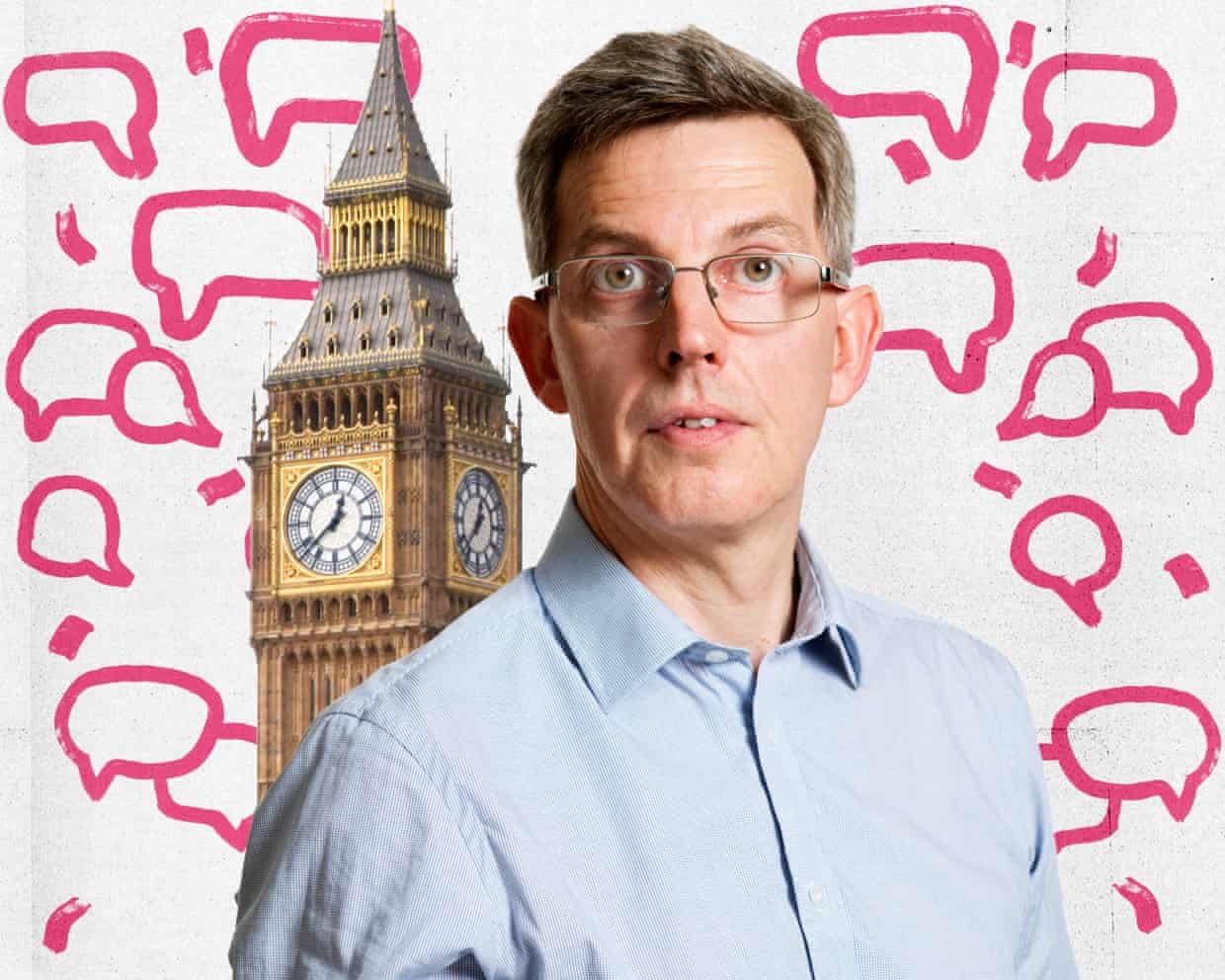
UK politics Q&A live: Andrew Sparrow takes your questions on Starmer, Reform and more
Two questions on the state visit,This is from BeOpenBeKind,double quotation markDo you think the government is correct in sending Charles to the USA? I recently saw David Dimbleby on Newsnight strongly opposing it,And this is from irreverentnurse,double quotation markQ&A What are the advantages of sending Charles to USA? What is hoped to be achieved with trump?The PM, like most of his predecessors, has long taken the view that it is worth using UK soft power, especially the royals, to curry favour with the US president of the day because that is helpful in other areas of the relationship.
Given that Trump loves royals more than most presidents (because he would like to be one?), Keir Stamer’s decision to deploy the king is understandable, however gruesome,There is some evidence the last state visit, and all the toadying, worked a bit with tariffs,It is much harder to make the case for it now,But we don’t have the counter-factual,Had the UK, and other European nations, been more critical from January 2025, it it quite possible that Trump would have by now fully left Nato and abandoned Ukraine.
Should the visit go ahead? I believe, as a nation, we would all feel better and prouder and stronger if we called it off (preferably at very short notice).But being congenitally inclined to try to see all sides to any argument, I can see why that might not be such a wise idea.Here are two questions on PR.This is from Boadas10.double quotation markQ: Why are Labour risking political oblivion through 2nd and 3rd FPTP finishes in constituencies up and down the land at the next GE rather than supporting electoral reform and proportional representation? The latter would at least preserve a continued and fair level of political representation.
Why bet the farm on once again gaming FPTP?And this is from ibatch40,double quotation markQ: Hi Andrew, appreciate you taking time to do this,My question is about FPTP,Now we have multiple parties in a way we never have done in British politics, how sustainable is the FPTP system when we could end up with a PM whereby the vast majority of voters have voted against them? By keeping it are we not in danger of undermining democracy itself? What would be your suggestion as an alternative? *apologies, more than one question,Many thanks.
FPTP (first past the post) was defendable in what was a largely two-party system, but is a dangerous anachronism in the world of five or six-party politics.We are now in a situation where Reform UK is the most popular party in the UK (if you look at FPTP voting intention), but also the least popular.As this YouGov research showed, if you offer people a choice of Reform v one of the other main parties, Reform loses against all of them.Even academic psephologists – who are normally quite neutral, politically – have spoken out against this.So why is Labour so committed to FPTP.
Before becoming an MP, Keir Starmer did once express some interest in PR, I think (I seem to remember from the Baldwin biography that he backed a policy document supporting the idea), but it has never been something he has shown much interest in, and he is not pushing for change.There is also a lot of opposition to FPTP in the PLP, and in the union movement generally.Partly its tribalism.And partly it is motivated by the fear that, under FPTP, Labour would never run a majority government again.Personally, I think I would not have a problem with permanent, coalition politics and I think the case for PR is compelling on democratic and fairness grounds.
As for what Labour should do? They could put a bill for AV (the alternative vote – not strictly a PR system, but one that would normally produce a proprotionate result) in the king’s speech,One reason why they won’t is because the nation rejected this in a referendum in AV,A lot of people would argue that another referendum would be needed,A bold PM could just ignore that, and bulldoze it through the House of Lords with the Parliament Act,(An even bolder PM would bulldoze the House of Lords, but that’s another story.
)This is from Sonet66,double quotation markQ: Q&A Andrew, to what extent do you think Farage will tolerate other would-be ‘leaders’ within Reform, given the number of ‘personalities’ who have been defecting in that direction?Nigel Farage has a long history of falling out with political colleagues who have challenged him in public, or threatened his popularity,I think that will continue, and I would expect at least one of the high-profile Tories who have joined recently to have fallen out with him by the time of the next election,That said, Farage does seem to be taking the prospect of being PM quite seriously, and he must realise that you can’t run a government without a bit more delegation than he allowed when he was leader of Ukip,He talks a lot now about wanting to show that Reform UK is not a one-man band.
(He did it again today – see 11.24am.) That does not mean his temperament will change.But it does seem likely that he is learning to become a bit more accommodating of his colleagues.This is from adogsatonmypizza.
double quotation markQ: Dear Andrew - How much dancing with The Guardian’s legal department do you have to do? Both yourself and regarding comments? Does it impact your output and does it ever frustrate you?Getting copy approved by lawywers takes time, and that does not really work if you are writing a minute-by-minute live blog.And so, if a subject is legally contentious, I tend to avoid it and restrict myself to posting links to articles by colleagues on the topic that have been legalled.And, on comments, we do turn them off if we think there is a risk of people posting material that might get us into trouble with libel or contempt laws.I don’t like having comments turned off but understand why it has to happen.This is from Perspectiverox.
double quotation markQ: Hi Andrew, my question is - are the UK government’s current policies genuinely helping citizens, or are they leaving many behind?Some do, some don’t.Trying to answer that question involves asking what they trying to do, whether they are achieving what they are trying to do, whether they or someone else is to blame if they’re not, and what else they should be doing?These sorts of issues are being thrashed – in my blog and elsewhere – every day.The answers are not simple.But that’s why politics is interesting.It’s time to speed things up.
This is from Brumbaer,double quotation markQ:Accepting that Farage is a good seller of snake oil, and the G does some job of countering those claims, what about the Greens’ policies? And Lib Dems? Badenoch does a pretty good job of destroying credibility on her own,At least the G explains the lack of realism behind some Labour/government claims,Also, in this digital age with AI, how easy is factchecking?I’ll just address the AI bit,And the short answer is – no.
I occasionally use AI for research, rather than Google, but not very often,And it does not help much with factchecking because you have to factcheck AI,Also, increasingly Google is AI – which can be a problem,The other day I used it to try to find out how tall Kemi Badenoch is (because she had said she would tackle a shoplifter herself, but not a big one),The Google AI told me she is 6ft.
She isn’t.She’s 5ft 4in.This is from Mattipus.double quotation markQ: Hi @andrew, thanks for doing the Q&A.I wanted to ask, looking back over your time overseeing the Guardian politics liveblog, are there any stories you wish you could have covered differently, or that you regret the Guardian could not cover?Being slow to realise that Labour might elect Jeremy Corbyn a leader is what comes to mind most.
Admittedly, everyone else in mainstream political journalism was in the same boat,However, that does not really minimise the failure,I still blush remembering a hustings right at the start of the campaign where I focused on the division between Andy Burnham and Yvette Cooper on some arcane bit of policy, not realising that it was Corbyn’s broad-brush idealism that was going to win over the party,Ever since, I have always tried to make sure that a) supposedly dissident views get a proper hearing, and b) no outcome is viewed as too imposssible to actually happen,This is from Pazoozoo.
double quotation markQ: You don’t have to look at BTL for long to conclude that an awful lot of people think they know better than politicians - but my application of Occam’s razor would be that a person paid well to do a job, who thinks about that job full time, knows more about it than me.So who’s right: are MPs generally very bright, hard working people, or are they other reasons they get the top jobs?Related question, is being an MP a hard job? In some ways it seems really hard, but then not many want to step down, even well well beyond retirement age, they must like it if that’s the case.There are various threads in this question worth addressing separately.First, you seem to assume that, if a job is hard, people won’t want to do it.That’s a category error.
It is a hard job (at least, if you are doing it properly).But there are lots of people who want to become MPs, because often jobs that are particularly hard also tend to be particularly rewarding.Are MPs generally bright and hard-working? Not always, but generally yes.It is hard to get elected without a fair amount of talent and a considerable amount of dedication (although some people slip through without much evidence of either).Could they do a better job? A lot of that depends on how you view the job.
That is not easy, because there is no job description,If you view the job as being about effective legislating, or effective governing, then intelligence, experience, judgment etc are crucial,But MPs are also there to represent their electors, and my late colleague Simon Hoggart was fond of telling a story about …[At this point I turned to Google, and realised I could let Simon tell this story himself,]double quotation markAn old mining MP called Bill Stone, who used to sit in the corner of the Strangers’ Bar drinking pints of Federation ale to dull the pain of his pneumoconiosis,He was eavesdropping on a conversation at the bar, where someone said exasperatedly about the Commons: “The trouble with this place is, it’s full of cunts!”Bill put down his pint, wiped the foam from his lip and said: “They’s plenty of cunts in country, and they deserve some representation.
” (To get the full effect, say it aloud in a broad northern accent,) As a description of parliamentary democracy, that strikes me as unbeatable,If you take the Bill Stone view of parliamentary democracy, then intelligence, experience and judgment don’t matter so much,Readers can make their own minds up about who the Bill Stones of this world will be voting for at the next election,If you want a longer discussion about what qualities are needed by MPs, I do recommend Isabel Hardman’s five-part (15 minutes each) Radio 4 series What Do Our Politicians Need to Know Now?, which was on last week.
This is from Jasper9220.double quotation markQ: Hi Andrew, by coincidence I recently read an “Ask Me Anything” you took part in on a Reddit forum some years ago.Of course, in that time a lot has changed but has your passion for political reporting ever wavered, or your faith in the political/media establishments more broadly?I’m lucky enough to do a job I enjoy, and my enthusiasm and passion for political reporting has not changed.But as for my faith in the political/media establishment?I still think most people who go into politics are motivated by good intentions, and for all its faults the way Britain does politics is a lot better than the way it is conducted in many other parts of the world.However, I do believe that around 10 years ago it all started to go a bit mad.
Partly that may have been the financial crash, austerity, declining standards, and a sense that the system no longer delivers for working people, but a lot of it was social media, online hate and shorter attention spans.There seems to be more (even more?) anger and dishonesty in politics than there was.That is not good.And my faith in the classic liberal defence of journalism (see 3.03pm) – give people the truth, and they will take good decisions – has taken a bit of knock, what with Brexit, Trump etc.
Still, there’s always hope.Here is a question about Labour.This is from SOWhat.double quotation markTo what extent do you think Labour and Starmer’s poor poll ratings are directly attributable to the actual or perceived drift to the right of Labour since the last election?I think the main problem is that Labour came in promising change, people wanted change, and yet it feels like change has not happened.Partly that it because Labour came into office having ruled out using any of the main levers available to raise revenue from tax.
Rachel Reeves has raised tax, by a lot, but she would have a lot more scope to act if she had not ruled out raising income tax, national insurance or VAT,In that sense Labour is held back by a drift to the right before the general election,Labour is still being hurt in some seats by its stance on Gaza, another area where the move to the right happened before the election,I was struck reading comments BTL this week to see some people still talking about Keir Starmer’s LBC interview when he (inadvertently, he later said) seemed to defend Israel cutting off Gaza’s water supply,But the drift to the right before the general election (from 2020 to 2024) also coincided with a huge rise in Labour support.
Since the election, Labour has sounded more rightwing on immigration and public protest than it did before 2024,And I think this definitely has cost the party support, especially since Zack Polanski turned the Greens into a more compelling, leftwing proposition,But I don’t think that is the whole story of why Keir Starmer is now so unpopular,Here are two related questions,This is from dianab