Bank of England expected to leave interest rates on hold; UK construction activity shrinks again – business live
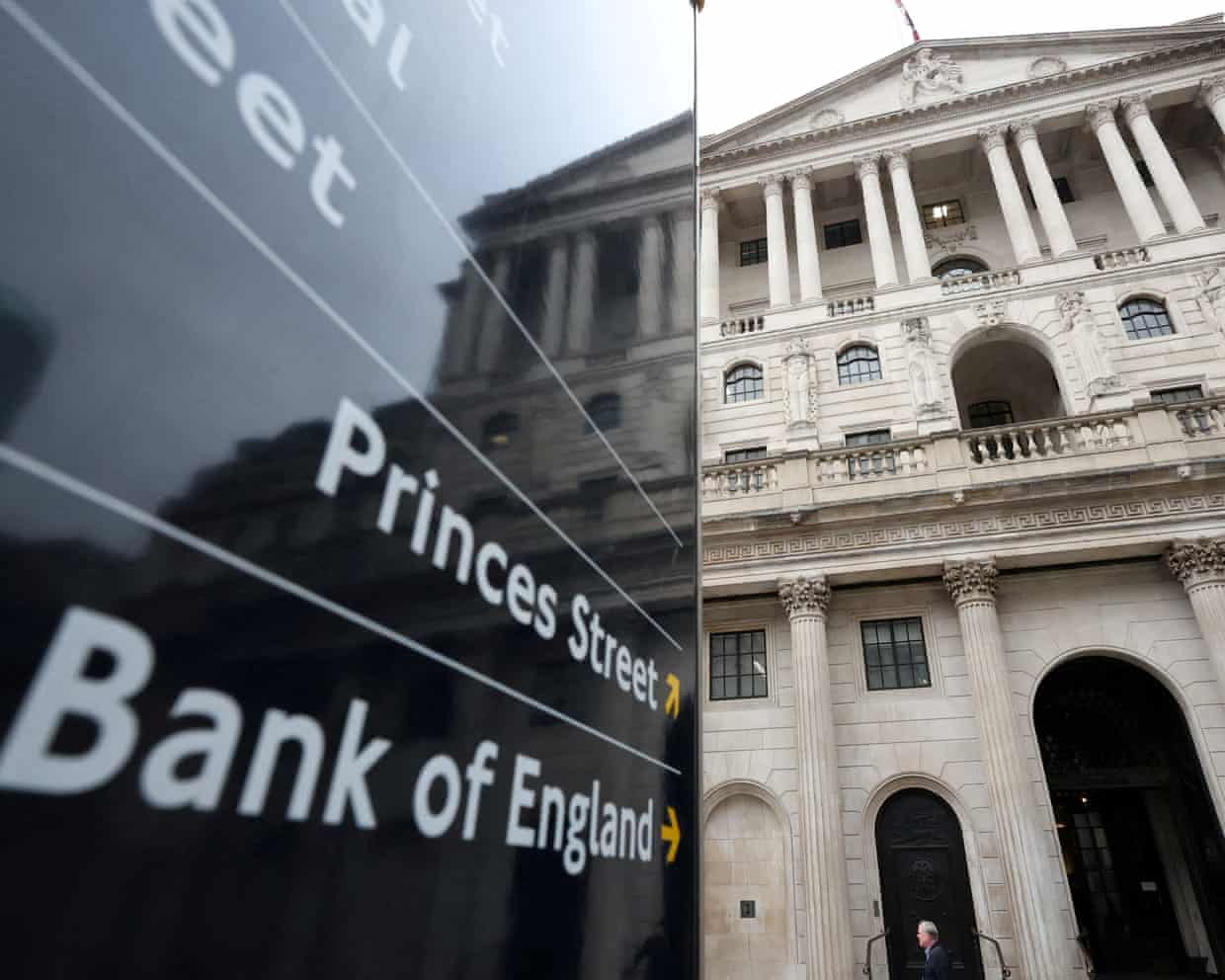
Good morning, and welcome to our rolling coverage of business, the financial markets and the world economy.Interest rates on both sides of the channel are likely to be left on hold today, but relief may be coming for UK borrowers within months.Both the Bank of England (BoE) and the European Central Bank (ECB) are expected to maintain their respective interest rates unchanged today.UK interest rates are currently 3.75%, and the rise in inflation in December to 3.
4% makes it implausible that many BoE policymakers will vote to cut interest rates.The City money markets indicate there is just a 5% chance that the BoE lowers interest rates to 3.5%, and a 95% likelihood that we get ‘no change’ at noon today.Economists also predict seven policymakers will vote for a hold, with just two dovish members (Swati Dhingra and Alan Taylor) expected to vote for a cut.But looking further ahead, almost two quarter-point cuts are expected by the end of this year.
Julien Lafargue, chief market strategist at Barclays Private Bank and Wealth Management, says:The Bank of England is widely expected to keep interest rates unchanged in February.On the back of the Budget, we could see a more benign outlook on the inflation front, at least in the short-term.When it comes to forward guidance, the BoE is likely to remain noncommittal about the timing of any future interest rate cuts.That said, the combination of lower inflation ahead and continued softening of the UK labour market should reinforce the central bank’s view that the path for monetary policy is towards a lower Bank rate, potentially as early as next month.Interest rates are already lower in the eurozone, at 2%, meaning there’s less pressure on the ECB to ease policy any further.
Eurozone inflation fell to 1.7% in January, data yesterday showed, thanks to lower energy costs and a stronger euro.Richard Flax, chief investment officer at wealth manager Moneyfarm, says:For investors, this environment of stable inflation and steady interest rates provides a degree of clarity and reduces the risk of further policy tightening.We expect the ECB to remain on hold, as markets have already priced in, with a high bar for any policy action in the near term.That said, we continue to monitor underlying price pressures and external risks, such as geopolitical developments and shifts in global demand, that could influence the outlook.
”8,30am GMT: eurozone construction PMI report for January9am GMT: UK car sales for January9,30am GMT: UK construction PMI report for JanuaryNoon: Bank of England interest rates decision12,30pm GMT: BoE press conference1,15pm GMT: European Central Bank interest rate decision.
1.45pm GMT: ECB press conferenceNewsflash: The Bank of England has left UK interest rate on hold today, at 3.75%.That matches economist forecasts, as inflation rose further over its target in December.More to follow….
Matthias Scheiber, senior portfolio manager and head of the multi asset team at Allspring Global Investments, says:“The BoE is likely to leave rates at 3,75% this Thursday,Faster than expected cooling in inflation is offset by stubbornly high wage growth while economic growth seems to have picked up again,“Inflation is expected to fall back to 2% in spring because of the cost-of-living measures announced by the government,We still expect the BoE to cut interest rates at least one more time, possibly more this year.
“This should ease the burden on mortgage payments, and the housing market has lately shown signs of recovery.”Tension is ratcheting up as we await the Bank of England’s decision on interest rates, at noon today.The City are expecting the BoE to leave interest rates on hold, at 3.75% – with just a 4% chance of a cut.The Bank last cut its rates in December, from 4% to 3.
75% – but a cut today does seem unlikely as inflation has risen further from its target,Dan Coatsworth, head of markets at AJ Bell, sets the scene:“Markets are currently pricing in a 96% chance of no change to interest rates when the BoE policymakers sit down today, with the next cut not expected until April,“Barring a huge turn up for the books, attention will be centred on the balance of votes and whether this shifts the calculus on the timing and trajectory of rate cuts through the remainder of 2026,Keir Starmer’s travails are causing losses in sterling and gilts today, reports Chris Beauchamp, chief market analyst at IG,With UK borrowing cost still higher today (see earlier post), and the pound still down against the US dollar (see here), Beauchamp says:The relative calm in UK borrowing costs following the budget has come to an abrupt end as the PM’s leadership comes under threat.
Investors are clearly wary of the consequences of what will follow from Keir’s possible defenestration, given the wide field of leadership candidates from the various sections of the Labour Party.A rerun of the disastrous Truss premiership is unlikely, but a more left-wing leader devoted to higher spending might upset the delicate balance in UK government borrowing markets, leading to higher borrowing costs.The ‘wisdom of the crowds’ suggests no change in interest rates today, professor Costas Milas of the University of Liverpool tells us:The BoE should keep interest rates unchanged based on the wisdom of the crowds.Indeed, as I discuss in my latest piece for LSE Business Review, public expectations of inflation have recently been more accurate than the BoE’s own inflation forecasts.The public currently predicts inflation in excess of 3% for 2026Q1 which suggests no change in Bank Rate either today or next month (on the 19th of March).
The US-led critical minerals summit on Wednesday involving 50 countries has unleashed a slew of agreements aimed at loosening the grip of China on more than 25 key elements, both in their raw form, and processed.The EU and the US have announced joint intentions to work closer together, committing to a memorandum of understanding in the next 30 days.The two will also work with Japan on building additional supplies, following a separate US Japan arrangement signed in October.The US state department said it had signed 11 bilateral deals on critical minerals at the summit, convened by state secretary Marco Rubio.Patrick Schroeder, senior research fellow at Chatham House’s Environment and Society Centre said the opening speeches by Rubio and vice president JD Vance made it clear the driving interest was that the US wanted to secure supplies for AI development.
Schroeder said:Although they didn’t say it explicitly, it is still America first.It was framed as ‘America needs your help.’ There was no mention of renewables.Separately Germany is closing in on a deal with Australia after separate talks in Canberra between foreign minister Johann Wadephul and Penny Wong.And South Korea, which was also at the summit involving around 50 countries, announced it would also cooperate with other countries including the US, Vietnam and Laos while allocating about $172.
35m (£127m) of state funds to support local companies developing overseas mines.Picking up on Canada prime minister Mark Carney’s much-quoted speech at Davos about the need for “middle powers” such as Canada and Europe to work together, Wong said: “As middle powers, we want to contribute to a world where no country dominates and no country is dominated,” she said.“We must diversify our supply chains, and we must cooperate as closely as possible,” said Wadephul on Thursday.“We want to eliminate that problem of people flooding into our markets with cheap critical minerals to undercut our domestic manufacturers,” Vance told a gathering of visiting ministers in Washington without mentioning China.Back in the financial markets, the pound has dropped by almost a cent against the US dollar now.
Sterling has slipped to $1.3555, still its lowest in almost two weeks, as City traders anticipate the Bank of England’s interest rate decision… and watch pressure build on Keir Starmer.Michael Saunders, a former Bank of England interest rate setter and current senior economic advisor with Oxford Economics, suggested yesterday that a change in leadership would have implications for the markets.It could lead to a further shift to ‘tax and spend’ (under Angela Raynor), increased borrowing for the nationalisation of utilities (Andy Burnham), persistent low inward migration (Shabana Mahmood) or a more pro-EU stance (Wes Streeting).Saunders says:“We doubt any of these alternatives would significantly lift potential economic growth in the next few years.
“Indeed, tax and spend or persistent low net migration would probably damage potential growth.But a major shift to closer EU trade links could boost potential growth in the medium term.”Britain’s construction sector continued to contract last month, but the worst of the downturn may be over.Data firm S&P Global has reported that the decline in UK construction activity slowed in January, to the smallest drop in seven months.But, housebuilding, civil engineering and commercial building activity all continued to drop.
House building was the weakest-performing segment in January, S&P Global’s poll of purchasing managers has found, though the pace of contraction eased to its slowest for three months,Survey respondents cited a lack of new residential development projects and subdued demand conditions, a sign that the government is struggling to hit its home building targets,Overall, the construction PMI index rose to 46,4 in January, up from December’s five-and-a-half year low of 40,1, but still below the 50-point mark showing stagnation.
Tim Moore, economics director at S&P Global Market Intelligence, said:“January data provided encouraging signs that the UK construction sector has exited its tailspin, and firms are becoming more hopeful that new projects will get back on track in 2026.The latest reduction in total industry activity was the slowest since last June.Commercial work outperformed, with activity moving close to stabilisation amid a postBudget boost to contract awards.House building weakness persisted, although even here the rate of decline eased considerably since December and was the least marked for three months.Construction companies noted subdued underlying demand due to fragile client confidence and elevated risk aversion, but there were some reports of improving investment sentiment and greater sales enquiries at the start of the year.
As a result, business activity expectations rebounded to an eight-month high, while the pace of job losses moderated,Britain’s car market has recorded its strongest start to a year since 2020, despite a slowdown in demand for electric cars,The Society of Motor Manufacturers and Traders (SMMT) has reported that the UK new car market grew by 3,4% in January to reach 144,127 units,But uptake of battery electric vehicles rose just 0.
1% to 29,654 units.As a result, BEV’s share of the market dipped to 20.6%, the lowest since April 2025.New car market starts year with growth but EV share fallshttps://t.co/TROcpisMR5 pic.
twitter,com/4KdVEG9yQKMike Hawes, SMMT chief executive, says:Britain’s new car market is building back momentum after a challenging start to the decade,It is also decarbonising more rapidly than ever and, despite a January dip in EV market share, the signs point to growth by the end of the year,The pace of the transition, however, may be slowing and is certainly behind mandated targets,With sales of new pure petrol and diesel cars planned to end in less than four years, there needs to be a comprehensive review of the transition now, to ensure ambition can match reality.
The SMMT has also lifted its forecast for growth in the UK car market this year to 1.4%, with the EV share expected to rise to 28.5%.There are three things to watch out for from the Bank of England’s interest rate decision and its latest monetary policy report (MPR), reports Simon French, chief economist at City firm Panmure Liberum:What the qualitative comments from MPC [monetary policy committee] members tell us about whether the disinflation bias remains intact? It probably holds - but a good MPR will always throw up some interesting analysis;What is the latest estimate for Q2 inflation? A sharp drop from 3.0% YoY to 2.
4% YoY will be largely be the result of base effects, and one off policy measures.Any sign of a growing output gap weighing on core inflation forecasts?Politics could have a big say around the 30 April MPC - coming a week out from the local elections.Does the MPC seek to manage (down) market expectations for a rate cut in Q2, or would it have one eye on the June meeting instead when politics will be clearer (and two more months of CPI data will be available).The gap between the UK’s short-term and long-term borrowing costs has hit its widest level in around eight years, as the pressure on Keir Starmer has mounted, Bloomberg has spotted.Bloomberg’s Alice Gledhill explains:The yield gap between two- and 10-year gilts hit the widest since 2018 as a fresh round of UK political turbulence weighed on government bonds.
The 10-year yield rose as much as four basis points to 4.59% at Thursday’s open, pushing the gap over the two-year to 85 basis points.UK borrowing costs are rising, slightly, this morning, as investors ponder whether Sir Keir Starmer’s premiership could be ended by the Peter Mandelson scandal.UK bond prices are dipping, which pushes up the yield (or interest rate) on the bonds.UK 10-year bond yields are up three basis points (0.
03 percentage points) at 4.56%, while 30-year bond yield are up four basis points at 5.363% – the highest level since last November.These are relatively small moves in bond market terms, though it’s also notable that US government bond yields have dropped slightly and German yields are flat.Eurasia Group says Starmer is “fighting for his political life”, and now put the probability of a leadership challenge and his removal this year at 80% (up from 65% previously)

Pinterest sacks two engineers for creating software to identify fired workers
Pinterest has fired two engineers who created a software tool to identify which workers had lost their jobs in a recent round of cuts and then shared the information, according to reports.The digital pinboard business announced significant job cuts earlier this month, with the chief executive, Bill Ready, telling staff he was “doubling down on an AI-forward approach”, according to a LinkedIn post by a former employee.Pinterest, which is based in San Francisco and has an office in London, said the cuts would affect about 15% of its workforce, or about 700 people, but did not specify which teams or staff members would be affected.Two engineers at the company then wrote code to identify sacked staff.A spokesperson for Pinterest said: “Two engineers wrote custom scripts improperly accessing confidential company information to identify the locations and names of all dismissed employees and then shared it more broadly

Fairphone 6 review: cheaper, repairable and longer-lasting Android
The Dutch ethical smartphone brand Fairphone is back with its six-generation Android, aiming to make its repairable phone more modern, modular, affordable and desirable, with screw-in accessories and a user-replaceable battery.The Guardian’s journalism is independent. We will earn a commission if you buy something through an affiliate link. Learn more.The Fairphone 6 costs £499 (€599), making it cheaper than previous models and pitting it squarely against budget champs such as the Google Pixel 9a and the Nothing Phone 3a Pro, while being repairable at home with long-term software support and a five-year warranty

French headquarters of Elon Musk’s X raided by Paris cybercrime unit
Prosecutors have raided the French headquarters of Elon Musk’s social media platform X and summoned the tech billionaire and the company’s former chief executive for questioning as part of an investigation into alleged cybercrime.“A search is under way by the cybercrime unit of the Paris prosecutor’s office, the national police cyber unit and Europol,” the Paris prosecutors’ office said in a post on X on Tuesday, adding that it would no longer be publishing on the network.It said in a statement that Musk and Linda Yaccarino had been summoned for “voluntary questioning” in April in their capacity as “de facto and de jure managers of the X platform at the time of the events”. Yaccarino resigned as chief executive of X in July last year.The French prosecutors’ announcement comes amid a hardening of European attitudes to social media firms

From ‘nerdy’ Gemini to ‘edgy’ Grok: how developers are shaping AI behaviours
Do you want an AI assistant that gushes about how it “loves humanity” or one that spews sarcasm? How about a political propagandist ready to lie? If so, ChatGPT, Grok and Qwen are at your disposal.Companies that create AI assistants, from the US to China, are increasingly wrestling with how to mould their characters, and it is no abstract debate. This month Elon Musk’s “maximally truth-seeking” Grok AI caused international outrage when it pumped out millions of sexualised images. In October OpenAI retrained ChatGPT to de-escalate conversations with people in mental health distress after it appeared to encourage a 16-year-old to take his own life.Last week, the $350bn San Francisco startup Anthropic released an 84-page “constitution” for its Claude AI

UK privacy watchdog opens inquiry into X over Grok AI sexual deepfakes
Elon Musk’s X and xAI companies are under formal investigation by the UK’s data protection watchdog after the Grok AI tool produced indecent deepfakes without people’s consent.The Information Commissioner’s Office is investigating whether the social media platform and its parent broke GDPR, the data protection law.It said the creation and circulation of the images on social media raised serious concerns under the UK’s data regime, such as whether “appropriate safeguards were built into Grok’s design and deployment”.The move came after French prosecutors raided the Paris headquarters of X as part of an investigation into alleged offences including the spreading of child abuse images and sexually explicit deepfakes.X became the subject of heavy public criticism in December and January when the platform’s account for the Grok AI tool was used to mass-produce partially nudified images of girls and women

Anthropic’s launch of AI legal tool hits shares in European data companies
European publishing and legal software companies have suffered sharp declines in their share prices after the US artificial intelligence startup Anthropic revealed a tool for use by companies’ legal departments.Anthropic, the company behind the chatbot Claude, said its tool could automate legal work such as contract reviewing, non-disclosure agreement triage, compliance workflows, legal briefings and templated responses.Shares in the UK publishing group Pearson fell by nearly 8% on the news, and shares in the information and analytics company Relx plunged 14%. The software company Sage lost 10% in London and the Dutch software company Wolters Kluwer lost 13% in Amsterdam.Shares in the London Stock Exchange Group fell by 13% and the credit reporting company Experian dropped by 7% in London, amid fears over the impact of AI on data companies
Bank of England expected to leave interest rates on hold; UK construction activity shrinks again – business live

Shell to hand investors bigger payouts despite continued fall in profits

What does the disappearance of a $100bn deal mean for the AI economy?

Google Pixel Buds 2a review: great Bluetooth earbuds at a good price

From London to LX: the British mastermind behind the Seahawks’ standout Super Bowl defense
The Patriots’ Robert Kraft posed as an NFL voice of reason – then fell back in line for Trump | Howard Bryant