Oil price tops $100 a barrel again after Trump announces strait of Hormuz blockade – business live
UK mortgage rates have dipped slightly today.The average 2-year fixed residential mortgage rate today is 5.89%, down from 5.90% on Friday, data provider Moneyfacts reports.The average 5-year fixed residential mortgage rate today is 5.
77%, down from 5.78% at the end of last week.That follows a drop in borrowing costs at the end of last week, on hopes that last weekend’s peace talks might have delivered progress.With government borrowing costs a little higher this morning, it’s possible that tomorrow’s Moneyfacts data will show mortgage rates have gone up again!Germany is rolling out support for consumers and businesses facing higher motor fuel costs.Chancellor Friedrich Merz has announced that petrol and diesel taxes will be cut for two months to provide relief to households and businesses hit by the energy shock during the Middle East war.
Merz told a press conference:double quotation mark“We will reduce,,,the fuel tax on diesel and gasoline by approximately 17 (euro) cents per litre for two months,”Rachel Reeves said she would set out a support package this week to help businesses struggling with soaring energy costs as a result of the Iran war.
Like other countries, the UK is exposed to the economic fallout from the Iran war, which has driven oil and gas prices sharply higher on world markets, thereby increasing energy bills and fuel prices for households and businesses.Crude oil prices spiked to nearly $120 a barrel during the war, but fell below $100 a barrel last week after the US and Iran agreed a temporary ceasefire.However, they are expected to rise again on Monday after the two countries failed to reach a deal to end the war over the weekend.Writing in the Sunday Times, the UK chancellor said:double quotation mark“The war in Iran will come at a cost to British families and business… We don’t yet know the full scale of those costs, but the immediate priority must be to ensure that the ceasefire holds.”She added:double quotation mark“That is the best protection we have against higher costs at home and at the IMF meetings in Washington this week I will be working with allies on the action we can take to guarantee freedom of navigation, including the Strait of Hormuz, to keep energy supplies moving again.
”.She and other finance ministers along with central bankers are heading to Washington for the International Monetary Fund and World Bank’s spring meetings starting on Monday.Higher energy prices will increase the pressure on central banks to tighten monetary policy, to prevent a surge in inflation.This morning, City investors are pricing a roughly 84% chance that the Bank of England raises interest rates twice this year, Reuters reports, up from a 60% chance on Friday.Shares in European airlines are dropping in early trading, amid disappointment that the talks between Washington and Tehran broke up without a breakthrough last weekend.
British Airways’ parent company, IAG, are down over 2% this morning, with budget rivals Wizz Air (-6.5%) and easyJet (-3.8%) falling more sharply.In Germany, Lufthansa has dropped by 4%.London’s stock market has opened with a bump, as traders react to the lack of progress in the US-Iran peace talks.
The FTSE 100 index of blue-chip shares has lost 0.6% at the start of trading, falling by 67 points to 10,533 points.AB Foods (the grocery, sugar, agriculture, ingredients and retail group) are the top faller, down 2.7%, with airlines, miners, banks and housebuilders all lower.Energy companies are rallying, though; BP and Shell are both up more than 1%.
The surge in energy costs from the Iran war will cost a typical UK household almost £500, new research from the Resolution Foundation shows.The Resolution Foundation have esimated that rising energy prices are likely to tip living standards growth into negative territory this year.That’s because the increased cost of energy bills and petrol at the pump will almost certainly be passed onto households.The typical household is now set to see its income fall by 0.6% – a difference of £480 – over the course of the current financial year, they say, Before the conflict, they were on track for 0.
9% growth.Average income growth for the poorest fifth this year is now set to be just 1.2%, down from 2.8% before the conflict.James Smith, chief economist at the Resolution Foundation, says:double quotation mark“Despite hopes for a sustained peace, the path of this conflict remains uncertain and energy prices remain well above pre-war levels, meaning many households face a decline in their purchasing power this year.
“This squeeze will run right through the income distribution.Lower-income households will still see some income growth thanks to a long-awaited rise in real benefit levels, but inflation will likely knock more than a percentage point off what they stood to gain.For those in the middle and towards the top of the income distribution, even the thin growth they had been expecting has tipped into negative territory.“Deescalation is certainly welcome, but damage to household finances this year is to a large degree already done.The Government should act now to prepare a social tariff that reaches households falling through the cracks this winter.
”Heathrow Airport has warned that the outlook for the next few months is uncertain, due to the ongoing conflict in the Middle East.In its latest traffic commentary, Heathrow says it is supporting airlines and passengers as they adapt to airspace closures, adding:double quotation markThe knock-on impacts to global supply chains, including fuel, have not affected airport operations.Heathrow will monitor the situation and liaise with Government and airlines to protect passengers’ journeys.The US dollar is rallying as a sharp risk-off move ripples across markets.The dollar index, which tracks the greenback against a basket of other currencies, has gained 0.
35% this morning.The pound is down half a cent, to just above $1.34.The price of wholesale gas has also risen this morning.The month-ahead US gas contract is up 9% to 119.
50 a therm, its highest level since last Tuesday (before Donald Trump announced the two-week ceasefire with Iran).Before the conflict began at the end of February, gas was trading below 80p a therm, before hitting 180p/therm in mid-March.Every barrel of risk added to oil markets carries an inflation price tag for the global economy, warns Priyanka Sachdeva, analyst at brokerage Phillip Nova:double quotation markOil markets have decisively re-entered geopolitical mode, with prices vaulting back above the psychological $100 per barrel threshold as the United States moved to impose a naval blockade targeting Iranian shipping through the strait of Hormuz.Both benchmarks, WTI and Brent, opened gap-up and currently hover with almost 8% gains.The market reaction underscores a simple but powerful reality: Hormuz risk is not theoretical; it is structural, and it is real.
The latest catalyst came after talks mediated by Pakistan failed to produce a durable agreement, prompting the U,S,to announce enforcement of maritime restrictions on vessels moving to and from Iranian ports,The mere threat of enforcement alone has been sufficient to re-price risk, demonstrating how vulnerable oil remains to geopolitical triggers,The breakdown of US-Iran peace talks last weekend has only led to modest losses in Asia-Pacific markets.
Japan’s Nikkei index is down 0.75%, while Hong Kong’s Hang Seng index and the South Korean KOSPI have both dropped by 1.15%.Michael Brown, senior research strategist at brokerage Pepperstone, says:double quotation markWhile crude has advanced, and stocks slipped a touch, the overall market reaction to the weekend news of a US Navy blockade of the strait of Hormuz has been relatively contained, as participants view the move largely as a negotiating gambit from President Trump.While it’s clearly a risk-averse start to the trading week, amid President Trump’s announcement of a Navy blockade in the strait of Hormuz, the general market reaction can be summed up as ‘could be worse’.
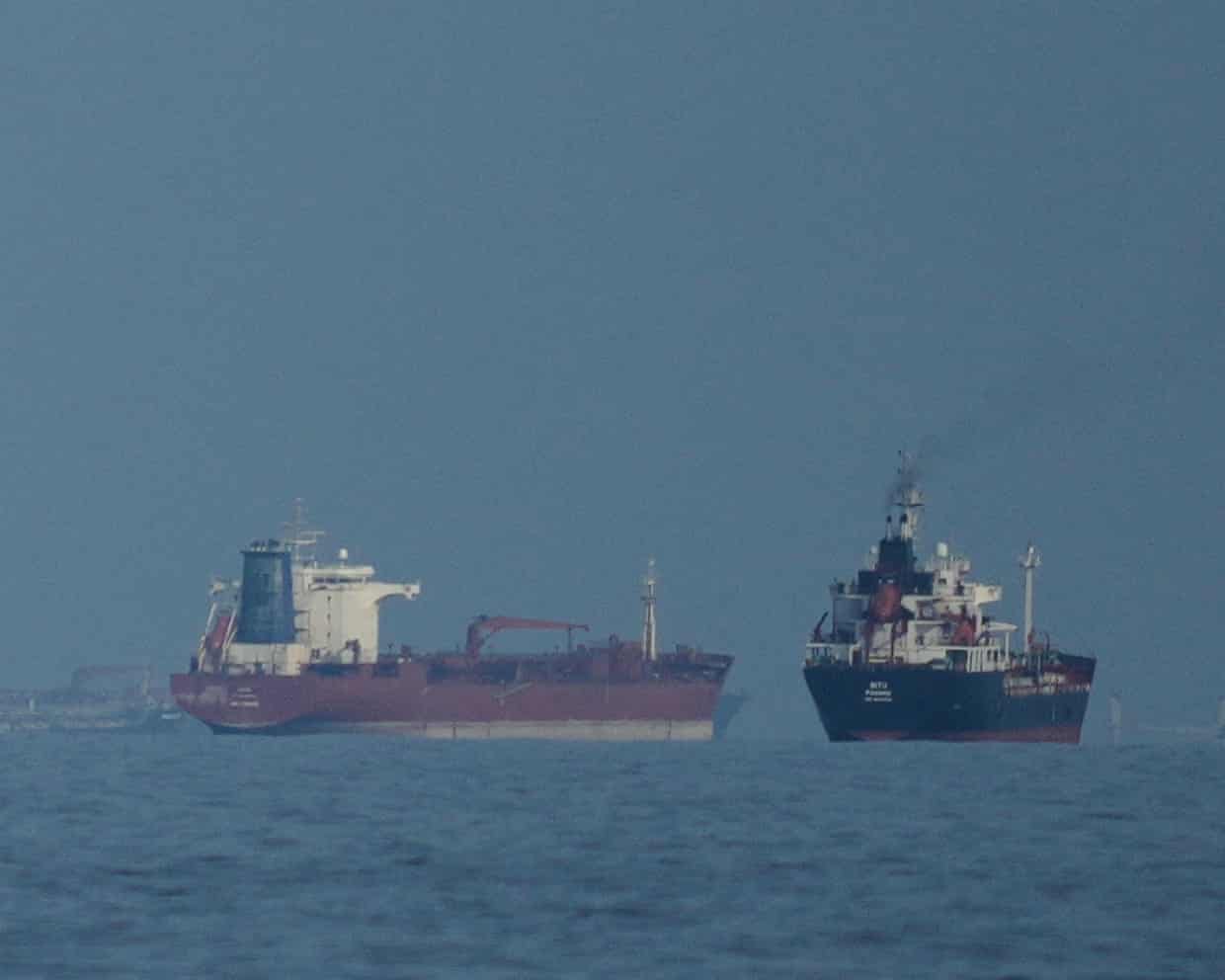
The US blockade of the strait of Hormuz is a blow to the 20,000 seafarers who have been trapped in the Gulf for the last six weeks.One told us last week:double quotation mark“I gave my notice exactly one month ago.I’ve informed the master, I’m not willing to sail through the strait.It’s about safety, it’s all about safety.”Good morning, and welcome to our rolling coverage of business, the financial markets and the world economy.
We start a new week, again, with an escalating conflict in the Middle East, after the collapse of US-Iran peace talks last weekend.Donald Trump’s threat to impose a blockade on the strait of Hormuz has driven the oil price back over $100 a barrel again this morning, as hopes of an end to the conflict soon take another knock.Brent crude, the international benchmark, has jumped by 7% to $101.88 a barrel, while US crude is up over 8% to $104.69 a barrel – back towards the highs of almost $120 set early in the conflict.
The US president also said he had asked the US Navy to “interdict” any ship that had paid a toll to Iran for passage through the strait, in an attempt to choke off the flow of Iranian oil.Tony Sycamore, market analyst at IG, says:double quotation markBy doing so, the US aims to force Tehran’s allies and customers to put pressure on Iran to reopen the vital chokepoint, potentially resolving the impasse without committing ground forces to another protracted conflict.This approach will undoubtedly strain Iran’s relationship with its largest customer, China.Having already lost Venezuelan supply earlier this year, Beijing now faces the potential loss of another roughly 2m barrels a day.The war has already driven confidence across Britain’s biggest companies down to a six-year low.
Deloitte’s quarterly survey of chief financial officers has found that concerns around energy prices, inflation and interest rates surging after the Middle East conflict, to its lowest level since early in the Covid-19 pandemic in 2020.2pm BST: Opec’s monthly oil market report3pm BST: US home sales for March

From soups and greens to roots, how to survive the ‘hungry gap’
Spring may have firmly sprung – I write this with a view of vivid yellow forsythia blossom in next door’s garden, and the melodious warble of full-throated birdsong – but though the greenery may be flourishing in our gardens, it’s a different story at the farmers’ market. Despite a few spindly spears of asparagus and miniature jersey royals making an appearance on our Easter tables last weekend, the new season of British produce doesn’t kick off in earnest for another few weeks yet. That means we’re now heading into the so-called “hungry gap”, an annual quirk of our relatively northern latitude, when temperatures are too high for much winter veg such as kale and brassicas, but too low for the more delicate likes of peas and broad beans to ripen – let alone high-summer treats such as berries, squash and stone fruit.Happily, many hardy winter crops store well, and are versatile enough to shake off their heavy winter coat of cream and butter in favour of a lighter treatment. The late Skye Gyngell gifted us a carrot, celery, farro and borlotti bean soup, Nigel Slater has an early spring laksa with purple sprouting broccoli (and some spinach, which I suspect you could use frozen), and Nicholas Balfe offers a ceviche with celeriac and a baked beetroot dish (pictured top) – both of which look just the thing to wake up your taste buds
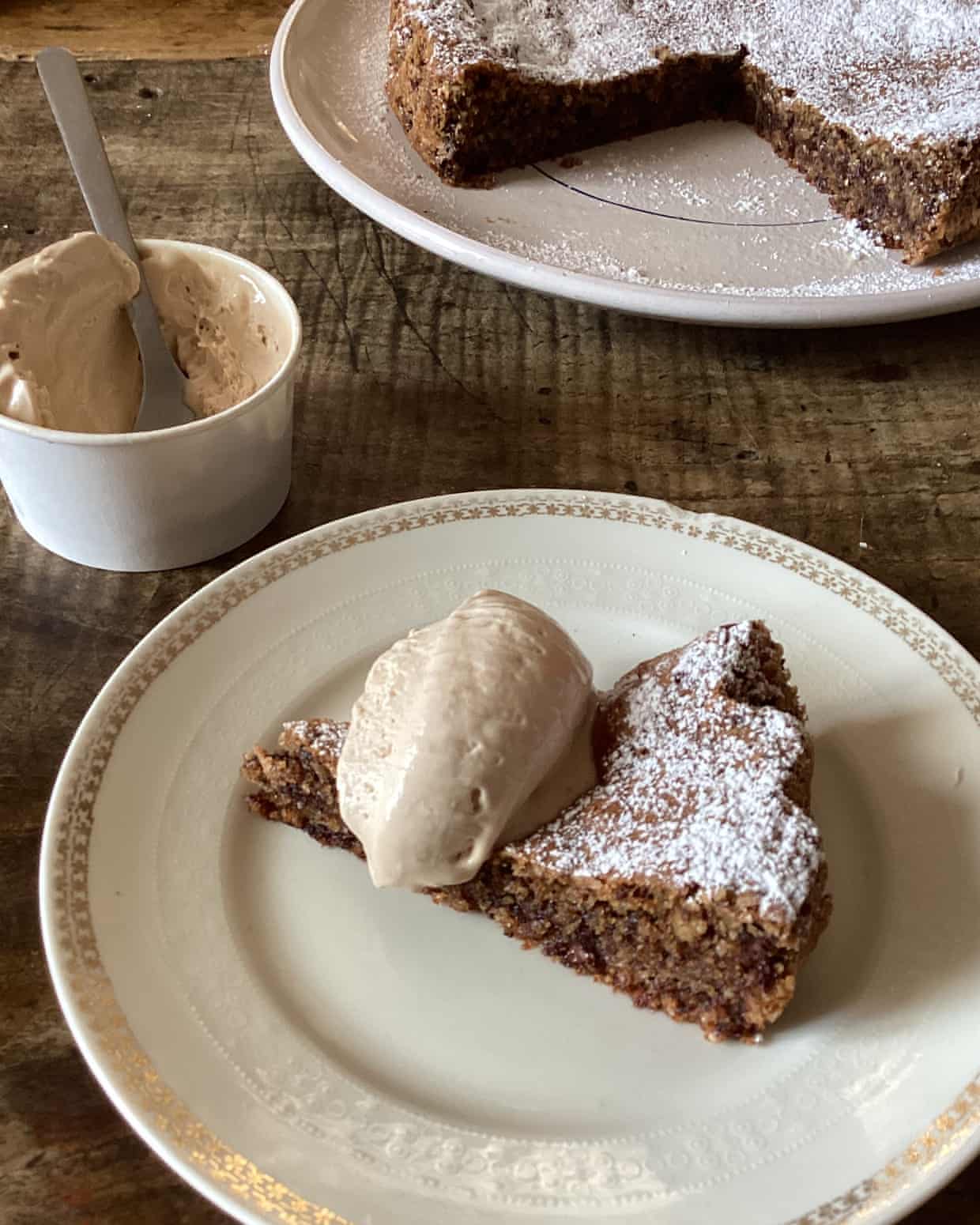
Rachel Roddy’s recipe for hazelnut and chocolate cake | A kitchen in Rome
Having been kept waiting for three hours, Dick Dewy leaves Miss Fancy Day snipping and sewing her blue dress. The plan is that he will return for her a quarter of an hour later, however, Dick convinces himself that he has been scandalously trifled with by Fancy and decides that, to punish her, he will not return. Instead, he leaps over the gate, pushes up the lane for two miles, takes a winding path called Snail-Creep, and crawls through the opening to the hazel grove in Grey’s Wood.Getting a class of 15-year-olds to relay/read the opening of chapter four of Under the Greenwood Tree, which is memorably entitled “Going Nutting”, is an extremely effective way to engage them with the majesty of Thomas Hardy. And the title is nothing compared to the line (as Dick vanished among the bushes): “Never man nutted as Dick nutted that afternoon
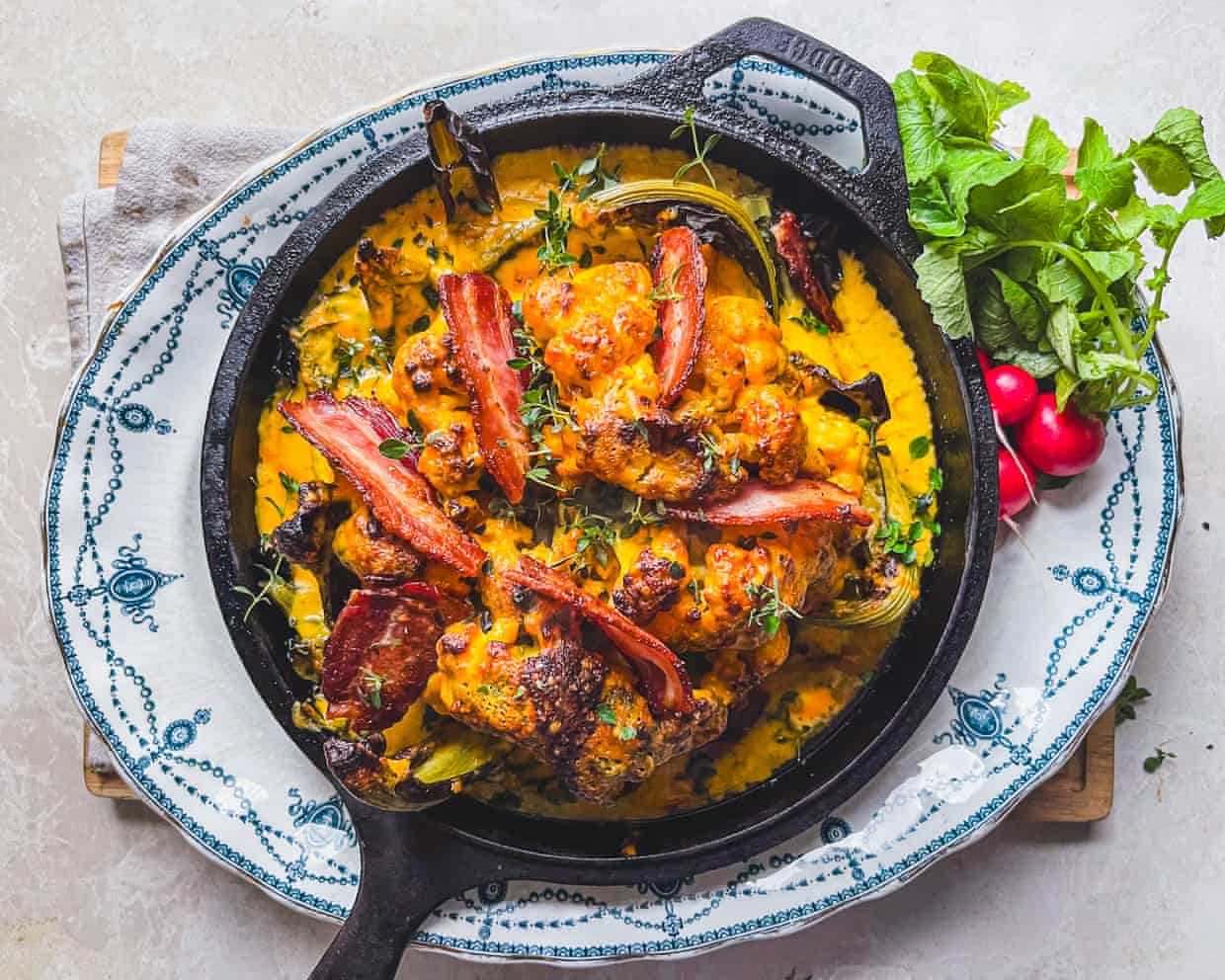
How to make cauliflower cheese using the whole plant – recipe | Waste not
This recipe, adapted from one in my cookbook, is a very elaborate way to serve humble cauliflower cheese. The whole plant, including the leaves and core, is seasoned with nutmeg and roasted, and it’s then dressed with a satisfying layer of rich cheese sauce and grilled until charred and bubbling. Choose a cauliflower with plenty of leaves, because they go deliciously crisp when roasted.This is perhaps the most decadent cauliflower cheese I’ve ever made. Inspired by an orange-coloured cauliflower I found sitting proudly in a box at my local Brockley Market in south London, I decided to make a vibrant and very orange cauliflower cheese using red leicester cheese and turmeric

A marmalade-dropper for Paddington Bear? | Letters
As a Portuguese-British citizen, I feel it is my duty to add to your explainer article (Keir Starmalade, anyone? Will marmalade really have to be rebranded in UK?, 4 April) and explain where the word marmalade originated from. Marmalade comes from the fruit marmelo (quince). And marmalade was and is quince jam in Portugal. This jam began to be exported to England at the end of the 15th century. Only in the 17th century did the English start to apply the word marmalade to orange jam

How to save limp herbs | Kitchen aide
What can I do with herbs that are past their best?Joe, by email Happily, Joe and his on-the-turn herbs aren’t short of options. “The obvious choice for hard herbs is to chuck them in a sandwich bag and freeze them for future stock-making,” says Alice Norman, founder of regenerative bakery Pinch in Suffolk. Alternatively, Sami Tamimi, author of Boustany, would be inclined to dry his excess herbs. In summer, he’d simply pop them on a tray and put them outside in the sun, but right now he “dries them in a 60-70C oven, then packs in containers, ready for the next time you’re short of fresh herbs”.Norman’s current MO is to blitz languishing herbs (“rosemary and/or thyme work best”) with a 3:4 ratio of fine salt

‘Before I can stop her, my daughter is licking crumbs from the table’: my search for the perfect kids’ menu
Chips, fish fingers, pizza … restaurant food for children is depressingly predictable. Are there more adventurous options? I took my four-year-old daughter on a month-long mission to find outWe’re heading out for dinner. Before I tell my four-year-old where we’re going, she has already announced that she’s going to have fish, chips and lots of ketchup. It sounds delicious; a classic. But there’s the irksome feeling that the intrepid impulses of childhood should be met with food that expands palates rather than feeding into the well-trodden path to a beige meal

Votes for populist parties in May elections will put NHS at risk, Streeting says

Tories would reinstate two-child benefit cap to fund defence, says Badenoch
UK starts crackdown on EU citizens’ post-Brexit rights

Reform UK local election candidate was twice disciplined by Tories over ‘racist comments’

Starmer implies he didn’t tell Trump he was ‘fed up’ about his impact on rising UK energy bills – as it happened

Not just about Gaza: the Muslim voters turning from Labour to the Greens