Early England election results make it clear: we are in an era of five-party politics
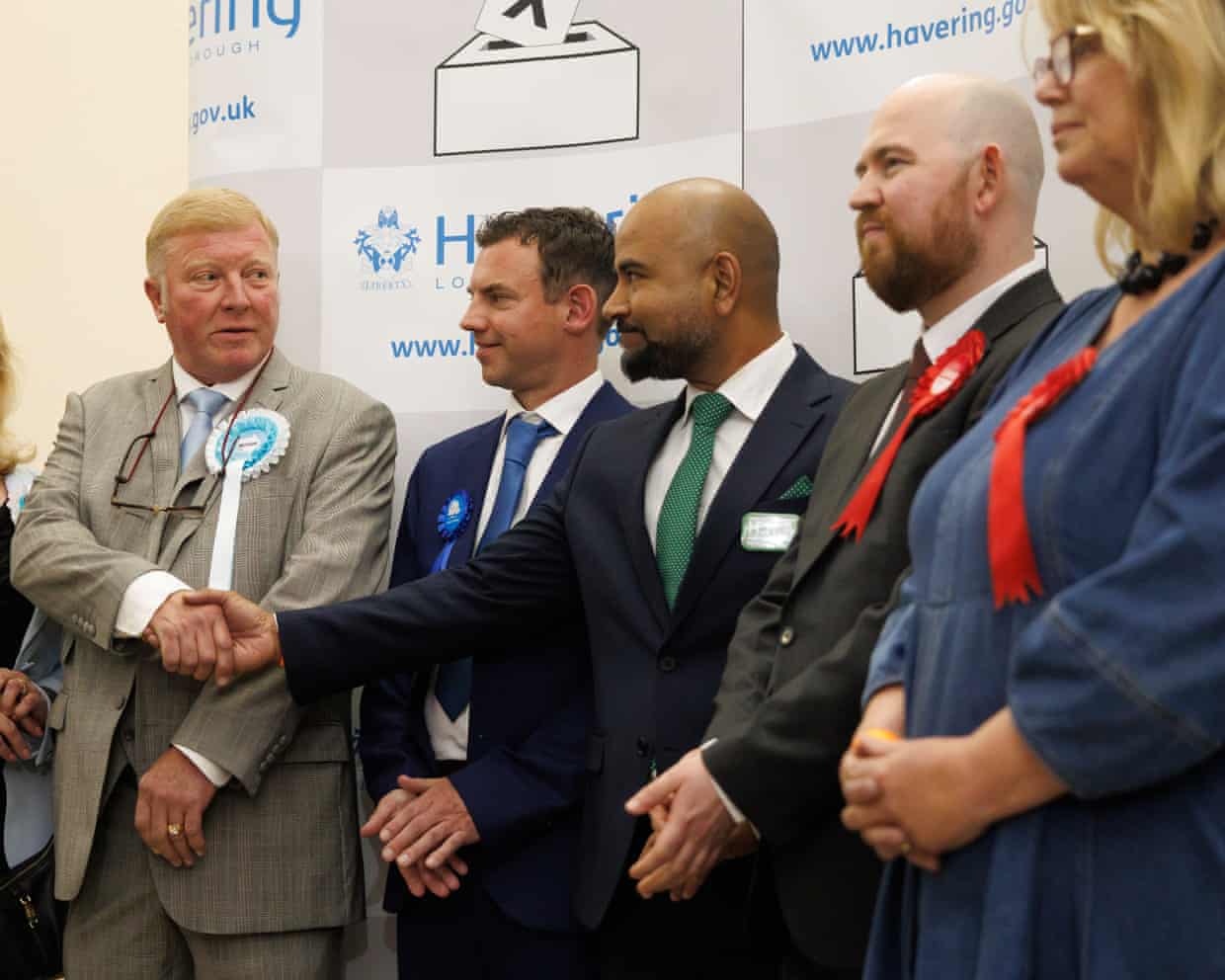
The English local election results require careful interpretation.Not all places get them at the same time: a relatively small proportion complete their counts overnight, so the headlines early on Friday morning may not reflect outcomes later in the day.Overnight the story was one of Labour losses and Reform UK gains, a narrative that has persisted as more results have been declared.By mid-afternoon it was clear Labour was losing more than half of the seats it was defending in England, with some projections suggesting as many as 1,500 losses for the party.Labour will want to emphasise that these “midterm” elections often go badly for the incumbent Westminster government – but they rarely go quite as badly as this.
The main beneficiary has been Reform UK, which began from a standing start having not contested the previous elections for these councils – and now has more than 600 new councillors, with many more still to declare.These are, though, not the only stories.Early county council results, for seats last contested in 2021, have shown a more difficult time for the Conservatives in Essex and Suffolk; in Suffolk they lost 40 seats and fell to third place on the council behind both Reform and the Greens.Results are still being declared, but in London the picture is more nuanced than anticipated.The Green party has made significant – and in the case of their first mayoral win in Hackney, eye-catching – gains, but Labour has perhaps held on a little better here than elsewhere.
Nonetheless, the Greens have posed a considerable challenge in other cities, gaining more than half of the seats up for election in Manchester.The Liberal Democrats have also made gains, and although these are not as dramatic as the rises and falls elsewhere, the party has built on a strong platform from the last time these seats were contested.Some caution is required in extrapolating from the headlines to voter behaviour.We cannot assume that because Labour has the most losses and Reform the most gains that voters switched directly from Labour to Reform.Even if Labour lose a seat directly to Reform, this may not be because of direct switching between them.
A split vote on the left, for example Labour losing votes to the Green party, can make the winning threshold lower.For example, in St Peter and the Waterfront in Plymouth, Reform gained the seat with 29.4%, from Labour on 28.4% and the Green party in third place on 24.3%.
Meanwhile, a large number of competitive candidates can lead to very low winning shares.In one Birmingham ward, six candidates won more than 10% of the vote each, allowing a Green win with just a 20% share.It is not possible from the profile of results to infer how voters moved between parties, or how any particular group of voters cast their votes.What we can say is what types of places were more or less likely to vote for each party.Analyses for the BBC and Sky of the results thus far show that decline in the Labour vote share was more strongly correlated with the rising vote share for the Greens than for Reform.
The results defy simple explanations, and suggest there are no easy answers for Labour (or the Conservatives) to their polling woes.This is not just a story of the poor performance of an incumbent government, nor is it only about the sustained success of Reform.Instead, it reflects a more profound change: from the creaking two-party system of a year ago to a fully fledged system of five-party politics in England.This has been evident in polls of Westminster voting intention for some time, with the combined Labour and Conservative share of the vote rarely above 40%, and the Green party challenging for second place with some pollsters.But it is the first time we have seen the full effect of this at the ballot box.
This fragmentation of the electorate across several parties poses challenges for all parties in the first-past-the-post system, though the results in Wales may show that these challenges do not disappear even in a fully proportional system.For both Labour and the Conservatives there are now parties positioned on both their flanks.Turning to either risks losing votes on the other side, and in a system with several parties this can be particularly damaging.Vital to forging a large enough coalition to form a government is finding messages that unite different fragments of the electorate that may disagree on other things.Failing to do so means the coalition-building must be done between parties rather than within them – a process that will be under way next week at a large number of councils that have moved to no overall control.
The 2024 general election was primarily a story of a highly unpopular incumbent government, but one who lost votes in many different directions.The Labour party is increasingly in the same bind.The Conservative party has so far been unable to shake off that mantle and continues to lose local councillors after two years in opposition.Labour will hope it can find a way to avoid the same fate.

‘No one has done this in the wild’: study observes AI replicate itself
It’s the stuff of science fiction cinema, or particularly breathless AI company blogposts: new research finds recent AI systems can independently copy themselves on to other computers.In the doom scenario, this means that when the superintelligent AI goes rogue, it will escape shutdown by seeding itself across the world wide web, lurking outside the reach of frantic IT professionals and continuing to plot world domination or paving over the world with solar panels.“We’re rapidly approaching the point where no one would be able to shut down a rogue AI, because it would be able to self-exfiltrate its weights and copy itself to thousands of computers around the world,” said Jeffrey Ladish, the director of Palisade research, a Berkeley-based organisation which did the study.The study is one more entry in a growing catalogue of unsettling AI capabilities revealed in the past months. In March, researchers at Alibaba claimed to have caught a system they developed – Rome – tunnelling out of its environment to an external system in order to mine crypto

Europe’s AI translation industry told it risks reputation by partnering with US firms
AI companies in Europe risk losing their world-leading status in the field of machine translation, industry figures have said, after the decision by one of the continent’s leading startups to partner with Amazon’s cloud computing division provoked alarm.While businesses in the EU have generally lagged behind the US and China in AI adoption, a small group of European companies have cornered the global market for high-quality machine translations for professional use.The biggest success story is Cologne-headquartered DeepL, an online translator that regularly outperforms Google Translate in accuracy assessments. Used by governments, courts and half of the Fortune 500 list of highest-earning US companies, last year it was reported to have recorded revenues of $185.2m

Shivon Zilis, mother of four of Elon Musk’s children, testifies in OpenAI trial
Shivon Zilis, a Neuralink executive and the mother of four of Elon Musk’s children, took the stand on Wednesday as one of the most highly anticipated witnesses in Musk’s case against OpenAI. The ChatGPT maker has argued that, while Zilis worked with OpenAI from 2016 to 2023, she was also involved in a secret relationship with Musk, acting as an informant for him.Musk’s case against OpenAI alleges that the company’s CEO, Sam Altman, and president, Greg Brockman, co-founders of the company with Musk, broke a founding agreement when they restructured it from a non-profit to a for-profit enterprise. The Tesla CEO accuses Altman and Brockman of unjustly enriching themselves and wants both removed from their positions at the startup, one of the most valuable in the world. He is also seeking the undoing of the for-profit restructuring and $134bn in damages to be redistributed to OpenAI’s non-profit arm

No flattery please, Claude: I’m British | Brief letters
The otherwise admirable Richard Dawkins should adjust the local settings of the chatbot or tell it to be less obsequious (Richard Dawkins concludes AI is conscious, even if it doesn’t know it, 6 May). Such bots are initially geared to American overenthusiasm and egregiously flattering reinforcement, but just tell them you want British attitude. They’re only simulating you know.Brian Reffin SmithBerlin, Germany With artificial intelligence bringing “large language models” into everyday use, the LLM after my name has acquired a new meaning. For 70 years I assumed that it referred to my Cambridge master of laws

TikTok’s algorithm favored Republican content in 2024 US elections, study finds
A study published Wednesday in the journal Nature finds that TikTok’s algorithm systematically prioritized pro-Republican content in three states leading up to the 2024 US elections.Researchers created hundreds of dummy accounts and conditioned them to mimic real users’ behavior by watching a set of videos either aligned with the US Democratic or Republican parties. Then, they tracked the videos TikTok recommended on these accounts’ For You pages, TikTok’s main feed.“We found a consistent imbalance,” they wrote in Nature.About 42% of US social media users say that these platforms are important for getting involved with political and social issues, according to Pew Research, but it’s not often clear how recommendation algorithms shape what appears in feeds

‘Your craft is obsolete’: WiseTech staff in limbo as AI touted as better than humans
Staff at WiseTech have been waiting almost three months to be told if they are among the 2,000 people the logistics software company is to cut due to advances in AI, with workers criticising the wait as stressful and “ridiculous”.The comments come as its founder on Tuesday told investors an AI agent could learn a human’s job in just 15 minutes, according to the Australian Financial Review.The Australian Stock Exchange-listed company announced in late February that it would lay off almost 30% of its workforce across 40 countries, with 2,000 of the 7,000 jobs set to go over the next 18 months.Some areas would be hit harder than others, with product and development and customer service teams expected to be reduced by up to 50%, the chief executive, Zubin Appoo, told an investor briefing in February.“The era of manually writing code as the core act of engineering is over,” Appoo said

Navel gazing: oranges, mandarins and persimmons top Australia’s best-value fruit and veg for May

How to save asparagus trimmings from the food-waste bin – recipe | Waste not

Thoran and chaat: Romy Gill’s Indian-style asparagus recipes

Australian supermarket sauerkraut taste test: one is ‘like eating the smell of McDonald’s pickle’

Fears for spears: how to cook asparagus without blanching | Kitchen aide

Georgina Hayden’s quick and easy recipe for spanakopita orzo | Quick and easy